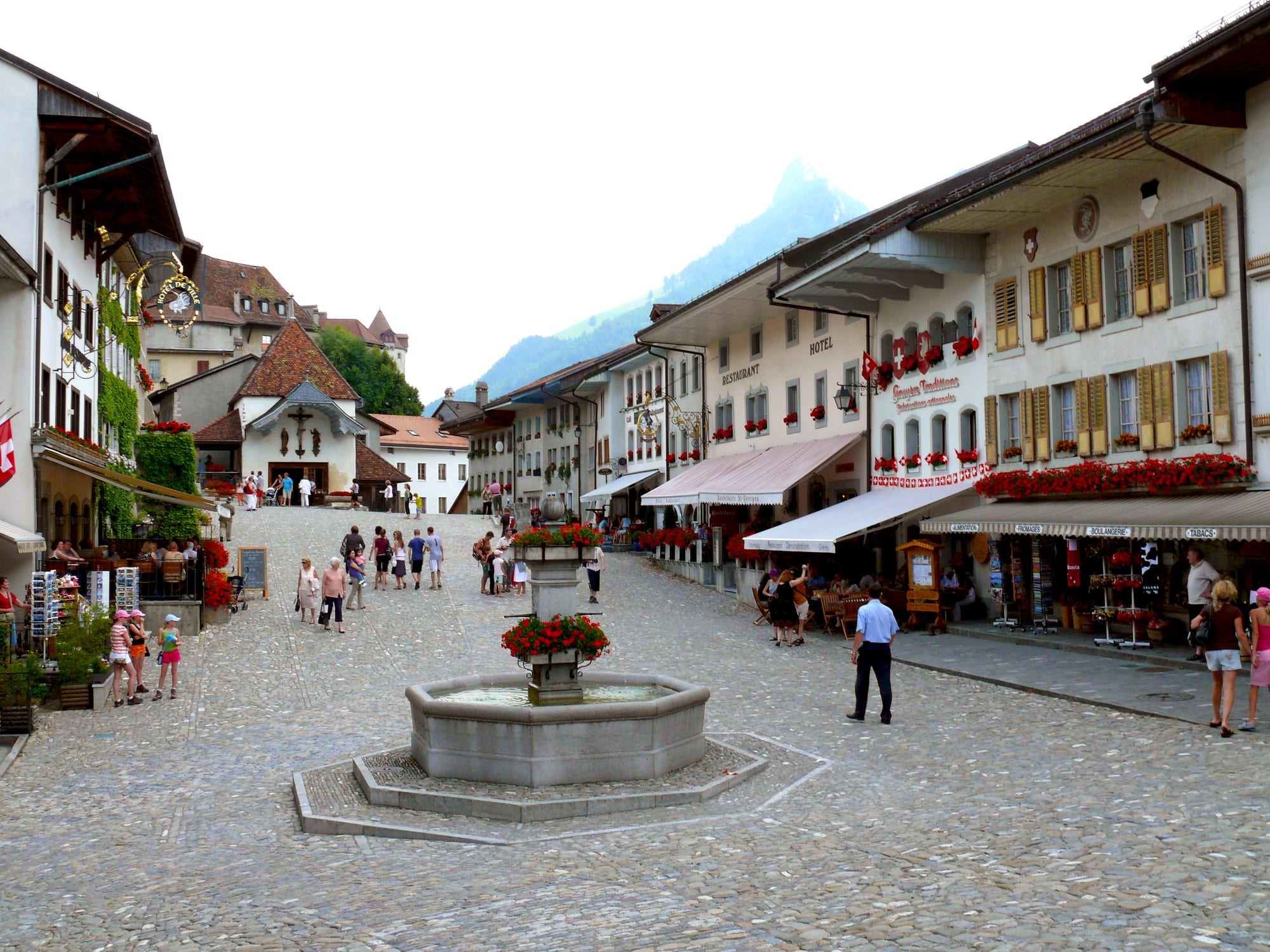
A wide cobbled street with a flower-decked fountain, shuttered houses and café awnings, a green peak rising behind

Geneva, Lake Geneva & Romandy, Switzerland

Gruyères

The main street of medieval Gruyères, leading up towards the castle. (Cjeiler / Wikimedia Commons · Public domain)

A small medieval town on an isolated hill in the Fribourg foothills, where the Sarine leaves the Alps below Mount Moléson. It grew beneath the castle of the Counts of Gruyère, nineteen of whom are recorded between the 11th and 16th centuries, and gave its name to Gruyère cheese. Today a single cobbled street, the castle and the dairy country around it draw large numbers of visitors.

Neighbourhoods

  • The medieval town
    • First-time visitors
    • Historic district

    The old town on the hilltop, essentially one broad cobbled street lined with old houses, restaurants and shops, leading up to the castle.

    Open in Maps
  • Pringy and Épagny
    • Close to public transport
    • Cheese

    The two villages of the municipality at the foot of the town hill, Pringy to the west and Épagny to the north, quieter and more everyday than the old town above.

    Open in Maps
  • Moléson-Village
    • Walking
    • Mountain views

    A holiday settlement at about 1,130 metres in the Albeuve valley, at the foot of Mount Moléson, the highest point of the municipality.

    Open in Maps

Things to do

The castle and museums

  • Gruyères Castlelandmark

    The castle of the Counts of Gruyère, built between 1270 and 1282 on the square plan of Savoy fortifications, later home to Fribourg's bailiffs and prefects, and a museum since the canton bought it back in 1938.

    Open in Maps
  • HR Giger Museummuseum

    The museum and bar of the Swiss artist H. R. Giger, known for his designs for the Alien films, in the Saint-Germain Castle: a permanent repository of his work.

    Open in Maps
  • Tibet Museummuseum

    A museum of antiquities from Tibet, next to the HR Giger Museum in the old town.

    Open in Maps

Cheese and chocolate

  • La Maison du Gruyèreattraction

    A cheese dairy beside the station in Pringy, open to visitors, devoted to Gruyère cheese.

    Open in Maps
  • Maison Caillerattraction

    The visitor centre of the Cailler chocolate factory in nearby Broc, with tours of the brand's history and chocolate-making that end in a tasting room.

    Open in Maps

Walks and viewpoints

  • Molésonviewpoint

    The 2,002-metre mountain that rises above Gruyères, the highest point of the municipality, overlooking the Gruyère region, with a funicular and cable car to near the summit.

    Open in Maps

Eat and drink

Long-standing places and food districts in Gruyères. Hours, ratings and directions come from your maps app, always current.

Gruyères classics

  • Fondue moitié-moitiérestaurant

    Fondue made from Gruyère and Vacherin is served in every restaurant in the town.

    Open in Maps
  • Meringues with double creamrestaurant

    Gruyères is famous for its thick double cream, served with meringues or berries.

    Open in Maps

Cheese

  • La Maison du Gruyèremarket

    The cheese dairy beside the station, open to visitors.

    Open in Maps

Experience Gruyères

History

Gruyères stands on an isolated hill north of the Alps, where the Sarine leaves the Fribourg mountains. The Counts of Gruyère built their castle on the hilltop to control the upper valley, and the town grew up beneath it; nineteen counts are recorded between the 11th and 16th centuries. The present castle was built between 1270 and 1282, and in 1397 Count Rudolph IV confirmed an older town charter modelled on that of Moudon.

The end of the 15th century was the counts' golden age: in 1476 Count Louis fought on the side of the Confederates in the Burgundian Wars, and the castle's esplanade and chapel, the spiral staircase in its courtyard and its main building were remodelled. The last count, Michel, was in financial trouble for most of his life and went bankrupt in 1554. From 1555 to 1798 the castle was the seat of the bailiffs, and later the prefects, sent by Fribourg.

In 1849 the castle was sold to the Bovy and Balland families, who spent their summers there and restored it with the help of painter friends. The canton of Fribourg bought it back in 1938 and opened it to the public as a museum. The town's later fame came from its cheese and its intact medieval street, which made it an important tourist location, and the artist H. R. Giger later acquired the Saint-Germain Castle, which now houses his museum.

Culture & Customs

Gruyères lies in the Catholic, French-speaking district of Gruyère in the canton of Fribourg, and identity here is bound up with dairy farming. Franco-Provençal is still used in rural areas of French-speaking Switzerland, and the Gruyères poet Joseph Yerly wrote in it. The Fribourg traditions of the Bénichon, an autumn feast of harvests with a large shared meal, and the Désalpe, when the herds come down from the alpine pastures, are kept up across the area.

The castle is the cultural centre of the town, with a regional museum, an arts museum and concerts and theatre performances. Its chapel of St John the Baptist has two stained-glass windows from the late 15th century. The counts were buried under the altar of the parish church.

The town's most unexpected neighbour is the HR Giger Museum in the Saint-Germain Castle, a permanent collection of the Swiss artist's dark, biomechanical work, with the Giger Bar opposite, and next to it a museum of antiquities from Tibet. Giger, known for his designs for the Alien films, made it a popular tourist destination.

Daily Life

The municipality had about 2,200 people in December 2020, spread between the medieval town on its hill, the villages of Épagny and Pringy at its foot, the small village of Saussivue, the holiday settlement of Moléson-Village and isolated farms. In 2008 about 15 per cent of residents were foreign nationals, and French is the first language of nine in ten.

Cheese has always been the economy: the town formerly lived from trading cheese and livestock, and farming still supplies the raw materials for cheese and meat production, with Gruyère the most important product. Tourism is the other pillar, with the castle, the museums, the restaurants of the main street and the show dairy attracting large numbers of day visitors.

Life is quiet once the day visitors leave. Bulle, the district capital, is about 4.5 km away, and the mountain of Moléson, at 2,002 metres the highest point of the municipality, rises behind the town.

Food

The town gave its name to Gruyère, a hard cheese that originated in the cantons of Fribourg, Vaud, Neuchâtel, Jura and Bern, and gained the protected AOC label in 2001, which became an AOP in 2013. Fully aged, from five months to a year, it develops small cracks and a slightly grainy texture. It is a good melting cheese, suited above all to fondue alongside Vacherin Fribourgeois.

Fondue made from Gruyère and Vacherin is served in every restaurant in Gruyères. The classic dessert is meringue, a sweet of whipped egg whites, served with Gruyère cream, a thick double cream of about 50 per cent fat that originates in the region, or with berries; the local dairy herds also supply ice cream sold in the town.

The Fribourg Bénichon menu includes cuchaule, a saffron brioche served with Bénichon mustard. Nearby Broc has the Maison Cailler chocolate factory, whose tours cover the brand's history and chocolate-making and end in a tasting room.

Planning tools

Budget

Gruyères is small and visited mostly on day trips, so prices in the restaurants on the main street reflect the crowds. The country inns of the Gruyère district and the town of Bulle nearby offer better value than the lake cities, and a picnic of local cheese and bread is the cheapest meal.

Daily Budget Midrange
USD 320–580 (hotel, fondue dinners, castle and museum tickets, regional trains)
Daily Budget Shoestring
USD 120–190 (hostel bed or a room in Bulle, bakery lunches and picnics, regional trains)

Arrive early or late in the day to see the main street without the tour-coach crowds.

Best Time to Visit

Late spring to early autumn for walks on Moléson and the pastures, with autumn bringing the cattle down from the alpine pastures. Summer is the busiest time in the medieval town. Winter is quiet and suits fondue, with snow on the mountains around.

Suggested Number of Days

Most visitors come for a single day, which is enough for the town, the castle and the cheese. Two or three days allow time for the mountain above, the walks of the surrounding district and the nearby chocolate factory.

First Visit
1 day
With Surroundings
2–3 days

Transportation

Gruyères has a station below the town, served by trains from Bulle, which has regular services to Fribourg and Bern and on to the rest of the Swiss railway network. Drivers come by motorway to Bulle and then by road to Gruyères.

The medieval town sits on a hilltop above the station, so allow time for the climb.

Airport & Station Connections

Bulle, the district capital, lies about 4.5 km north-north-west of Gruyères and is the main rail hub, with trains to Fribourg and Bern; from Lausanne and Vevey drivers follow the motorway to Bulle. Geneva and Zurich are the main international airports, both reached by train via the Swiss rail network.

Walkability

The medieval town is small and entirely walkable, though it sits on a steep hill and its street is cobbled, which is hard going in smooth shoes or with a pushchair. The station is below the hill.

Safety

Switzerland is very safe, with low crime. Gruyères is a quiet small town; the main risks are on the surrounding mountains, where weather changes fast and paths are steep.

Check the weather before walking on Moléson and keep to marked paths. Check current official travel advice before travelling.

Climate

Higher and cooler than the shore of Lake Geneva, in the foothills of the Fribourg Alps. Summers are pleasant for walking; winters are cold, with snow on the mountains around the town.

Summer
pleasant — cooler than on the Lake Geneva shore, where July afternoons in Lausanne average about 24°C
Winter
colder than on the Lake Geneva shore, where January in Lausanne averages between about −0.4°C and 3.5°C, with snow on the surrounding mountains

Local Customs

Gruyères is French-speaking and Catholic, the heart of a dairy-farming district where cheese is a matter of local pride, and the old Franco-Provençal dialect has had writers from the town. By law, a service charge is included in the bill, and tipping is a personal contribution, never legally requested.

Greet shopkeepers and restaurant staff with 'bonjour', and keep quiet in the church and in the castle chapel.

Common Payment Methods

The currency is the Swiss franc; euros are widely accepted and many price lists show both. Switzerland is more cash-oriented than many European countries, but card payments are common, all ATMs accept foreign cards, and money can be exchanged at train stations and most banks.