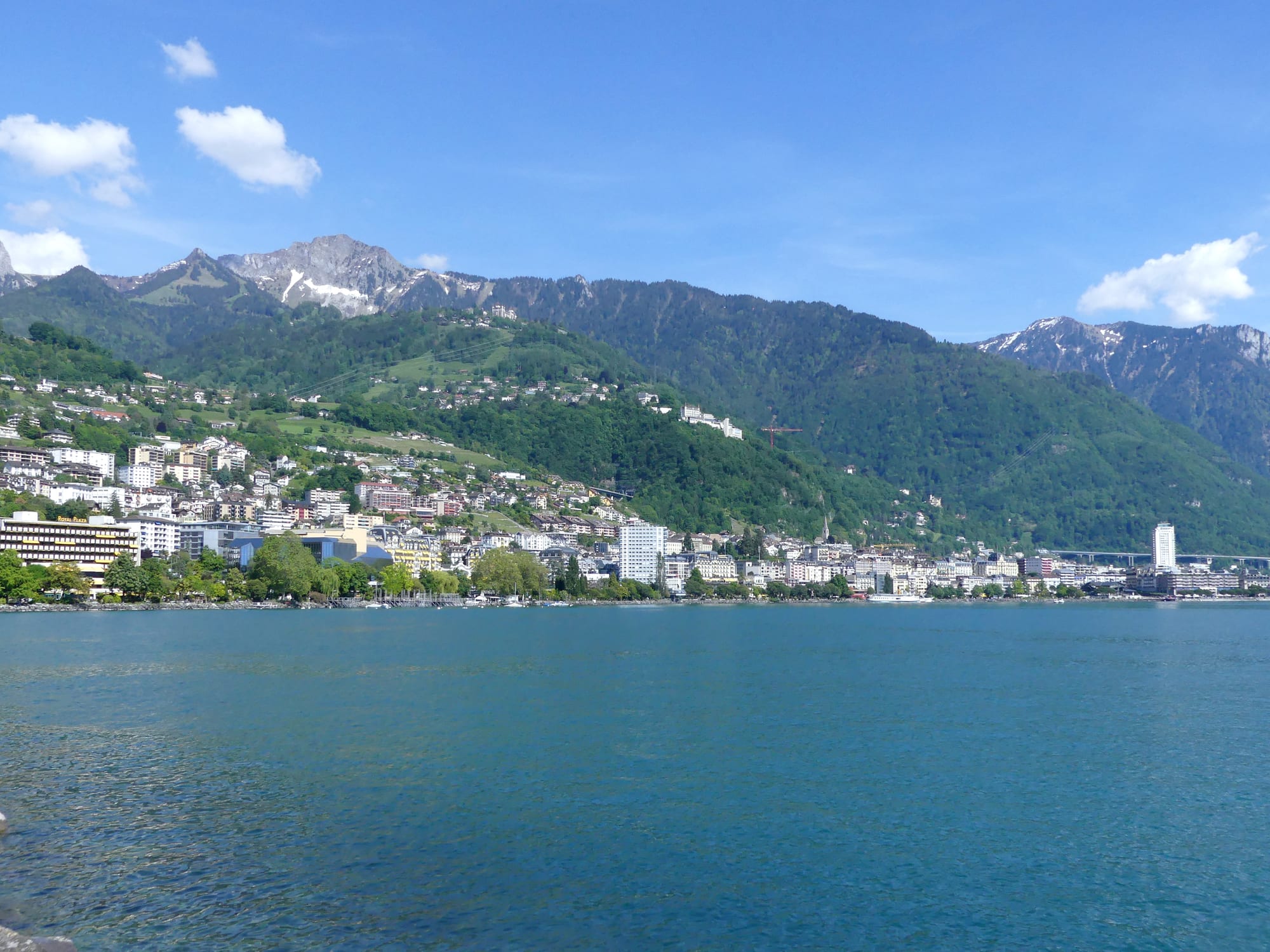
Montreux spread along the shore of a blue-green lake below wooded slopes and rocky peaks with patches of snow

Geneva, Lake Geneva & Romandy, Switzerland

Montreux

Montreux and Lake Geneva seen from Clarens, with the mountains behind the town. (Florian Pépellin / Wikimedia Commons · CC BY-SA 4.0)

A lakeside town on the north-eastern shore of Lake Geneva, at the centre of the Vaud or Swiss Riviera, climbing from the water to the foothills of the Alps. Its mild climate has drawn visitors since the 19th century; today it is known for its July jazz festival, the island castle of Chillon just along the shore and a lakefront promenade of flowers.

Neighbourhoods

  • Montreux centre and the quays
    • First-time visitors
    • Lakefront
    • Close to public transport

    The town centre around the station, the covered market hall and the Place du Marché, with the Freddie Mercury statue facing the lake. The quays, planted with flowers, run along the water in both directions, and the casino and the festival venues are close by.

    Open in Maps
  • Clarens
    • Quiet and residential
    • Lakefront

    The western part of the town, with its own station on the lakeside line and international schools, along the quays towards Vevey.

    Open in Maps
  • Territet and Veytaux
    • Historic district
    • Close to Chillon

    Territet, the lakeside quarter east of the centre, forms with neighbouring Veytaux an urban village listed as a whole in the Inventory of Swiss Heritage Sites; a funicular climbs from Territet to Glion, and the lakeside walk continues to Chillon Castle at Veytaux.

    Open in Maps
  • Glion and Caux
    • Views
    • Walking

    Villages high on the slopes above the town, on the cog railway to the Rochers de Naye, known for their hotel schools and their wide views over the lake.

    Open in Maps

Things to do

Famous landmarks

  • Chillon Castlelandmark

    A medieval castle on a steep limestone rock in the lake at Veytaux, held by the House of Savoy and then by Bern from 1536 to 1798, and among the most visited medieval castles in Europe; Byron's poem The Prisoner of Chillon made it famous.

    Open in Maps
  • Freddie Mercury statuelandmark

    The statue of Queen's singer on the Place du Marché, facing Lake Geneva.

    Open in Maps
  • Smoke on the Water monumentlandmark

    A lakeshore monument to Deep Purple's song about the night in December 1971 when the Montreux Casino burned down, inscribed with the band's name, the title and the riff.

    Open in Maps
  • Montreux Casinoattraction

    The casino whose fire inspired Smoke on the Water, reopened in 1975; its former Mountain Studios became the exhibit Queen: The Studio Experience in 2013.

    Open in Maps

Walks and viewpoints

  • Lakeside promenadetrail

    A walking trail along the lake from Villeneuve to Vevey, passing the flower-lined quays of Montreux and Chillon Castle.

    Open in Maps
  • Rochers de Nayeviewpoint

    The 2,042-metre summit above the town, reached by the cog railway from Montreux through Glion, with a via ferrata and caves on the trail from the Col de Jaman.

    Open in Maps

Short trips from the town

  • Chaplin's Worldmuseum

    The museum in the manor above Corsier-sur-Vevey that was Charlie Chaplin's home from 1952 until his death in 1977.

    Open in Maps
  • Lavauxtrail

    About 30 km of terraced vineyards on the northern shore of the lake, east of Lausanne, a UNESCO World Heritage Site since 2007.

    Open in Maps

Seasonal events

  • Montreux Jazz FestivalJuly

    A music festival held every July since 1967, now lasting about two weeks.

  • Freddie Celebration Daysearly September

    A free event around 5 September, Freddie Mercury's birthday, in memory of Queen's singer.

  • Montreux Christmas marketChristmas season

    A Christmas market held for several weeks over the holiday period.

Eat and drink

Long-standing places and food districts in Montreux. Hours, ratings and directions come from your maps app, always current.

Montreux classics

  • Lake perch filletsrestaurant

    Perch from Lake Geneva, often prepared meunière style — coated in flour and fried in butter — at lakeshore restaurants.

    Open in Maps
  • Papet vaudois and malakoffsrestaurant

    Vaud's dish of leeks and potatoes, and malakoffs, fried cheese balls or sticks from La Côte in the canton of Vaud.

    Open in Maps

Food districts and markets

  • Marché couvertmarket

    The covered market hall in the town centre, listed among the town's heritage sites of national significance.

    Open in Maps
  • Lavaux wine villagesneighborhood

    Chasselas, the main white wine of French-speaking Switzerland, grows on the terraces just west along the shore.

    Open in Maps

Experience Montreux

History

The shore around Montreux was long a string of villages rather than a town. Under Bernese rule, from 1536 to 1798, it belonged to the Bailiwick of Chillon, renamed the Bailiwick of Vevey in 1735, and the Reformation made the area around Montreux and Vevey a haven for Huguenots from Italy, who brought artisanal skills and set up workshops and businesses. Chillon Castle, on its rock in the lake at Veytaux, had been a stronghold of the House of Savoy before the Bernese took it in 1536; Byron's poem The Prisoner of Chillon, based on François Bonivard, a political prisoner from Geneva released that year, later made it famous.

From the 19th century the mild climate turned the shore into the Swiss Riviera, and Montreux became an important tourist destination. Grand hotels, railway stations and a funicular were built; cog railways climbed to Glion, Caux and the Rochers de Naye. For a long time there were three independent municipalities sharing a central authority, each with its own taxes and mayor; in 1962 Le Châtelard and Les Planches merged to form the present Montreux, while Veytaux stayed independent.

The town has a place in diplomatic history: the Montreux Convention, which still governs the Turkish Straits, was signed here in July 1936, and in January 2014 a United Nations peace conference on Syria met in Montreux. In 2006 the old Vevey district was dissolved and Montreux became part of the new district of Riviera-Pays-d'Enhaut.

Culture & Customs

Music defines modern Montreux. The Montreux Jazz Festival has been held every July since 1967 and now runs for about two weeks. In December 1971 a Frank Zappa fan with a flare gun set the casino on fire, and Deep Purple, who had come to record there, wrote Smoke on the Water about the night; a monument on the lake shore carries the band's name, the title and the riff. The casino reopened in 1975.

Freddie Mercury's statue on the Place du Marché faces the lake; Mountain Studios, rebuilt inside the casino, recorded the festival's live performances and since 2013 has been the exhibit Queen: The Studio Experience, and the free Freddie Celebration Days are held around his birthday on 5 September. Writers and artists have drawn on the shore since Byron's day.

Montreux is also a town of schools: international and boarding schools in Clarens and Territet, and private hospitality schools in Caux and Glion. Every year a Christmas market runs for several weeks over the holiday period.

Daily Life

Montreux had about 26,000 people in December 2020, and the Vevey–Montreux agglomeration about 85,000 in 2019. In 2008 some 44 per cent of residents were foreign nationals.

Tourism has shaped the town since the 19th century, health care and education are large employers, and the town is also a place where many people commute in and out: in 2000 almost as many workers left the municipality each day as arrived, and about half the working population drove to work. The heritage of the resort years is everywhere, and the whole urban village of Territet and Veytaux, as well as the areas of Caux, Montreux and the Villas Dubochet, are part of the Inventory of Swiss Heritage Sites.

Life is lived on two levels: the flat lakefront of quays, flowerbeds and promenades, and the steep slopes above, laced with railways and roads, where villages such as Glion and Caux look down on the water. The lakeside walk from Villeneuve to Vevey is used by residents and visitors alike, on foot and on wheels.

Food

Montreux eats the food of the canton of Vaud. Papet vaudois, a filling dish of leeks and potatoes, is the cantonal classic, and malakoffs, fried cheese balls or sticks, come from La Côte, the wine shore west of Lausanne. Fondue, several hard cheeses such as Gruyère and Vacherin melted with white wine and eaten hot with bread, is the winter favourite.

Perch and fera from Lake Geneva are served in lakeshore restaurants, and perch fillets are often prepared meunière style, coated in flour and fried in butter. The covered market hall, the Marché couvert, is listed among the town's heritage sites of national significance. Papet vaudois is often considered the national dish of Vaud, its leeks and potatoes sharing the white and green of the cantonal flag.

Wine comes from just along the shore. Chasselas, the most common white wine of French-speaking Switzerland, is the main grape of the Lavaux terraces east of Lausanne; in the Valais the same wine is known as Fendant, and in Geneva as Perlan.

Planning tools

Budget

Montreux is a little cheaper than Geneva but still expensive, and rooms fill and prices rise during the Jazz Festival in July. Lakeside restaurants and the mountain railway are the larger costs; the lakeside walk, the quays and the views cost nothing.

Daily Budget Midrange
USD 320–580 (hotel, lake-fish and fondue dinners, museum tickets, a lake steamer)
Daily Budget Shoestring
USD 120–190 (hostel bed, bakery lunches and supermarket picnics, regional trains)

Book well ahead for festival weeks in July, or stay elsewhere on the lake and ride the train in.

Best Time to Visit

May to September for the lake, the steamers and walks on the slopes, with July bringing the Jazz Festival and the biggest crowds. Early autumn is quieter and good for the vineyard terraces. Over Christmas the town holds a market lasting several weeks.

Suggested Number of Days

One or two days are enough for the town, the lakefront and the castle. Three or four allow time for the mountain above it and for the vineyard terraces and towns further along the shore; festival-goers often stay longer.

First Visit
1–2 days
With Surroundings
3–4 days

Transportation

Montreux has three stations on the Simplon line along the lake — Clarens, Montreux and Territet. Montreux station is also the start of the cog railway to Glion and the Rochers de Naye and of the line into the mountains towards Lenk; Montreux is the base of the GoldenPass tourist route. A funicular climbs from Territet to Glion, and lake steamers call at the quays.

Mountain trains to the Rochers de Naye stop running in the early evening and may stop earlier in bad weather.

Airport & Station Connections

Geneva Airport is the nearest major airport. Trains from the airport and from Geneva and Lausanne run along the lake to Montreux, and lake boats connect it with Lausanne, Geneva, Évian and other shore towns.

Walkability

The lakefront is flat and easy on foot, and a walking trail follows the shore from Villeneuve to Vevey, passing Chillon Castle. Behind the quays the town climbs steeply up the hillside, so the funicular and the cog railway are the easy way to the upper villages.

Safety

Switzerland is very safe, with low crime. The mountain above the town has the usual risks of weather and steep ground, and its trains stop running early when the weather turns bad.

Watch belongings in festival crowds, and check the weather before heading up the mountain. Check current official travel advice before travelling.

Climate

Montreux's mild climate made its name as a resort: the shore faces south-west and is sheltered from the bise by the mountains, giving it a particularly mild microclimate, and the Quai des Fleurs grows plants rare for the region.

Summer
warm — in nearby Lausanne, July temperatures average about 15°C at night and 24°C in the afternoon
Winter
cool and often grey — in nearby Lausanne, January averages between about −0.4°C and 3.5°C

Local Customs

Montreux is French-speaking, and a large share of residents are foreign nationals. By law, a service charge is included in the bill, and tipping is a personal contribution, never legally requested.

Greet shopkeepers with 'bonjour', keep noise down on Sundays and late at night, and respect the quiet of residential streets after festival concerts.

Common Payment Methods

The currency is the Swiss franc; euros are widely accepted and many price lists show both. Switzerland is more cash-oriented than many European countries, but card payments are common, all ATMs accept foreign cards, and money can be exchanged at train stations and most banks.