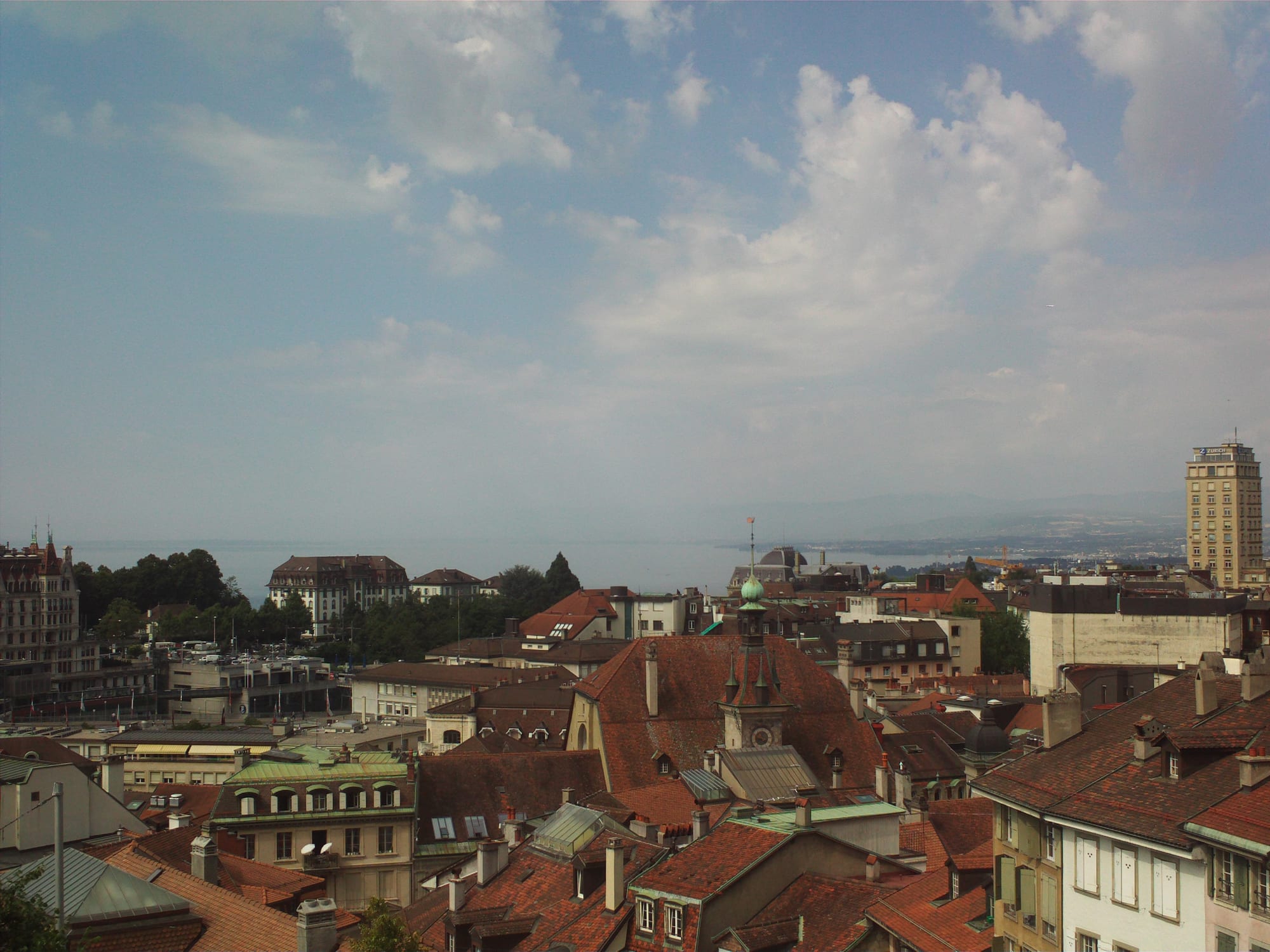
Red-tiled roofs and a small green-domed clock tower of Lausanne's old town, with Lake Geneva hazy beyond

Geneva, Lake Geneva & Romandy, Switzerland

Lausanne

Looking west over the roofs of Lausanne's old town from the cathedral square. (Ypsilon from Finland / Wikimedia Commons · CC0)

The capital of the canton of Vaud, climbing about 500 metres from the port of Ouchy on Lake Geneva to its northern edge, facing Évian across the water. A bishops' town under a Gothic cathedral, ruled by Bern for more than two centuries, it is now the seat of the International Olympic Committee and a university city and the smallest city in the world with a metro.

Neighbourhoods

  • La Cité
    • First-time visitors
    • Historic district

    The hilltop old town around the cathedral, with the bishops' Château Saint-Maire, the former academy and steep lanes leading down to the market streets, with views over the roofs to the lake.

    Open in Maps
  • Ville Marché and the Palud
    • Markets
    • Shopping
    • Close to public transport

    The medieval market town below the Cité, around the Place de la Palud, with its town hall of 1673–1675, and Saint-François. The streets fill with a farmers' market on Wednesdays and Saturdays.

    Open in Maps
  • Flon
    • Nightlife
    • Students and nightlife
    • Close to public transport

    A former warehouse district in the valley of the Flon, now the centre of Lausanne's nightlife, with bars, clubs and restaurants around the metro hub.

    Open in Maps
  • Ouchy
    • Lakefront
    • Parks and the lake
    • Families

    Once a fishing village, incorporated into Lausanne in the mid-19th century as its lake port. Today it has the steamer landing, the lakeside promenade and the Olympic Museum, with views across the water to France.

    Open in Maps
  • Sous-Gare
    • Quiet and residential
    • Close to public transport

    The quiet district just below the railway station, known for its cafés, on the M2 metro between the station and Ouchy.

    Open in Maps

Things to do

Famous landmarks

  • Lausanne Cathedrallandmark

    The Gothic cathedral of Notre Dame, around which the medieval town grew; a lookout still calls out the hour from the tower every night from 10 pm to 2 am.

    Open in Maps
  • Château Saint-Mairelandmark

    The castle at the top of the Cité, built as a residence of the bishops of Lausanne.

    Open in Maps
  • Place de la Paludlandmark

    The square of the medieval market quarter, beside the town hall built in 1673–1675.

    Open in Maps

Museums

  • Olympic Museummuseum

    The museum of the Olympic Games at Ouchy, founded in 1993 and set in a park of sports sculpture by the lake, in the city where the International Olympic Committee is based.

    Open in Maps
  • Plateforme 10museum

    An arts district beside the railway station, formally inaugurated in June 2022 on the site of old railway locomotive halls, holding the cantonal fine arts museum, the design museum mudac and Photo Elysée.

    Open in Maps
  • Collection de l'art brutmuseum

    The museum of outsider art that grew from the collection Jean Dubuffet began in 1945 and later donated.

    Open in Maps
  • Fondation de l'Hermitagemuseum

    An art foundation in a historic house and grounds, listed among the city's heritage sites of national significance.

    Open in Maps
  • Roman ruins of Vidyattraction

    The remains of Lousonna, the Gallo-Roman town by the lake at Vidy, with a Roman museum.

    Open in Maps

Parks and the lakefront

  • Ouchy lakefrontpark

    The promenade along the lake at Ouchy, with the steamer landing, hotels and restaurants around the port and views across the water to France.

    Open in Maps
  • Parc de Mon-Repospark

    The park of the Mon-Repos estate, listed among the city's heritage sites of national significance.

    Open in Maps

Music, sport and nights out

  • Flon districtneighborhood

    The converted warehouse quarter in the valley below the centre, with bars, clubs and restaurants.

    Open in Maps

Short trips from the city

  • Lavauxtrail

    About 30 km of terraced vineyards along the shore east of the city, a UNESCO World Heritage Site since 2007, where Chasselas is the main grape.

    Open in Maps

Seasonal events

  • Prix de Lausanneearly in the year

    An international ballet competition for young dancers seeking a professional career; many past prize winners are now leading dancers.

  • Festival de la CitéJuly

    A festival of performances, music and theatre held each July in the old town.

  • Athletissimasummer

    An annual international track and field meeting held in the Olympic capital.

  • Lausanne Marathonautumn

    A marathon and shorter road races held each year in the city.

Eat and drink

Long-standing places and food districts in Lausanne. Hours, ratings and directions come from your maps app, always current.

Lausanne classics

  • Papet vaudoisrestaurant

    The canton of Vaud's filling dish of leeks and potatoes, accompanied by cabbage sausages.

    Open in Maps
  • Malakoffsrestaurant

    Fried cheese balls or sticks from La Côte, the wine shore west of the city.

    Open in Maps
  • Lavaux Chasselasneighborhood

    Chasselas, the most common white wine of French-speaking Switzerland, is the main grape on the terraces just east of the city.

    Open in Maps

Food districts and markets

  • Lausanne marketmarket

    On Wednesdays and Saturdays the car-free streets of the centre become a large farmers' market.

    Open in Maps
  • Flonneighborhood

    Restaurants and bars in the former warehouses of the valley.

    Open in Maps
  • Ouchyneighborhood

    Restaurants around the port on the lakefront.

    Open in Maps

Experience Lausanne

History

The Romans built a military camp they called Lousonna at the site of a Celtic settlement by the lake, where Vidy and Ouchy now stand, with a fort on the hill above. Insecurity in the 4th century drove the inhabitants up to the present hilltop centre, which was easier to defend, and the town that grew there came under the rule of the County of Savoy and the Bishop of Lausanne. It became the centre of the bishops' secular power and grew at the foot of the cathedral of Notre Dame, built in the 12th century.

In 1536 forces from Bern invaded and ruled Lausanne until 1798. The Bernese brought the Reformation and stripped the cathedral of its Catholic furnishings, carrying off treasures including its hanging tapestries. In 1803 the city became the capital of the new canton of Vaud, which joined the Swiss Confederation.

The 19th and 20th centuries brought railways, the port at Ouchy and a reputation as a place of refuge and inspiration: the historian Edward Gibbon and the poets Shelley and Byron lived or stayed in or near the city. In the 20th century Lausanne became a capital of international sport, hosting the International Olympic Committee, the Court of Arbitration for Sport and some 55 international sports associations; the IOC has recognised it as the "Olympic Capital" since 1994. It hosted the 2020 Winter Youth Olympics.

Culture & Customs

The cathedral is the city's emblem, and one of its customs is the lookout, who still announces the time by calling out the hour from the tower between 10 pm and 2 am, every night of the year. In July the Festival de la Cité fills the old town with performances, and Lausanne is the home of the Béjart Ballet and the Prix de Lausanne, an international competition for young ballet dancers.

The museum scene has been transformed by Plateforme 10, an arts district beside the station that brings the cantonal fine arts museum, the design museum mudac and Photo Elysée onto one site, launched in June 2022. The Collection de l'art brut, founded on Jean Dubuffet's collection of outsider art, and the Fondation de l'Hermitage are older favourites.

As the Olympic capital, the city stages a calendar of sport: the Athletissima athletics meeting, the 20 km of Lausanne road race, the Lausanne Marathon and the Tour de Romandie cycling race. With the University of Lausanne and the federal technology institute, EPFL, it has a large student population, and the Flon district is the centre of its nightlife.

Daily Life

Lausanne had about 140,000 people in December 2020, making it the fourth-largest city in Switzerland, and its agglomeration about 420,000 in 2019. It belongs to the Arc lémanique, the urban belt around Lake Geneva that had more than 1.3 million people in 2017 and is the fastest-growing area of the country. In 2013, 42 per cent of the city's residents were foreign nationals.

Education, health and international sport are pillars of the economy. The University of Lausanne and EPFL draw students and researchers from around the world, and the university hospital, CHUV, is a hospital centre with associated research. The Banque Cantonale Vaudoise and the insurer Vaudoise Assurances are among the large companies based in the city.

The slope shapes daily life: people live on terraces of streets between the lake and the woods of the northern edge, and the M2 metro, Switzerland's first rubber-tyred line, has made the climb part of the routine since 2008. On Wednesdays and Saturdays a farmers' market fills the centre, summer evenings are spent at Ouchy, and the Lavaux vineyards and the mountains are a short train ride away.

Food

Lausanne's food is that of the canton of Vaud. The signature dish is papet vaudois, a filling dish of leeks and potatoes, and the Côte, the wine shore west of the city, is the home of malakoffs, fried cheese balls or sticks. Fondue — hard cheeses such as Gruyère and Vacherin melted with white wine and eaten hot with bread — is the cold-weather favourite across the Suisse romande.

From the lake come perch and fera, served in lakeshore restaurants; perch fillets are often prepared meunière style, coated in flour and fried in butter. On Wednesdays and Saturdays a large farmers' market fills the car-free streets of the centre.

Wine is central to the city's identity. Vaud is one of Switzerland's main wine cantons, and Chasselas, the most common white wine in French-speaking Switzerland, is the main grape of Lavaux, whose 830 hectares of terraces stretch for about 30 km along the shore east of the city. The terraces have been a UNESCO World Heritage Site since 2007.

Planning tools

Budget

Lausanne is slightly cheaper than Geneva but still expensive by any international measure. Rooms and restaurant meals are the main costs. Hotel guests receive a free metro and bus pass, and markets, bakeries and lakeside picnics keep food bills down.

Daily Budget Midrange
USD 320–580 (hotel, lake-fish and fondue dinners, museum tickets, a lake steamer)
Daily Budget Shoestring
USD 120–190 (hostel bed, bakery lunches and supermarket picnics, regional trains)

The cathedral, the old town, the Ouchy promenade and a walk through the Lavaux terraces cost nothing; a train back from the wine villages saves the climb.

Best Time to Visit

May to October, when the lakefront and the terraces of Lavaux are at their best, the steamers run often and the old town holds its July festival. September and October bring the grape harvest. Winters are grey, with valley fog, but the museums are quiet and the mountains are close.

Suggested Number of Days

Two days are enough for the old town, the lakefront and the main museums. Three or four allow time for the vineyard terraces, a steamer on the lake and the towns further along the shore.

First Visit
2 days
With Surroundings
3–4 days

Transportation

Lausanne is the smallest city in the world with a full metro: the M2, a fully automated rubber-tyred line opened in 2008, climbs the steep slope from Ouchy through the station, Flon and the old town to Épalinges. Transports publics de la région lausannoise also runs buses, many of them trolleybuses, and the station is the hub of the RER Vaud commuter trains.

Use the metro for climbing: the walk up from Ouchy to the old town is steep, and the M2 does it in minutes.

Airport & Station Connections

The nearest airport is Geneva's; trains between Geneva Airport and Lausanne station take about 42 minutes and run four times an hour. Lausanne is a main stop on the Swiss rail network, with frequent trains along the lake to Geneva and Montreux and inland to Bern and beyond, and lake steamers from Ouchy cross to France.

Walkability

The centre is compact but very steep, built on a slope that drops about 500 metres from the northern edge to the lake. Bridges cross the valley of the Flon, and stairs and covered steps link the Cité to the market streets. The lakefront at Ouchy is flat and pleasant on foot; between the levels, the M2 metro saves the legs.

Safety

Switzerland is very safe, with low crime. Lausanne is quite safe by day for a city of its size.

Keep an eye on bags in crowded places and nightlife areas. Check current official travel advice before travelling.

Climate

Mild for Switzerland, softened by the lake. Summers are warm and sunny, with thunderstorms; winters are cool and grey, often under valley fog.

Summer
warm — in July the temperature averages about 15°C at night and 24°C in the afternoon, with thunderstorms
Winter
cool and grey — January averages between about −0.4°C and 3.5°C, with little sun because of valley fog

Local Customs

Lausanne is French-speaking, historically Protestant, and today Catholics form a plurality. Around four in ten residents are foreign nationals, and the universities give it a young population. By law, a service charge is included in the bill, and tipping is a personal contribution, never legally requested.

Greet shopkeepers with 'bonjour'; keep noise down on Sundays and late at night, and dress respectfully in the cathedral.

Common Payment Methods

The currency is the Swiss franc; euros are widely accepted and many price lists show both. Switzerland is more cash-oriented than many European countries, but card payments are common, all ATMs accept foreign cards, and money can be exchanged at train stations and most banks.