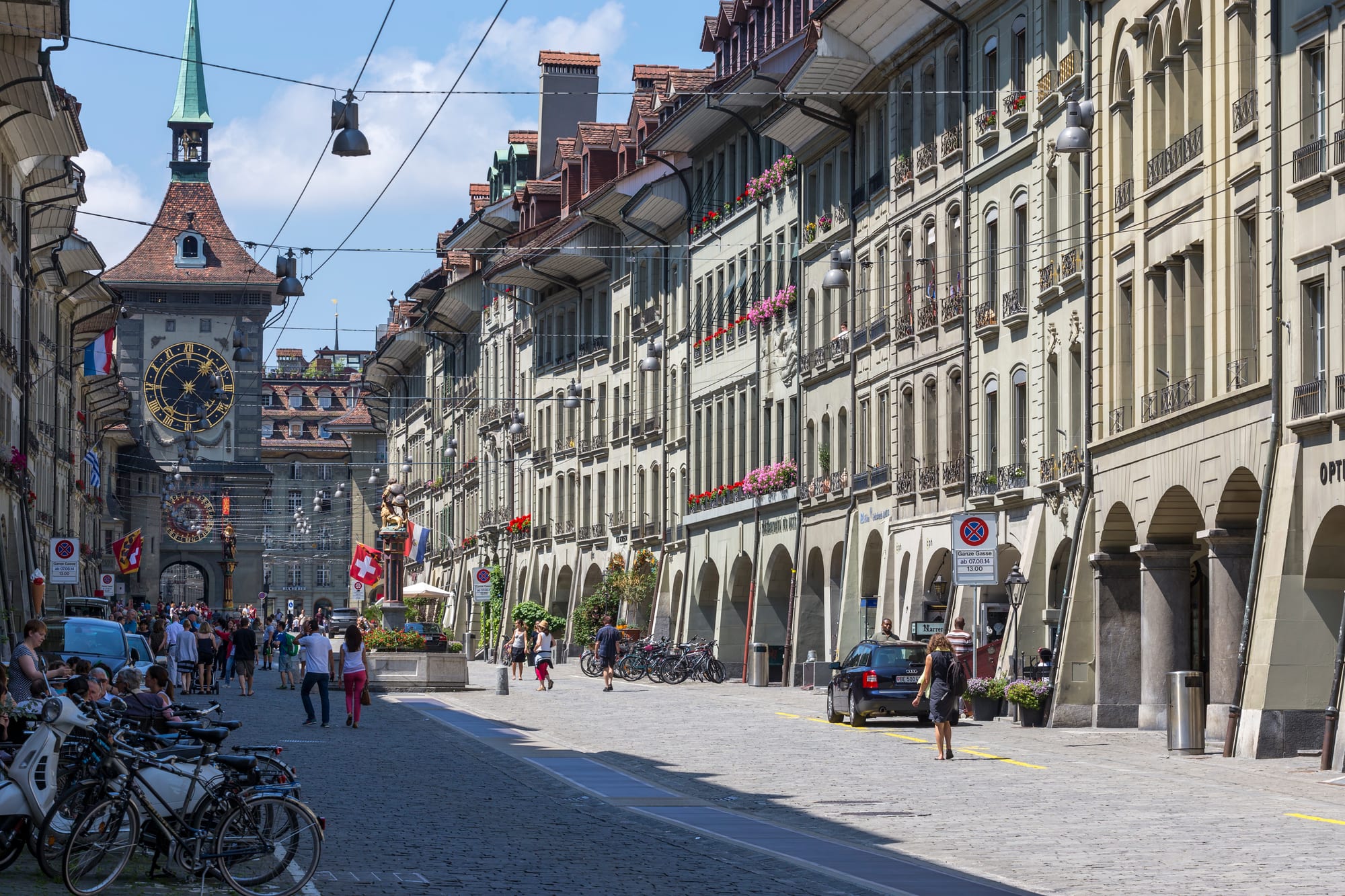
A cobbled old-town street with arcaded stone houses, flower boxes and a fountain, leading to a clock tower with a large gold dial

Bern, Lucerne & Central Switzerland, Switzerland

Bern

Kramgasse in Bern's old town, looking west to the Zytglogge clock tower. (JoachimKohler-HB / Wikimedia Commons · CC BY-SA 4.0)

The Swiss federal city and capital of the canton of Bern, built on a hilly peninsula in a loop of the Aare. Founded around 1191 by the Zähringer dukes and named, by legend, after a bear, it grew into a powerful city-state; today its arcaded medieval old town is a UNESCO World Heritage Site and the seat of the national parliament and government.

Neighbourhoods

  • Old City
    • First-time visitors
    • Historic district
    • Shopping

    The medieval centre on its narrow hill above the Aare, a UNESCO World Heritage Site. Long streets of sandstone houses run between the railway station and the Nydegg bridge, with some 6 kilometres of arcades, 16th-century fountains, the Zytglogge, the Minster and the Federal Palace.

    Open in Maps
  • Matte
    • Riverside
    • Quiet and residential
    • Local life

    The old working-class quarter down by the river, once known for its own dialect and secret language, Mattenenglisch. Its low streets lie by the Aare, well below the higher-lying districts.

    Open in Maps
  • Marzili
    • Swimming
    • Summer
    • Riverside

    The riverside district below the Federal Palace, linked to it by the very short Marzilibahn funicular. Its public pool on the Aare is where many of Bern's river swimmers climb out after drifting downstream in summer.

    Open in Maps
  • Kirchenfeld
    • Museums
    • Quiet and residential

    A district of mansions laid out after 1881 across the Kirchenfeld bridge from the old town, home to the Bern Historical Museum, with the Dählhölzli zoo along the river.

    Open in Maps
  • Länggasse
    • Students
    • Local life

    The higher-lying quarter where most of the University of Bern's buildings stand, a residential district well above the river.

    Open in Maps

Things to do

Famous landmarks

  • Zytgloggelandmark

    The medieval clock tower built in the early 13th century, once the western gate of the city, with an astronomical clock and moving figures.

    Open in Maps
  • Bern Minsterlandmark

    The Gothic Reformed cathedral begun in 1421, whose 100.6-metre tower, completed only in 1893, makes it the tallest cathedral in Switzerland.

    Open in Maps
  • Federal Palacelandmark

    The domed seat of the Swiss parliament and government, built between 1857 and 1902, which can be visited.

    Open in Maps
  • Bärengraben and BärenParkattraction

    Bern has kept bears, its heraldic animal, since at least the 16th century; the old bear pit by the Nydegg bridge has been joined since 2009 by a larger enclosure on the steep river bank.

    Open in Maps
  • Käfigturmlandmark

    The tower that marked the city's western edge from 1256 until 1345, after the Zytglogge, and one of the landmarks of the second expansion of the old town.

    Open in Maps

Museums

  • Einsteinhausmuseum

    The flat at Kramgasse 49 where Albert Einstein lived with his wife and son from 1903 to 1905, the year of his Annus Mirabilis papers, now a small museum.

    Open in Maps
  • Zentrum Paul Kleemuseum

    A museum designed by Renzo Piano on the eastern edge of the city, holding about 40 per cent of Paul Klee's pictorial work.

    Open in Maps
  • Bern Historical Museummuseum

    Switzerland's second-largest historical museum, in a castle-like building of 1894 in Kirchenfeld.

    Open in Maps
  • Museum of Fine Arts Bernmuseum

    The city's museum of fine arts, established in 1879.

    Open in Maps
  • Swiss Alpine Museummuseum

    A museum on Helvetiaplatz about the relationship between people and the mountains of the Swiss Alps.

    Open in Maps

The river and the hills

  • Rose Gardenpark

    A rose garden on a hill above the old town, laid out in 1913 on a former cemetery, with a panoramic view over the roofs, the Minster and the loop of the Aare.

    Open in Maps
  • Swimming in the Aareattraction

    On hot summer days many people drift downstream in the fast, cold river and climb out at the public pools of the Marzili or the Lorraine.

    Open in Maps
  • Marzilibahntransit hub

    A very short funicular linking the riverside Marzili district with the Federal Palace on the hill above.

    Open in Maps
  • Gurtenviewpoint

    The 858-metre hill just south of the city, with restaurants, a 25-metre viewing tower and views of Bern, the Jura and the Alps.

    Open in Maps
  • Dählhölzli Zoopark

    The public zoo opened in 1937 on the bank of the Aare near the old town, with an enclosure next to the river.

    Open in Maps

Sport

  • Stadion Wankdorfattraction

    The football stadium of BSC Young Boys and one of the venues of the 2008 European Championship.

    Open in Maps
  • PostFinance Arenaattraction

    The home of the ice hockey club SC Bern and the main venue of the 2009 ice hockey world championship.

    Open in Maps

Seasonal events

  • Zibelemäritfourth Monday in November

    Bern's largest market, when farmers fill the old town with onion braids, wreaths and onion dishes, and a confetti battle breaks out in the afternoon.

  • GurtenfestivalJuly

    An annual music festival on the Gurten, the hill above the city.

  • shnit International Shortfilmfestivalearly October

    A short-film festival held in Bern every year.

Eat and drink

Long-standing places and food districts in Bern. Hours, ratings and directions come from your maps app, always current.

Bern classics

  • Berner Platte in the old townneighborhood

    Bern's traditional meat platter — smoked pork and beef, bacon and sausages with juniper-flavoured sauerkraut, potatoes and beans — is served in restaurants across the old town.

    Open in Maps
  • Zibelemäritmarket

    The November onion market, with onion pie, onion soup, bratwurst with onions and mulled wine at the stalls.

    Open in Maps

Food districts

  • Restaurants under the arcadesneighborhood

    Restaurants, cafés and cellars line the arcaded streets of the old town between the station and the Nydegg bridge.

    Open in Maps
  • Bern railway stationmarket

    On Sundays, when the city's shops close, the supermarkets in the main station stay open into the evening.

    Open in Maps

Experience Bern

History

Fortified settlements stood in the area long before the city, but medieval Bern was a foundation of the Zähringer dukes, probably in 1191 by Berthold V. By legend he vowed to name the town after the first animal he met on the hunt, and it was a bear; the bear has been on the city's seal since at least the 1220s, and live bears have been kept in a pit since the 15th century. The town grew westward along the peninsula in planned stages: the Zytglogge marked its western gate until 1256, then the Käfigturm until 1345.

Bern joined the Confederation in 1353 and became the largest city-state north of the Alps, ruling a territory that stretched as far as Vaud. Its population grew from about 5,000 in the 15th century to about 12,000 by 1800. A popular legend links the Zibelemärit to help given after a fire that devastated the city in 1405, though records show the market only from the mid-19th century.

On 28 November 1848 the new Federal Assembly chose Bern as the federal city, the seat of government, ahead of Zurich and Lucerne — the constitution does not name an official capital. The Federal Palace was built between 1857 and 1902, and between 1903 and 1905 a patent examiner named Albert Einstein lived on Kramgasse. The population passed 100,000 in the 1920s and peaked at about 165,000 in the 1960s. In 1983 the old town was listed as a UNESCO World Heritage Site.

Culture & Customs

The Bernese have their own dialect, Bernese German. The Matte, the old working-class quarter by the river, even had its own speech, Mattenenglisch — both a local sociolect and a kind of pig Latin — which fell out of use in the 20th century but is still cultivated by enthusiasts.

The city's cultural life is broader than its size suggests. The Zentrum Paul Klee holds about 40 per cent of the painter's pictorial work, the Museum of Fine Arts dates from 1879, and the Einsteinhaus marks the years in which Einstein, then a patent examiner, worked out his theory of relativity. Festivals fill the calendar: the Gurtenfestival on the hill above the city, the BeJazz and international jazz festivals, the Buskers street-music festival, the shnit short-film festival in October and Queersicht in November. Bern also has its own Fasnacht carnival.

Old customs survive in the Zibelemärit, when the whole old town is given over to onions and confetti on the fourth Monday of November. Sport draws big crowds: BSC Young Boys play football at the Wankdorf, and SC Bern play ice hockey at the PostFinance Arena. In summer, drifting down the Aare past the Federal Palace and climbing out at the Marzili is part of local life.

Daily Life

About 146,000 people lived in Bern in 2024, making it the fifth-largest city in Switzerland, and the agglomeration of 36 municipalities had about 407,000 in 2014. About a third of residents are foreign nationals, and German is the first language of most, with Italian and French the next most common. The city is governed by a Municipal Council led since 2025 by Marieke Kruit.

Bern's economy is overwhelmingly one of services. It is the seat of the parliament, the federal government and much of the federal administration, as well as the canton's government, the University of Bern, the University of Applied Sciences and the Universal Postal Union. Toblerone has been made in the city since 1908 by the Tobler chocolate factory, founded there in 1899, although part of the range has been made in Slovakia since 2022.

Most people live outside the old town, in districts such as Länggasse near the university, the mansion district of Kirchenfeld, Breitenrain and the western suburbs of Bümpliz and Betlehem. Bern station, with about 165,000 passengers each weekday in 2022, is the second-busiest in the country. Shops close on Sundays, apart from those in the station.

Food

Bern's signature dish is the Berner Platte, the Bernese plate: smoked pork and beef, pork belly, sausages, bacon and sometimes pork ears or tails, served on a large plate with juniper-flavoured sauerkraut, potatoes and green or dried beans. It is not a stew — each meat and side dish is prepared separately — and it is sometimes served as a buffet.

Rösti, the fried potato cake now eaten all over Switzerland, began as a breakfast dish of farmers in the canton of Bern, and French speakers still call it röstis bernois. It is commonly served beside other dishes, such as spinach with fried eggs, a cervelas sausage or Fleischkäse. Zopf, the braided bread with a golden crust, belongs to Sunday breakfasts and brunches.

The Zibelemärit is the city's great food day: farmers sell onion braids alongside Zwiebelkuchen (onion pie), Zwiebelsuppe (onion soup), onion pizza and bratwurst with onions, and mulled wine is the usual drink. Bern's best-known product is Toblerone, the triangular chocolate bar created by the Tobler factory, whose packaging hides the outline of a bear, the city's symbol, in its mountain.

Planning tools

Budget

Bern is expensive by international standards. Hotels and restaurant meals are the main costs; many of the best things — the arcades, the bear park, the Rose Garden view, the Federal Palace square and the river — cost nothing.

Daily Budget Midrange
USD 280–500 (hotel, restaurant dinners, museum tickets, public transport)
Daily Budget Shoestring
USD 120–200 (hostel bed, supermarket and takeaway meals, trams and buses)

The station supermarkets, open even on Sundays, help keep meal costs down, and a half-fare card cuts the cost of trips out of the city.

Best Time to Visit

May to September, when the arcades and terraces are busiest and in high summer people swim in the Aare. November brings the Zibelemärit, and December the Christmas season in the old town. Winters are cold and often grey, but the museums and arcades keep the city usable in any weather.

Suggested Number of Days

Two days are enough for the old town, the river and the main museums. Adding Thun, the Emmental or the Bernese Oberland, all reached by train, stretches a stay to three to five days; a summer visit that includes time in the river may need longer.

First Visit
2 days
With Surroundings
3–5 days

Transportation

Bern has a dense network of trains, trams, trolleybuses and buses, with fares based on zones; the central part of the city is one fare zone. Bern station is Switzerland's second-busiest and the hub for the whole region. The Marzilibahn funicular climbs from the river to the Federal Palace.

The river and the old-town arcades are best on foot; trams and buses cover the outer districts, and Bern station is the starting point for day trips across the region.

Airport & Station Connections

Most visitors arrive by train. Zurich, Geneva and Basel airports are all reachable in less than two hours by train or car. Bern Airport, near Belp about 10 km south of the city, mostly serves general aviation and charter flights.

Walkability

The old town is compact and best seen on foot, with arcades giving shelter from rain and sun. Its streets run along a narrow ridge, so the river quarters of Matte and Marzili lie well below — the Marzilibahn funicular links the river with the Federal Palace. Kirchenfeld and the bear park are a short walk across the bridges.

Safety

Switzerland is very safe, with low crime. In Bern the main hazard is the Aare: the river is fast and cold, and some stretches around the old town are only for strong swimmers with local knowledge.

Swim in the Aare only on the recommended stretches and leave the water at a public pool such as the Marzili or the Lorraine. Check current official travel advice before travelling.

Climate

A temperate climate on the Swiss plateau: warm summers and cold winters; the highest temperature recorded nearby was 37°C, in August 2003.

Summer
warm — July averages about 18°C, with daily highs around 24°C
Winter
cold — January averages about −0.4°C, with nights around −3.6°C

Local Customs

Bern is German-speaking, and the Bernese dialect is the everyday language; the city also lies close to the French-speaking west. Shops close on Sundays, except those in the main railway station. By law a service charge is included in the bill, and any tip is a personal choice.

When swimming in the Aare, follow local practice and the recommended stretches; Sunday is a rest day, when quiet is expected.

Common Payment Methods

The currency is the Swiss franc. Switzerland is more cash-oriented than many European countries, but credit and debit card payments are common, and all ATMs accept foreign cards. Some places, such as supermarkets, restaurants, ticket counters and the railways, accept euro notes (but not coins) and give change in francs.