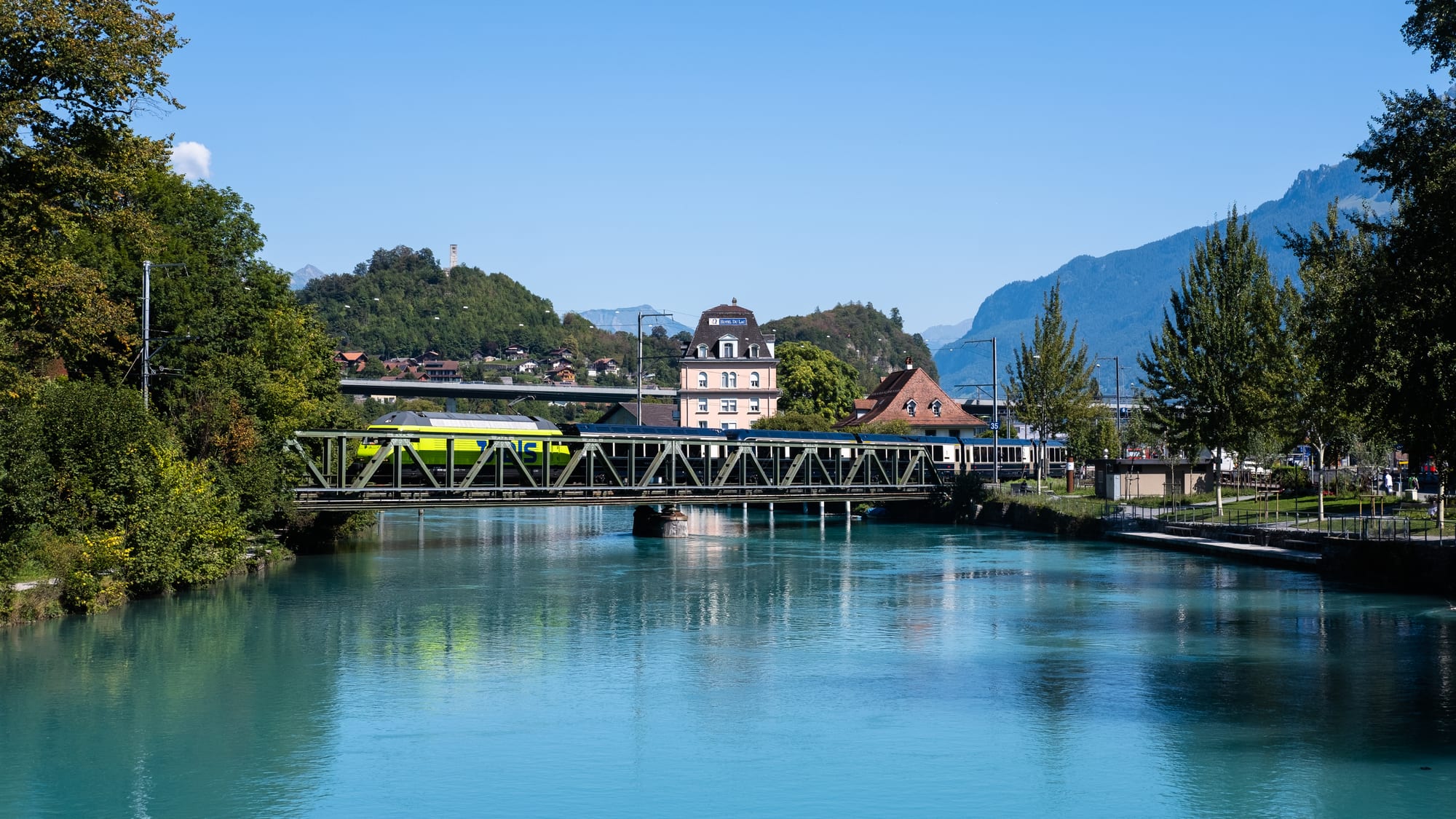
The turquoise Aare river in Interlaken with a train crossing a steel bridge, houses, wooded hills and mountains behind

Bern, Lucerne & Central Switzerland, Switzerland

Interlaken

The Aare in Interlaken, beside the Interlaken Ost railway station. (Christian David / Wikimedia Commons · CC BY-SA 4.0)

A small resort town in the canton of Bern, built on the flat alluvial land of the Bödeli between Lake Thun and Lake Brienz. A medieval monastery town that became a spa and tourist centre in the 19th century, it is now the main transport gateway to the Jungfrau region, its mountain railways and its adventure sports.

Neighbourhoods

  • Höheweg and the Höhematte
    • First-time visitors
    • Close to public transport
    • Mountain views

    The main street, running between the Interlaken West and Interlaken Ost railway stations, lined with many of the town's hotels, shops and restaurants. It borders the Höhematte, the open meadow in the centre of town with a view of the snow-covered Jungfrau.

    Open in Maps
  • Unterseen
    • Historic district
    • Quiet and residential

    The neighbouring municipality across the Aare, which grew up in 1279/80 next to the monastery village. Its small old town lies close to Interlaken West station.

    Open in Maps
  • Matten and Wilderswil
    • Quiet and residential
    • Close to the mountain railways

    The villages on the southern side of the Bödeli, joined to Interlaken by newer building. Wilderswil is the starting point of the Schynige Platte railway, and the ruins of Unspunnen Castle rise above the fields where the Unspunnenfest is held.

    Open in Maps

Things to do

In town

  • Interlaken Monasterylandmark

    The Augustinian house founded around 1133 that gave the town its name; it was secularised at the Reformation in 1528, and Bern used its buildings for the district administration.

    Open in Maps
  • Höhemattepark

    The large open meadow in the middle of the town, from which the Jungfrau can be seen above the valley.

    Open in Maps
  • Unterseen old townneighborhood

    The small old town on the far bank of the Aare, a separate medieval foundation from the 13th century.

    Open in Maps

Walks and viewpoints

  • Harder Kulmviewpoint

    A viewpoint at about 1,320 metres on the ridge just north of the town, reached by the Harderbahn funicular, looking down on Interlaken and both lakes towards the high Alps.

    Open in Maps
  • Heimwehfluhviewpoint

    A low hill above the town at 680 metres, reached by funicular, with an observation tower, a model railway and a bobsleigh run.

    Open in Maps
  • Schynige Platte Railwayattraction

    A rack railway climbing from Wilderswil to the Schynige Platte at about 1,970 metres, known for its alpine wildflower garden and views of the high mountains.

    Open in Maps
  • Unspunnen Castlelandmark

    The ruins of a castle probably built in the early 12th century, overlooking Interlaken from Wilderswil, below which the Unspunnenfest is held.

    Open in Maps

The lakes

  • Lake Thunattraction

    The lake to the west, reached from a quay beside Interlaken West station by a ship canal; boats sail to Spiez and Thun.

    Open in Maps
  • Lake Brienzattraction

    The turquoise lake to the east, with boats leaving from the Aare quay by Interlaken Ost for Brienz and the lakeside villages.

    Open in Maps

Short trips from the town

  • Jungfraujochattraction

    The saddle between the Jungfrau and the Mönch at 3,454 metres, the highest point in Europe reachable by train, reached by a chain of mountain railways starting at Interlaken Ost.

    Open in Maps
  • Brienz Rothorn Railwayattraction

    A rack railway, unusual in Switzerland for running mostly with steam locomotives, climbing from the woodcarving village of Brienz at the eastern end of Lake Brienz.

    Open in Maps
  • Giessbach Funicularattraction

    A historic funicular climbing from a landing stage on Lake Brienz, served by the lake boats, near the Giessbach waterfalls.

    Open in Maps

Seasonal events

  • Greenfield FestivalJune

    A rock music festival on the outskirts of Interlaken, held every year since 2005 and drawing up to 30,000 visitors.

  • Unspunnenfestlate summer, about once every twelve years

    A festival of traditional Swiss culture first held in 1805, with Schwingen wrestling, yodelling and the throwing of the 83.5-kilogram Unspunnen stone; the most recent was in 2017.

Eat and drink

Long-standing places and food districts in Interlaken. Hours, ratings and directions come from your maps app, always current.

Food districts and views

  • Restaurants on the Höhewegneighborhood

    The main street between the two stations holds most of the town's restaurants, from Swiss dishes such as fondue and raclette to the many international kitchens that serve its visitors.

    Open in Maps
  • Unterseen old townneighborhood

    Smaller restaurants and cafés in the old streets across the Aare, a few minutes from Interlaken West station.

    Open in Maps
  • Harder Kulm restaurantrestaurant

    The castle-like mountain restaurant on top of the Harder, beside an observation platform, a short walk from the upper funicular station.

    Open in Maps

Experience Interlaken

History

Interlaken takes its name from the Augustinian monastery recorded around 1133 as "inter lacus" — between the lakes — on imperial land on the left bank of the Aare. The canons controlled a bridge over the river and drew income from its tolls, and a village with a mill grew up around them; in 1279/80 the small town of Unterseen was founded nearby on the other bank. A document of 1310 records 30 priests, 20 lay brothers and 350 women at the house; despite reform measures the nuns' convent was closed in 1484, and at the Reformation in 1528 Bern secularised the monastery and turned its lands into a bailiwick governed from its buildings.

For centuries the place was a cluster of farming villages, Aarmühle and Matten among them, whose quarrels shaped the local borders. Tourism changed that. The Unspunnenfest of 1805 and 1808, a festival of Swiss traditions held below the ruins of Unspunnen Castle, drew the first crowds; from 1820 visitors came for the mountain air and spa treatments, and a Kursaal opened in 1859. Aarmühle used the name Interlaken for its post office and station, and in 1891 the municipality adopted it officially.

Railways followed: the Bödelibahn opened from Därligen on Lake Thun to Interlaken in 1872, the Bernese Oberland railway reached Lauterbrunnen and Grindelwald in 1890, and lines to Thun and Lucerne completed the connections. The boom stopped abruptly in 1914, resumed more slowly after the war, and the villages of the Bödeli have since grown together into one built-up area.

Culture & Customs

Interlaken's identity is that of a host town. Its life revolves around visitors from all over the world, and the Höheweg, the main street lined with hotels between the two stations, still shows the shape of the old resort. The Kursaal is listed as a Swiss heritage site of national significance, and the whole built-up village is part of the Inventory of Swiss Heritage Sites.

Older Bernese Oberland traditions survive alongside the tourism. The Unspunnenfest, held roughly once every twelve years, brings together Schwingen wrestling, yodelling and Steinstossen, the throwing of the heavy Unspunnen stone, made of Aare granite from the Hasli valley. In summer the Greenfield Festival brings rock bands to the outskirts of town. Brienz, a short train ride along the lake, is the centre of Swiss woodcarving.

The town is also known as an adventure-sports centre. Guiding companies offer paragliding, hang gliding, skydiving, canyoning, rafting and climbing. The town's parliament meets in the Kunsthaus, the art museum on Amman-Hofer-Platz.

Daily Life

Interlaken had about 5,700 residents at the end of 2020, and the agglomeration around it about 23,000. Over a quarter of residents are foreign nationals, and German is the main language, with Portuguese and Italian the next most common. Apartments are scarce: the vacancy rate in 2010 was just 0.1 per cent.

Tourism dominates the economy. In 2017 the town had about 27 hotels with some 1,600 rooms, and most overnight stays are by international visitors. About 6,900 people were employed in the municipality in 2014. Industry never vanished entirely despite the emphasis on tourism: a parquet factory operated from 1850 until 1935, and a wool-weaving factory opened in 1921.

Matten, Unterseen and Interlaken share their infrastructure and have grown into a single small town on the Bödeli. The rhythm of the year follows the seasons of the mountains: crowded summers, a busy Christmas and winter season, and quieter weeks between, when some lifts close.

Food

Interlaken's restaurants serve the dishes of German-speaking Switzerland to a largely international clientele. Fondue, usually several hard cheeses such as Gruyère and Vacherin melted with white wine and eaten hot with bread, and raclette, melted cheese served with potatoes, are the convivial dishes associated with mountain culture, more often eaten on cold evenings than every day.

Rösti, a fried potato cake, was originally a breakfast dish of farmers in the canton of Bern and is now served all over the country, often beside fried eggs, a cervelas sausage or Fleischkäse. Älplermagronen, the herdsmen's macaroni, combines pasta, potatoes, onions, small pieces of bacon and melted cheese, and is traditionally served with apple sauce. Zopf, a braided bread with a golden crust, is the bread of Sunday breakfasts.

Meiringen, further up the valley beyond Lake Brienz, claims to be the place where meringue was first created. Swiss chocolate, from Lindt and Cailler to Toblerone, fills the shelves of the supermarkets by the stations.

Planning tools

Budget

Interlaken is the costly heart of an expensive region. The mountain railways are the biggest expense, and rooms fill and rise in price in summer and at Christmas. The town also has a good choice of backpacker hostels, and supermarket meals and lake walks keep a day's costs down.

Daily Budget Midrange
USD 320–580 (hotel, restaurant dinners, a mountain railway or cable car most days)
Daily Budget Shoestring
USD 130–210 (hostel bed, supermarket meals, walks and the lake shores)

A half-fare card or a regional pass reduces the cost of the mountain railways and lake boats; check the summit weather before paying for a trip to the top.

Best Time to Visit

June to September, when the high trails are clear, the lake boats run their full service and the mountain railways are busiest, with July and August the peak. December to March brings skiing in the resorts above the town. Spring and autumn are quieter, though some lifts close between seasons.

Suggested Number of Days

Two or three days cover the town, its viewpoints and the lakes. Most visitors stay longer because Interlaken is a base for the whole Jungfrau region, and mountain weather often decides how many days are needed to see the high peaks.

First Visit
2–3 days
With Surroundings
4–6 days

Transportation

The town has two railway stations, Interlaken West and Interlaken Ost, both on the line to Spiez, Thun and Bern. The Bernese Oberland railway leaves from Ost for Lauterbrunnen and Grindelwald, the first stage of the routes up to the Jungfraujoch. Boats cross Lake Thun from a quay by West station and Lake Brienz from the Aare by Ost, local buses run to the neighbouring villages, and two funiculars climb the hills beside the town.

Leave the car at the valley stations: the mountain resorts above are reached by train, and some of them are car-free.

Airport & Station Connections

Trains from Bern run every half hour and take just under an hour, via Thun and Spiez, to Interlaken West and Interlaken Ost. Trains from Lucerne run hourly over the Brünig line via Brienz to Interlaken Ost. Travellers arriving at Zurich or Geneva airports continue by train, changing at Bern.

Walkability

The centre is flat and compact: the Höheweg links the two railway stations, passing the Höhematte, and Unterseen is just across the Aare. Paths follow the river and the lake shores, and the funicular stations for the viewpoints are within walking distance of the centre.

Safety

Switzerland is very safe, with low crime. In Interlaken the risks are those of the mountains and the water: sudden storms, rockfall and steep paths above the town, and cold lakes. Adventure sports such as paragliding, canyoning and skydiving are offered by many operators.

Carry warm layers to the summits, stay on marked trails, and make sure travel insurance covers adventure sports and mountain rescue. Check current official travel advice before travelling.

Climate

A mild, humid continental climate at 566 metres, between two lakes and surrounded by mountains. Summers are pleasant in the valley but much cooler on the summits above, and winters are cold.

Summer
mild — July is the warmest month, with a mean temperature of about 18.6°C
Winter
cold — January averages about 0°C

Local Customs

Interlaken is German-speaking, though English is spoken throughout the tourist trade and the town receives visitors from all over the world. By law a service charge is included in the bill, and any tip is a personal choice. Sundays are quiet, and shops close.

Rules on behaviour are those of the rest of Switzerland: Sunday is a rest day, and Swiss German dialect is the everyday spoken language.

Common Payment Methods

The currency is the Swiss franc. Switzerland is more cash-oriented than many European countries, but credit and debit card payments are common, and all ATMs accept foreign cards. Some places, such as supermarkets, restaurants, ticket counters and the railways, accept euro notes (but not coins) and give change in francs, or in euros if they have them.