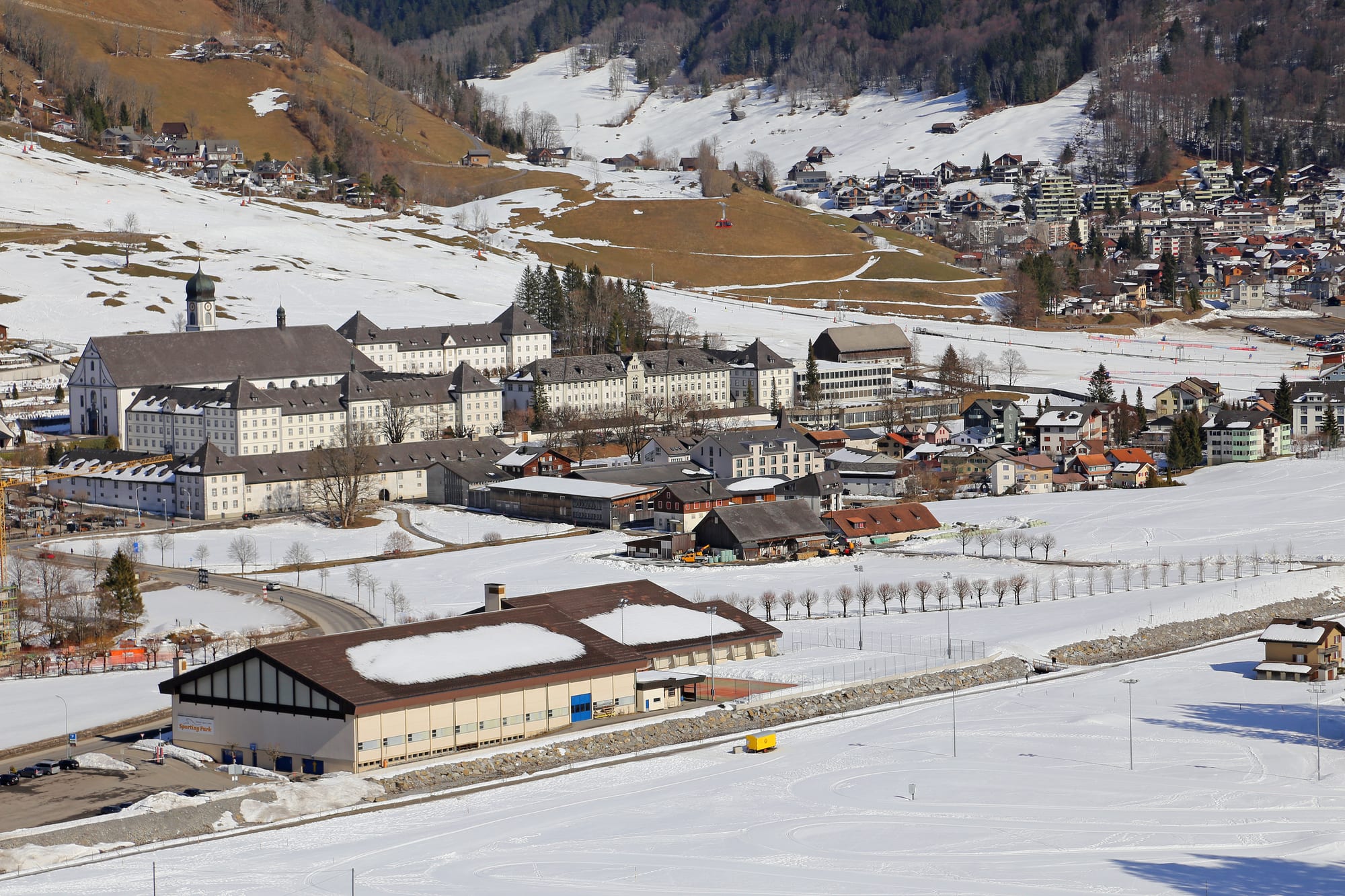
The long white buildings and church of Engelberg Abbey on a snowy valley floor, with the village and wooded slopes behind

Bern, Lucerne & Central Switzerland, Switzerland

Engelberg

Engelberg Abbey and the village of Engelberg. (W. Bulach / Wikimedia Commons · CC BY-SA 4.0)

A mountain village and exclave of the canton of Obwalden, in a high valley ringed by peaks south of Lake Lucerne. It grew around a Benedictine abbey founded in 1120, became a resort in the 19th century, and is now a year-round base for skiing and hiking, with the world's first rotating cable car climbing towards the glacier of the Titlis.

Neighbourhoods

  • Village centre
    • First-time visitors
    • Close to public transport
    • Shops and restaurants

    The streets around Dorfstrasse and the railway station, the terminus of the line from Lucerne. The Talmuseum on Dorfstrasse tells the story of the valley, and the cable cars to the Titlis and Brunni start from the village.

    Open in Maps
  • The abbey
    • Historic district
    • Quiet

    The large Benedictine monastery on the valley floor, around which the village grew. Its church, library and the show cheese dairy in its grounds are the heart of old Engelberg.

    Open in Maps
  • Grafenort
    • Quiet
    • Heritage

    A small village within the municipality of Engelberg, with a mansion and the Holy Cross chapel, both Swiss heritage sites of national significance.

    Open in Maps

Things to do

In the village

  • Engelberg Abbeylandmark

    The Benedictine monastery founded in 1120 by Count Conrad of Sellenbüren, a heritage site of national significance for its buildings, library, archives and music collection.

    Open in Maps
  • Show cheese dairyattraction

    A cheese dairy within the abbey grounds where cheese-making can be watched and its products bought.

    Open in Maps
  • Talmuseummuseum

    The valley museum on Dorfstrasse, showing the history of the area and of Swiss rural life.

    Open in Maps

The Titlis

  • Titlisviewpoint

    The 3,238-metre peak south of the village, the highest summit of its range, whose glacier has retreated sharply; an illuminated glacier cave is entered from the top cable-car station.

    Open in Maps
  • Titlis Cliff Walkattraction

    A pedestrian suspension bridge about 100 metres long and just 1 metre wide, strung between two rock faces at around 3,000 metres and opened in 2012.

    Open in Maps
  • Trübseepark

    An alpine lake at 1,764 metres beside the middle station of the Titlis cable cars, with walking trails up from the village and across the Jochpass.

    Open in Maps

Other mountains

  • Brunnipark

    The sunny recreation area north of the village, reached by cable car to Ristis and a chairlift above, with ski runs and a toboggan run.

    Open in Maps
  • Gross-Titlis-Schanzeattraction

    The large ski-jumping hill at Engelberg, a regular venue of the FIS Ski Jumping World Cup.

    Open in Maps

Seasonal events

  • Ski Jumping World CupDecember

    A round of the FIS World Cup on the Gross-Titlis-Schanze, usually held just before the Four Hills Tournament.

Eat and drink

Long-standing places and food districts in Engelberg. Hours, ratings and directions come from your maps app, always current.

Engelberg classics

  • Abbey cheese dairymarket

    The demonstration cheese dairy and shop inside the abbey, where the cheese made on site can be bought.

    Open in Maps
  • Dorfstrasse restaurantsneighborhood

    Restaurants and cafés in the village centre, between the station and the abbey.

    Open in Maps
  • Klein Titlis stationrestaurant

    The mountain station at the top of the Rotair, with restaurants, shops and an observation terrace above the glacier; the antenna tower beside it was opened as an observation tower in May 2026.

    Open in Maps

Experience Engelberg

History

Engelberg — "mountain of the angels" — owes its existence to its abbey. Count Conrad of Sellenbüren founded the Benedictine monastery on 1 April 1120, with monks from Muri Abbey and Adelhelm of Muri as its first abbot, and the name Engilperc first appears in 1122. Under Abbot Frowin a scriptorium was founded, and the abbey became a double monastery of monks and nuns. Its abbots held quasi-episcopal authority over the town that grew up around its walls and over the parishes of the area. The library, said to have held over twenty thousand volumes and two hundred manuscripts, was pillaged by the French in 1798.

In 1815, when Nidwalden hesitated to accept the new Federal Treaty, Engelberg quickly declared its support, and after federal troops forced Nidwalden to accept it, the valley was joined to Obwalden. That is why Engelberg is an exclave, entirely surrounded by the cantons of Bern, Nidwalden and Uri.

Tourism followed in the 19th century, led by local families such as the Cattani, Hess and Odermatt, who built hotels. A wider road was built in 1872–74 and the electric railway from Stansstad opened in 1898; the Gerschnialp funicular followed in 1913 and a cable car to Ober Trüebsee in 1927. The railway was extended to Lucerne in 1964, the upper cable car to the Titlis opened in 1967, and the Rotair, the world's first rotating cable car, later carried visitors to Klein Titlis. The Titlis Xpress gondola replaced an older lift in 2015.

Culture & Customs

The abbey remains the centre of Engelberg's identity. Its library, archives and music collection are a heritage site of national significance, and the library still holds a complete set of Martin Luther's writings — an unexpected treasure for a Catholic monastery. Visitors can watch cheese being made at the dairy in the abbey grounds, and the Talmuseum on Dorfstrasse tells the story of the valley and of Swiss rural life.

Winter sport shapes the village's calendar. The FIS Ski Jumping World Cup comes to the Gross-Titlis-Schanze each December, usually just before the Four Hills Tournament, and the glacier slopes of the Titlis can sometimes be used by advanced skiers from October until May. Summer belongs to hikers and mountain bikers on the trails to Trübsee, the Jochpass and the passes leading into the neighbouring valleys.

The village has also become a meeting place, regularly hosting conferences, and its international visitors are reflected in daily life: English is the third most common first language among residents. Engelberg's mix of monastery, ski resort and high glacier makes it unlike the lake towns of central Switzerland below.

Daily Life

Engelberg had about 4,200 residents at the end of 2020. About a quarter are foreign nationals, and in 2015 around 6 per cent had been born in Germany; German is the mother tongue of most, with Serbo-Croatian and English the next most common. The population grew by about 6 per cent between 2010 and 2016.

By the turn of the millennium the service sector, above all tourism, provided most jobs, with the cable cars, hotels, restaurants and shops at its core. The abbey, with its cheese dairy, is part of village life as well as a sight for visitors.

The year turns on the seasons of the mountains. Winter runs from December to April, the cable cars carry hikers and mountain bikers in summer, and the Titlis glacier draws visitors in every month. Its retreat is a local concern: the glacier on the northern side of the massif has receded dramatically and is expected to disappear in about twenty years. Lucerne is the nearest major urban centre.

Food

Engelberg's best-known local product is the cheese made at the abbey's show dairy, sold in its shop. Two cheese dairies also operate in summer on the Gerschni pasture above the village, along the walking trails towards Trübsee.

The restaurants serve the food of German-speaking Switzerland. Fondue, usually several hard cheeses such as Gruyère and Vacherin melted with white wine and eaten hot with bread, and raclette, melted cheese with potatoes, are associated with mountain culture and winter sports and are most popular in cold weather. Älplermagronen, the Alpine herdsmen's macaroni, combines macaroni, potatoes, onions, small pieces of bacon and melted cheese and is traditionally served with apple sauce rather than vegetables or salad.

Rösti, the fried potato cake that began as a breakfast dish of farmers in the canton of Bern, is eaten across the country, often with cheese, onions and cold meat or eggs. Zopf, a braided bread with a golden crust, is traditionally eaten on Sunday mornings.

Planning tools

Budget

Engelberg is expensive, like all Swiss mountain resorts. The cable cars to the Titlis are the largest single cost, and rooms rise in price in the ski season and in summer. Walking in the valley and around the abbey costs nothing, and the abbey's cheese shop and the supermarkets make for cheaper picnics.

Daily Budget Midrange
USD 320–580 (hotel, restaurant dinners, a cable car most days)
Daily Budget Shoestring
USD 130–210 (hostel or simple guesthouse, supermarket meals, valley walks)

A half-fare card or a regional pass reduces the cost of the trains and some lifts; check the summit weather before paying for the trip to the Titlis.

Best Time to Visit

The winter sports season generally lasts from December to April, and the glacier slopes on the Titlis can sometimes be used by advanced skiers from October to May. The cable cars generally run all year, so summer brings hiking and mountain biking. December also brings the ski jumping World Cup.

Suggested Number of Days

One or two days are enough for a first look at the village and the high mountains above it. Skiers and walkers usually stay longer, and cloud on the summits can make it worth keeping a spare day.

First Visit
1–2 days
With Surroundings
3–5 days

Transportation

Engelberg railway station, in the village, is the terminus of the line from Lucerne, served by hourly InterRegio trains. In the village the Titlis Xpress gondola runs from the valley station to Trübsee and Stand, where the Rotair continues to Klein Titlis; a funicular climbs to Gerschnialp, and a cable car rises to Ristis in the Brunni area on the opposite side of the valley.

The lifts and the station are within the village, so a car is rarely needed once there.

Airport & Station Connections

Hourly InterRegio trains run from Lucerne up the valley to Engelberg, on a narrow-gauge rack railway through Stans. Lucerne, the nearest major city, is the usual starting point, and a road follows the same valley.

Walkability

The village lies on the flat floor of a high valley and is easy to walk around: the station, the abbey, the shops and the lift stations are close together. Walking trails lead out across the pastures, up to Gerschni and Trübsee, and over the passes into neighbouring valleys.

Safety

Switzerland is very safe, with low crime. The risks around Engelberg are alpine: altitude and cold at Klein Titlis, glaciers that should never be crossed without a guide, sudden weather changes and steep paths in summer, and avalanches off-piste in winter.

Stay on marked trails and pistes, carry warm layers to the summit even in summer, and make sure travel insurance covers mountain rescue. Check current official travel advice before travelling.

Climate

A mountain valley climate at about 1,000 metres, with an annual mean temperature of about 6.8°C, cold snowy winters and mild summers; the Titlis above is far colder at any season.

Summer
mild — July averages about 15.4°C
Winter
cold and snowy — January averages about −1.7°C

Local Customs

Engelberg is German-speaking and has grown up around its abbey, though visitors come from all over the world. By law a service charge is included in the bill, and any tip is a personal choice. Sundays are quiet, and noisy activities are frowned on.

The abbey church is a place of worship: quiet and modest dress are expected during services.

Common Payment Methods

The currency is the Swiss franc. Switzerland is more cash-oriented than many European countries, but credit and debit card payments are common, and all ATMs accept foreign cards. Some places, such as supermarkets, restaurants, ticket counters and the railways, accept euro notes (but not coins) and give change in francs.