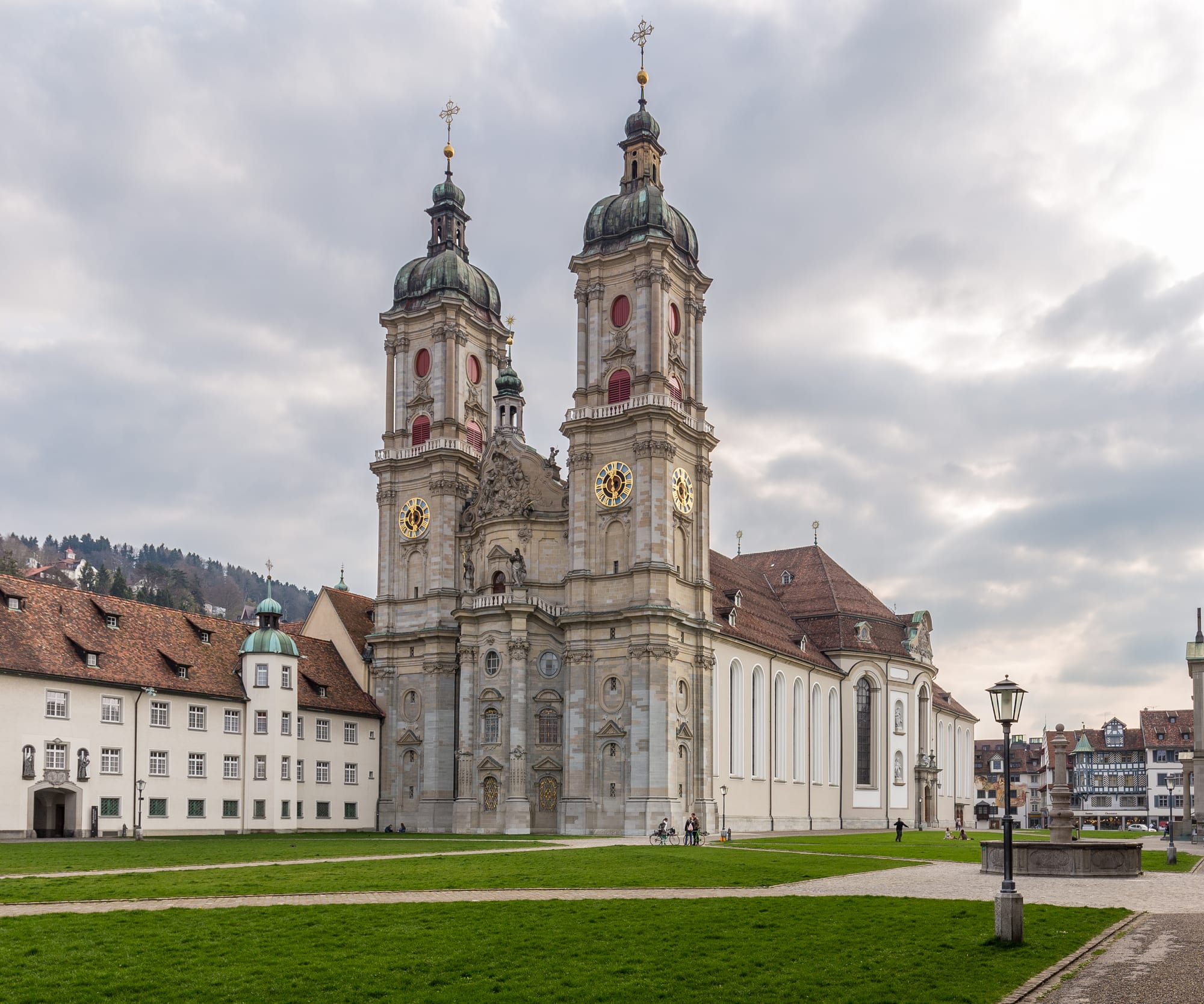
The twin-towered Baroque abbey cathedral of St. Gallen with green domes, beside a white abbey wing and a wide lawn under grey cloud

Zurich, Basel & Northern Switzerland, Switzerland

St. Gallen

The abbey cathedral of St. Gallen and its lawn in the abbey precinct. (JoachimKohler-HB / Wikimedia Commons · CC BY-SA 4.0)

The main city of eastern Switzerland, in a high valley between Lake Constance and the Appenzell Alps. It grew around an abbey founded on the site of the Irish monk Gallus's hermitage, whose library is one of the oldest monastic libraries in the world, became rich on embroidery, and today is a university city of oriel-windowed lanes around a UNESCO-listed abbey precinct.

Neighbourhoods

  • Abbey precinct
    • First-time visitors
    • Historic district

    The former abbey grounds at the southern edge of the old town, a UNESCO World Heritage Site since 1983. The twin-towered cathedral and the abbey library stand around a wide lawn.

    Open in Maps
  • Old Town
    • Historic district
    • Best for food
    • Shopping

    The pedestrian lanes north of the abbey, with more than a hundred oriel windows, some painted and some carved in wood, and streets of shops, cafés and restaurants. The railway station is about 500 metres away.

    Open in Maps
  • Bleicheli and the Stadtlounge
    • Architecture
    • Close to public transport

    A city-centre quarter where the artist Pipilotti Rist and the architect Carlos Martinez designed the Stadtlounge as an open-air living room, its red surface covering the ground, benches, sculptures and a fountain.

    Open in Maps
  • Drei Weieren and the southern hills
    • Walks and viewpoints
    • Swimming

    The hillside above the old town, reached by the Mühleggbahn funicular, with three ponds built in the textile era and Art Nouveau bath houses, used for swimming by day and as a gathering place in the evenings.

    Open in Maps

Things to do

The abbey

  • Abbey of Saint Galllandmark

    The precinct of the monastery founded by Saint Othmar from 719 on the spot of Gallus's hermitage, a UNESCO World Heritage Site since 1983.

    Open in Maps
  • Abbey library of Saint Gallmuseum

    One of the oldest monastic libraries in the world, kept in a Rococo hall built in 1758–1767 to designs by Peter Thumb, with some 2,100 manuscripts from the 8th to the 15th centuries.

    Open in Maps
  • St. Gallen Cathedrallandmark

    The Baroque former abbey church with twin towers, now the cathedral of the Diocese of Saint Gallen.

    Open in Maps

The city

  • Textile Museummuseum

    A museum of historical lace, embroidery and cloth, recalling the industry that made the city rich.

    Open in Maps
  • Stadtloungeattraction

    A pedestrian area in the city centre designed to look like a living room set out in the street.

    Open in Maps
  • Drei Weierenpark

    Three artificial ponds above the city with Art Nouveau bath houses, a summer swimming place reached by the Mühleggbahn.

    Open in Maps
  • Mühleggbahntransit hub

    The funicular from the edge of the old town up the hillside towards Drei Weieren.

    Open in Maps
  • Schützengarten breweryattraction

    The city's own brewery, with a beer bottle museum and a restaurant next door.

    Open in Maps

Short trips from the city

  • Appenzellattraction

    A small town in the Appenzell hills, reached from the city by the narrow-gauge trains of the Appenzell Railways.

    Open in Maps
  • Säntisviewpoint

    The highest mountain of the Alpstein massif at 2,502 metres, reached by aerial tramway from Schwägalp.

    Open in Maps
  • Rorschachattraction

    A small town on the shore of Lake Constance, whose abbots once planned to move the abbey there.

    Open in Maps

Seasonal events

  • OLMAautumn

    The traditional Swiss fair for agriculture and food at the city's exhibition grounds, where the St. Galler Bratwurst is the staple.

  • Open Air St. Gallenfirst weekend of July

    An annual open-air music festival in the Sitter valley on the edge of the city.

Eat and drink

Long-standing places and food districts in St. Gallen. Hours, ratings and directions come from your maps app, always current.

St. Gallen classics

  • Bratwurst standsmarket

    Street stands around the Marktplatz and across the city sell the white veal St. Galler Bratwurst with a hard bread roll.

    Open in Maps
  • Schützengartenrestaurant

    The restaurant beside the city's own brewery, which makes the local beers.

    Open in Maps

Food districts

  • Old town restaurantsneighborhood

    Restaurants, cafés and bars fill the pedestrian lanes of the old town around the Marktplatz.

    Open in Maps

Experience St. Gallen

History

According to legend the Irish missionary Gallus settled as a hermit by the river Steinach in 612, and around 719 Saint Othmar founded a monastery on the spot. The abbey became one of the great centres of learning in early medieval Europe: under Abbot Waldo of Reichenau manuscripts were copied and a famous library gathered, and in the 9th century a larger church was built and the library expanded. Because Gallus chose a boggy valley for solitude rather than a city site, buildings on the valley floor still have to stand on piles.

The town that grew around the abbey fought for its own freedom. Its citizens joined the Swiss Confederation as full members in 1454 and became completely free of the abbot in 1457. After the Reformation the city was Protestant while the abbey remained a Catholic stronghold in its midst until 1803.

St. Gallen became known for fine textiles, and in the 19th century the first embroidery machines were developed here. By 1910 embroidery was Switzerland's largest export, 18 per cent of the country's export value, and more than half of the world's embroidery came from St. Gallen; a fifth of the people of eastern Switzerland worked in textiles. The industry then collapsed and only partly recovered from the 1950s. In 1983 the abbey precinct became a UNESCO World Heritage Site.

Culture & Customs

The abbey shapes the city's identity. Its Rococo library hall, built in 1758–1767, holds 1,650 books printed before 1500 and some 2,100 manuscripts from the 8th to the 15th centuries, including Irish and Carolingian works, and the baroque cathedral beside it is the seat of the Diocese of Saint Gallen.

Textiles remain part of the culture: the Textile Museum shows historical lace and embroidery, and St. Gallen embroidery is still sought by Parisian haute couture designers. The University of St. Gallen, known as HSG, is known for its business school, and its International MBA is recognised as one of Europe's leading programmes. Contemporary design appears too, in the Stadtlounge, a city-centre street laid out as an open-air living room.

The calendar peaks with the OLMA, the national agricultural and food fair each autumn, and the Open Air St. Gallen music festival in the Sitter valley in July. FC St. Gallen plays at the kybunpark, and on summer evenings young people gather at the Drei Weieren ponds above the city.

Daily Life

About 76,000 people lived in the city at the end of 2020, and in 2019 about 31 per cent were foreign nationals. German is the main language, and at the 2000 census Italian and Serbo-Croatian were the next most widely spoken. St. Gallen is the capital of its canton and the main city of eastern Switzerland, lying between Lake Constance and the mountains of the Appenzell Alps.

The economy now rests largely on services and the university, since only a reduced textile industry survived the competition of computer-operated embroidery machines. The station has trains to Zurich every half-hour, making the city well connected for commuters and business.

Daily life runs between the pedestrian old town, the station district and the hills above, where the Drei Weieren ponds are a public swimming place and an evening meeting point. Lake Constance and the Alpstein are close enough for after-work and weekend outings.

Food

The St. Galler Bratwurst is the city's dish. It is a white sausage of veal and pork made with fresh milk, which gives its pale colour, and flavoured with spices such as cardamom, coriander, ginger, nutmeg and lemon. The butchers' guild statutes of 1438 already required it to be made with veal, bacon, spices and fresh milk, and today it is protected by a PGI label. It is also called the Olma Bratwurst, after the autumn fair where it is the staple.

Locals are firm about how it is eaten: in the region it is served with bread only, never with sauce or mustard. Stands around the Marktplatz and across the city sell it with a hard bread roll, and it also appears in sit-down dishes such as rösti with veal sausage and onion sauce.

The city has its own brewery, Schützengarten, whose beers are poured across town and which has a restaurant and a beer bottle museum beside the brewery. The old town lanes hold traditional Swiss restaurants, cafés and bars, and on fine days flea-market stalls appear in the old town streets a short walk from the abbey.

Planning tools

Budget

St. Gallen costs somewhat less than Zurich or Basel, though prices are still high by international standards. The abbey precinct, the old town and the walks above the city are free; the abbey library ticket and trips to the Säntis are the main extras.

Daily Budget Midrange
USD 280–480 (hotel, restaurant dinners, the abbey library and a mountain trip)
Daily Budget Shoestring
USD 110–180 (hostel, bratwurst and supermarket meals, local buses)

Hotels fill and prices rise during the OLMA fair and the Open Air festival, so check the dates before booking.

Best Time to Visit

May to September for the swimming ponds of Drei Weieren, the walks in the hills and trips into the Alpstein; the Open Air festival comes at the start of July and the OLMA fair in autumn. Winters are cold, but the abbey library and museums make it a good place out of season too.

Suggested Number of Days

One or two days are enough for the city itself. Three or four allow time for trips into the mountains and down to the lake as well.

First Visit
1–2 days
With Surroundings
3–4 days

Transportation

The old town is compact and pedestrian, and city buses cover the rest. The Mühleggbahn funicular climbs from the edge of the old town towards Drei Weieren. Regional S-Bahn trains, part of a network that reaches round Lake Constance, link the city with the surrounding towns, and narrow-gauge trains run up into Appenzell.

The St. Gallen S-Bahn connects with the cross-border Bodensee S-Bahn, so trips to the lake and to Austria and Germany are easy without a car.

Airport & Station Connections

St. Gallen station has InterCity trains every half-hour to Zurich Airport and Zurich main station, and EuroCity trains to Munich via Bregenz. Zurich Airport is the usual arrival point. The station is about 500 metres from the old town.

Walkability

The old town and the abbey precinct are compact and easy to walk, and the station is within walking distance. Walks away from the centre soon climb the hillsides; the funicular helps on the southern side.

Safety

Switzerland is very safe, with low crime. The main risks are everyday ones: busy crowds at the OLMA fair and the Open Air festival, and steep, exposed paths for those heading into the nearby Alpstein.

Keep to marked routes in the Alpstein and check mountain weather before setting out. Check current official travel advice before travelling.

Climate

Cool summers and cold winters, with an annual mean temperature of about 9°C. The Föhn wind can raise temperatures by 10°C or more in a few hours.

Summer
mild to warm — July averages about 18°C over day and night
Winter
cold — January averages about 0°C over day and night

Local Customs

By law a service charge is included in the bill, so tips are modest and never required. Swiss German is the everyday speech. The St. Galler Bratwurst is a point of local pride: in the region it is eaten with bread alone, without mustard or sauce.

Keep quiet in the cathedral and the abbey library, and keep noise down in residential streets on Sundays.

Common Payment Methods

The currency is the Swiss franc. Switzerland is more cash-oriented than many European countries, but credit and debit card payments are common and it is easy to go for days without needing cash. Some supermarkets, restaurants, ticket counters and railway ticket machines accept euro notes (but not coins). ATMs accept foreign cards, and money can be exchanged at train stations and most banks.