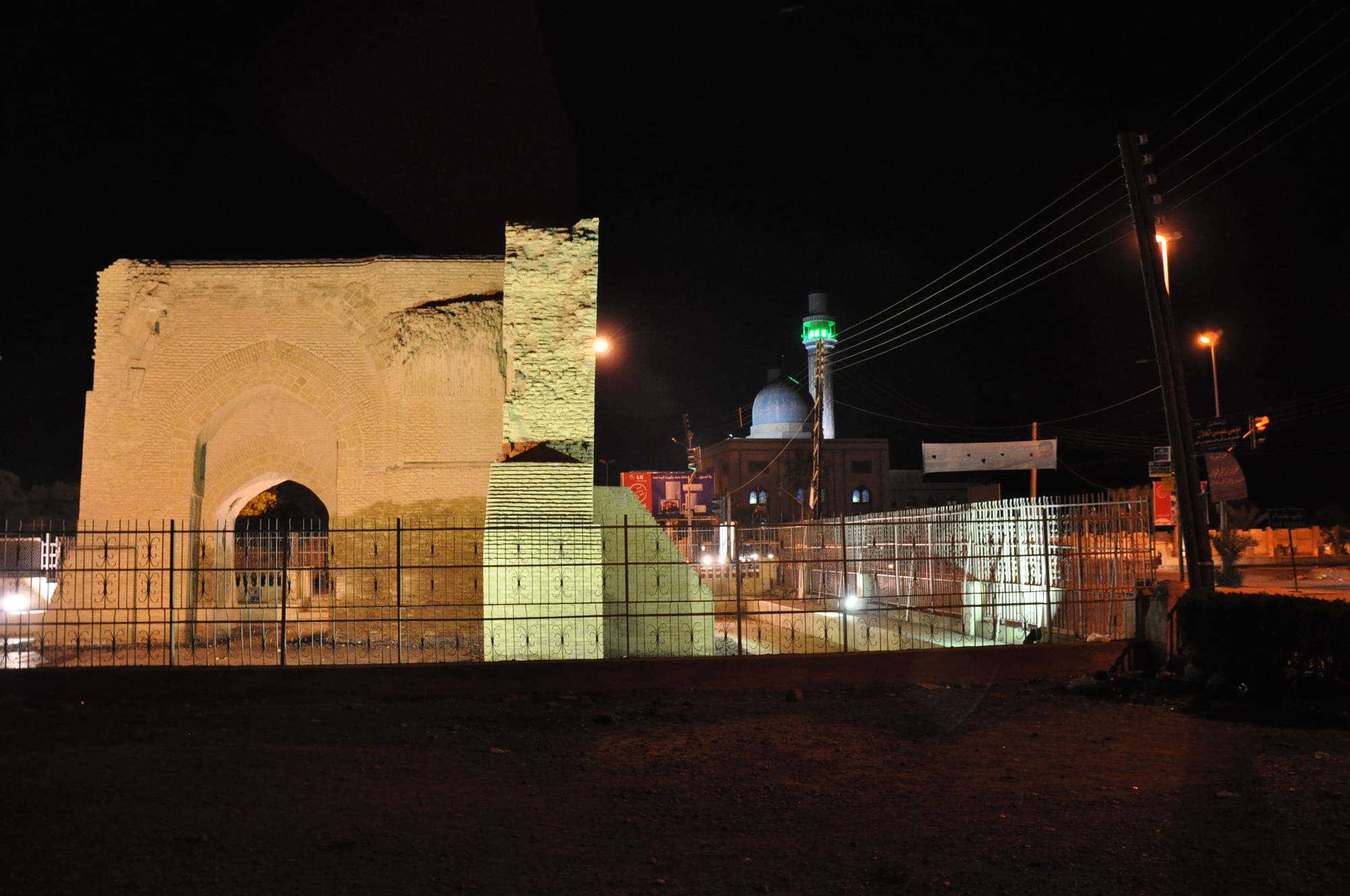
A floodlit brick gateway with a pointed arch behind iron railings at night, a domed mosque and lit minaret beyond

The Euphrates & the Northeast, Syria

Raqqa

The Baghdad Gate in Raqqa, lit at night, with the Awis al-Qarni mosque behind it; the mosque was destroyed during the war. (Lazhar Neftien / Wikimedia Commons · CC BY 2.0)

A city on the north bank of the Euphrates in eastern Syria, below the Tabqa dam and Euphrates Lake. Founded in antiquity and rebuilt by the Abbasids, it was the caliph Harun al-Rashid's imperial residence from 796 to 809, and keeps long stretches of its eighth-century walls and the later brick Baghdad Gate. It was largely destroyed in the war. This page is written to explain the city, not to encourage travel to it.

Neighbourhoods

  • The old walled area
    • Historic district
    • First-time visitors

    The horseshoe-shaped area marked by the line of the Abbasid walls, holding the Baghdad Gate, the remains of the Great Mosque and Qasr al-Banat among later streets and houses. Much of it was damaged in the fighting and building has gone on around the monuments.

    Open in Maps
  • The city centre
    • Markets
    • Close to transport
    • Local life

    The commercial grid north and west of the old walls, with the main market streets, shops, bakeries, bus and taxi stands and government offices. It is where the rebuilt city is most visibly back at work.

    Open in Maps
  • The riverside and the south
    • Riverside
    • Quiet and residential

    The districts running down to the Euphrates and the bridges, with gardens and irrigated farmland along the bank. The river was the city's recreation ground, and the crossings here were fought over and repaired.

    Open in Maps
  • The northern and eastern edges
    • Quiet and residential

    Newer housing spreading towards the Aleppo and Hasakah roads and the fields beyond, built up quickly in the late 20th century as villagers moved into the city. Services here are thin and rebuilding is uneven.

    Open in Maps

Things to do

The old walled city

  • The Abbasid city wallslandmark

    About 2,660 metres of the original 4,580 metres of wall built in the 770s for al-Rafiqa, the garrison city laid out beside older Raqqa on a horseshoe plan, together with the brick Baghdad Gate on the eastern side, a later structure of about the 11th or 12th century.

    Open in Maps
  • Great Mosque of Raqqalandmark

    The ruins of the congregational mosque built in 772, of which a 25-metre baked-brick minaret and a prayer-hall facade of eleven arches, added in a renovation of 1165, still stand.

    Open in Maps
  • Qasr al-Banatlandmark

    The brick ruins of a grand 12th-century residence inside the old city, its name meaning the castle or palace of the ladies.

    Open in Maps

Museums

  • Raqqa Museummuseum

    The provincial archaeological museum, founded in 1981 in an Ottoman government building of 1861 and holding finds from the tells of the Euphrates valley and from Islamic Raqqa. Much of the collection was stolen or destroyed during the war, and the building has been under restoration since 2018.

    Open in Maps

Short trips from the city

  • Tabqa Damlandmark

    The dam on the Euphrates built between 1968 and 1973 with Soviet help, which created Euphrates Lake and was designed to generate hydroelectric power and irrigate land on both banks.

    Open in Maps
  • Euphrates Lakeattraction

    The reservoir held back by the Tabqa dam, filled in 1974 and Syria's largest lake, formerly called Lake Assad, with fishing villages and bare shores along its edges.

    Open in Maps
  • Qal'at Ja'barlandmark

    A castle on a hill that became an island in the reservoir when the valley was flooded, now reached by a causeway, its brick walls and minaret largely the work of Nur ad-Din from 1168.

    Open in Maps
  • Resafalandmark

    A walled desert city south of the river, a place of pilgrimage to Saint Sergius with ruined basilicas and vast underground cisterns.

    Open in Maps

Eat and drink

Long-standing places and food districts in Raqqa. Hours, ratings and directions come from your maps app, always current.

Euphrates classics

  • River fishrestaurant

    Carp and other Euphrates fish are split, salted and grilled over a wood fire, traditionally eaten at simple places near the water rather than in the centre.

    Open in Maps
  • Lamb and rice feastsrestaurant

    The food of hospitality here is mutton or lamb slow-cooked and served on rice or on broth-soaked bread from a shared tray, with bread baked on the wall of a clay tannour oven.

    Open in Maps

Markets and food streets

  • The central market streetsneighborhood

    Grills, falafel and shawarma counters, bakeries and sweet shops sit among sellers of dates, nuts, sheep's cheese and dried yoghurt in the blocks north of the old walls.

    Open in Maps
  • The produce marketmarket

    Vegetables, melons and cucumbers from the irrigated land along the river, wheat and cotton country produce, and desert truffles in spring after good rains.

    Open in Maps

Experience Raqqa

History

There was a city here in antiquity: the Seleucids founded Nikephorion on the north bank of the Euphrates, and it was later known as Kallinikos, a Byzantine frontier town on the road between Syria and Mesopotamia. The Arab conquest brought the name Raqqa, and the settlement kept its position at the point where the Balikh river joins the Euphrates and where routes from Aleppo and the Jazira met the river road to Iraq.

Its great period began in 772, when the Abbasid caliph al-Mansur laid out a new garrison city, al-Rafiqa, beside the old town on a horseshoe plan with brick walls and a monumental gate. Harun al-Rashid made Raqqa his residence for roughly a decade around the turn of the ninth century, building palaces north of the walls, and for those years the city functioned as a capital of the Islamic world. It remained a centre of glass and glazed-pottery making and of Euphrates trade, declining after Mongol raids in the thirteenth century to little more than a village among ruins.

Modern Raqqa grew from the late Ottoman and mandate periods, when tribes were settled along the river and cotton and wheat farming expanded. The Tabqa dam upstream, finished in the 1970s, brought irrigation, electricity and rapid growth, and the city became a provincial capital of some size. In 2013 it passed out of government hands, in 2014 ISIS made it the centre of the territory it held, and the battle that ended that control in 2017 left most of the city destroyed. Rebuilding has gone on since, much of it by residents themselves, and the northeast was brought under the Damascus government during 2026.

Culture & Customs

Raqqa is a city of the Euphrates tribes rather than an old merchant capital, and much of its population moved in from the surrounding villages within living memory. Tribal confederations remain the framework of social life: disputes are often settled by mediation between families, marriages are arranged within known networks, and a guest is the responsibility of his host. The local dialect belongs to the Bedouin-influenced speech of the east and is distinct from that of Damascus or Aleppo.

Hospitality is elaborate and unhurried. Visitors are shown into a reception room, bitter coffee scented with cardamom is poured from a long-spouted pot into small cups, and refusing food is difficult. Weddings fill the streets with drumming, line dancing and convoys of cars, and condolence gatherings after a death draw the whole neighbourhood. Sung poetry in the Bedouin manner is still an admired skill.

Religious life is mainstream Sunni Islam, and the years of ISIS rule, with their imposed restrictions, are remembered with hostility by most residents rather than as part of the city's own tradition. Since 2017 a striking feature of public life has been how much reconstruction, schooling and local organisation has been carried out by residents, civil-society groups and returning families. The river is the other thread of identity: swimming, fishing and picnicking on the banks are what people describe when they talk about ordinary life returning.

Daily Life

Raqqa is the sixth largest city in Syria, with 531,952 residents recorded in the 2021 official census. The city was emptied during the fighting of 2017 and much of the population has since returned to damaged houses or to rebuilt rooms; any current figure is provisional. Almost everyone is Arab, with close ties between city families and villages up and down the river.

The economy is agricultural at its base. The irrigated land along the Euphrates grows wheat, cotton, vegetables and melons, sheep are raised on the steppe, and the city lives on trading and processing that produce, on transport, shops and workshops, and on aid and reconstruction work. Electricity from the Tabqa dam has been intermittent for years, so generators and solar panels are common, and water supply and sanitation have been rebuilt piecemeal.

Days begin early, with markets busiest in the first hours and again at dusk, and slow through the heat of the afternoon. Families gather in courtyards and on roofs after dark. Rubble clearance and the removal of unexploded ordnance, housing and property disputes, schooling for a very young population, the state of the water and power networks, and the fate of people missing or detained are the concerns that dominate conversation.

Food

Cooking here follows the plain, generous pattern of the Syrian east, closer to Iraq and to Bedouin practice than to the kitchens of Aleppo. A feast means mutton or lamb simmered in a large pot and served on rice, or laid over flatbread soaked in broth, eaten with the right hand from a tray set on the floor or a low table, with the guest given the best of the meat. Grilled kebab, kofta and chicken are the everyday restaurant food, with salads of tomato, cucumber and onion and plenty of bread.

Bread is baked on the inner wall of a clay tannour and appears at every meal. Wheat from the surrounding plains becomes burghul and freekeh, green wheat roasted and cracked, cooked with meat or in soup. Dairy comes from sheep and goats: laban, strained labneh, salty cheeses and kishk, dried yoghurt and grain reconstituted as a winter soup. The Euphrates supplies carp and other river fish, grilled slowly over wood by the water.

In spring, after good winter rains, the steppe produces kama, desert truffles that are gathered and sold by the sack and cooked with meat or rice. Melons, tomatoes and cucumbers from the river gardens fill the summer markets, and dates, figs and pistachios are sold alongside simple semolina sweets and pastries. Tea is drunk strong and very sweet throughout the day, while the bitter cardamom coffee of the tribes belongs to formal hospitality.

Planning tools

Budget

Raqqa never had a visitor trade, and the simple hotels that served traders and officials were destroyed or closed. What matters to any budget here is a trusted fixer, a driver and a vehicle, and enough cash brought in from outside, since nothing can be paid for electronically. Figures are indicative only.

Daily Budget Midrange
USD 120–250 (better hotel, fixer, car and driver) — indicative only
Daily Budget Shoestring
USD 30–50 (basic hotel, local food, shared transport) — indicative only

Carry all money as clean US dollar notes and budget generously for a fixer and driver, the one cost that cannot be cut; a redenominated pound with two zeros removed replaced the old notes during 2026.

Best Time to Visit

Historically March to April, when the steppe is briefly green and the heat has not set in, and October to November after summer breaks. Dust storms blow in spring and early summer, and midsummer beside the river is very hot. Security conditions, not the season, decide whether any visit is possible.

Suggested Number of Days

The surviving monuments of the city can be seen in a day. Two or three days make sense only for the sites along the river and in the steppe nearby, which are spread out and slow to reach by road.

First Visit
1 day
With Surroundings
2–3 days

Transportation

Roads run west along the Euphrates towards the Tabqa dam and Aleppo, east and downstream to Deir ez-Zor, and north towards Hasakah. Bridges over the river were destroyed in the war and some crossings remain makeshift, and checkpoints mark every route. Shared taxis and minibuses link the towns, while taxis and motorcycles do the work inside the city.

Move only with a local fixer who knows the current checkpoints and road conditions, and only in daylight.

Airport & Station Connections

Raqqa has no working commercial airport. Qamishli, far to the north-east, had regular flights until late 2024 and officials moved in 2026 to reopen it to civilian traffic, while Aleppo, some 160 km west, has taken flights again since 2025. Everyone arrives by road — from Aleppo along the river and past the Tabqa dam, from Deir ez-Zor downstream, or from Hasakah across the Jazira. Journeys are long and checkpoints add hours.

Walkability

The centre and the area of the old walls are flat and can be walked, and the monuments stand close together inside the horseshoe. Rubble, damaged buildings, building sites and unmarked ground make wandering unwise, and the summer heat rules out walking in the middle of the day. Anything outside the city needs a vehicle.

Safety

Most governments advise against all travel to this part of Syria. Raqqa was held by ISIS from 2014, was retaken in 2017 after a battle that destroyed much of the city, and remains heavily contaminated with mines, booby traps and unexploded ordnance among the ruins. Cells of the former insurgency have continued attacks in the surrounding desert, kidnapping and crime are risks, and consular help is absent.

Do not travel for leisure; anyone who must go should do so only with an experienced local fixer and security advice, keep off unmarked ground, and never touch debris. Check current official travel advice before travelling.

Climate

Desert climate on a river: very hot, dry summers, short cool winters with little rain, and wide swings between day and night. Dust storms are common in spring and early summer, and the lake and river soften the heat only immediately beside the water.

Summer
very hot and dry, often 38–44°C by day, with warm nights
Winter
cool, roughly 3–14°C, with frosty nights and most of the year's rain

Local Customs

Raqqa sits in Arab tribal country, and tribal ties shape hospitality, marriage and the settling of disputes. Visitors are received formally, with bitter cardamom coffee poured in small quantities and a meal pressed on them, eaten from a shared tray with the guest served first. Society is conservative: modest dress covering shoulders and knees is expected, and most women cover their hair.

Ask before photographing people, especially women, and never photograph soldiers, checkpoints, bridges, the dam or damaged areas. Alcohol has no place in public life here; accept at least one cup of coffee when it is offered.

Common Payment Methods

The currency is the Syrian pound, redenominated in 2026 with two zeros removed. Everything is paid in cash, international cards do not work and ATMs cannot be relied on, so visitors bring clean US dollar notes and change them through trusted local channels. Prices and rates shift from week to week.