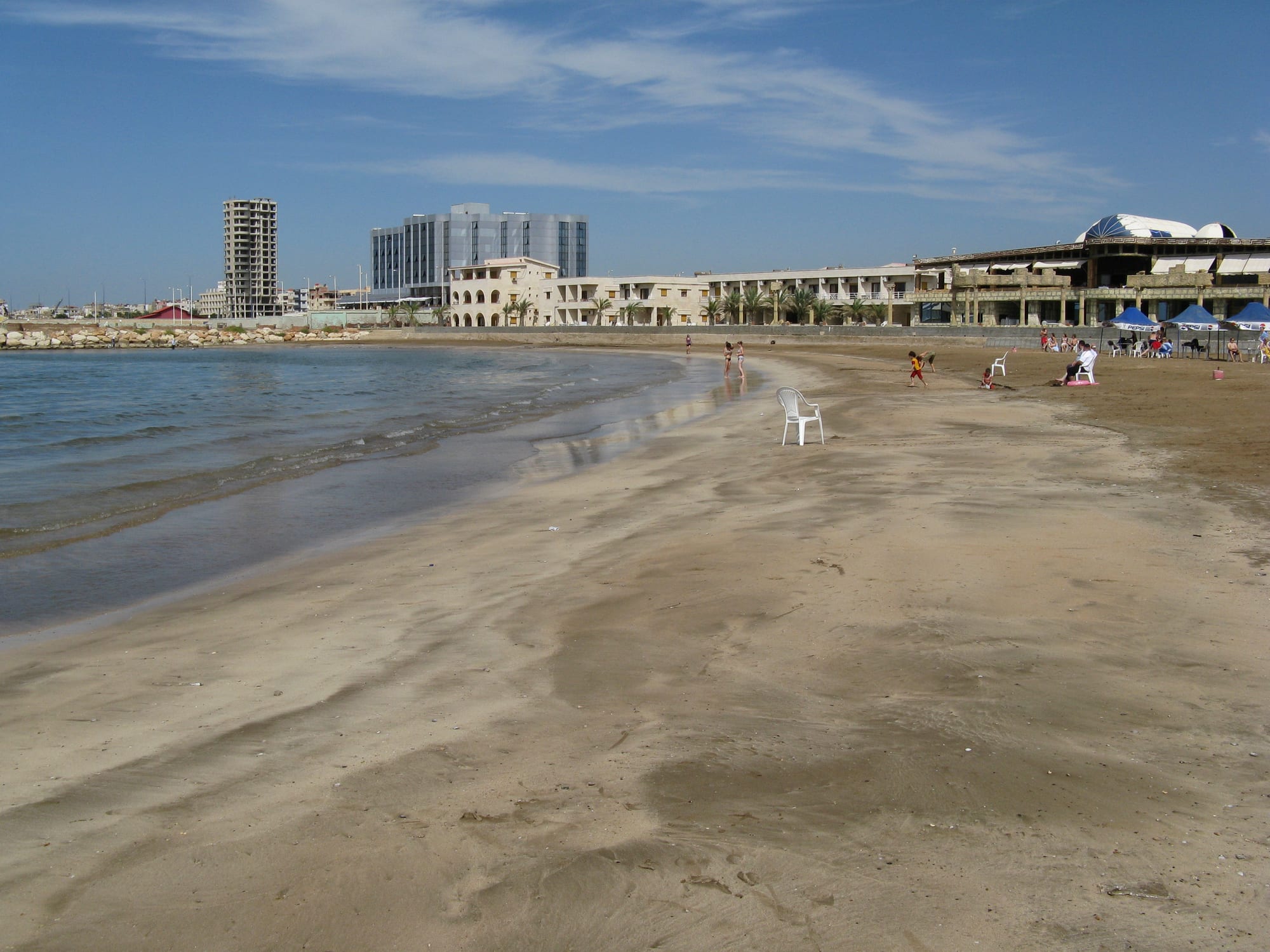
A curving sandy beach at Tartus with shallow blue sea on the left and low seafront buildings and tower blocks along the shore behind

Homs, Hama & the Coast, Syria

Tartus

The beach and seafront of Tartus on the Syrian Mediterranean coast. (Alen Ištoković / Wikimedia Commons · CC BY 3.0)

Syria's second port, on the Mediterranean opposite the small island of Arwad, and the Crusader town of Tortosa before that. A seafront promenade, a medieval quarter built inside the walls of a Crusader cathedral compound and a stretch of beach give it an easier feel than the inland cities. This page is written to explain the city, not to encourage travel.

Neighbourhoods

  • The old town
    • Historic district
    • First-time visitors
    • Walking

    The medieval quarter beside the sea, where houses were built into and around the walls of the Crusader cathedral compound, leaving narrow vaulted lanes and stone arches between ordinary homes. The cathedral itself stands at its centre.

    Open in Maps
  • The corniche and the port
    • Seafront walks
    • Cafés
    • Boats to Arwad

    The seafront road running north from the harbour, lined with cafés, palm trees and benches, busiest in the evening. Fishing boats and the ferry to Arwad leave from the small harbour at its southern end, with the commercial port beyond.

    Open in Maps
  • The beach strip
    • Beaches
    • Families
    • Summer

    Sand and shingle north of the centre, backed by holiday flats and seasonal cafés. Syrian families filled these beaches every summer before 2011, and the shore remains the focus of warm-weather life.

    Open in Maps
  • The modern city
    • Quiet and residential
    • Local life

    Apartment districts spreading inland and along the coast road, with markets, schools and the university campus. Ordinary and residential, and where most of the city's people actually live.

    Open in Maps

Things to do

The old town and the sea

  • Our Lady of Tortosalandmark

    The fortified Crusader cathedral of the 12th century, built over a chapel that pilgrims believed Saint Peter had founded and dedicated to the Virgin, and now the National Museum of Tartus.

    Open in Maps
  • Arwadattraction

    Syria's only inhabited island, about 3 km offshore, a dense huddle of houses, boatyards and fish restaurants reached by ferry from the harbour.

    Open in Maps

Phoenician and Roman remains

  • Amritlandmark

    A Phoenician site about 7 km south with a temple set in a rock-cut pool and two tower tombs known locally as the spindles.

    Open in Maps

Short trips from the city

  • Margatlandmark

    The Hospitaller castle of Marqab, about 35 km north near Baniyas, a spur castle standing on a headland above the sea.

    Open in Maps
  • Krak des Chevalierslandmark

    The Hospitaller castle commanding the Homs Gap about 60 km east, a UNESCO World Heritage Site and one of the best-preserved Crusader fortresses anywhere.

    Open in Maps
  • Safitaattraction

    A hill town about 30 km inland, built around a white Templar keep that still serves as a church.

    Open in Maps
  • Baniyasattraction

    A coastal town about 35 km north with an old quarter and a large oil refinery beside it.

    Open in Maps
  • Citadel of Saladinlandmark

    A castle on a narrow forested ridge inland from Latakia, cut off from the hillside by a deep ditch hewn out of the rock, UNESCO-listed together with Krak des Chevaliers.

    Open in Maps
  • Latakiaattraction

    Syria's principal port city, about 90 km north, with a long corniche, a Roman triumphal arch and the ruins of Ugarit just outside it.

    Open in Maps
  • Homsattraction

    Syria's third city, about 90 km east through the Homs Gap, with the mosque of Khalid ibn al-Walid and an old centre heavily damaged during the war.

    Open in Maps

Seasonal events

  • Beach seasonJune to September

    The coast fills with Syrian families through the summer, and the corniche and the beaches stay busy late into the evening.

  • Ramadan and the Eidsthe lunar month of Ramadan and the two feasts

    Evenings on the seafront fill after the fast is broken, and Eid al-Fitr and Eid al-Adha bring family visiting and sweets.

  • Christmas and EasterDecember and spring

    The city and the surrounding villages have long-established Christian communities, and church feasts are marked publicly in the old town.

Eat and drink

Long-standing places and food districts in Tartus. Hours, ratings and directions come from your maps app, always current.

From the sea

  • Arwad fish restaurantsneighborhood

    The island's harbour front is lined with places serving fried small fish, squid and grilled catch with tahini and lemon.

    Open in Maps
  • Harbour and corniche restaurantsneighborhood

    Seafood, mezze and sayadieh — fish on spiced rice with caramelised onions — served along the seafront in the city itself.

    Open in Maps

Markets and sweets

  • Tartus market streetsmarket

    Citrus fruit, olives, olive oil, vegetables from the coastal plain and spiced dried cheese from the mountains, sold in the shops and stalls of the centre.

    Open in Maps
  • Old town cafésneighborhood

    Coffee, tea and water pipes under the vaults of the medieval quarter and along the seafront, a long-standing habit on this coast.

    Open in Maps

Experience Tartus

History

The coast here was Phoenician long before the town existed: Arwad, the island offshore, was the city-state of Aradus, a sea power that ruled the facing mainland, and Amrit just to the south was its sanctuary and necropolis, with a temple set in a rock-cut pool. The mainland settlement that became Tartus was Antaradus, "opposite Arwad", rebuilt in the fourth century under Roman rule. Christian tradition holds that a chapel to the Virgin was built here very early, and the town grew around that cult.

The Crusaders took the coast at the beginning of the 12th century and called the place Tortosa. The Knights Templar were given the town in 1152, and the 12th-century cathedral of Our Lady of Tortosa, designed to be defensible, stood inside a walled compound with a keep and towers. The town fell to the Mamluks in 1291, and the Templars withdrew to Arwad, holding the island until 1302 — the last Crusader position in the Levant. Afterwards the fortifications were left to the local population, who built houses inside the compound walls, which is why the old town's lanes still run between medieval arches and vaults.

Under the Ottomans Tartus was a modest port in the shadow of Tripoli and Latakia. French rule after the First World War attached the district to the Alawite State that existed from 1920 to 1936, and after independence the town grew quickly: the port was developed into the country's second, an oil pipeline terminal and refinery were built along the coast, and Syrian families made the beaches their summer destination. The coast stayed under government control throughout the war after 2011 and received very large numbers of displaced people from inland. The Assad government fell in December 2024, and a transitional government followed in March 2025.

Culture & Customs

Tartus faces the sea, and that has shaped it. Boat-building on Arwad is a craft passed down in families, with wooden hulls still made by hand on the island's slipways and sold along the coast; fishing supplies the restaurants of the harbour; and the corniche in the evening, full of families, tea sellers and football on the sand, is the centre of social life in a way that has no real equivalent in the inland cities.

The province is mixed. The city has Sunni, Alawite and Christian residents, Christian villages lie in the hills behind it, and the coastal mountains are the Alawite heartland. That mixture, combined with a holiday economy, made the coast the most socially relaxed part of Syria, with mixed beaches, bars and a lighter dress code, and the city's identity has long been tied to being a place other Syrians came to enjoy themselves.

Weddings in the villages bring out the dabke line dance and drumming, and food is the main vehicle of hospitality. Arak is drunk with mezze where alcohol is served. Public space is used late: the promenade fills after sunset in summer, cafés serve coffee and water pipes until late, and the sea is swum in from spring to autumn. Football is followed closely, with local clubs a source of civic pride.

Daily Life

Tartus is a city of some 450,000 people, at the centre of a densely populated coastal province, and its population rose sharply during the war as families displaced from Homs, Aleppo and elsewhere settled here. Housing pressure, rents and crowded schools followed, and many of those families have not returned home.

The port is the city's spine: Syria's second harbour handles containers, bulk cargo and passenger traffic to Arwad, and related trade, customs work and haulage employ a large share of the city. The coastal plain around it grows citrus, olives, tomatoes under plastic and tobacco; the Baniyas refinery lies up the coast; Tartus University draws students from across the province; and fishing and boat-building continue on Arwad. Tourism from within Syria, once a major summer earner, has not recovered.

Days start early with the market and the fishing boats, quieten in the afternoon, and come alive again on the seafront in the evening. Power cuts, fuel prices and the cost of living dominate household planning here as everywhere in the country, and generators and solar panels are common. The economy of the coast, the return of displaced families and relations between communities under the new authorities are the questions people discuss.

Food

Tartus eats from the sea. Fish is grilled or fried whole and served with tahini sauce sharpened with lemon and garlic; sayadieh is fish laid over rice cooked with caramelised onions and spices; and small fish, squid and prawns are floured and fried and eaten with bread and salad in the harbour restaurants and on Arwad. Fish is expensive by local standards, so it is a dish for an occasion as much as an everyday meal.

The coastal plain and the mountains behind supply the rest. Olives and olive oil are pressed locally, citrus groves run along the shore, and figs, pomegranates and honey come down from the hills. Mountain families make shanklish, balls of dried, spiced cheese rolled in thyme and eaten crumbled with tomato and onion, and kishk, yoghurt fermented with bulgur and dried to a powder for winter soups. Mezze is built on hummus, moutabal, muhammara — a paste of red pepper, walnuts and pomegranate molasses — and pickles.

Sweets come from the Orontes tradition shared with Homs and Hama, above all halawet el-jibn, warm sweet cheese dough rolled around clotted cream with syrup and pistachio, alongside baklava and semolina cakes. Coffee is bitter and scented with cardamom, tea is drunk very sweet, and arak, the aniseed spirit distilled from grapes, is the drink served with a table of mezze in a coast where alcohol is openly sold.

Planning tools

Budget

Tartus was a domestic holiday town and remains cheap in dollar terms, with seafront hotels and simple guesthouses. The main costs are a room in summer and a car and driver for the castles inland, since these are hard to reach otherwise. Everything is paid in cash and prices move quickly. Figures are indicative only.

Daily Budget Midrange
USD 90–180 (seaside or city hotel, restaurants, private driver) — indicative only
Daily Budget Shoestring
USD 30–50 (simple hotel, local food, shared taxis) — indicative only

Carry clean US dollar notes, change them through trusted channels, and agree a driver's full-day price in advance.

Best Time to Visit

Historically spring, from March to May, when the coastal hills are green, and October to November, with warm, dry weather; the beaches filled with Syrian families in July and August. Flights have served Damascus and Aleppo again since 2025, but security conditions, not the season, decide whether any visit is possible.

Suggested Number of Days

The old town, the seafront and the island fill a day or two. Using the city as a base for the coastal castles and the mountain villages takes three or four, and checkpoints and road conditions decide journey times more than distance does.

First Visit
1–2 days
With Surroundings
3–4 days

Transportation

The coast road links Tartus with Baniyas and Latakia to the north and the Lebanese border to the south, and a road east through the Homs Gap reaches Homs and the M5 highway. Buses and shared taxis run on these routes, while Krak des Chevaliers, Margat and the mountain villages need a private car. Small boats cross to Arwad from the harbour. Checkpoints, fuel shortages and damaged roads slow every journey.

Keep to main roads in daylight with a local driver, and agree the route and the price before setting out.

Airport & Station Connections

There is no passenger airport. Most arrivals come by road: Homs is about 90 km east through the Homs Gap, Latakia about 90 km north along the coast, and Damascus roughly 250 km south-east. The airports at Damascus and Aleppo have handled flights again since 2025, and the Lebanese border lies a short distance to the south.

Walkability

The centre is flat, compact and made for walking: the old town, the harbour and the corniche are within a kilometre of each other, and the seafront gives a continuous route of a few kilometres. Lanes in the medieval quarter are narrow and uneven, traffic is heavy on the main roads, and the outer districts are spread out enough to need a taxi.

Safety

Most governments advise against all or all-but-essential travel to Syria. The coast and its mountains have suffered outbreaks of sectarian violence since the transition, with clashes continuing in the wider region, and crime and kidnapping are further risks. Consular help is minimal or absent, and the port and its approaches are sensitive.

Do not travel for leisure; anyone who must go should use an experienced local fixer, keep out of the desert and away from ruined areas, and never touch debris. Check current official travel advice before travelling.

Climate

A Mediterranean climate: hot, humid summers with almost no rain, and mild, wet winters, with most of the year's rain between November and March. The coastal mountains behind the city catch heavier rain and some snow.

Summer
hot and humid, around 30°C by day in July and August, with warm nights and sea breezes
Winter
mild and wet, with days around 15°C and heavy rain at times

Local Customs

The coast is the most socially relaxed part of Syria, with mixed beaches, café life and long-established Christian as well as Muslim and Alawite communities, so dress is less strict here than inland — though modest clothing away from the beach is still the norm. Greetings are warm and hospitality is pressed on guests, and alcohol is sold openly in many restaurants and shops.

Ask before photographing people, and do not photograph the port, naval facilities, soldiers or checkpoints.

Common Payment Methods

The currency is the Syrian pound, redenominated during 2026 with two zeros removed, but the economy runs on cash and US dollars are used for hotels and drivers. Foreign cards and cash machines cannot be relied on, so money is brought in as clean dollar notes and changed through trusted channels.