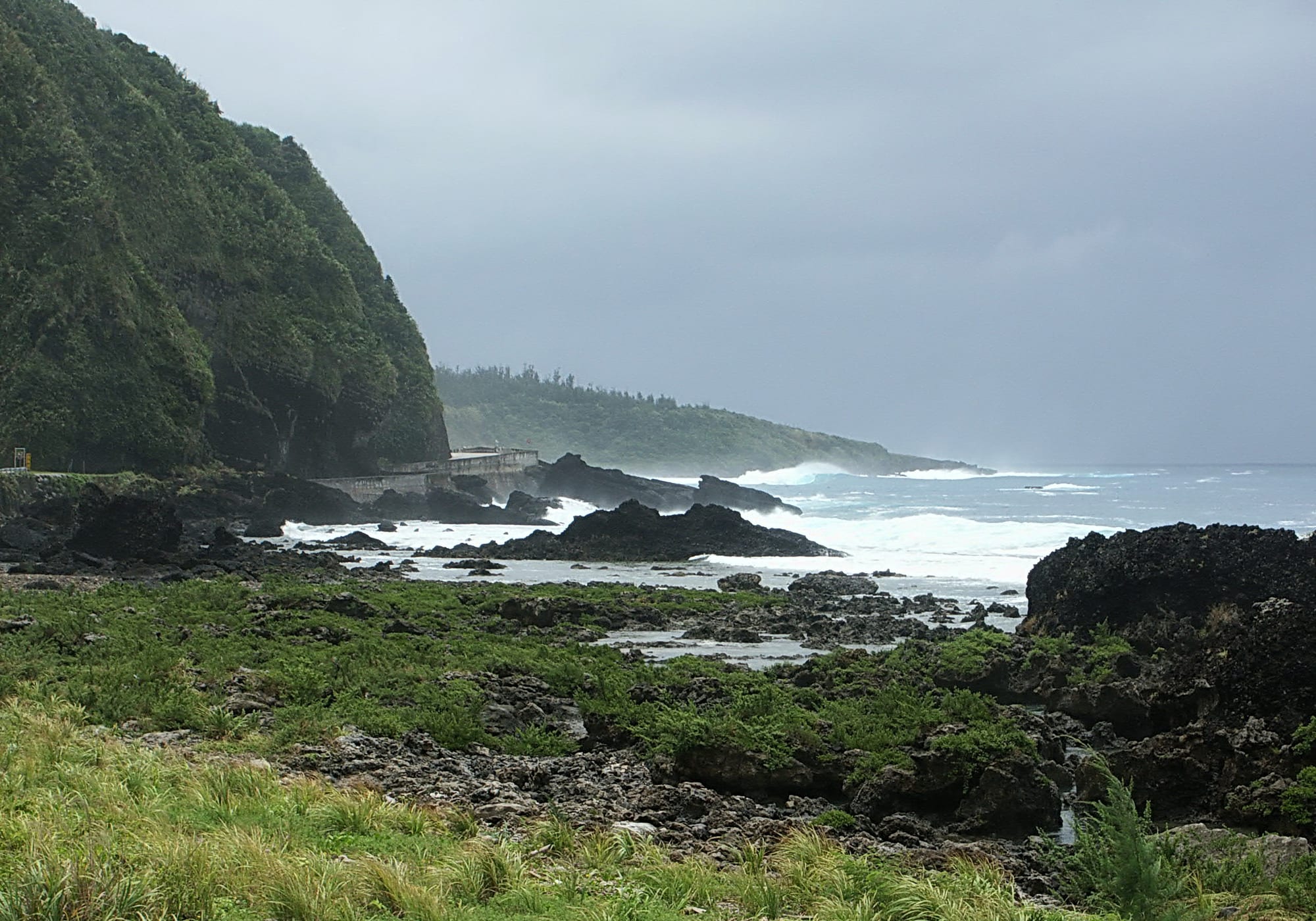
Dark volcanic rock and green coastal scrub below a steep wooded headland, with white surf breaking along the shore

Hualien, Taitung & the East Coast, Taiwan

Green Island

A rocky stretch of Green Island's coast, with the island road running below the headland. (lienyuan lee / Wikimedia Commons · CC BY 3.0)

A small volcanic island in the Pacific off Taitung, about 33 kilometres from the Taiwanese coast, ringed by a single road and fringed with coral. Once known as Burnt Island and settled by fishermen, it became a place of political imprisonment during the martial-law decades; today its prison sites are a memorial park, and the island lives on diving, snorkelling and a rare seawater hot spring.

Neighbourhoods

  • Nanliao
    • First-time visitors
    • Close to the ferry
    • Best for food

    The island's main village, built around the harbour where the ferries dock. Scooter hire, dive shops, guesthouses, the township office and most of the restaurants are here, and it is the only place that feels like a small town.

    Open in Maps
  • Zhongliao
    • Quiet and residential
    • Local life

    A village on the north coast between the harbour and the airstrip, with older houses, a temple and fields behind it. It is quieter than Nanliao and close to the northern snorkelling spots.

    Open in Maps
  • Gongguan
    • Snorkelling
    • Coastal scenery

    The settlement on the north-eastern shore, near the sea caves and the coral shallows that draw most snorkelling trips. A few homestays and cafés sit along the road above the rocks.

    Open in Maps
  • The south-east coast
    • Hot springs
    • Walks and viewpoints
    • Sunrises

    The thinly settled side of the island, where the road runs past the lighthouse road end, the memorial park, grassland grazed by deer and the seawater hot spring at the southern tip.

    Open in Maps

Things to do

Coast and sea

  • Zhaori Hot Springattraction

    One of only a few saltwater hot springs in the world, on the southern shore, where volcanic heat feeds stone pools built at the tide line.

    Open in Maps
  • Green Island Lighthouselandmark

    A white tower on the north-western point, built after the liner President Hoover ran aground off the island in 1937.

    Open in Maps
  • Dabaisha Beachbeach

    A white coral-sand beach on the southern coast, near the hot spring, and one of the island's main snorkelling and swimming spots.

    Open in Maps

History

  • Green Island White Terror Memorial Parkmuseum

    The preserved prison compounds where thousands of political prisoners were held under martial law, now a national human rights site with exhibitions and a wall of names.

    Open in Maps

Walks and viewpoints

  • Niutou Hillviewpoint

    A grassy headland on the north-eastern coast, grazed by deer and goats, with a path to a wide view over the reef.

    Open in Maps
  • Green Island Airporttransit hub

    The island's single airstrip beside the north coast, used by small aircraft on the short hop from Taitung.

    Open in Maps

Seasonal events

  • Diving and snorkelling seasonApril to October

    The calmest months, when the water is warmest and boats and visibility are most reliable; winter swell closes much of the coast.

  • Summer holidaysJuly and August

    The island's busiest weeks, when ferries, guesthouses and scooter hire are heavily booked and the harbour village is full.

Eat and drink

Long-standing places and food districts in Green Island. Hours, ratings and directions come from your maps app, always current.

Island food

  • Seafood and reef fishrestaurant

    Restaurants around the harbour cook whatever the boats bring in, along with squid, shellfish and, in season, flying fish.

    Open in Maps
  • Seaweed and sea-salt snacksmarket

    Shops in the main village sell dried seaweed, sea-salt ice cream and peanut and seaweed crackers, the island's standard souvenirs.

    Open in Maps
  • Nanliao village eateriesneighborhood

    Rice and noodle shops, breakfast stalls, cafés and barbecue counters cluster along the few streets behind the harbour, and are the practical option for most meals.

    Open in Maps
  • Venisonrestaurant

    Sika deer have been farmed on the island since the twentieth century, and deer dishes appear on menus alongside the seafood.

    Open in Maps

Experience Green Island

History

Green Island is the eroded remains of an andesite volcano, lifted and fringed with coral. Amis people from the Taitung coast are recorded as its earliest inhabitants, and Austronesian communities on the mainland and on Orchid Island knew and used it. Han fishermen and farmers settled from the nineteenth century — a British survey ship found about a hundred and fifty Chinese residents in 1845 — and the island was then called Huoshaodao, Burnt Island, a name usually explained by the fires lit to guide boats home or by the look of the hills at sunset.

Life was hard and isolated: thin soil, a difficult anchorage and a crossing that could be shut for weeks. Under Japanese rule the island was administered from Taitung, the lighthouse was built in 1939 after the American liner President Hoover struck the reef in 1937, and islanders continued to fish and to raise a little livestock. The name was changed to Lüdao, Green Island, in 1949.

From 1951 the island became a place of imprisonment. A prison camp built that year held thousands of political prisoners during the White Terror, the decades of martial law under which dissidents, suspected communists and intellectuals were detained; a later compound, known as the Oasis Villa, held prisoners including the writer Bo Yang and figures from the democracy movement. Martial law was lifted in 1987, the site opened as a human rights park in 2001, and in 2018 it was renamed the Green Island White Terror Memorial Park under the National Human Rights Museum. Tourism, diving and the hot spring have since become the island's economy.

Culture & Customs

The island's culture is that of a small Hokkien-speaking fishing community, closely related to the settlements of south-western Taiwan its founders came from. Temples to Mazu and to the Earth God anchor the villages, family names repeat through the population, and almost everyone is connected to the sea by work or by kin. Deer farming, introduced in the twentieth century, left herds of sika deer that are now a familiar sight on the grassland in the south-east.

The prison history sits alongside this and is not treated lightly. For many Taiwanese families the memorial park is where a relative was held, and the site is visited as much for remembrance as for sightseeing; former prisoners return, and oral-history and art projects continue there. The island's role in the national memory is disproportionate to its size, and residents are used to visitors arriving for two different reasons on the same boat.

Day-to-day manners are Taiwanese and informal. People are direct and used to strangers, guesthouse owners double as guides and scooter agents, and the whole island knows who came in on which ferry. Conservation rules are taken seriously, because the reef is both the attraction and the livelihood: taking coral or shells, feeding fish and anchoring on reef are all discouraged or prohibited. Night-time noise in the villages is a recurring local complaint about summer crowds.

Daily Life

About 3,000 people are registered as living on Green Island, spread between Nanliao, Zhongliao and Gongguan, though the number actually present varies with the season and with how many have moved to Taitung or Taipei for work. In July and August visitors can outnumber residents several times over; in winter the island empties and many businesses close.

Tourism is now the main employer — guesthouses, dive shops, scooter hire, boats and restaurants — with fishing, some farming and deer rearing alongside it, and public sector jobs at the township office, the school, the clinic and the prison facilities that remain on the island. Almost all food, fuel and building material arrives by ferry, which is why prices are higher than on the mainland and why a week of bad weather is felt immediately.

The rhythm follows the boats and the wind. Mornings begin early with dive groups and fishing, afternoons are hot and slow, and evenings gather at the harbour and in the hot-spring pools, which are at their best before dawn. Water supply, waste disposal and the pressure of summer visitors on a fragile reef are the standing local issues, along with the reliability of transport to Taitung for medical care, schooling and supplies.

Food

Eating on Green Island means seafood first. Restaurants around the harbour work with what comes in that day: reef and deep-water fish steamed or fried, squid, shellfish, sea urchin in season, and flying fish, which run in the spring and are dried on racks as they are throughout these waters. Sashimi is usual, and simple preparations — steamed fish with ginger and spring onion, fried squid, seafood noodles — are the norm rather than elaborate cooking.

The island's own products are few but distinctive. Seaweed gathered from the rocks appears in soups, omelettes and crackers; sea salt is used in snacks and, in a recent local speciality, in ice cream. Sika deer farmed on the island put venison on some menus, a rarity in Taiwan. Peanut and sesame sweets, dried fish and seaweed crackers fill the souvenir shops in Nanliao.

Everything else is Taiwanese and imported. Breakfast shops sell egg pancakes, soy milk and rice rolls; the village has beef noodle and braised pork rice counters, barbecue stalls that open in the evening and a handful of cafés serving iced coffee and fruit drinks to divers coming out of the water. Ingredients arrive by ferry, so menus shrink when the sea is rough, and many guesthouses cook for their guests as a matter of course.

Planning tools

Budget

Costs on the island are higher than on the Taiwanese mainland, because almost everything is shipped in. The ferry or flight, a hired scooter and a homestay bed are the fixed items, and diving or a night snorkelling trip is the main extra. Prices and availability tighten sharply in July and August and at weekends.

Daily Budget Midrange
USD 95–190 (better guesthouse or small hotel, seafood dinners, a scooter, a guided dive or boat trip)
Daily Budget Shoestring
USD 45–70 (homestay bed, village eateries, a shared scooter, snorkelling with hired gear)

Book the boat and a bed together for summer weekends, and carry enough cash for the whole stay.

Best Time to Visit

April to October, when the sea is calm enough for boats to run reliably and the water is warm and clear for snorkelling and diving. Summer is the busiest and hottest time, with typhoon risk. From November to March the north-east monsoon brings strong wind and swell, ferries are cancelled often and much of the coast is unusable.

Suggested Number of Days

Most visits run to two days and a night; the road around the island is short enough to ride in an hour. Divers and anyone travelling outside summer should allow longer, because cancelled boats are common.

First Visit
2 days
With Surroundings
3 days

Transportation

There is one road running right around the island, and a hired scooter or electric bicycle is how nearly everyone gets about; guesthouses arrange them at the harbour. There is no public bus network. Walking works within a village, and the coast road can be cycled by anyone comfortable with the hills on the eastern side.

A licence recognised in Taiwan is needed for a petrol scooter; helmets are compulsory, and the road is narrow with blind bends.

Airport & Station Connections

Ferries take about an hour from Fugang harbour near Taitung and are frequently cancelled in rough weather; the crossing is notoriously uncomfortable. Small aircraft make the short hop from Taitung Airport, with limited seats. Everything therefore depends on the sea and the wind.

Walkability

Nanliao village is small enough to cross on foot in minutes, and the memorial park, the hot spring and the beaches each work well on foot once reached. The distances between them, however, are several kilometres along a road with no pavement, so the island as a whole is not walkable without a scooter or bicycle.

Safety

Crime is very low. The hazards are the sea and the road: strong currents and surge around the reef, sharp coral, sunburn, and scooter accidents on a narrow coast road ridden by inexperienced visitors. Typhoons and winter swell can strand people on the island for days when boats stop.

Snorkel with a lifejacket and within marked areas, wear a helmet and shoes on a scooter, and allow spare time in case the boats are cancelled. Check current official travel advice before travelling.

Climate

Tropical maritime, warm all year and always humid. The summer half is hot and calm, with typhoons possible from July to September; the winter half is mild but relentlessly windy under the north-east monsoon, which raises the swell that closes the crossing.

Summer
hot and humid, about 27–32°C, with calm seas between typhoons
Winter
mild but very windy, about 18–23°C, with rough seas

Local Customs

Tipping is not expected. The island is a small community where families run the guesthouses, boats and shops, and visitors are asked to keep noise down late at night in the villages. The memorial park is a place of mourning for many Taiwanese families: visitors are expected to be quiet and to treat the cells and the wall of names accordingly.

Do not touch, stand on or take coral or shells, take all rubbish back to the mainland, and ask before photographing residents.

Common Payment Methods

The currency is the New Taiwan dollar. Cash is the norm for guesthouses, scooter hire, boat tickets and small restaurants, and card acceptance is patchy. There are only a few cash machines on the island and they can run out, so most people draw money in Taitung before crossing.