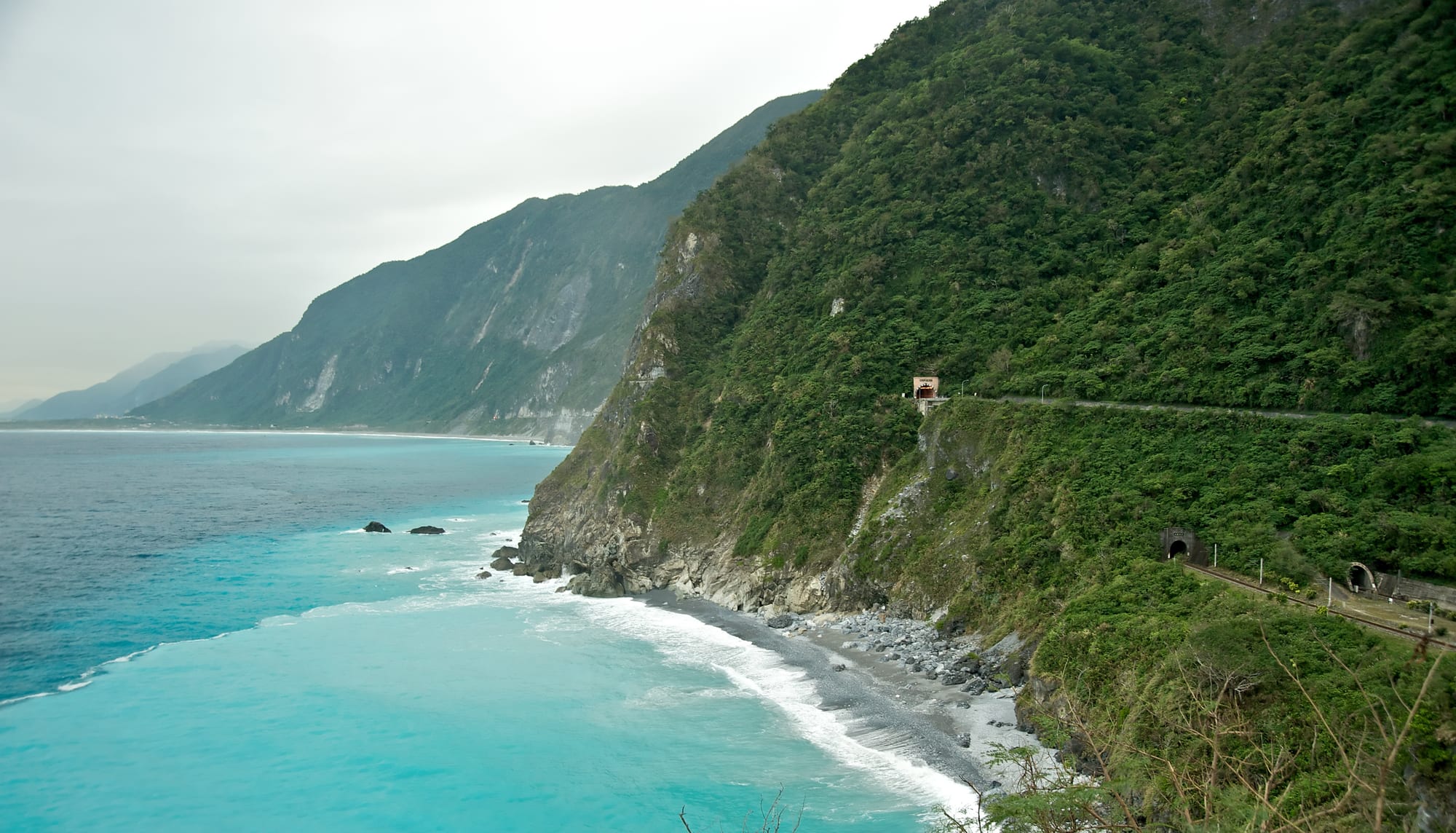
Forested mountains dropping steeply into a turquoise sea, with a road and railway tunnels cut into the cliff

Taiwan

Hualien, Taitung & the East Coast

The Qingshui Cliffs on the coast of northern Hualien, where the Suhua Highway runs above the Pacific. (Fred Hsu / Wikimedia Commons · CC BY-SA 3.0)

Taiwan's thinly populated Pacific side, the counties of Hualien and Taitung, where the Central Mountain Range drops to the sea and a long rift valley runs between it and the Coastal Range — the island's most Indigenous region, a land of marble gorges, rice fields, hot springs and offshore islands.

Explore Hualien, Taitung & the East Coast

History

The east was for centuries the country of Indigenous peoples — the Amis along the coast and valley, the Truku and Sediq in the gorges north of Hualien, the Puyuma and Bunun around Taitung, and the Kavalan, some of whom moved south from Yilan in the 19th century. Mountains cut the region off from Han settlement, and the Qing began to govern it seriously only from the 1870s, after the Japanese expedition of 1874 exposed the gap.

Japan's colonial government, from 1895, pushed roads and railways into the east, fought the Truku in the war of 1914 and brought in Japanese settlers to farming villages near Hualien. Rice and sugar spread through the valley, and Hualien harbour was developed.

After 1945 new migrants arrived: Hakka and Hokkien from the west, and veterans who built the Central Cross-Island Highway through Taroko in the late 1950s. Green Island became notorious as a prison for political detainees during the martial-law era; its prison is now a memorial park. The completion of the round-island railway in 1991 and the improved Suhua road in 2020 have linked the region more closely to the rest of Taiwan, and major earthquakes, most recently in 2024, remain a defining feature of life in Hualien.

Culture & Customs

The east has the highest share of Indigenous people in Taiwan. The Amis, the largest group, hold their Ilisin harvest festivals across the region from July to September, with communal dancing. The Truku, recognised separately in 2004, keep weaving and hunting traditions in villages around Taroko, and the Puyuma of Taitung are known for their year-end rituals. Orchid Island, off the Taitung coast, is home to the Tao people and their plank-built canoes.

Hokkien, Hakka and Mandarin speakers settled later, and many towns mix all of them. Hualien is also the base of Tzu Chi, the Buddhist charity founded there in 1966 by the nun Cheng Yen, which runs hospitals and a university in the city.

Life here has a reputation for being slower and more outdoor, and a small community of artists, surfers and returning young people has grown in coastal villages. Indigenous pop singers from Taitung have been prominent in Taiwan's music industry, and live music is common at local festivals.

Daily Life

Hualien County has about 320,000 people and Taitung County about 210,000, making the two among the least populated parts of Taiwan; Hualien city and Taitung city each have around 100,000. Villages are small and spread thinly along the valley and coast.

The economy rests on tourism, farming and public services. The valley grows rice — Chishang and Guanshan are famous for it — along with tea, pomelos and custard apples; cement quarrying around Hualien bring jobs and controversy over mining near Taroko. Many young people leave for work in Taipei and Kaohsiung, and the east's population is falling.

Days follow the weather and the train timetable. After typhoons and earthquakes, road closures shape travel plans, and the 2024 earthquake hit Hualien's tourist trade hard. Recovery and safer building have been the main concerns since.

Food

Indigenous food marks the east. Amis cooks use wild vegetables, betel-palm hearts and river fish, and a traditional technique cooks fish and seafood by dropping fire-heated stones into the vessel. Home-brewed millet and rice wine is also part of Amis food culture.

Hualien is known for its bianshi wontons, its mochi, sold as souvenirs, and seafood from the coast. Taitung's signature fruit is the custard apple, shijia, grown around Beinan, and the valley's rice is eaten in Chishang's famous lunchboxes, biandang, packed in thin wooden boxes. Luye's hills grow oolong tea, including a red oolong, and the valley supplies pomelos and daylily buds, jinzhen, used in soups.

Attractions & Natural Wonders

Taroko Gorge is the region's highlight: a marble canyon of the Liwu River with the Eternal Spring Shrine, the Swallow Grotto, the Tunnel of Nine Turns and the Shakadang trail. Many sections were damaged in the April 2024 earthquake and are reopening in stages. North of the gorge, the Qingshui Cliffs rise from the sea. Hualien city has Qixingtan pebble beach, the Dongdamen night market, whale-watching boats and the Pine Garden.

The East Rift Valley runs between Hualien and Taitung, with rafting on the Xiuguluan River from Ruisui, hot springs at Ruisui and Antong, the daylily hills of Liushidan, the rice fields and cycle paths of Chishang, and the Luye plateau of the balloon festival.

On the coast road, Shitiping has terraced rocks, and Sanxiantai's arched bridge leads to a rocky islet near Chenggong. Around Taitung city, the Zhiben hot springs lie in a forested valley. Off the coast lie Green Island, with the Zhaori seawater hot spring, coral reefs and the Human Rights Culture Park, and Orchid Island, home of the Tao.

Cities in Hualien, Taitung & the East Coast

Planning basics

Budget

The east is cheaper than Taipei for food, but accommodation is limited and fills quickly on weekends and holidays, particularly in Hualien city and on Green Island in summer. Homestays are the usual lodging outside the two county towns. Getting around without a car or scooter is the hidden cost, as buses are infrequent.

Daily Budget Midrange
USD 95–190 (hotel or hot-spring resort, restaurant meals, car hire or tours, a boat to Green Island)
Daily Budget Shoestring
USD 40–60 (hostel or homestay, local eateries, trains and a hired scooter)

Book east-coast trains and Green Island boats early for weekends and summer, and hire a scooter or car to explore the valley and coast.

Safety

Crime is low, but natural hazards are higher than elsewhere in Taiwan. Hualien sits on an active fault zone and suffered a strong earthquake in April 2024 that closed large parts of Taroko Gorge. Rockfall, landslides and typhoons can close roads, and the coast has strong currents.

Obey closures in Taroko, avoid swimming in the open sea, and carry water on long rides. Check current official travel advice before travelling.

Climate

Warmer and wetter than the west at similar latitudes, and more exposed to typhoons coming in from the Pacific, which usually strike here first. Hualien is subtropical and rainy in winter under the north-east monsoon; Taitung is more tropical and drier. The high mountains above Taroko are cold and can see snow in winter.

Summer
hot and humid, 28–33°C, with typhoons from July to September
Winter
mild, 16–24°C; wetter in Hualien, sunnier in Taitung

Transportation

Express trains run from Taipei to Hualien in about two to two and a half hours and continue down the valley to Taitung, which is also reached by the South-Link line from Kaohsiung. Both counties have small airports. Buses serve the coast road and the valley, but only a few times a day, so most visitors hire a scooter or car. Boats to Green Island leave from Fugang harbour near Taitung.

Train tickets on the Taipei–Hualien route sell out quickly; book as early as possible and check Taroko's road and trail status before going.

Best Time to Visit

October to December and March to May bring the steadiest weather. The Taiwan International Balloon Festival at Luye runs in summer, the Amis harvest festivals are held from July to September, and the orange daylily fields on the hills above the valley bloom in August and September. Typhoons can close roads and trails, and Green Island's boats run most reliably in summer.