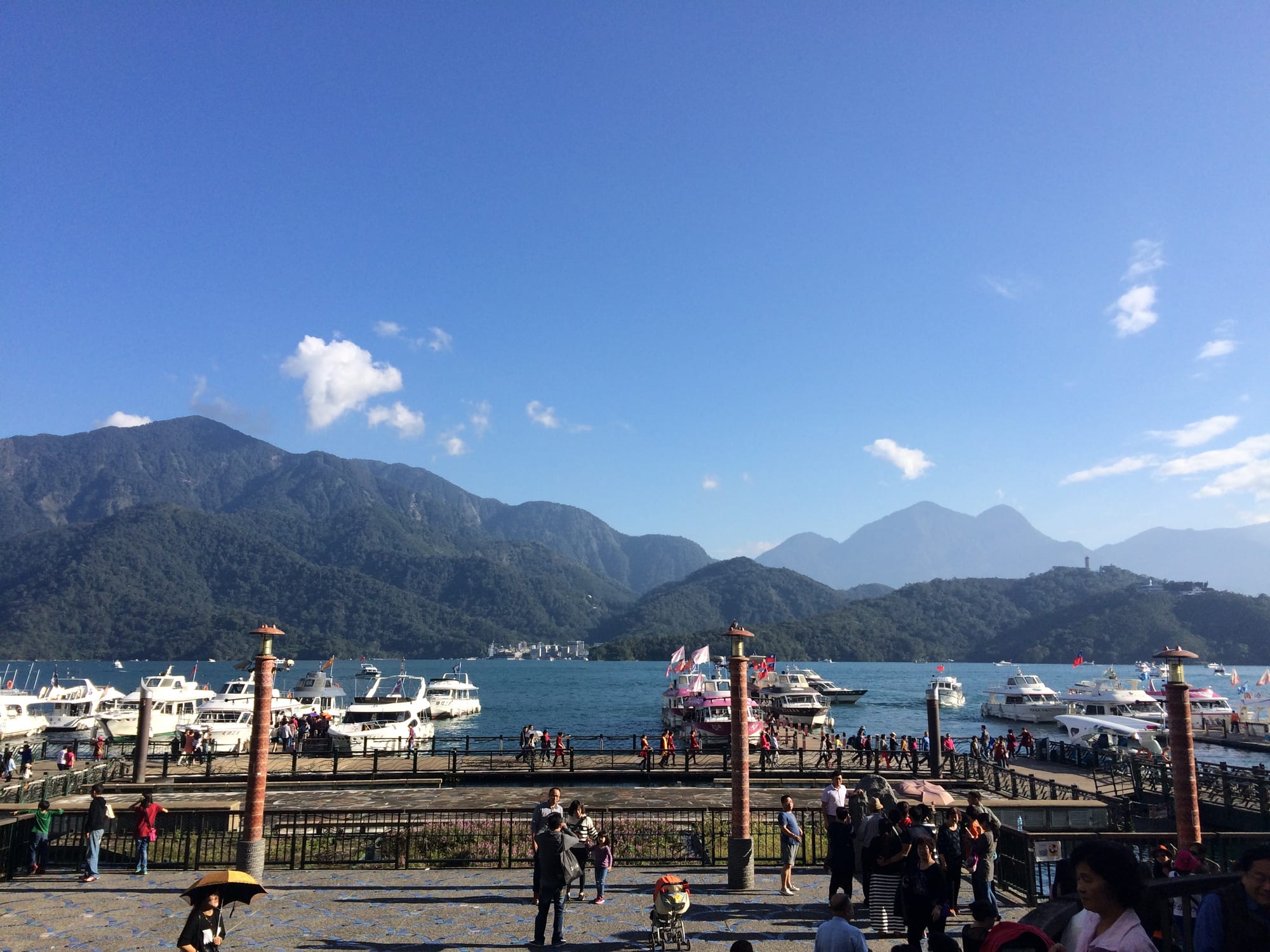
Tour boats moored at a lakeside pier, with blue water and forested mountains under a clear sky

Taiwan

Taichung & Central Taiwan

Shuishe Pier on Sun Moon Lake, the boat hub of the lake in Nantou County. (LowensteinYang / Wikimedia Commons · CC BY-SA 4.0)

The middle of Taiwan's west side, running from the Hakka hills of Miaoli through the city of Taichung and the farming plains of Changhua and Yunlin to Nantou, the island's only landlocked county — a region of machinery workshops, Mazu pilgrimages, the old port of Lukang, and tea gardens and lakes in the central mountains.

Explore Taichung & Central Taiwan

History

The central plains were home to the Babuza, Papora and other lowland Austronesian peoples, while the Thao lived around Sun Moon Lake and the Bunun and Atayal in the mountains. Han settlers from Fujian and Guangdong spread across the Changhua plain in the 18th century, and Lukang, facing the Fujian coast, became the chief port of central Taiwan — the "second" city in a well-known saying ranking Tainan, Lukang and Taipei's Mengjia. Silting of its harbour in the 19th century ended that trade.

Changhua was a Qing county seat and the scene of repeated uprisings, including the Lin Shuangwen rebellion of the 1780s. Liu Mingchuan planned a provincial capital at what became Taichung, but the seat moved to Taipei. Under Japanese rule the city was laid out on a grid with canals and a railway station, and the Japanese raised the level of Sun Moon Lake for a hydro-electric scheme.

From the late 1950s the Taiwan Provincial Government was based at Zhongxing New Village in Nantou. The Jiji earthquake of 21 September 1999, centred in Nantou, killed about 2,400 people and destroyed whole villages, and it remains the region's defining modern disaster. Since then Taichung has grown into Taiwan's second-largest city and a centre of precision industry.

Culture & Customs

Central Taiwan is Hokkien-speaking on the plains and Hakka-speaking in much of Miaoli, while the mountains of Nantou are home to Bunun, Atayal, Seediq and Thao communities; the Thao, among the smallest recognised Indigenous peoples, keep their village at Ita Thao on Sun Moon Lake.

Mazu worship is especially strong here. The Dajia Mazu pilgrimage, starting from Jenn Lann Temple in Taichung's Dajia district each spring, carries the goddess on a procession of about nine days through Changhua and Yunlin to Xingang in Chiayi and back, followed on foot by huge crowds, and Beigang's Chaotian Temple in Yunlin draws pilgrims all year. Yunlin is also a centre of budaixi, glove-puppet theatre, which grew into a television genre in Taiwan.

Craft towns keep older skills: Sanyi in Miaoli is known for wood carving and Puli for handmade paper. Lukang's lanes and temples make it the region's showpiece of Qing-era architecture, and its Dragon Boat Festival is one of the liveliest in the west.

Daily Life

Taichung has about 2.8 million people and is the region's economic engine, known for machine tools, precision components and bicycles — Giant is based in the city — along with chip plants in the Central Taiwan Science Park. It is a roomier, sunnier and more car-and-scooter-dependent city than Taipei, with a younger reputation and a lively café and dessert culture.

Changhua, with about 1.2 million people, and Yunlin, with under 700,000, are among Taiwan's great farm counties, growing rice, vegetables, flowers and fruit. Yunlin's coast is dominated by the Mailiao petrochemical complex, which brings jobs and recurring arguments over pollution. Nantou, with about 480,000, lives from tea, betel nut, flowers and tourism; Miaoli mixes Hakka farming towns with light industry.

Rural areas are ageing as young people move to Taichung or north to Taipei and Hsinchu, and many small towns run on temple festivals, morning markets and family farms.

Food

Taichung is best known for sweets. Taiyang bing, "sun cakes", are flaky round pastries filled with malt sugar, and the city's teahouses claim the invention of pearl milk tea. The Fengjia night market is a testing ground for new snacks.

Changhua's signature is bawan, a large translucent dumpling of sweet-potato and rice starch filled with pork and bamboo shoots, steamed or deep-fried and served with a sweet sauce. Lukang adds oyster dishes and old-fashioned pastry shops. Yunlin grows coffee around Gukeng and is known for soy sauce brewed at Xiluo. Miaoli's Hakka kitchens serve kejia xiaochao, a stir-fry of squid, pork and dried tofu, salted and preserved vegetables, mochi-like ciba, and strawberries from Dahu in winter.

Nantou is tea country: Dong Ding oolong from the slopes of Lugu, high-mountain oolong from Shanlinxi, and black tea grown around Sun Moon Lake since the Japanese era. Puli is known for water bamboo, jiaobai, and for its brewery's Shaoxing rice wine.

Attractions & Natural Wonders

Taichung itself offers the curving National Taichung Theater by Toyo Ito, the painted houses of Rainbow Village, the Fengjia night market, the Japanese-era station and Miyahara ophthalmology building turned sweet shop, and the tidal Gaomei Wetlands at sunset on the coast. Dajia's Jenn Lann Temple is the starting point of the spring Mazu procession.

In Changhua, Lukang's Longshan Temple, with its carved wooden ceiling, the Tianhou Temple and the narrow Nine Turns Lane are the highlights, while Changhua city has the Great Buddha on Bagua Mountain and a working fan-shaped railway roundhouse. Yunlin has Beigang's Chaotian Temple, the Xiluo Bridge over the Zhuoshui River and Gukeng's coffee hills.

Nantou holds the mountains. Sun Moon Lake is circled by a cycle path, with boats between piers, the Wenwu Temple, Ci'en Pagoda and a ropeway to the Formosan Aboriginal Culture Village. Beyond lie the tea country of Lugu and Shanlinxi, near Alishan in Chiayi, the Xitou forest, the Jiji branch railway, Puli's paper and wine museums, Cingjing Farm and the alpine road over Hehuanshan. To the north, the Miaoli hills have Sanyi's wood-carving museum, the red-brick Longteng broken bridge, the Hakka towns of Nanzhuang, and the Dahu strawberry farms.

Cities in Taichung & Central Taiwan

Planning basics

Budget

Central Taiwan is cheaper than Taipei. Taichung has good-value hotels and a strong food scene at modest prices, and the Changhua and Yunlin towns are cheaper still. Costs rise around Sun Moon Lake and at the Cingjing mountain resorts, especially at weekends, where lakeside hotels and homestays charge a premium.

Daily Budget Midrange
USD 95–170 (mid-range hotel, restaurant meals, a lake-boat pass or tea tasting, a hire scooter)
Daily Budget Shoestring
USD 30–55 (hostel or simple hotel, night markets and noodle shops, buses and local trains)

Visit Sun Moon Lake and Cingjing on weekdays, when room rates fall and the buses are less crowded.

Safety

The region is very safe. Natural hazards are the main concern: the area was devastated by the 1999 earthquake and landslides still follow typhoons on Nantou's mountain roads. Traffic on the plains is heavy, and hikes on the high peaks need proper gear and permits for some routes.

Check road conditions before driving into the mountains after rain and carry warm layers above 2,000 metres. Check current official travel advice before travelling.

Climate

Taichung is sheltered by the central mountains and is one of the driest, sunniest cities in Taiwan, escaping much of the north's winter drizzle. Summers on the plain are hot and wet with afternoon storms and typhoons. The mountains of Nantou are far cooler: Sun Moon Lake is mild all year, and the high passes such as Hehuanshan can see snow in cold winters.

Summer
hot and humid on the plain, 30–35°C; cooler at Sun Moon Lake and in the tea hills
Winter
dry and mild in Taichung, 13–23°C; cold nights and occasional snow on the high peaks

Transportation

The High Speed Rail stops at Miaoli, Taichung, Changhua and Yunlin; Taichung is about an hour from Taipei. The conventional railway serves the plains towns, and Taichung has a metro line and a dense bus network. Buses run from Taichung to Sun Moon Lake and Puli in about one and a half to two hours, and to Lukang via Changhua. The mountain areas are easiest by car or scooter.

Buy a Sun Moon Lake pass that combines bus, boat and ropeway if planning a full day there, and allow extra time on mountain roads.

Best Time to Visit

October to April is the dry season on the western plain, with clear skies over Taichung and the tea hills. Spring brings the Dajia Mazu pilgrimage, Miaoli's white tung blossom, and the strawberry harvest at Dahu in winter. Summer is humid and typhoon-prone, and mountain roads can close after heavy rain.