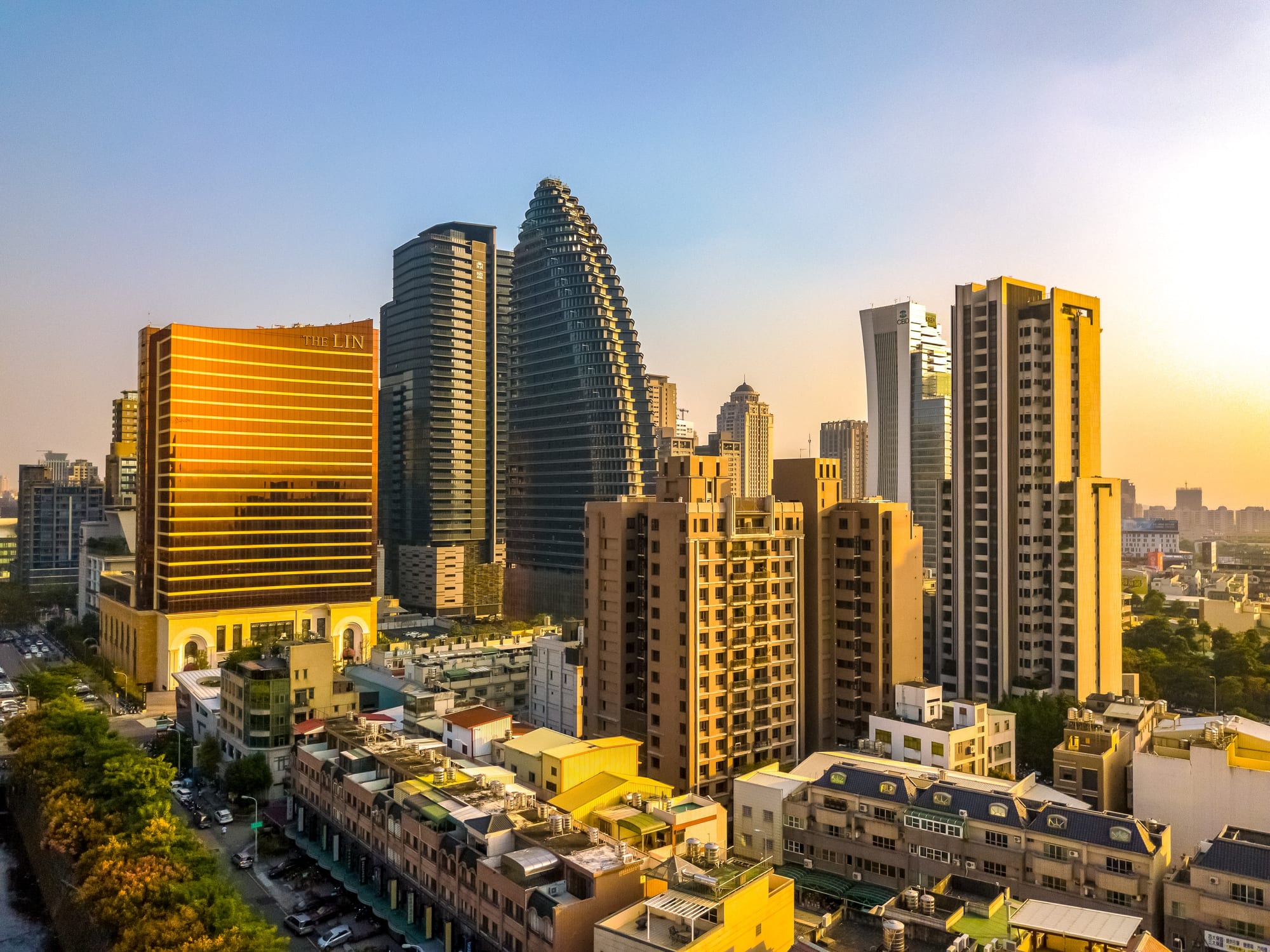
Evening light on Taichung's high-rise towers above a dense mass of low apartment blocks and rooftops

Taichung & Central Taiwan, Taiwan

Taichung

Towers of the Seventh Redevelopment Zone rising above the older rooftops of western Taichung. (michael spadoni / Wikimedia Commons · CC0)

Taiwan's central city, set on a basin between the western plain and the mountains, with the drier, sunnier weather that first recommended it as a capital. A Qing walled town and then a planned Japanese administrative centre, it is now a spread-out municipality of machine shops and bicycle factories, art museums, dense night markets and a curving concert hall.

Neighbourhoods

  • Central District and the old town
    • Historic district
    • Best for food
    • Close to public transport

    The original Japanese-planned grid around the red-brick railway station, the smallest and oldest district in the city. Long overshadowed by the newer west, it has been steadily restored — the old market halls, arcaded shophouses, the station square and lanes of cafés and small shops.

    Open in Maps
  • West District
    • Arts and culture
    • Cafés and bars
    • Museums

    The green, low-rise quarter of parks, embassy-style villas and tree-lined avenues just west of the centre, with the fine arts museum, the long strip of lawns known as the Calligraphy Greenway, and the highest concentration of independent cafés, bookshops and design studios in the city.

    Open in Maps
  • Xitun and the Seventh Redevelopment Zone
    • Nightlife
    • Shopping
    • Modern architecture

    The newer business quarter west of the centre, planned from the 1980s around wide boulevards. Hotels, department stores, the city hall and the National Taichung Theater stand among towers of flats; the Fengjia night market and the university are at its northern edge.

    Open in Maps
  • North District and Yizhong
    • Students and nightlife
    • Best for food
    • Parks

    A busy student quarter around Yizhong Street, with several schools and colleges nearby and a night market that trades all afternoon and evening. Taichung Park and the natural science museum are at its southern and western edges.

    Open in Maps
  • Nantun
    • Quiet and residential
    • Local life

    A residential district to the south-west built around Litoudian, an early Qing-era village whose old street still keeps a few timber shops and temples among the flats and schools.

    Open in Maps
  • The coastal districts
    • Wetlands and sunsets
    • Local life

    Twenty-odd kilometres west of the centre the municipality reaches the sea at Qingshui, Wuqi and Dajia — a flat landscape of rice fields, wind turbines, a container port, a famous Mazu temple and the tidal flats of the Gaomei wetlands.

    Open in Maps

Things to do

Landmarks and architecture

  • National Taichung Theaterlandmark

    Toyo Ito's opera house in Xitun, designed with Cecil Balmond of Arup and officially opened in 2016, built as a continuous lattice of curved concrete surfaces.

    Open in Maps
  • Taichung railway stationtransit hub

    The station rebuilt in red brick in 1917, in a Renaissance style, on the site of a wooden station of 1905, now preserved beside the elevated platforms that replaced it.

    Open in Maps
  • Luce Memorial Chapellandmark

    A chapel completed in 1963 on the Tunghai University campus, designed by I. M. Pei and Chen Chi-kuan as four warped concrete surfaces faced in yellow glazed tiles.

    Open in Maps
  • Taichung Confucius Templelandmark

    A temple begun in 1972 and completed in 1976 in Song dynasty style, laid out after the Confucius temple at Qufu in Shandong.

    Open in Maps

Museums and galleries

  • National Museum of Natural Sciencemuseum

    Taiwan's first national science museum, opened in 1986, with dinosaur halls, a botanical glasshouse and displays on the island's geology and Indigenous peoples.

    Open in Maps
  • National Taiwan Museum of Fine Artsmuseum

    A large state art museum in West District, devoted to Taiwanese art from the Japanese period onwards, set in parkland with a sculpture lawn.

    Open in Maps

Parks and viewpoints

  • Taichung Parkpark

    The city's oldest park, laid out in 1903 under Japanese rule around an artificial lake, with twin pavilions built to mark the completion of the island's trunk railway in 1908.

    Open in Maps
  • Taichung Metropolitan Parkpark

    A large hillside park on the Dadu plateau west of the city, with grassland, woods and long views over the basin at sunset.

    Open in Maps
  • Gaomei Wetlandspark

    A protected estuary of tidal flats and reeds on the coast, crossed by a boardwalk and known for wading birds, wind turbines and sunsets.

    Open in Maps

Markets and street life

  • Fengjia Night Marketmarket

    Claimed to be the largest night market in Taiwan, filling the streets around Feng Chia University with food stalls, clothes and games.

    Open in Maps
  • Rainbow Villageattraction

    The remains of a military dependants' village in Nantun, painted all over with figures, birds and flowers by a former soldier, saved from demolition by a student campaign.

    Open in Maps
  • Taichung Second Marketmarket

    A Japanese-era market hall of 1917, built with hallways radiating from a hexagonal tower, still trading in produce, noodles and old-style snack stalls.

    Open in Maps

Sport and performance

  • Taichung Intercontinental Baseball Stadiumattraction

    The city's main baseball ground, home to a professional club and a venue for international tournaments.

    Open in Maps
  • Tunghai Universityattraction

    A wooded campus of low tiled courtyards laid out in the 1950s, with a tree-lined avenue and the Luce chapel at its heart.

    Open in Maps

Short trips from the city

  • Jenn Lann Templelandmark

    The Mazu temple at Dajia in the north-west of the municipality, starting point of one of the island's biggest annual pilgrimages.

    Open in Maps
  • Lukangneighborhood

    A former port town south-west in Changhua, with Qing temples, craft workshops and narrow brick lanes preserved from its trading heyday.

    Open in Maps
  • Sun Moon Lakeattraction

    Taiwan's largest lake, in the mountains of Nantou, with boat services, a ropeway, lakeside temples and Thao communities on its shores.

    Open in Maps
  • Port of Taichungtransit hub

    The artificial deep-water harbour at Wuqi, one of Taiwan's main container ports, with a promenade and seafood market beside it.

    Open in Maps

Seasonal events

  • Dajia Mazu Pilgrimagespring, on a date set each year by divination at the temple

    A nine-day procession carrying the Mazu statue from Jenn Lann Temple in Dajia south through several counties and back, drawing enormous crowds.

  • Taichung Jazz Festivalautumn

    Taiwan's biggest jazz festival, played on open-air stages along the Calligraphy Greenway in West District, with the main stage at Civic Square.

  • Lunar New YearJanuary or February

    Temples fill with worshippers, markets stay open late and the city empties of students as families gather for several days.

  • Flower season on the plainNovember to February

    The fields at Xinshe and Houli east of the city are planted with flowers and the hills with strawberries, drawing weekend traffic from across central Taiwan.

Eat and drink

Long-standing places and food districts in Taichung. Hours, ratings and directions come from your maps app, always current.

Taichung classics

  • Bubble teacafe

    Tea shaken with milk and chewy tapioca pearls, whose invention in the late 1980s is claimed by a teahouse in this city and, for 1986, by a tea room in Tainan; branches of the Taichung house are scattered across the centre.

    Open in Maps
  • Sun cakescafe

    Round pastries of flaky dough filled with maltose, which come from this city and are sold in gift boxes as its standard souvenir, with bakeries clustered in the old centre.

    Open in Maps
  • Small sausage in large sausagerestaurant

    A grilled pork sausage wrapped in a split sticky-rice sausage with pickles and garlic, a night-market snack sold across Taiwan and a staple of the stalls here.

    Open in Maps

Markets and food streets

  • Fengjia Night Marketmarket

    The city's biggest night market, crowded every evening with students and visitors, and the source of several snacks now sold across Taiwan.

    Open in Maps
  • Yizhong Street Night Marketmarket

    A daytime and evening market street beside the schools of North District, known for fried chicken, grilled squid, shaved ice and cheap clothes.

    Open in Maps
  • Taichung Second Marketmarket

    A century-old produce hall in the old centre whose stalls sell braised pork rice, thick noodle soup and rice dumplings from early morning.

    Open in Maps
  • West District cafésneighborhood

    The lanes around the fine arts museum and the Calligraphy Greenway hold roasteries, tea rooms, bakeries and bookshop cafés, the centre of the city's café culture.

    Open in Maps

Experience Taichung

History

The basin was farmed by Papora and Babuza communities, who with others formed the 17th-century Kingdom of Middag, before Han settlers from Fujian began clearing the basin in the early 18th century and founding villages such as Litoudian in what is now Nantun. The settlement that grew on the higher ground, traced to 1705, was called Toatun, and a Qing garrison was placed near the present Taichung Park in 1721. Its moment came in 1887, when the Qing government made Taiwan a separate province and chose this central spot for the capital, which took the title Taiwan-fu from Tainan. The capital was ultimately moved to Taipei, and in 1895 the island passed to Japan.

The colonial administration flattened most of the walls and rebuilt the town on a grid turned at an angle to the compass, with a planned drainage system that gave the city its reputation for order, and a new name, Taichū, meaning central Taiwan. A park opened in 1903, the west coast railway was completed through the town, and the red-brick station of 1917 became its symbol. Sugar, rice and banana exports paid for the growth.

After 1945 Taichung industrialised in a distinctive way, through thousands of small workshops making machine tools, screws, hand tools and bicycle parts; Giant, founded at Dajia in 1972, grew into the world's largest bicycle maker, and Merida also builds here. The county and the city merged into a single special municipality at the end of 2010, adding the coast and the mountain townships, and in 2017 the population overtook Kaohsiung's, making Taichung Taiwan's second-largest city.

Culture & Customs

Taichung has long been Taiwan's second cultural centre, with a reputation for art and leisure rather than politics. The state fine arts museum and the natural science museum both sit here, the National Taichung Theater brought Toyo Ito's architecture to the western suburbs, and West District's cafés, bookshops and galleries make the city a byword for tea-drinking and slow afternoons. The claim that bubble tea was invented in a Taichung teahouse in the late 1980s is a matter of local pride, though a tea room in Tainan claims the invention too.

Religious life is strong across the municipality. The Mazu temple at Dajia sends out one of the island's biggest pilgrimages each spring, when tens of thousands walk for nine days behind the goddess's palanquin, and neighbourhood temples run processions with drums, firecrackers and costumed generals through the year. Military dependants' villages built for families who arrived after 1949 left their own traces, most visibly in the painted houses of Rainbow Village and in the noodle and dumpling shops of the old quarters.

Sport and making things are part of the identity too: baseball at the Intercontinental stadium, cycling on the roads that climb towards the mountains, and a culture of small workshops where owners and machinists know each other's trade. The mood is less hurried than Taipei's and less boisterous than the south's, and locals are used to explaining that the weather is better here.

Daily Life

About 2.86 million people live in the municipality, which reaches from the coast to mountain townships and is now the second most populous in Taiwan, though the built-up core holds only part of that number. The city grew westwards for decades: the old centre emptied as business moved to the Seventh Redevelopment Zone, and only recently have restored market halls, hostels and cafés brought life back to the streets near the station.

Precision machinery, machine tools, fasteners, bicycles and optics dominate the economy, made largely by small and medium firms in industrial parks and back lanes; the port at Wuqi, offshore wind construction and a large service sector round it out. Universities in the north and west bring tens of thousands of students, which is why night markets there trade on weekday afternoons as well as evenings.

Daily life is scooter-based, with breakfast shops from six in the morning, lunchboxes at midday, and families eating out or walking in the parks after dark. Housing is cheaper than in Taipei but rising, traffic and pavement parking are constant complaints, and winter air pollution on the western plain — blamed variously on the coal-fired power station on the coast, on traffic and on factories — is one of the city's most argued-about issues.

Food

Taichung eats late and eats out. The night markets are the heart of it: Fengjia by the university, said to be the biggest in the country, and Yizhong Street beside the schools of North District, where fried chicken cutlets, grilled squid, stinky tofu, oyster omelettes and towering cups of shaved ice pass over the counters all evening. Several snacks now sold across Taiwan are associated with the stalls here, among them the grilled sausage wrapped in a split sticky-rice sausage known as small sausage in large sausage.

The city's two best-known products are sweeter. Bubble tea — black tea shaken with milk and tapioca pearls — was claimed to have been devised in a Taichung teahouse in 1988, a claim contested by a tea room in Tainan, and the drink is now inseparable from Taiwan's image abroad. The sun cake, a flat pastry of flaky layers around a maltose filling, originated here and is the standard souvenir, sold by old bakeries in the centre along with pineapple cakes and mung bean pastries.

Everyday food runs to braised pork over rice, beef noodle soup, thick starchy noodle soup with squid, rice dumplings and bean soups, much of it from the stalls inside the old market halls. The surrounding plain supplies the rest: rice from the basin, high mountain oolong from the ranges to the east, mushrooms from Xinshe, strawberries and pears from the hills, and seafood landed on the coast at Wuqi.

Planning tools

Budget

Taichung is cheaper than Taipei for hotels and about the same for food, and the night markets make eating well very inexpensive. The main extra cost is transport, since the city is spread out and the sights are far apart; taxis, a hire scooter or a car quickly add up for anyone going to the coast or the mountains.

Daily Budget Midrange
USD 85–160 (mid-range hotel, restaurant meals, museum tickets, taxis or a hire scooter)
Daily Budget Shoestring
USD 30–55 (hostel bed, night-market meals, city buses and the metro)

City bus journeys within a set distance are free or nearly free with an EasyCard, which makes moving around the centre very cheap.

Best Time to Visit

October to April is the dry season here, and the city escapes much of the drizzle that settles over northern Taiwan in winter, with mild sunny days and cool nights. Spring brings the Mazu pilgrimage and the flower fields east of the city. Summer is hot, humid and stormy, with typhoon risk from July to September.

Suggested Number of Days

Two days is enough for the museums, the old centre and a night market. Four or five allow the coast, the lake and the mountain towns of central Taiwan as well. Distances within the city are long, so having a car or scooter changes how much fits into a day.

First Visit
2 days
With Surroundings
4–5 days

Transportation

A single metro line, the Green line, opened in 2021, runs from Beitun through the eastern and southern city to the high speed rail station at Wuri, and a dense bus network covers the rest, with the busiest routes along Taiwan Boulevard between the old centre and Xitun. Conventional trains serve the older districts and the coastal towns. Many residents use scooters, and bicycles are widely hired in a city that makes most of the world's better bicycle frames.

Allow for heavy traffic on the main boulevards at rush hour, and use the high speed rail station at Wuri rather than the city station for long journeys.

Airport & Station Connections

High speed trains from Taipei reach Taichung's station at Wuri, south-west of the centre, in around an hour, with a connecting local train into town. Conventional trains and motorway coaches also run from Taipei, Tainan and Kaohsiung. Taichung International Airport, at Qingquangang to the north-west, handles a small number of regional flights, while most international arrivals come through Taoyuan, about two hours away by coach or rail.

Walkability

The old centre around the station and the park district to its west are pleasant on foot, with covered arcades, small blocks and the long green strip of the Calligraphy Greenway. Beyond them the city was built for traffic: wide boulevards, long blocks and scooters parked across the pavement. Most visits combine short walks in one district with buses, taxis or the metro between them.

Safety

Crime is low and the streets are safe at night, including the crowded night markets. The real risks are traffic — heavy scooter and lorry traffic on wide roads where crossing takes care — along with summer typhoons, afternoon heat and the earthquakes that central Taiwan experiences periodically.

Cross at signals and watch for scooters turning, carry water in summer, and learn the drill for earthquakes in tall buildings. Check current official travel advice before travelling.

Climate

Sheltered by the central mountains, Taichung is one of the driest and sunniest cities in Taiwan, with a marked wet season from May to September and clear, mild weather for much of the rest of the year. Air quality on the western plain can be poor in winter, when the wind drops.

Summer
hot and humid, about 28–34°C, with afternoon thunderstorms and typhoon risk
Winter
mild and dry, about 13–23°C, with sunny days and cool evenings

Local Customs

Tipping is not expected. Temples are open to anyone who keeps quiet and asks before photographing worshippers; step over the raised thresholds rather than on them. Food is often eaten standing at market stalls, and rubbish is taken away rather than left. Shoes come off in homes and in some guesthouses and teahouses.

Tea is a social ritual here: if a shopkeeper offers a cup, accepting and drinking slowly is the polite response.

Common Payment Methods

The currency is the New Taiwan dollar. Cards are taken in hotels, department stores and larger restaurants, while night markets, small kitchens and local buses run on cash and stored-value cards. ATMs are in every convenience store, and an EasyCard or similar card covers the metro, buses and many small purchases.