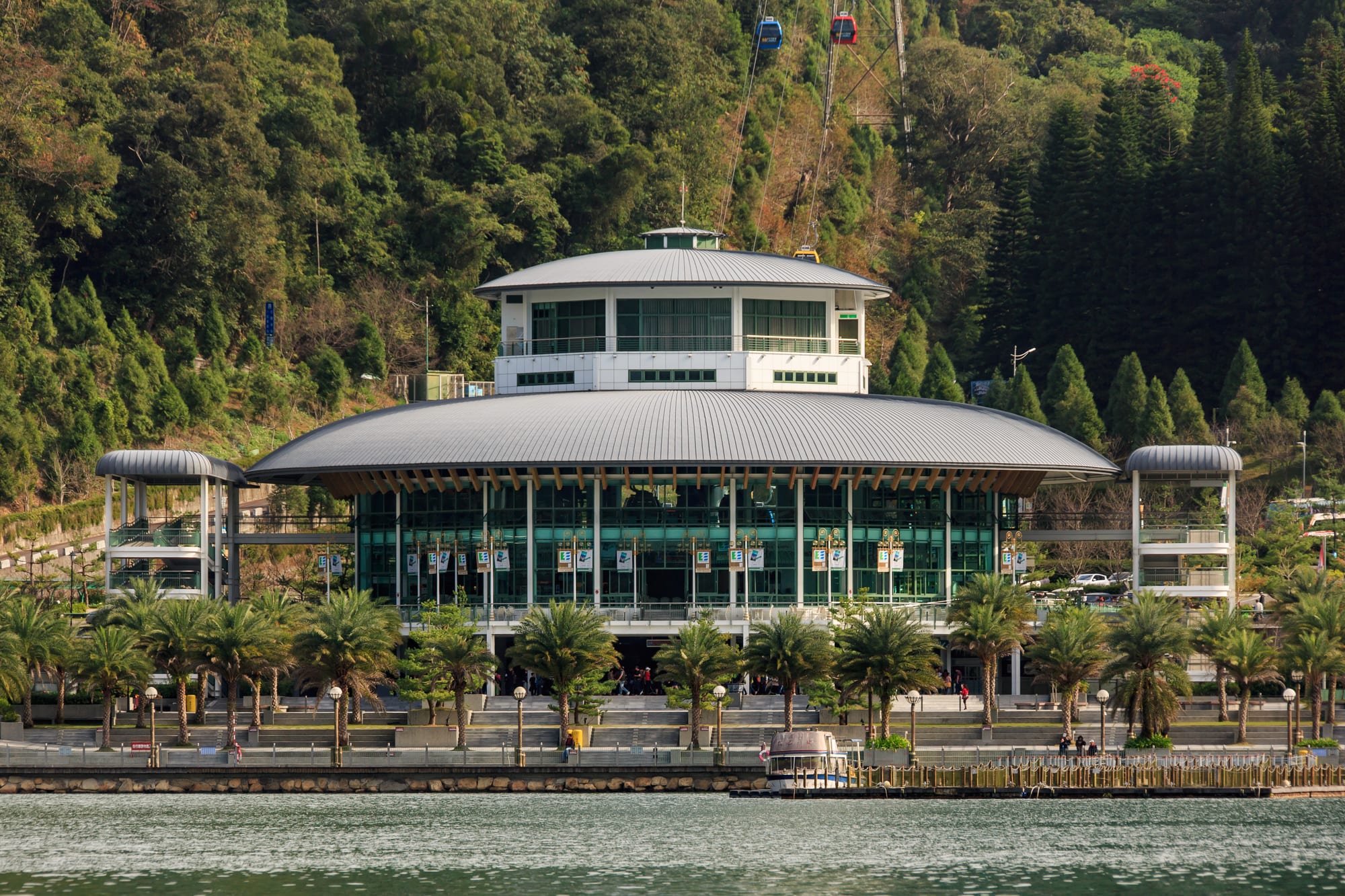
A curved-roofed lakeside station building with palms along the shore, cable cars climbing the forested hillside behind it

Taichung & Central Taiwan, Taiwan

Sun Moon Lake

The lower station of the Sun Moon Lake Ropeway on the shore at Ita Thao, Nantou County. (CEphoto, Uwe Aranas / Wikimedia Commons · CC BY-SA 3.0)

A mountain lake in Yuchi Township, Nantou County, at about 750 metres in the hills of central Taiwan. Enlarged by a Japanese-era hydro-electric scheme, it is the homeland of the Thao, one of the smallest of Taiwan's recognised Indigenous peoples, and is now a resort ringed by temples, a cycle path, boat piers and a ropeway.

Neighbourhoods

  • Shuishe
    • First-time visitors
    • Close to public transport
    • Hotels and restaurants

    The main village on the northern shore and the arrival point for buses from Taichung and Puli. Hotels, convenience stores, bike hire and the busiest boat pier are within a few minutes of each other, and the lakeside promenade runs west from the village towards the dam.

    Open in Maps
  • Ita Thao
    • Local life
    • Best for food
    • Indigenous culture

    The Thao village on the southern shore, rebuilt after the 1999 earthquake, with a pedestrian lane of snack stalls and craft shops leading down to its pier. The lower station of the ropeway stands at the edge of the settlement, and performances of Thao song and drumming are held here.

    Open in Maps
  • The southern shore
    • Temples
    • Quiet and residential
    • Walks

    The wooded slopes between Ita Thao and Xuanguang hold the lake's quieter monuments — the Xuanzang and Xuanguang temples and the stepped path up to the Ci'en Pagoda. There are few shops, and most visitors arrive by boat or on the round-the-lake bus.

    Open in Maps
  • Xiangshan and the western shore
    • Cycling
    • Viewpoints
    • Quiet and residential

    The least developed stretch of shoreline, reached by the lakeside cycle path from Shuishe past boardwalks built out over the water. The scenic area's main visitor centre stands here on a low headland, with long views across the lake to the eastern hills.

    Open in Maps

Things to do

Temples and landmarks

  • Wen Wu Templelandmark

    A large temple on the northern shore, rebuilt in Chinese palace style in 1969 after rising water forced the removal of earlier shrines, with Lord Guan in the central hall and Confucius at the rear, looking down the length of the water.

    Open in Maps
  • Xuanzang Templelandmark

    A hillside temple above the southern shore, built in 1965 to enshrine relics of the Tang-dynasty monk Xuanzang that Japan returned to Taiwan a decade earlier, reached by a short climb from the lake path.

    Open in Maps
  • Ci En Pagodalandmark

    An octagonal pagoda of 46 metres completed in 1971 on Mount Shabalan, raised by Chiang Kai-shek in memory of his mother, with a stair climb from the road and a panorama of the whole lake from the top.

    Open in Maps
  • Lalu Islandlandmark

    The small islet in the middle of the lake, held by the Thao to be the home of their highest ancestral spirits, all but flooded when the Japanese dam raised the water in the 1930s and reduced again by the 1999 earthquake; boats pass close to it.

    Open in Maps

On and around the water

  • Sun Moon Lake Ropewayattraction

    A gondola lift of nearly two kilometres, opened at the end of 2009, that climbs from the lake over a forested ridge to the Formosan Aboriginal Culture Village, giving the widest views of the water on the way.

    Open in Maps
  • Round-the-lake cycle pathtrail

    A lakeside route of boardwalks and quiet lanes running west from Shuishe past Xiangshan, part of a circuit of roughly 30 kilometres around the shore.

    Open in Maps
  • Shuishe Piertransit hub

    The busiest of the lake's three piers, where the shuttle boats that link Shuishe, Ita Thao and Xuanguang set out.

    Open in Maps
  • Formosan Aboriginal Culture Villageattraction

    A large park on the ridge above the eastern shore, reached by the ropeway, combining reconstructed houses and performances from Taiwan's Indigenous peoples with fairground rides.

    Open in Maps

Short trips from the lake

  • Pulineighborhood

    The market town on the way in from Taichung, with a state liquor brewery, the Paper Dome at Taomi and the Chung Tai Chan monastery on its outskirts.

    Open in Maps
  • Jiji Lineattraction

    Taiwan's longest branch line, running up the Zhuoshui valley from Ershui to Checheng, a former timber town at the foot of the hills below the lake.

    Open in Maps
  • Xitou Nature Education Areapark

    A bamboo and conifer forest in Lugu south of the lake, part of National Taiwan University's experimental forest, with a skywalk through the canopy and cool air in summer.

    Open in Maps

Seasonal events

  • Sun Moon Lake Swimming Carnivalaround the Mid-Autumn Festival, September or early October

    A mass open-water race of about three kilometres across the lake, held since 1983 and open to anyone over ten who can swim the distance, on the one day of the year when swimming here is allowed.

  • Thao ceremonial seasonset each year by the lunar calendar

    The Thao community's main ceremonies at Ita Thao, among them Lus'an, with pestle music sounded to notify the ancestral spirits, singing and rites closed in part to outsiders.

Eat and drink

Long-standing places and food districts in Sun Moon Lake. Hours, ratings and directions come from your maps app, always current.

Lake classics

  • Presidential fishrestaurant

    Zongtong yu, a freshwater fish from the lake usually steamed or fried, named for Chiang Kai-shek's fondness for it and on the menu of most lakeside kitchens.

    Open in Maps
  • Sun Moon Lake black teacafe

    The slopes around the lake grow large-leaf black tea, above all the Hongyu or Ruby cultivar, a cross of assam and a native Taiwanese variety, served by the pot in tea houses on the hillside.

    Open in Maps
  • Tea eggsmarket

    Eggs simmered with black tea, shiitake and spices, sold from steaming pots at stalls outside Wen Wu Temple and around the piers.

    Open in Maps

Food streets

  • Ita Thao laneneighborhood

    The pedestrian street behind the pier, with millet wine, wild boar sausage, grilled mushrooms, mochi and fried snacks aimed squarely at day visitors.

    Open in Maps
  • Shuishe villageneighborhood

    The widest choice of sit-down meals at the lake, from Taiwanese set dishes and hotel dining rooms to cafés with terraces over the water.

    Open in Maps

Experience Sun Moon Lake

History

The lake lies in the basin the Qing knew as Shuishalian, the country of the Thao, who fished it and farmed its shores long before Han settlers pushed inland from the Changhua plain in the 18th and 19th centuries. The two halves of the water gave it its Chinese name: a rounder eastern basin likened to the sun and a crescent western one to the moon, divided by the hill that became Lalu Island. Qing officials, missionaries and later Japanese surveyors all described it as one of the sights of the interior.

The lake that exists today is partly man-made. Between 1919 and 1934 the Japanese colonial government built a scheme that diverted water from the Zhuoshui River through a tunnel into the basin and dammed its outlet, raising the water level to drive the power stations below. Farmland and Thao settlements went under, Lalu shrank to a rock, and the community was moved to the site that is now Ita Thao. The power stations made the lake central to Taiwan's electricity supply for decades.

Tourism followed the road. Guest houses and temples spread along the shore after 1945, and the Ci'en Pagoda was built above the southern bank in 1971. The Jiji earthquake of 21 September 1999, centred a short distance away in Nantou, destroyed hotels, roads and much of Ita Thao. Reconstruction remade the lake as a resort under a national scenic area, adding the round-the-lake cycle path, new piers, a visitor centre on the western shore and, at the end of 2009, the ropeway.

Culture & Customs

The Thao are one of the smallest of Taiwan's officially recognised Indigenous peoples, numbering around 800, and recognition came late, in August 2001, when they were made the tenth recognised group. Their highest ancestral spirits are held to live on Lalu Island, the pestle song is sounded to notify those spirits before a ceremony, and that music — wooden pestles struck on a stone — grew out of the pounding of millet by the women of the community. The harvest ceremonies of late summer remain the centre of the community's year, and much of what visitors see on stage is a shortened, public version of a longer private calendar.

Han religious life is just as visible. Wen Wu Temple, rebuilt when the rising water drowned two older shrines, puts Confucius and the god of war under one roof and draws students before examinations; the Xuanzang and Xuanguang temples on the southern shore were built around relics of the Tang monk and are quieter places of pilgrimage. The lake also carries a layer of mid-20th-century state memory, from the pagoda raised in a mother's honour to the villa where Chiang Kai-shek stayed.

Above all this is a place people come to look at. Photography, cycling and the September swim have given the lake a set of modern rituals of its own, and the seasonal rhythms of tea picking and mist on the water shape how it is shown on postcards and in painting.

Daily Life

Yuchi Township, which contains the lake, is a small rural township of the central hills, and Ita Thao a village at one end of it. Almost everything turns on visitors: hotels and homestays, boat crews, bus and taxi drivers, bicycle hire, the ropeway, souvenir and snack stalls, and the tea gardens and mushroom farms on the slopes behind. Many staff commute up from Puli, the nearest real town, or from Shuili below.

The daily rhythm is unusual for Taiwan. Mornings begin early with photographers and cyclists out for the mist; the piers fill from mid-morning as coaches arrive; and the villages empty in the early evening when day trippers leave, so that Shuishe and Ita Thao are quiet by the standards of a Taiwanese town after dark. Weekends and national holidays reverse this completely, filling the shore road with traffic.

Local debates are the familiar ones of a small resort: how much building the shoreline can take, water levels in dry years — the lake is a reservoir as well as a view, and its level visibly drops in a drought — and how the Thao community keeps control of land and ritual sites in a place whose economy depends on outsiders. Younger residents often leave for Taichung to study or work, returning at festival time.

Food

The lake's signature dish is the fish the Chinese menus call zongtong yu, "presidential fish", a freshwater species said to have been a favourite of Chiang Kai-shek and usually steamed with ginger and spring onion or fried whole. Other lake and river fish, freshwater shrimp and the small fried fish sold in paper bags belong to the same tradition, and mushrooms grown in the humid hills around Puli turn up grilled, in soups and dried in shops along the shore.

Ita Thao's lane is the place for snacking. Wild boar sausage grilled over charcoal, millet wine, mochi pounded to order, fried mushrooms, and the small round tea-scented buns sold hot from ovens are the staples, along with shaved ice in summer. Stalls by the temples and piers sell tea eggs simmered in black tea with shiitake and spices, a smell that hangs around Wen Wu Temple all day.

Tea is the lake's other export. The region is known for large-leaf black teas, above all Hongyu, a hybrid of assam and a native Taiwanese variety sold as Ruby or No. 18, with its notes of honey, cinnamon and mint. Tea houses on the hillside above Ita Thao brew it by the pot with a view over the water, and packets of leaf tea, tea cakes and black tea ice cream are the standard thing to take home.

Planning tools

Budget

The lake is one of the more expensive places in central Taiwan. Rooms with a water view, and the weekend rates that most lakeside hotels and homestays charge, are the main cost; boat passes, the ropeway and bike hire add up quickly if bought separately. Eating at the snack stalls rather than in hotel restaurants keeps the daily figure close to the rest of Nantou.

Daily Budget Midrange
USD 95–170 (mid-range hotel, restaurant meals, a combined boat and ropeway pass, a hire scooter)
Daily Budget Shoestring
USD 35–60 (hostel or simple homestay, snack stalls and convenience stores, the round-the-lake bus, a hire bicycle)

Come midweek if possible: room rates drop sharply from Sunday to Thursday, and the piers and cycle path are far quieter.

Best Time to Visit

October to April brings the clearest air and the most settled weather, with cool mornings and mist rising off the water. Spring adds cherry and tung blossom on the surrounding slopes. Summer is hot and humid with afternoon storms and the risk of typhoons, and the lake is at its busiest during school holidays and long weekends.

Suggested Number of Days

One full day covers the shore and the main temples; a second allows the circuit by bicycle at an easy pace. A third and fourth suit the tea hills and forests of the surrounding county. Weather makes the biggest difference, as rain closes in quickly on the water.

First Visit
1–2 days
With Surroundings
3–4 days

Transportation

A round-the-lake bus links Shuishe, Ita Thao, Xuanguang and the ropeway, and passenger boats shuttle between the three piers, both covered by combined passes. Bicycles, including electric ones, are hired in Shuishe and Ita Thao for the lakeside path. Scooters and cars suit the wider area of Nantou; parking at the villages fills on holiday weekends.

The round-the-lake road is narrow, winding and busy with coaches, so cyclists are better off on the separate lakeside path where it exists.

Airport & Station Connections

Most visitors arrive by bus. Services run from Taichung's High Speed Rail station and city centre in roughly one and a half to two hours, and from Puli in about half an hour; Taichung is around an hour from Taipei by high-speed train. Drivers come up from the Jiji valley or over the hills from Puli. There is no railway station at the lake.

Walkability

Each village is small enough to cross on foot in a few minutes, and boardwalk sections of the lakeside path make pleasant level walks, but the villages are kilometres apart on a hilly road and are best linked by boat or bus. Temple visits involve steps — the Ci'en Pagoda in particular needs a steady climb from the road.

Safety

The lake is a very safe place to travel, with little crime. The hazards are natural and practical: Nantou was the centre of the 1999 earthquake, heavy rain and typhoons bring landslides and road closures in the mountains, and the lake itself is deep and cold, with swimming allowed only during the September carnival. Coach and scooter traffic on the narrow shore road calls for care.

Check mountain road conditions after heavy rain, stay off the water outside organised boat services, and wear a helmet on a hired scooter. Check current official travel advice before travelling.

Climate

At about 750 metres the lake is noticeably cooler and damper than the Taichung plain below, and mist and low cloud are common in the mornings. Rain falls mostly between May and September; the winter months are milder and drier, though nights can be chilly.

Summer
warm and humid rather than hot, generally in the high 20s°C, with afternoon thunderstorms and typhoon rain
Winter
mild days of about 15–20°C with cold mornings; frost is rare at the lake but the high peaks beyond can see snow

Local Customs

Tipping is not expected. Lalu Island and parts of the shore are sacred to the Thao, and signs asking visitors not to land, climb or make noise should be taken seriously. Temples welcome visitors who dress modestly, move quietly and avoid stepping on thresholds or photographing worshippers at prayer. Indigenous performances are a livelihood, and permission to photograph performers or their houses is worth asking for.

Shoes stay on in most temples but come off in some halls and homestays, and litter bins are scarce, so rubbish is usually carried away.

Common Payment Methods

The currency is the New Taiwan dollar. Hotels, the ropeway and boat operators take cards, but snack stalls, small homestays and bike-hire kiosks often want cash. EasyCard and similar stored-value cards work on the buses and in convenience stores; ATMs are in Shuishe and in the convenience stores, with more choice in Puli.