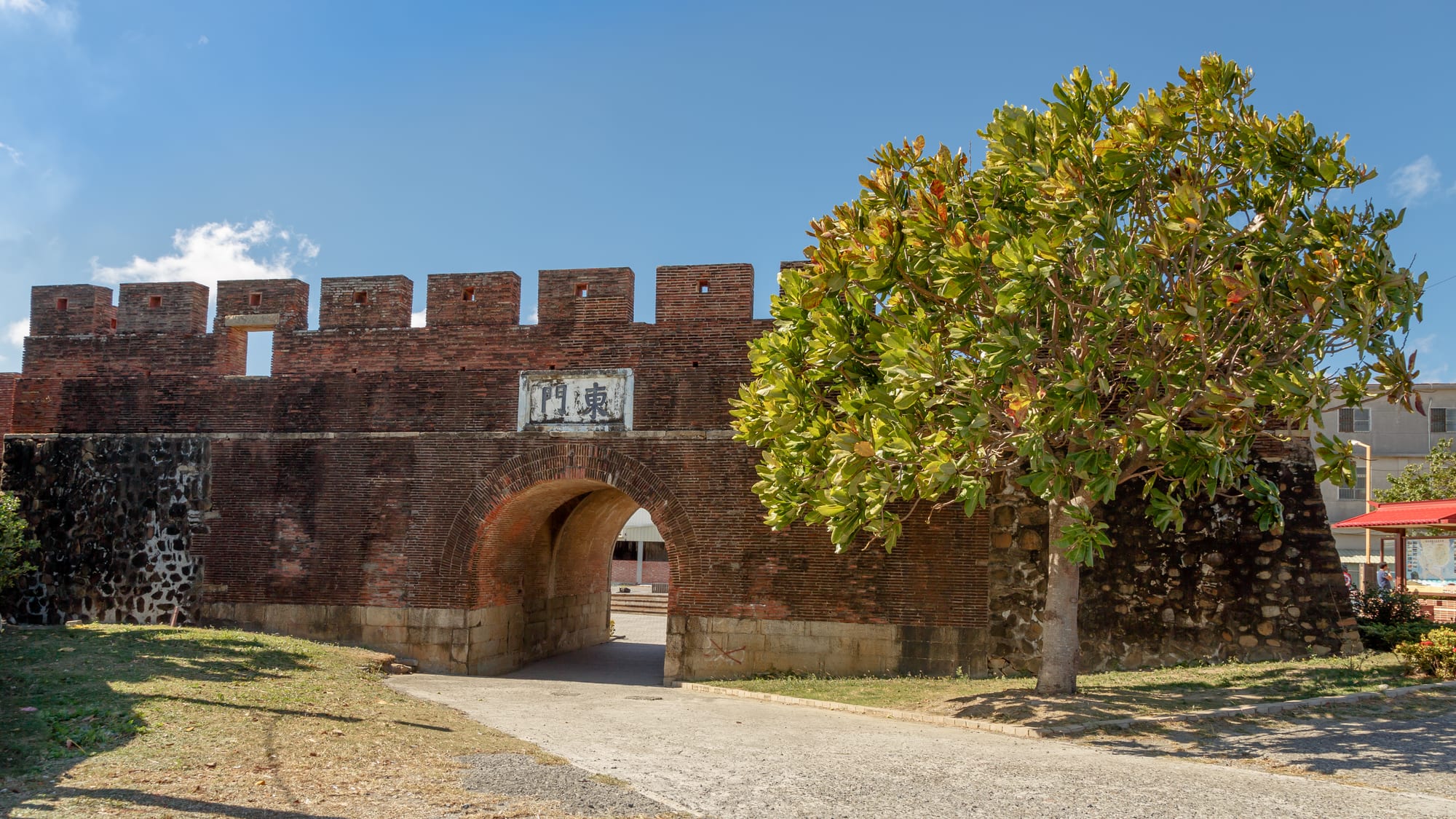
A red brick and stone city gate with a crenellated wall and arched tunnel, beside a broad tree under a blue sky

Tainan, Kaohsiung & the South, Taiwan

Hengchun

The East Gate of the Qing-era town wall at Hengchun, Pingtung County. (CEphoto, Uwe Aranas / Wikimedia Commons · CC BY-SA 3.0)

A small walled town at the southern tip of Taiwan, in Pingtung County, built by the Qing in the 1870s and still marked by its four old gates and long stretches of brick and stone wall. Its name means 'eternal spring', and the tropical climate that earned it also draws visitors to the Kenting beaches, the Eluanbi lighthouse and the coral coasts that surround the town on three sides.

Neighbourhoods

  • The walled old town
    • First-time visitors
    • Historic district
    • Best for food

    The grid of streets inside the line of the Qing wall, between the four surviving gates. Low shophouses, an old market, small temples and the town's everyday shops fill it, and the wall itself can be walked in sections. Most of Hengchun's own guesthouses and cheap eating places are here.

    Open in Maps
  • Kenting village and the Nanwan coast
    • Beaches
    • Nightlife
    • Resorts

    The beach strip about ten kilometres south of the town, strung along one main road facing the sea. Hotels, surf shops, seafood restaurants and a busy evening street market line it, and the bays of Nanwan and Xiaowan are a short walk or ride away.

    Open in Maps
  • Checheng and Sichongxi
    • Hot springs
    • Quiet and residential

    The neighbouring township north of Hengchun, on the road in from Kaohsiung, with a small hot-spring area at Sichongxi and the large marine aquarium on the west coast. It is greener and much quieter than the beach strip.

    Open in Maps
  • Manzhou and the east coast
    • Quiet and residential
    • Walks and viewpoints

    Farmland, grassland and tea gardens on the windward side of the peninsula, east of the town. Villages are small, the Pacific coast is rocky and exposed, and the winter monsoon blows hard across the open hills.

    Open in Maps

Things to do

The old town

  • Hengchun Old City Walllandmark

    The wall of the Qing county seat, built between 1875 and 1879; all four original gates still stand, the only such set left in Taiwan, though road-building removed much of the wall between them.

    Open in Maps
  • Hengchun Airporttransit hub

    A small airport on the coast west of the town, opened in 2004 and lightly used from the start; scheduled flights ended in 2014 and it now handles no passenger services.

    Open in Maps

Coast and national park

  • Kenting National Parkpark

    Taiwan's oldest national park, covering the beaches, coral terraces, uplifted limestone and forest of the peninsula around the town.

    Open in Maps
  • Eluanbi Lighthouselandmark

    A white tower at Cape Eluanbi, the southernmost point of the main island, finished in 1883 and the only armed lighthouse built in Taiwan, ringed by a moat and pierced with gunports for its garrison.

    Open in Maps
  • Maobitouviewpoint

    A coral headland west of Kenting whose eroded rocks are said to resemble a crouching cat, with wide views along the strait.

    Open in Maps
  • Longluan Lakepark

    A freshwater lake in the national park west of the town, where migratory birds gather in winter, with a centre explaining their ecology.

    Open in Maps
  • Maanshan Nuclear Power Plantlandmark

    Taiwan's southernmost nuclear station, on the coast west of the town; its two reactors ran from 1984 and 1985 until their licences expired and they were shut down in 2024 and 2025.

    Open in Maps
  • Sheding Nature Parkpark

    Uplifted coral limestone, grassland and forest on the hills above Kenting, with short trails through narrow rock clefts.

    Open in Maps
  • National Museum of Marine Biology and Aquariummuseum

    A large aquarium and marine research museum at Checheng, north-west of the town, opened in 2000, with coral reef, polar and kelp forest displays and a long underwater tunnel.

    Open in Maps

Seasonal events

  • Spring ScreamApril

    An independent music festival held at Kenting in early April since 1995, which fills the peninsula's hotels each spring.

  • Hengchun folk song eventsautumn

    Competitions and performances of the local yueqin-accompanied folk songs, a tradition kept up in the town and at temple contests on the peninsula.

  • Raptor migrationautumn

    Grey-faced buzzards pass south over the peninsula in large numbers each October, drawing birdwatchers to the park's viewpoints.

Eat and drink

Long-standing places and food districts in Hengchun. Hours, ratings and directions come from your maps app, always current.

Hengchun classics

  • Ludousuanmarket

    The town's best-known sweet — split mung beans cooked soft and served in syrup, hot in winter or over shaved ice in summer, sold from small shops around the old town.

    Open in Maps
  • Hengchun onionsmarket

    The peninsula's dry winter wind produces small, strongly flavoured onions, sold fresh in season and turned into pancakes, crackers and pickles in the town's shops.

    Open in Maps

Markets and food streets

  • Hengchun old town streetsneighborhood

    Noodle shops, braised-meat rice counters, breakfast stalls and dessert shops fill the lanes inside the wall, and prices are far below the beach strip.

    Open in Maps
  • Kenting Street night marketneighborhood

    The evening market along Kenting's main road, with grilled squid, seafood stalls, fried snacks and drinks stands running the length of the village.

    Open in Maps
  • Houbihu harbourneighborhood

    A working fishing harbour on the south-west coast where restaurants and a fish market sell the day's catch, including sashimi from the tuna and mahi-mahi boats.

    Open in Maps

Experience Hengchun

History

The Hengchun peninsula was the country of Paiwan communities long before any walled town stood on it, and Qing officials treated the far south as territory beyond effective administration. That changed after 1871, when sailors from the Ryukyu Islands were wrecked on the coast and killed at Mudan, and Japan used the incident to land an expedition in southern Taiwan in 1874. The episode exposed how little control the Qing exercised over the island's southern tip.

The response was a town. Shen Baozhen, the viceroy of Liangjiang who toured Taiwan in 1875, noted the year-round greenness of the place during his inspection of 1875, and a county seat was built there; work on the walls ran from 1875 to 1879 and the new county was named Hengchun, 'eternal spring', for its climate. The wall was laid out with attention to the surrounding peaks and to feng shui, with four gates, the western one facing north-west. All four still stand, the only complete set of original gates in Taiwan, along with stretches of the wall; the site has been protected since 1979.

Hengchun stayed a small agricultural and fishing centre under Japanese rule and after 1945, growing onions, sweet potatoes and tea and sending boats out from the harbours on either coast. Tourism arrived with the designation of Kenting National Park in 1984, the first in Taiwan, which turned the beaches south of the town into a national holiday destination. The 2008 film Cape No. 7, largely shot in and around Hengchun, brought a further wave of visitors. The town has kept its own character as the everyday centre of the peninsula, while the resort economy has concentrated along the coast.

Culture & Customs

Hengchun's strongest cultural mark is musical. The town gave its name to a family of folk songs, sung to the two-stringed yueqin, whose melodies carry improvised words about work, migration and longing; the best known of them, Sixiangqi, is familiar across Taiwan. Chen Da (1905–1981), a Hengchun singer whose recordings were made by visiting folklorists, became the tradition's defining voice, and the town still holds competitions and classes to pass the songs on to younger players.

The peninsula is mixed in its make-up. Hokkien-speaking farming and fishing families, Hakka households, Paiwan communities in the hills of Mudan and Manzhou, and more recent arrivals working in tourism all share the district, and temple life provides much of the shared calendar. Local temples hold the usual cycle of birthday festivals for their deities, and Ghost Month is marked with street offerings and temple rites as it is across the south.

Everyday manners are Taiwanese: queuing, quiet voices on buses, shoes removed indoors where asked, and a general willingness to give directions to a lost visitor. The contrast between the two economies is part of the town's identity — the beach strip runs on holidaymakers and noise, while the streets inside the wall keep the rhythms of a small agricultural town, and residents are conscious of the difference.

Daily Life

About 30,000 people live in Hengchun Township, with several thousand more in neighbouring Checheng and Manzhou. The population is older than Taiwan's average, as younger people leave for Kaohsiung and the north, and it swells enormously at summer weekends and during festivals, when the peninsula's roads and water supply come under strain.

Work divides between farming, fishing and tourism. Onions are the signature crop, planted in autumn and harvested in early spring, with sweet potatoes, mangoes, bitter melon and a small amount of tea grown on the eastern hills. Fishing boats work out of Houbihu and the smaller harbours, supplying restaurants on the coast. The national park, the aquarium at Checheng and the hotels of Kenting employ a large share of residents, and the nuclear power station on the west coast, whose last reactor was shut down in 2025, was for forty years part of the local economy and of local argument.

The daily rhythm is early. Markets and breakfast shops open before dawn, fieldwork and fishing are done in the cool of the morning, and afternoons slow down in the heat. Scooters are the normal way to move. Wind shapes the winter: the monsoon blows for months across the low saddle of the peninsula, strong enough to bend trees and to be used for drying onions and flying kites, and it is the main reason the peak season here runs opposite to much of the island's.

Food

Hengchun's most identified dish is ludousuan, a dessert of hulled and split mung beans simmered until soft and served in a light brown-sugar syrup — hot in the cooler months, or poured over shaved ice in summer. The name translates as 'mung bean garlic', a reference to the way the split beans look rather than to any garlic in the bowl, and several long-standing shops around the old town sell little else.

Onions run through the rest of the local cooking. The peninsula's winter wind produces small, dense, sharply flavoured bulbs, sold fresh after the spring harvest and turned into onion pancakes, crackers, pickles and sauces in the town's shops. A little tea is grown on the windy east side of the peninsula around Manzhou, and is sold mainly near where it is picked.

Seafood dominates the coast. Houbihu's harbour has a fish market and a row of restaurants working with what the boats bring in, including sashimi from tuna, mahi-mahi and sailfish, along with squid, shellfish and fish soups. Kenting's evening street market adds grilled squid, skewers, fried chicken and the usual Taiwanese night-market range, and it sells a great deal of fruit ice and cold drinks in summer. Inside the wall, the food is plainer and cheaper: braised pork over rice, noodle soups, stuffed rice rolls at breakfast, and the sweet potato and mango that grow in the fields around the town.

Planning tools

Budget

Hengchun town itself is inexpensive — guesthouses, noodle shops and market food cost little. The beach strip at Kenting is the expensive part, and room rates there climb steeply in summer, at weekends and during festivals. A hired scooter is the main extra cost, since the sights are spread along thirty kilometres of coast.

Daily Budget Midrange
USD 90–170 (mid-range hotel or beach resort room, restaurant meals, a hired scooter, park and aquarium tickets)
Daily Budget Shoestring
USD 35–60 (hostel or guesthouse bed, market food and night-market snacks, buses and a shared scooter)

Staying in the old town rather than at Kenting cuts costs sharply, and beaches, gates and coastal viewpoints are mostly free.

Best Time to Visit

October to April is the driest and most comfortable stretch, though the north-east monsoon makes the peninsula windy from November to February. Summer is hot, humid and the season for swimming and diving, but also for typhoons and the heaviest crowds. April brings the music festivals and autumn the raptor migration.

Suggested Number of Days

Two days cover the walled town and the nearest beaches. Three or four allow the whole peninsula, including the east coast and the aquarium. Anyone without a scooter or car should allow longer, as buses along the coast are infrequent.

First Visit
2 days
With Surroundings
3–4 days

Transportation

Express buses from Kaohsiung's Zuoying high-speed rail station run down the west coast to Hengchun and Kenting in roughly two to three hours. Within the peninsula a shuttle bus links the main coastal stops, but services are spaced out, and most visitors hire a scooter or car. The old town is small enough to cross on foot in fifteen minutes.

A scooter licence recognised in Taiwan is needed to hire anything larger than an electric bicycle; helmets are compulsory and the coast road is busy at night.

Airport & Station Connections

There is no railway on the peninsula. Most people arrive by bus or car from Kaohsiung, about 110 kilometres north, using the west-coast expressway; the nearest airport is Kaohsiung International. Buses also run from Pingtung City and, along the southern cross-island route, from Taitung on the east coast.

Walkability

The walled town is compact and flat, and the gates, market and main streets are all within a short walk of one another. Everything beyond it is not: the beaches, capes and viewpoints lie several kilometres apart along a road with narrow verges and fast traffic, so walking between them is not practical.

Safety

Crime is low and the town is safe to walk at night. The real hazards are natural and traffic-related — strong currents and rip tides off the beaches, heat and sun, typhoon rain in late summer, and heavy scooter traffic on the Kenting strip in the evenings.

Swim only at lifeguarded beaches, wear a helmet on a scooter, and check road and trail conditions after heavy rain. Check current official travel advice before travelling.

Climate

Tropical and warm all year, which is what gives the town its name. The winter half of the year is dry and sunny but persistently windy under the north-east monsoon, which funnels across the low saddle of the peninsula; the summer half is hot, humid and wet, with typhoons possible from July to September.

Summer
hot and humid, about 28–33°C, with heavy showers and typhoon risk
Winter
warm and dry, about 20–26°C, but often very windy

Local Customs

Tipping is not expected in Taiwan, and service is added at some larger hotels and restaurants. Temples are open to visitors who stay quiet, avoid blocking worshippers and keep clear of ritual objects. Beachwear belongs on the beach rather than in the old town's shops and temples, and shoes come off where a sign or a row of shoes says so.

Ask before photographing people, take litter away from the beaches, and do not touch or stand on coral inside the national park.

Common Payment Methods

The currency is the New Taiwan dollar. Cards work in hotels, the aquarium and larger restaurants, but small eating places, market stalls, scooter hire and guesthouses often prefer cash. ATMs are in the old town and at convenience stores, which are also the easiest place to top up an EasyCard for buses.