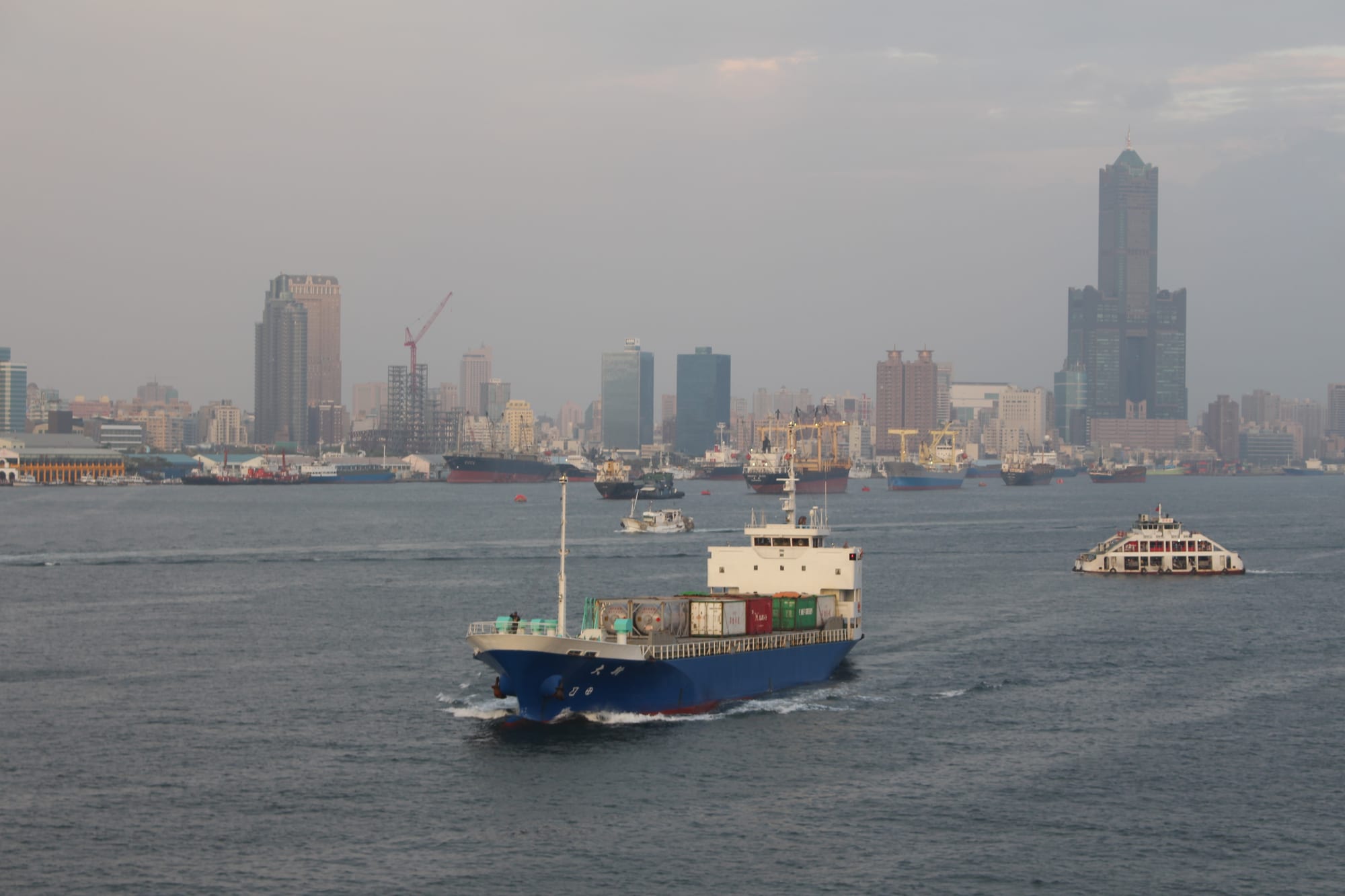
A container ship and a passenger ferry crossing a wide harbour channel, with tower blocks and a tall skyscraper behind

Tainan, Kaohsiung & the South, Taiwan

Kaohsiung

Kaohsiung's harbour and skyline seen from Cijin, with the 85 Sky Tower on the right. (Chi-Hung Lin / Wikimedia Commons · CC BY-SA 2.0)

Taiwan's largest port and the biggest city in the south, built around a natural harbour sheltered by the long sandbar of Cijin. A Japanese-era planned harbour that grew into a centre of steel, shipbuilding and petrochemicals, it has spent recent decades turning waterfront warehouses, railway land and a lagoon into art districts, parks and concert halls.

Neighbourhoods

  • Yancheng
    • First-time visitors
    • Waterfront
    • Arts and culture

    The old commercial quarter beside the harbour mouth, once the city's main shopping district and now the setting for the Pier-2 warehouses, the music centre and the ferry pier. Low older buildings, small hotels and long-standing food shops fill the grid behind the water.

    Open in Maps
  • Gushan and Sizihwan
    • Views
    • Beaches
    • Students

    The hilly north-west corner where Shoushan drops to the sea. Sizihwan's small bay, the former British consulate on the bluff and the campus of National Sun Yat-sen University sit close together, with macaques on the wooded slopes above.

    Open in Maps
  • Cijin
    • Beaches
    • Best for food
    • Day trips

    A long sandbar island facing the open sea, reached by a short ferry from Gushan. A beach, a lighthouse, an old fort, a temple street and a strip of seafood restaurants line the narrow strip between harbour and surf.

    Open in Maps
  • Zuoying
    • Temples
    • Close to public transport

    The northern district around Lotus Pond, with its dragon and tiger pagodas, temples and lakeside paths, and the walls of an old Qing garrison town. The High Speed Rail terminus and a large naval base are here.

    Open in Maps
  • Sanmin and the station area
    • Close to public transport
    • Best for food
    • Local life

    The dense central district around Kaohsiung main station, with the Liuhe and Ruifeng night markets, ordinary residential streets and much of the city's cheaper accommodation.

    Open in Maps
  • Lingya and Weiwuying
    • Shopping
    • Parks
    • Music and theatre

    The modern commercial centre east of the harbour, with department stores, the Sanduo shopping strip and the 85 Sky Tower, and, further east, the vast metropolitan park and arts centre at Weiwuying.

    Open in Maps

Things to do

The harbour and the waterfront

  • Pier-2 Art Centerattraction

    Disused harbour warehouses in Yancheng converted into galleries, studios, shops and outdoor sculpture, linked by a cycle path along the quays.

    Open in Maps
  • Kaohsiung Music Centerattraction

    A group of shell-like performance buildings on the harbour front near Pier-2, built for live music and with public walkways over the water.

    Open in Maps
  • Love Riverattraction

    The river running through the centre to the harbour, cleaned up after decades of pollution and now lined with promenades, cafés and evening boat trips.

    Open in Maps
  • Cijin Islandneighborhood

    The sandbar island across the harbour mouth, reached by ferry, with a black-sand beach, seafood streets, a temple and paths along the shore.

    Open in Maps
  • Cihou Lighthouselandmark

    A white lighthouse on the hill at the northern tip of Cijin, first built by British engineers in the Qing period and rebuilt under Japanese rule in 1916, with a view over the harbour entrance and the container terminals.

    Open in Maps
  • Former British Consulate at Takaomuseum

    An 1879 brick consular residence on the bluff above the harbour mouth, now a museum of the treaty-port era with an arcaded terrace and wide views.

    Open in Maps

Temples and old Zuoying

  • Lotus Pondpark

    An artificial lake in Zuoying ringed by temples, pavilions and walking paths, the most photographed spot in the city.

    Open in Maps
  • Dragon and Tiger Pagodaslandmark

    Twin seven-storey pagodas on Lotus Pond, entered through the dragon's mouth and left through the tiger's, a route said to turn bad luck to good.

    Open in Maps
  • Fongyi Academylandmark

    A Qing-era Confucian academy in Fengshan, the largest preserved academy of its kind in Taiwan.

    Open in Maps

Museums, parks and views

  • Kaohsiung Museum of Fine Artsmuseum

    The city's main art museum, set in a large park of lakes and sculpture north of the centre.

    Open in Maps
  • Kaohsiung Museum of Historymuseum

    The former Japanese-era city hall beside the Love River, completed in 1939 in Imperial Crown style and now telling the city's story.

    Open in Maps
  • National Kaohsiung Center for the Artsattraction

    A single undulating roof over four halls at Weiwuying, one of the largest performing-arts venues under one roof anywhere, on a former military site.

    Open in Maps
  • Shoushanviewpoint

    The limestone hill above the harbour, wooded and full of Formosan rock macaques, with trails and lookouts over the port and the strait.

    Open in Maps
  • Formosa Boulevard stationtransit hub

    A metro interchange whose concourse holds the Dome of Light, a very large circular glass artwork by Narcissus Quagliata.

    Open in Maps
  • 85 Sky Towerlandmark

    The tallest building in the city, completed in 1997 and long known as the Tuntex Sky Tower, its split lower form meant to suggest the character for "high" in the city's name.

    Open in Maps
  • Kaohsiung Metropolitan Parkpark

    A large park of lawns, lakes and tree plantations on the northern edge of the city, built over a former landfill site.

    Open in Maps

Short trips from the city

  • Fo Guang Shan Buddha Museummuseum

    The museum complex beside the Fo Guang Shan monastery in Dashu District, about 20 kilometres inland, with pagoda-lined avenues and a large seated Buddha visible from far off.

    Open in Maps
  • Meinong Districtneighborhood

    A Hakka farming town to the north-east known for oil-paper umbrellas, tobacco-curing barns, flat rice noodles and surrounding countryside.

    Open in Maps
  • Cishan Districtneighborhood

    An old sugar town inland, with a Japanese-era street of arcaded shopfronts and a former sugar railway.

    Open in Maps

Seasonal events

  • Lantern Festivalfirst lunar month, late winter

    Lantern displays and crowds for the fifteenth night of the lunar new year; Kaohsiung has several times hosted the national Taiwan Lantern Festival along the Love River.

  • Dragon boat racesfifth lunar month, early summer

    Team races on the Love River in the middle of the city, with stands along the banks.

  • Ghost Monthseventh lunar month, late summer

    Street offerings, temple ceremonies and, in the harbour districts, rites connected with the sea and those lost at it.

  • Kaohsiung Film Festivalautumn

    An international festival with a reputation for short films and experimental work, screened at venues around the city.

Eat and drink

Long-standing places and food districts in Kaohsiung. Hours, ratings and directions come from your maps app, always current.

Kaohsiung classics

  • Cijin seafood streetsneighborhood

    Restaurants on the island's main street display the morning's catch in tanks and trays — squid, crab, clams, prawns and grilled fish — a short ferry ride from the city.

    Open in Maps
  • Papaya milk and fruit stallscafe

    Papaya blended with milk is one of the fruit-and-milk drinks sold at Taiwanese night markets, and is long associated with the south, alongside sugarcane juice and iced fruit teas.

    Open in Maps
  • Banana and sugar sweetsmarket

    The region's old sugar and banana trade survives in dried fruit, banana desserts and sugar sweets sold in markets and gift shops.

    Open in Maps

Night markets and food streets

  • Liuhe Night Marketmarket

    A straight run of stalls near Formosa Boulevard station, long the best-known night market in the city and heavy on seafood, steak plates and fruit drinks.

    Open in Maps
  • Ruifeng Night Marketmarket

    A larger, grid-like market in Zuoying favoured by residents and students, with games as well as food and a younger crowd.

    Open in Maps
  • Yancheng food streetsneighborhood

    The old shopping quarter keeps shaved-ice shops, duck rice, sticky rice dumplings and noodle kitchens that have traded for decades near the harbour.

    Open in Maps
  • Sanfong Central Streetmarket

    A market lane in Sanmin District selling dried goods, preserved fruit and snacks, busiest before Lunar New Year.

    Open in Maps

Experience Kaohsiung

History

The harbour began as a settlement of the Makatao people, whose name for the place Chinese explorers wrote as Dagou and the Japanese authorities changed to Takao in 1920. Han settlers arrived in numbers in the 17th and 18th centuries and the Qing built a walled garrison town inland at Zuoying and later at Fengshan, while the lagoon itself stayed a modest anchorage. After the Treaty of Peking of 1860 the Qing opened Takau to foreign trade, and the British consulate moved there in 1864, taking a residence on the bluff above the harbour mouth; sugar, rice and camphor went out through the port.

Japanese rule made the modern city. From the early 1900s engineers dredged the lagoon, finishing the first stage of the works in 1908, built quays and breakwaters, laid out a grid on reclaimed land at Yancheng and connected the harbour to the west coast railway, turning Takao into Taiwan's southern port and an industrial base with cement, aluminium and sugar refining. Heavy American bombing in 1944 and 1945 destroyed much of it. Renamed Kaohsiung after 1945, the city became the engine of Taiwan's export economy: the China Steel works, shipyards, the petrochemical complexes and, from 1967, an export processing zone.

Growth brought pollution and political tension. On 10 December 1979 a rally organised by the Formosa magazine ended in clashes and mass arrests; the Kaohsiung Incident and the trials that followed became a turning point for the democracy movement, and several defendants and defence lawyers later led the country. Since the 1990s the city has reworked what heavy industry left behind — warehouses into the Pier-2 district, a cleaned-up Love River, an arts centre on a former military site, and an underground railway whose old tracks became a linear park.

Culture & Customs

Kaohsiung's culture is that of a working port: direct, informal and proud of having built things. Taiwanese Hokkien is heard everywhere, the pace is slower than Taipei's, and evenings are spent outdoors at markets, on the harbour walk or by the river. The city has a strong Democratic Progressive Party tradition and a political memory shaped by 1979, marked in museums and in the naming of streets and parks.

The arts have become central to how the city presents itself. Pier-2 fills old warehouses with studios and galleries, the music centre and the Weiwuying arts complex draw performances that once went only to the capital, and the film festival has a reputation for experiment. Large outdoor concerts and festivals in the harbour district are a fixture of the cooler months.

Religious life is as dense as elsewhere in the south. Temples to Mazu and to the Wangye plague gods are scattered through the harbour districts, Lotus Pond is lined with shrines, and Fo Guang Shan, whose monastery in the hills inland is the largest in Taiwan, was founded there in 1967. Hakka communities around Meinong keep their language, umbrella-making and paper crafts, and Indigenous Bunun and Rukai villages lie in the mountain districts that the municipality absorbed in 2010.

Daily Life

About 2.7 million people live in the municipality, which reaches from the coast into the mountains and includes farming districts as well as the port. The economy still rests on the harbour — one of the busiest container ports in the world — and on steel, shipbuilding, petrochemicals and machinery, with technology investment, shipping services and tourism growing. The naval base at Zuoying makes the city a military centre as well.

Life runs on scooters, the metro and the light rail. Breakfast shops open early with soy milk, rice rolls and egg pancakes; the working day ends with markets and food streets filling from six; and the waterfront is busiest after dark, when the heat drops. Housing is mostly mid-rise flats, cheaper than in Taipei, and many families live in the newer eastern districts and commute towards the harbour.

Heavy industry has left a legacy the city is still managing. Air pollution, petrochemical safety — gas explosions beneath city streets in 2014 killed dozens and reshaped the debate — and the cost of cleaning contaminated land are persistent issues, alongside an ageing population and the loss of young workers to the north. Typhoon flooding and water shortages in dry years affect the whole plain, and the closure or relocation of older plants remains a live argument about jobs against air quality.

Food

Kaohsiung eats late, cheaply and outdoors. Night markets are the backbone: Liuhe near the centre and the bigger Ruifeng in Zuoying, along with neighbourhood markets that appear on set evenings. Grilled squid, oyster omelettes, fried chicken cutlets, stinky tofu, sausages wrapped in glutinous rice and papaya milk are the standard run, and southern seasoning is sweeter than in the north.

Seafood is the city's strength. The Cijin waterfront is the best-known place to eat it, with tanks of clams, crab, squid and fish cooked simply, and harbour districts sell milkfish, cured mullet roe and shrimp rolls. Local specialities include duck rice, meat-and-rice bowls with braised pork, sticky rice dumplings wrapped in bamboo leaves, and thick soups of fish or squid thickened with starch.

Inland districts bring their own food into the city. Meinong's Hakka kitchens serve ban tiao, flat rice noodles in broth or fried with pork and vegetables, along with preserved vegetables and stewed pork; Cishan is associated with sugar, with sweets made from it and with ice cream. Fruit is a constant — mangoes, wax apples, pineapples, custard apples and lychees from the surrounding plain — eaten fresh, blended into drinks or heaped onto shaved ice in summer.

Planning tools

Budget

Kaohsiung is cheaper than Taipei for almost everything, with plenty of mid-range hotels near the station and the harbour and very inexpensive night-market food. The metro, light rail and public bicycles keep transport costs low. Prices rise around Lunar New Year and the Lantern Festival.

Daily Budget Midrange
USD 90–170 (mid-range hotel, restaurant meals, a scooter or taxis, museum and concert tickets)
Daily Budget Shoestring
USD 30–55 (hostel or simple hotel, night markets and noodle shops, metro, light rail and public bicycles)

Pier-2, the harbour walk, Lotus Pond, Shoushan and the Cijin ferry cost little or nothing, so most of a budget goes on beds and food.

Best Time to Visit

November to April is dry and warm, the most comfortable time and the season for the Lantern Festival and outdoor concerts. Summer from June to September is hot, humid and wet, with heavy afternoon rain and typhoons, though the beaches and evening waterfront come into their own.

Suggested Number of Days

Two or three days is enough for the harbour, the temples and the island. Four or five allow the monastery, the Hakka country inland and trips to Tainan or Kenting. The city is spread out, so more time means less backtracking rather than more sights.

First Visit
2–3 days
With Surroundings
4–5 days

Transportation

Kaohsiung has the best public transport in southern Taiwan: two metro lines crossing at Formosa Boulevard, a light rail loop around the city whose circle was completed in 2024, a dense bus network, a large public bicycle scheme and ferries to Cijin. Scooters and cars dominate the wider road network, and taxis are inexpensive.

A stored-value card works on the metro, light rail, buses, the Cijin ferry and in convenience stores.

Airport & Station Connections

Kaohsiung International Airport lies about 10 kilometres south of the centre and is connected directly by metro, with domestic flights and regional services across East and South-East Asia. High Speed Rail trains from Taipei reach Zuoying station in about an hour and three quarters, and conventional trains and long-distance buses serve the main station in the centre.

Walkability

The city is flat, and individual districts walk well — Yancheng and the Pier-2 quays, the Love River banks, Lotus Pond, Sizihwan and Cijin's main street. The distances between districts are large, so walking is best combined with the metro, light rail or a bicycle. Pavements are often occupied by parked scooters, and summer heat and humidity are serious obstacles in the middle of the day.

Safety

Kaohsiung is a very safe city for visitors, with little violent crime. The main hazards are traffic, especially scooters at junctions and on the wide boulevards, strong sun and heat in summer, and typhoons between July and October. Rip currents make the open sea off Cijin dangerous outside the patrolled beach area, and air quality on the plain can be poor in the dry months.

Swim only in the marked and patrolled section at Cijin, wear a helmet on a hired scooter, and take the heat seriously in summer. Check current official travel advice before travelling.

Climate

A tropical climate with a sharp wet and dry season. Nearly all the rain falls between May and September, often in brief violent storms, and typhoons can strike in that period. The dry months from November to March are warm, sunny and pleasant, though hazy on windless days.

Summer
hot and humid, generally 28–33°C, with heavy rain and typhoon risk
Winter
warm and dry, generally 18–26°C, with little rain

Local Customs

Tipping is not customary in Taiwan. Taiwanese Hokkien is widely spoken alongside Mandarin, and the south is more attached to it than the north. Temples are places of worship: dress modestly, do not touch offerings or ritual objects, and ask before photographing worshippers. Eating and drinking are not allowed on the metro, and queues form naturally at ticket gates and stall counters.

Take shoes off where a household or temple hall asks for it, carry small notes for stalls and ferries, and keep to the right on escalators.

Common Payment Methods

The currency is the New Taiwan dollar. Cards and mobile payment work in hotels, department stores, chains and larger restaurants, while night markets, small kitchens and ferries run on cash. ATMs at banks and convenience stores accept foreign cards, and stored-value transit cards are accepted in convenience stores and some shops.