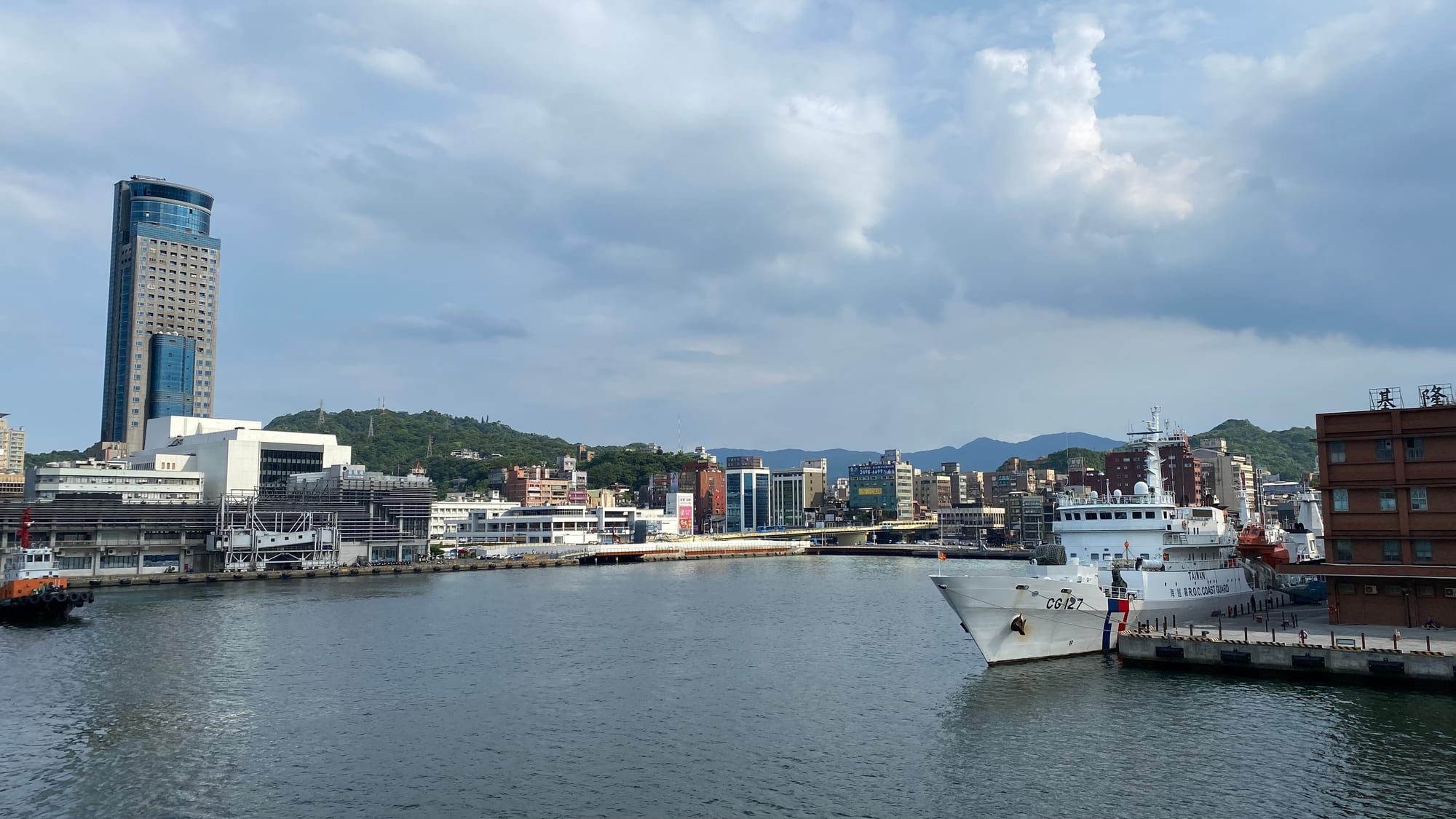
Keelung's inner harbour with a white coastguard cutter moored at the quay and low city blocks and green hills behind

Taipei & Northern Taiwan, Taiwan

Keelung

The inner harbour and downtown Keelung, with the hills that ring the bay behind. (Bigmorr / Wikimedia Commons · CC BY-SA 4.0)

A port city at the northern tip of Taiwan, built around a deep natural harbour ringed by steep green hills about three quarters of an hour from Taipei by train. Spanish, Dutch, Qing, French and Japanese forces all fought over or held the bay, and the shipping that followed shaped a working city known for rain, seafood and one of the island's best-known night markets.

Neighbourhoods

  • Ren'ai District and the harbour front
    • First-time visitors
    • Best for food
    • Close to public transport

    The commercial heart of the city, wrapped around the head of the harbour. The railway station, the bus stands, the ferry and cruise berths, the department stores and the Miaokou night market are all within a few streets of each other, and a waterside plaza looks straight down the bay at the container cranes.

    Open in Maps
  • Zhongzheng District
    • Coast and sea views
    • Historic district
    • Seafood

    The long eastern shore of the harbour, running out past the old fishing quays to Heping Island and the headland at Badouzi. It holds the colourful waterfront houses of Zhengbin, the remains of the Spanish and Qing forts, the lighthouse road and the marine science museum.

    Open in Maps
  • Xinyi District
    • Viewpoints
    • Quiet and residential

    The hillside immediately east of the centre, climbing in flights of steps and narrow lanes to Zhongzheng Park and its tall white Guanyin statue. The views over the harbour are the best in the city, and the streets above the shops are ordinary and residential.

    Open in Maps
  • Anle District
    • Local life
    • Beaches

    The western and north-western part of the city, largely housing estates and schools, with the coast road running out to the sand and bathing area at Dawulun. It is where much of Keelung lives rather than where visitors stay.

    Open in Maps
  • Qidu and Nuannuan
    • Quiet and residential
    • Close to public transport

    The inland southern districts along the Keelung River valley, on the railway towards Taipei and the Pingxi line. Nuannuan grew up around a river crossing and keeps a small old street and a Qing-era waterworks; Qidu is a busy commuter suburb with a large station.

    Open in Maps

Things to do

Harbour and forts

  • Port of Keelungtransit hub

    The deep natural harbour that made the city, working cargo and cruise berths within sight of the main shopping streets.

    Open in Maps
  • Ershawan Batterylandmark

    A Qing coastal battery above the harbour mouth, its stone gateway inscribed 'Haimen Tianxian', built to guard the bay and fought over in the 1880s.

    Open in Maps
  • Baimiweng Fortlandmark

    A gun emplacement on a bluff on the western side of the harbour entrance, rebuilt in the Japanese period, with wide views out to sea.

    Open in Maps
  • Keelung railway stationtransit hub

    The terminus of the west coast main line, rebuilt as a glass hall beside the water, a few minutes' walk from the night market.

    Open in Maps

Coast and islands

  • Heping Islandattraction

    An island joined to the city by a short bridge, with a coastal park of eroded sandstone platforms, tidal pools and a seawater bathing area.

    Open in Maps
  • Zhengbin Fishing Portattraction

    The old fishing harbour, lined on one side by a row of sixteen houses painted in bright colours that has become the city's most photographed spot.

    Open in Maps
  • Keelung Isletviewpoint

    A steep uninhabited island a few kilometres offshore, visible from most of the coast and reached by seasonal boat trips.

    Open in Maps

Parks and viewpoints

  • Zhongzheng Parkpark

    A terraced hillside park above the centre, laid out in 1933 and topped by a 25-metre white statue of Guanyin and a temple, with the whole harbour laid out below.

    Open in Maps

Museums

  • National Museum of Marine Science and Technologymuseum

    A large museum at Badouzi, opened in 2014 in the converted North Thermal Power Plant of 1937, covering Taiwan's seas, fisheries and marine research.

    Open in Maps

Short trips from the city

  • Yehliu Geoparkattraction

    A cape west along the north coast where wind and sea have carved the sandstone into mushroom-shaped rocks, including the 'Queen's Head'.

    Open in Maps
  • Jiufenneighborhood

    A former gold-mining town of stepped lanes, teahouses and red lanterns on a hillside south-east of the city.

    Open in Maps
  • Jinguashiattraction

    A former gold and copper mining settlement beyond Jiufen, with mine tunnels, Japanese-era quarters and a museum of the industry.

    Open in Maps
  • Shifen Waterfallattraction

    A broad curtain waterfall in the Pingxi valley, reached on the branch railway that climbs inland from the Keelung River.

    Open in Maps
  • Pingxi Districtneighborhood

    A green valley of old coal villages on a single-track railway, known for sky lanterns released from the tracks at Shifen.

    Open in Maps

Seasonal events

  • Keelung Mid-summer Ghost Festivalseventh lunar month, usually August

    A month of rites organised in turn by the city's clan associations, with lantern parades and water lanterns floated at the beach to guide wandering spirits.

  • Lunar New YearJanuary or February

    Temples around the harbour fill with worshippers, the markets stay open late, and families return to the city for several days of visiting.

  • Mazu's birthdaythird lunar month, usually April

    Processions and temple opera mark the sea goddess's birthday in a city whose livelihood has always come from the water.

  • Cruise seasonspring and autumn

    The harbour's passenger berths are busiest in the shoulder seasons, when large ships tie up a few streets from the night market.

Eat and drink

Long-standing places and food districts in Keelung. Hours, ratings and directions come from your maps app, always current.

Keelung classics

  • Miaokou Night Marketmarket

    The market that grew up around Dianji Temple, a covered double row of numbered stalls known across Taiwan for crab thick soup, tempura, one-bite sausages and the deep-fried bun of ham, egg and mayonnaise called the nutritious sandwich.

    Open in Maps
  • Ding bian cuorestaurant

    A soup of rice-batter sheets poured round the rim of a hot pan and scraped in, with dried shrimp, squid, bamboo shoots and golden needle flowers — a dish the city claims as its own.

    Open in Maps
  • Kanziding fish marketmarket

    A wholesale fish market in the old town that trades through the night, with auctioneers calling the catch in the hours before dawn and small kitchens nearby cooking it later in the day.

    Open in Maps

Food districts

  • Zhengbin and Heping Island seafoodneighborhood

    Restaurants and cafés along the old fishing quay and on the island beyond it, serving whatever the boats have landed, from steamed fish to squid and sea urchin in season.

    Open in Maps
  • Renai Market and the old town lanesneighborhood

    The blocks between the station and the night market hold breakfast shops, thin-noodle stalls, curry rice counters and old-fashioned cafés that open long before the market stalls do.

    Open in Maps

Experience Keelung

History

The bay was used by Ketagalan people long before Europeans arrived. In 1626 a Spanish expedition took the islet now called Heping Island, built Fort San Salvador and founded a small colony; the Dutch drove the Spanish out in 1642 and held the harbour until they in turn were expelled from Taiwan in the 1660s. Under Qing rule the settlement, then known as Kelang, remained a modest fishing and coal port, but the coal seams behind it and the sheltered water in front of it made it strategically valuable. Batteries were built above the harbour mouth, and in 1884 and 1885 French forces landed and occupied the town during the Sino-French War, losing many men to disease before withdrawing.

Japanese troops came ashore near here in 1895, and the colonial government turned Keelung into Taiwan's main gateway. The harbour was dredged and walled, a railway ran south to Taipei and on down the west coast, and passenger liners tied up where the cruise terminal stands today. Allied bombing in the Pacific War left much of the built-up area in ruins. After the war the port was rebuilt and grew enormously with containerisation, ranking for a time among the busiest container ports in the world.

Since the 1990s larger ships and deeper berths have moved much of the cargo trade to Taipei Port and Kaohsiung, and Keelung's population has slowly fallen. The city has turned instead to cruise passengers, seafood and day visitors from the capital, restoring its forts and old quays and redeveloping the land around the station.

Culture & Customs

Keelung's identity is bound up with the sea and with rain. Residents joke about the weather constantly, carry umbrellas as a matter of course, and take a certain pride in living in the wettest city on the island. The port has always brought outsiders through — Spanish, Dutch, Japanese, mainland migrants after 1949, seafarers of every nationality — and the old town is a compressed mixture of temples, shophouses and colonial-era masonry.

The city's best-known tradition is the Mid-summer Ghost Festival of the seventh lunar month, held here since 1855. It began as a way of ending feuding between settler groups from different parts of Fujian, who agreed to take turns hosting the rites rather than fighting; the clan associations still rotate the duty year by year. Lanterns are paraded through the streets and water lanterns are burned and floated off the beach to guide spirits, and the whole city takes part.

Temple life is strong for a small city: Dianji Temple sits at the heart of the night market, Mazu is honoured near the water, and processions with drums, gongs and costumed figures block the streets several times a year. Baseball, karaoke and long evenings eating outdoors are ordinary pleasures. People speak Mandarin and Taiwanese Hokkien, often mixed in the same sentence, and the manner of the place is plain, unhurried and less polished than Taipei's.

Daily Life

A few hundred thousand people live in Keelung, in a built-up strip squeezed between the harbour and steep hills, and the number has been falling for years as younger residents move to New Taipei and the capital. Housing climbs the slopes in narrow blocks reached by staircases, and flat land is so scarce that schools, markets and car parks are stacked into whatever space the terrain allows.

The port still anchors the economy — shipping agents, customs brokers, warehousing, fishing and ship repair — alongside the cruise business, the military and coastguard presence, and the fish trade that runs through the night market and the wholesale market in the old town. A great many people commute to Taipei, and the trains and motorway buses are full in both directions at either end of the day. The city government's long-running projects to redevelop the harbour front and reopen derelict port land are a constant subject of local debate.

The daily rhythm follows the boats and the weather: fish auctions in the small hours, breakfast shops from dawn, quiet wet afternoons, and then the night market and the harbour plaza filling after dark. Landslides after heavy rain, ageing housing and the slow decline of the container trade are the issues residents raise most often.

Food

Keelung is treated as a food destination by the rest of Taiwan, and the Miaokou night market is the reason. Its stalls are numbered and many have been run by the same families for decades. The dish most associated with the city is ding bian cuo, a soup in which a thin rice batter is poured around the sloping rim of a hot pan, half-steamed, then scraped into a broth of pork, dried shrimp, squid, bamboo shoot, golden needle flowers and cabbage. Almost as famous is the so-called nutritious sandwich, a small deep-fried roll filled with ham, cucumber, tomato, a slice of boiled egg and a thick layer of mayonnaise — a post-war invention that has become a local emblem.

Seafood runs through everything else. Crab thick soup, a starchy broth full of crab meat, appears at several stalls; so do tempura, meaning fish-paste cakes in a sweet chilli sauce, oyster omelettes, one-bite sausages, squid soup and sticky rice steamed in bamboo. Cold pao pao ice, shaved and heaped with fruit or taro, ends the evening. The wholesale fish market in the old town supplies restaurants across northern Taiwan, and the quays at Zhengbin and Heping Island serve the catch simply steamed, fried or turned into soup.

Everyday eating is plainer: beef noodle soup, braised pork over rice, thin noodles with oyster, curry rice, and the pastries and buns of the old bakeries. Taiwan's tea culture is present everywhere, from bubble tea counters to pots of oolong, and convenience stores fill the gaps at every hour.

Planning tools

Budget

Keelung is cheaper than Taipei and many people visit it as a day trip rather than sleeping there, which keeps hotel prices modest. Food is the main pleasure and costs little, since most of it comes from market stalls and small restaurants. Buses and local trains are inexpensive, and the forts, parks and coastal paths are free.

Daily Budget Midrange
USD 85–150 (mid-range harbour hotel, seafood dinners, taxis to the coast, a museum ticket)
Daily Budget Shoestring
USD 35–60 (hostel bed or simple hotel, night-market and noodle-shop meals, local trains and buses)

Staying in Taipei and travelling out for an evening at the night market is often cheaper than a harbour-front room, and the last trains back run late.

Best Time to Visit

October to early December and March to May are the most comfortable months, with drier, clearer air for the coast and the hill parks. Keelung is among the wettest places in lowland Taiwan, and the north-east monsoon brings weeks of cool drizzle from December to February. Summer is hot and humid and can be interrupted by typhoons; the ghost festival fills the city in the seventh lunar month.

Suggested Number of Days

The harbour, the old town and the night market fit comfortably into a day, which is how most people see the city. Two or three days allow the coast, the islands and the mining towns inland as well. Rain and the hill lanes both slow the pace.

First Visit
1 day
With Surroundings
2–3 days

Transportation

The city is compact and served by a dense network of city buses radiating from the terminus beside the railway station, which reaches the forts, Zhengbin, Heping Island and Badouzi. Local and express trains run along the harbour into Taipei, and a passenger ferry crosses to Heping Island in season. Taxis are easy to find in the centre; scooters dominate the traffic, as elsewhere in Taiwan.

An EasyCard works on the city buses, the local trains and the Taipei metro, and saves buying tickets for each leg.

Airport & Station Connections

Keelung lies about 20 kilometres north-east of central Taipei. Trains from Taipei Main Station take roughly 40 to 50 minutes and terminate beside the harbour, and frequent buses use the motorway from several points in the capital. Taoyuan International Airport is about 50 kilometres away, with direct coaches and a rail connection through Taipei. Cruise ships berth in the middle of the city.

Walkability

The centre is small and best seen on foot: the station, the waterfront plaza, the temples and the night market are all within about ten minutes of each other. Beyond that the city climbs steeply, and stairways and alleys take the place of pavements on the hillsides. The harbour road out to Zhengbin is long and busy, so buses are worth using. Rain is frequent, and an umbrella is standard equipment.

Safety

Crime is low and the city is safe to walk at night, including the crowded market streets. The practical hazards are the weather and the terrain: slippery steps and rock platforms, heavy rain, strong swell on the open coast, typhoons in late summer, and dense scooter and lorry traffic around the port.

Keep off wet rocks and behind barriers on the coastal platforms, swim only at supervised beaches, and follow typhoon and rough-sea warnings. Check current official travel advice before travelling.

Climate

Subtropical, mild and very wet. The city sits where the north-east monsoon meets the hills, and rain falls on more days than almost anywhere else in lowland Taiwan, which is why it is nicknamed the rainy port. Winters are cool and grey rather than cold; summers are hot, humid and prone to typhoons.

Summer
hot and humid, about 28–34°C, with afternoon storms and the risk of typhoons from July to September
Winter
cool and damp, about 14–19°C, with long spells of drizzle and wind off the sea

Local Customs

Tipping is not expected in Taiwan, and service charges appear only in smarter restaurants. Queuing at market stalls is orderly and food is usually eaten standing or at shared tables. Temples are open to visitors who keep quiet, avoid the central threshold and do not photograph people at prayer without asking. Shoes come off in homes and in some guesthouses.

During the seventh lunar month many residents make offerings in the street; step around the burners and offerings rather than through them, and ask before photographing rituals.

Common Payment Methods

The currency is the New Taiwan dollar. Cards work in hotels, chain stores and larger restaurants, but the night market, small kitchens and the fish market are cash businesses, so notes and coins are needed daily. ATMs are easy to find in convenience stores, and an EasyCard can be topped up with cash and used for small purchases.