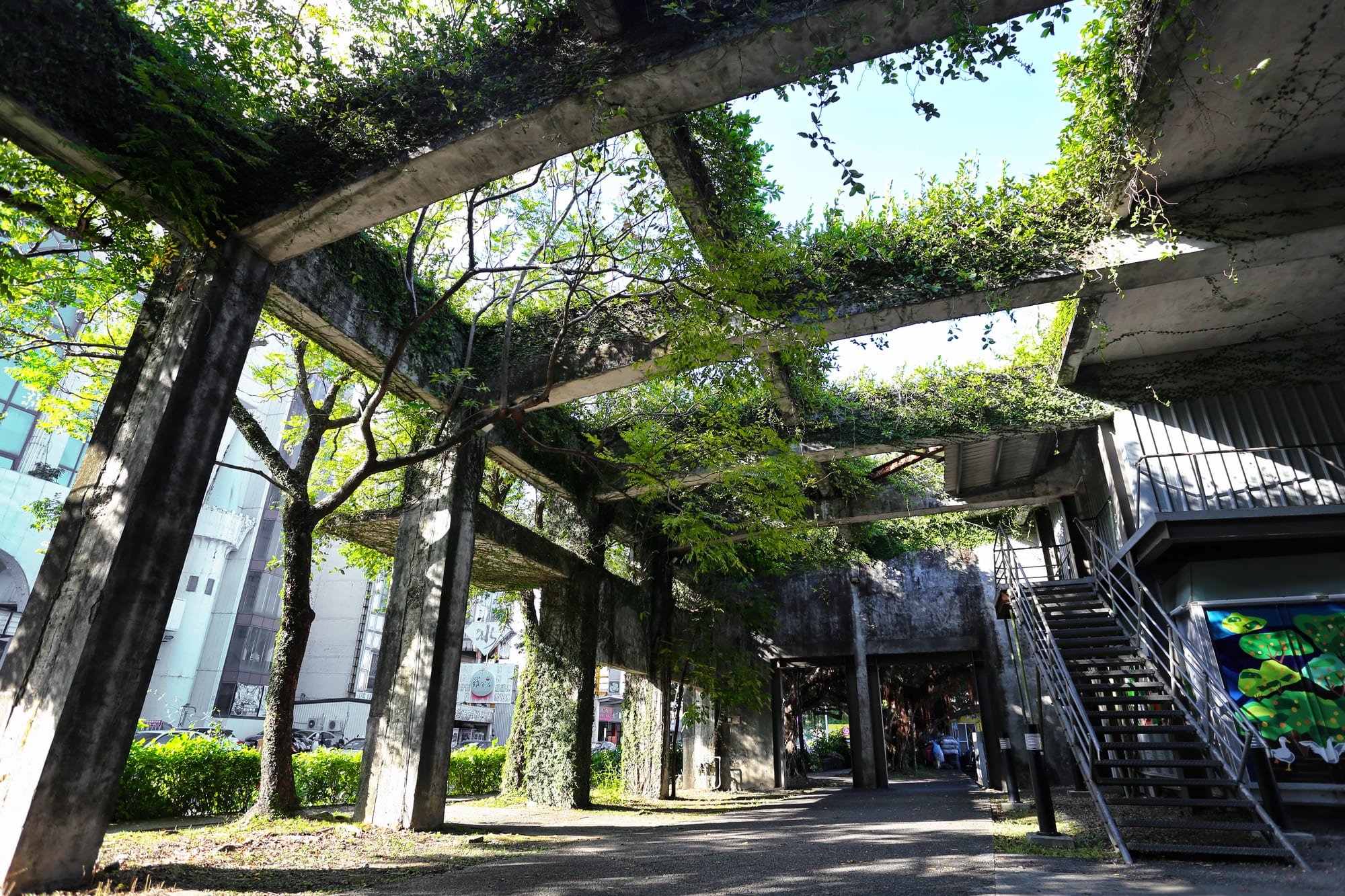
Concrete beams of a disused railway warehouse overgrown with creepers, shading a path beside shops in Yilan

Taipei & Northern Taiwan, Taiwan

Yilan

The old railway warehousing beside Yilan station, kept as a shaded public space in the town centre. (Mk2010 / Wikimedia Commons · CC BY-SA 4.0)

The county town of Yilan, set on the flat Lanyang Plain between the Snow Mountains and the Pacific in north-eastern Taiwan. Founded as a walled Qing outpost in the early 19th century, it is now a low-rise market and administrative town whose ring roads trace the vanished walls, an hour from Taipei through a long mountain tunnel.

Neighbourhoods

  • The old walled centre
    • First-time visitors
    • Historic district
    • Temples

    The oval of streets inside the ring roads that replaced the Qing town wall, around Zhongshan Road and the city god temple. Shops, banks and small restaurants occupy two- and three-storey buildings, and several Japanese-era wooden houses survive in the lanes behind them.

    Open in Maps
  • Around the railway station
    • Close to public transport
    • Best for food
    • Families

    The eastern edge of the centre, where the station, the bus stands and the old rail warehouses sit together. Illustrated sculptures by the artist Jimmy Liao stand in the small parks beside the tracks, and the Dongmen night market is a short walk away.

    Open in Maps
  • The riverside and the county quarter
    • Quiet and residential
    • Walks and cycling

    North and west of the centre the town runs down to the embankments of the Yilan River, with sports grounds, cycle paths and the county government offices. It is quiet, green and flat, with the mountains filling the skyline on clear days.

    Open in Maps
  • The outer plain
    • Local life
    • Quiet and residential

    Beyond the ring road the town dissolves quickly into rice fields dotted with new villas and homestays, criss-crossed by irrigation channels. Most visitors pass through it on the way to the hot springs, the coast or the craft villages.

    Open in Maps

Things to do

In the town

  • Yilan railway stationtransit hub

    The town's station on the Yilan line, its frontage and the disused warehouses beside it decorated with sculptures from the picture books of the illustrator Jimmy Liao.

    Open in Maps
  • Kavalan Distilleryattraction

    A single malt whisky distillery at Yuanshan just outside the town, founded in 2005 as Taiwan's first, whose bottlings brought Taiwanese whisky international recognition.

    Open in Maps
  • Yilan Museum of Artmuseum

    A small county art museum that opened in 2014 in a former Bank of Taiwan branch in the centre, showing work by artists from the Lanyang Plain.

    Open in Maps

Hot springs and water

  • Jiaoxiattraction

    A hot-spring town on the plain north of Yilan, its water piped into public pools, foot baths and spa hotels and busiest in winter.

    Open in Maps
  • Wufengqi Waterfallattraction

    A waterfall of three tiers dropping about 100 metres in the hills above Jiaoxi, reached by a short paved walk through subtropical forest.

    Open in Maps
  • Dongshan River Water Parkpark

    A long landscaped park along the river south-east of town, used for dragon-boat racing and as the site of the summer children's festival.

    Open in Maps

Coast and islands

  • Toucheng and the Wai'ao coastneighborhood

    A coastal town at the northern end of the plain, with a dark-sand surf beach at Wai'ao and boat trips out to the turtle-shaped volcanic island offshore.

    Open in Maps
  • Lanyang Museummuseum

    A museum at Toucheng in a wedge-shaped building that echoes the tilted rock strata of the coast, explaining the plain's geology, Kavalan history and fishing.

    Open in Maps

Craft, forest and short trips

  • National Center for Traditional Artsattraction

    A large riverside complex of reconstructed old streets and workshops south-east of town, with puppet theatre, opera and craft demonstrations.

    Open in Maps
  • Luodongneighborhood

    The plain's busiest market town, south of Yilan, known for its night market and for a park on the site of the Japanese-era timber yards.

    Open in Maps
  • Taipingshanattraction

    One of Taiwan's three main forest recreation areas, high in the mountains west of the plain, a former logging centre with old-growth forest, a narrow-gauge line rebuilt from the timber railway and cloud-covered ridges.

    Open in Maps
  • Su'aoneighborhood

    A fishing and naval harbour at the southern end of the plain, known for its cold mineral springs and for the start of the cliff road south.

    Open in Maps

Seasonal events

  • Yilan International Children's Folklore and Folkgame FestivalJuly and August

    A summer festival of games, water play and folk performance in the Dongshan River park, with groups invited from abroad.

  • Yilan Green Expospring

    An outdoor exhibition of farming, forestry and ecology held on the plain, aimed largely at families and school groups.

  • Lunar New YearJanuary or February

    Temples in the old centre fill with worshippers and the night markets stay open late as families return to the town.

  • Ghost month ritesseventh lunar month, usually August

    Offerings are made outside houses and shops across the plain, and Toucheng holds its pole-climbing ritual at the end of the month.

Eat and drink

Long-standing places and food districts in Yilan. Hours, ratings and directions come from your maps app, always current.

Yilan classics

  • Scallion pastriesrestaurant

    Flaky fried pastries stuffed with the long, mild green onions grown at Sansing on the plain, sold from stalls and shopfronts across the county.

    Open in Maps
  • Gao zharestaurant

    A local speciality of thickened chicken or pork stock set into blocks, crumbed and deep-fried so that the inside is almost liquid.

    Open in Maps
  • Yalushi duckrestaurant

    Duck smoked or roasted and served sliced with rice, a dish the plain's restaurants are known for, along with duck congee and duck noodle soup.

    Open in Maps

Markets and food streets

  • Dongmen Night Marketmarket

    The town's main night market, in the streets near the railway station, with stalls of fried chicken, oyster omelettes, sausages, shaved ice and bubble tea.

    Open in Maps
  • Luodong Night Marketmarket

    A larger market in the town to the south, known across Taiwan for its mutton soup, spring-onion pancakes and steamed buns.

    Open in Maps
  • The old centre's noodle shopsneighborhood

    Breakfast counters, beef noodle shops and old-fashioned bakeries line the streets inside the ring roads, busiest in the early morning and at lunchtime.

    Open in Maps

Experience Yilan

History

The Lanyang Plain was the country of the Kavalan people, who farmed and fished its river mouths in dozens of villages and long resisted outside settlement because the mountains cut the plain off from the rest of Taiwan. Han Chinese arrived in force only in the late 18th century, when a party led by Wu Sha pushed in from the north and built a stockade at Toucheng. In 1810 the Qing authorities set up a formal administration on the site of modern Yilan, the Komalan sub-prefecture, and the town wall was completed the year after. The Kavalan lost most of their land within a few decades and many moved south towards Hualien.

Under Japanese rule from 1895 the walls came down and were replaced by the ring of roads that still circles the centre, and the plain was reorganised around rice, timber from the mountains and a new railway, which reached Yilan in 1919 and was completed as the Yilan line in 1924. Government offices, schools and wooden official residences gave the town its administrative character, which it has kept ever since.

For most of the 20th century Yilan remained hard to reach from Taipei, either by a slow coastal railway or over a winding mountain pass. That changed in 2006 with the opening of the Hsuehshan Tunnel, almost 13 kilometres long, which cut the road journey to about an hour. Weekend visitors, homestays and retirement houses followed, and the plain has been remaking itself around them since.

Culture & Customs

Yilan thinks of itself as a cultural county rather than an industrial one, and county government has spent decades on festivals, museums and parks rather than factories. The children's folklore festival on the Dongshan River, held since 1996 apart from a break in the late 2000s, is the best-known result, and the National Center for Traditional Arts nearby keeps glove puppetry, Taiwanese opera and craft workshops going as living trades rather than museum pieces. Taiwanese opera, the only form of Han traditional drama known to have begun in Taiwan, started here.

The town's own rhythms are those of a small administrative centre: temple festivals, school events, morning markets and the county fair. The city god temple and the older Mazu and Guandi halls organise processions with drums, firecrackers and costumed guardians several times a year, and in the seventh lunar month the whole plain makes offerings, culminating in the pole-climbing contest at Toucheng, where teams scale greased towers hung with offerings.

Kavalan identity, long suppressed, has been publicly revived in recent decades, and their name is attached to everything from the plain's history museums to its whisky. Newcomers from Taipei have added cafés, galleries and small presses. The manner of the place is rural and unhurried; Taiwanese Hokkien is widely spoken alongside Mandarin, and people are used to weekend visitors but not shaped by them.

Daily Life

About 95,000 people live in Yilan City, and roughly 450,000 in the county as a whole, spread among the market towns of the plain rather than concentrated in one centre. Luodong to the south is busier commercially, and Su'ao holds the harbour, so Yilan's role is administrative: the county government, courts, hospitals and senior schools are here, and much of the working population is employed by them.

Farming still shapes the landscape, above all rice, with the long scallions of Sansing, kumquats, pears and vegetables on the terraces above. Fishing works out of Su'ao and the smaller harbours, and the mountains behind supply water and, historically, cypress timber. Tourism is now a mainstay: hot-spring hotels, hundreds of homestays among the fields, and weekend traffic that regularly backs up in the tunnel on Sunday evenings.

Life is low-rise and slow by Taiwanese standards. Mornings begin early at temple markets and breakfast shops, the afternoon is quiet, and the night markets do their trade after dark. The issues residents discuss are familiar ones: farmland turned into holiday villas, water and flooding on a plain that drains badly in heavy rain, ageing villages as young people commute or move to Taipei, and the persistent damp of the winter monsoon.

Food

Yilan's food is plainer and sweeter-edged than Taipei's, built on what the plain grows. The three-star scallions of Sansing — long, white-stemmed and mild — are the county's emblem, chopped into the flaky fried pastries known as scallion pancakes that are sold at roadside stalls, or into omelettes and dumplings. Duck is the other great local product: smoked or roasted, sliced over rice, shredded into congee, or served as duck noodle soup in restaurants across the plain.

The most distinctive local dish is gao zha, a thickened stock of chicken or pork enriched with egg, set firm, cut into blocks, crumbed and deep-fried so that the outside is crisp and the inside almost liquid. Banquet cooking on the plain also keeps up the old Taiwanese outdoor-feast repertoire of steamed fish, taro and pork dishes. Kumquats are candied or pressed into a sour-sweet drink, and glutinous rice cakes, peanut brittle rolled with ice cream and coriander, and preserved plums turn up in markets and gift shops.

Night markets are where most visitors eat: Dongmen in Yilan and the larger Luodong market to the south, where mutton soup, fried buns and shaved ice draw long queues. Tea, bubble tea and cold-brewed drinks are everywhere, and the Kavalan distillery just outside the town has made Yilan an unlikely name in single malt whisky.

Planning tools

Budget

Yilan is noticeably cheaper than Taipei for food and rooms, and many visitors stay in the homestays that fill the surrounding rice fields. Hot-spring hotels at Jiaoxi and lakeside or riverside resorts raise the cost at weekends and holidays, when the plain fills with traffic from the capital. Buses, local trains and market food cost very little.

Daily Budget Midrange
USD 80–150 (mid-range hotel or homestay, restaurant meals, a hot-spring bath, a hire car or taxis)
Daily Budget Shoestring
USD 30–55 (hostel or simple hotel, night-market meals, local trains and buses)

Rooms are cheapest midweek; public hot-spring pools and foot baths at Jiaoxi cost a fraction of a spa hotel stay.

Best Time to Visit

Autumn, from October to early December, and spring from March to May are the most comfortable seasons on the plain. Winter is the season for the hot springs, though the north-east monsoon makes Yilan one of the wettest places in Taiwan from December to February. Summer is hot and humid, brings the children's festival and the beach crowds, and carries the risk of typhoons.

Suggested Number of Days

A day or two covers the town itself, which is small and flat. Three or four allow the hot springs, the coast, the craft centre and the mountain forest as well. Weather and whether a car is available change the number more than anything else.

First Visit
1–2 days
With Surroundings
3–4 days

Transportation

Local and express trains on the Yilan line link the town with Jiaoxi, Luodong, Su'ao and the north coast, and are the simplest way to move along the plain. County buses radiate from the station to the villages, the craft centre and the mountains, but run infrequently outside the main routes. Many visitors hire a car or a scooter, and bicycles suit the flat lanes and river embankments.

Check bus times before setting out for Taipingshan or the smaller villages; services thin out sharply in the afternoon.

Airport & Station Connections

Yilan lies about 60 kilometres by road south-east of Taipei. Motorway coaches through the Hsuehshan Tunnel take roughly an hour from several points in the capital and run very frequently; trains on the Yilan line take between one and two hours depending on the service, and continue south towards Hualien. Taoyuan International Airport is about two hours away by direct coach.

Walkability

The centre is small, flat and easily walked: the station, the night market, the old temples and the county offices lie within about fifteen minutes of one another. Pavements are interrupted by parked scooters, and shopfront arcades often serve in their place. Beyond the ring roads distances open out across the fields, and walking gives way to bicycles, scooters and cars.

Safety

Crime is low and the town is quiet at night. The main hazards are natural and practical: heavy rain and typhoons from summer into autumn, flooding and landslides on the mountain roads afterwards, strong rip currents on the open coast, earthquakes, and busy scooter traffic on the main roads.

Follow typhoon warnings and beach flags, swim only where lifeguards are posted, and check mountain road conditions after heavy rain. Check current official travel advice before travelling.

Climate

Subtropical and very wet. The plain faces north-east into the winter monsoon, which brings weeks of rain and wind between December and February, while summer is hot, humid and prone to afternoon storms and typhoons. Clear days give long views to the mountains and to Turtle Island.

Summer
hot and humid, about 28–34°C, with afternoon thunderstorms and typhoon risk from July to September
Winter
cool and wet, about 14–20°C, with long spells of drizzle driven in off the sea

Local Customs

Tipping is not expected in Taiwan. Temples are open to visitors who keep quiet and ask before photographing worshippers. Shoes are removed in homes, in many homestays and at the entrance to hot-spring pools, where bathers wash before entering and tattoos may draw comment in older establishments. Rural hosts are hospitable and often insist on offering tea or fruit.

At hot springs, rinse off before getting in and keep towels out of the water; swimwear is required in mixed public pools.

Common Payment Methods

The currency is the New Taiwan dollar. Hotels, chain shops and larger restaurants take cards, but night-market stalls, small kitchens, homestays and rural buses often want cash, so notes are needed every day. ATMs are in convenience stores throughout the town, and an EasyCard covers trains and buses.