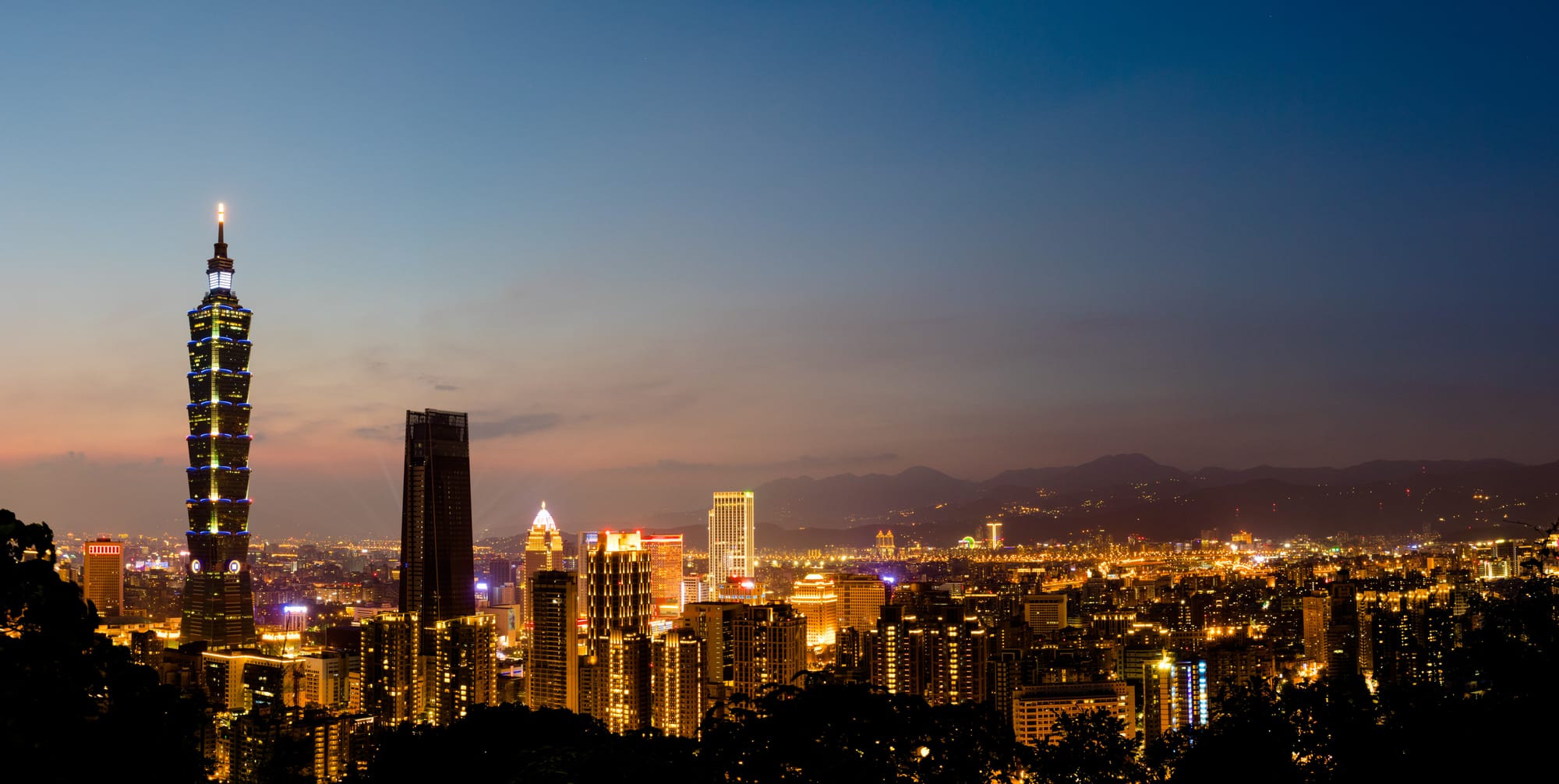
Taipei at dusk from a wooded hillside, the lit tower of Taipei 101 rising above a wide floor of city lights and dark mountains

Taipei & Northern Taiwan, Taiwan

Taipei

The Taipei basin at dusk, seen from the hills on the city's eastern edge. (Jorge Cancela / Wikimedia Commons · CC BY 2.0)

Taiwan's capital, set in a basin ringed by green hills where the Danshui, Keelung and Xindian rivers meet. A 19th-century walled city that became the seat of Japanese colonial government and then of the Republic of China, it is now a dense, orderly city of metro lines, temples, night markets and hot springs, with the 508-metre Taipei 101 at its centre.

Neighbourhoods

  • Xinyi
    • First-time visitors
    • Shopping
    • Nightlife

    The planned business and shopping district built on former army land in the east of the city, with Taipei 101, the city hall, department stores, cinemas and the Taipei World Trade Center. Elephant Mountain rises straight behind it, giving the standard view back over the towers.

    Open in Maps
  • Zhongzheng
    • Historic district
    • Museums
    • Close to public transport

    The administrative core, holding the Presidential Office Building, the Chiang Kai-shek Memorial Hall and its two theatres, the Japanese-era Taipei Main Station area and the Huashan creative park. Almost every metro and rail line meets here.

    Open in Maps
  • Wanhua
    • Temples
    • Street food
    • Local life

    The oldest part of the city, once the river port of Mengjia. Longshan Temple, the Bopiliao rows of Qing and Japanese-era shophouses, herbal medicine streets and the Huaxi Street night market are all within a few blocks, in a district that is poorer and more worn than the east side.

    Open in Maps
  • Datong and Dadaocheng
    • Historic district
    • Tea and dried goods
    • Cafés

    The 19th-century tea-trading quarter on the Danshui River, where Dihua Street's arcaded merchant houses sell dried seafood, herbs and fabric, busiest before Lunar New Year. Old shops now sit beside small cafés, tea rooms and galleries, with the Ningxia night market nearby.

    Open in Maps
  • Da'an
    • Best for food
    • Students and bookshops
    • Quiet and residential

    The central residential district around National Taiwan University and Da'an Forest Park, with the lanes of Yongkang Street, the Shida and Gongguan student areas and a dense spread of restaurants, bakeries and bookshops. Well served by two metro lines.

    Open in Maps
  • Zhongshan
    • Hotels
    • Shopping
    • Close to public transport

    A hotel and department-store district north of the main station, with the tree-lined Zhongshan North Road laid out in the Japanese era, the Taipei Fine Arts Museum and Xingtian Temple at its edges, and a long-established Japanese restaurant and bar quarter around Linsen North Road.

    Open in Maps
  • Beitou
    • Hot springs
    • Quiet and residential
    • Families

    The hot-spring valley in the far north of the city, reached by a branch of the metro. Sulphurous steam rises from Thermal Valley, public and hotel baths line the stream, and the Japanese-era wooden bathhouse is now a museum. Yangmingshan National Park begins above it.

    Open in Maps
  • Shilin
    • Museums
    • Night markets
    • Families

    The large northern district holding the National Palace Museum, the Shilin Official Residence gardens, the science and astronomy museums at Shilin's edge and the city's best-known night market. Much of the district is hill and forest rather than street.

    Open in Maps

Things to do

Famous landmarks

  • Taipei 101landmark

    The 508-metre tower completed in 2004 and the world's tallest building until 2009, with an indoor and outdoor observatory and a huge steel damper hung near the top.

    Open in Maps
  • Chiang Kai-shek Memorial Halllandmark

    A white hall under a blue octagonal roof, opened in 1980, standing above a vast square shared with the National Theater and National Concert Hall.

    Open in Maps
  • Longshan Templelandmark

    Wanhua's temple, founded in 1738 by settlers from Fujian and rebuilt several times, crowded with worshippers making offerings to Guanyin and to Taoist and folk deities.

    Open in Maps
  • Presidential Office Buildinglandmark

    A red-brick Japanese-era building of 1919 with a central tower, built as the Governor-General's office and still the seat of the presidency.

    Open in Maps
  • Bao'an Templelandmark

    A Datong temple to the medicine god Baosheng Dadi, known for its carving and painting and for a restoration that won a UNESCO heritage conservation award.

    Open in Maps
  • Xingtian Templelandmark

    A busy street-corner temple in Zhongshan to Guan Yu, patron deity of merchants, soldiers and police, known for the dragon sculptures worked into its design.

    Open in Maps

Museums and galleries

  • National Palace Museummuseum

    One of the world's great collections of Chinese art, brought from Beijing's Forbidden City, with bronzes, jades, ceramics, painting and calligraphy shown in rotation.

    Open in Maps
  • Taipei Fine Arts Museummuseum

    The first museum in Taiwan built for contemporary art exhibitions, opened in 1983 in a stacked white building beside the Keelung River, showing Taiwanese and international contemporary work.

    Open in Maps
  • National Taiwan Museummuseum

    The island's oldest museum, founded under Japanese rule in 1908, in a domed neoclassical building in 228 Peace Memorial Park, covering natural history and Indigenous cultures.

    Open in Maps
  • Beitou Hot Spring Museummuseum

    The Japanese-era public bathhouse of 1913, built of red brick and wooden weatherboards and described as the largest bathhouse in East Asia of its day, now telling the story of the valley.

    Open in Maps
  • Su Ho Memorial Paper Museummuseum

    A small Zhongshan museum devoted to handmade paper, opened in 1995.

    Open in Maps

Parks, hills and viewpoints

  • Taipei Botanical Gardenpark

    A garden laid out under Japanese rule beside the Nanhai academic quarter, with a lotus pond, themed plant beds and an old Qing-era official building in its grounds.

    Open in Maps
  • Yangmingshan National Parkpark

    A volcanic park of fumaroles, sulphur deposits, hot springs and hiking trails, known for its spring cherry blossom, rising directly above the city's northern districts.

    Open in Maps
  • Da'an Forest Parkpark

    A large green square of lawns, banyans and an ecological pond in the middle of the city, opened in 1994 on land cleared of postwar housing.

    Open in Maps
  • 228 Peace Memorial Parkpark

    A central park with pavilions and ponds, holding the memorial and museum to the 228 Incident of 1947 and its long aftermath.

    Open in Maps
  • Maokong Gondolaattraction

    A cable car from Taipei Zoo over forested ridges to the tea-growing hills of Maokong, where teahouses look back at the city.

    Open in Maps
  • Taipei Zooattraction

    A large hillside zoo in Wenshan, known for its Formosan animal area and giant pandas.

    Open in Maps

Night markets and shopping streets

  • Shilin Night Marketmarket

    The city's largest and best-known night market, with a basement food court and streets of clothing and game stalls around it.

    Open in Maps
  • Raohe Street Night Marketmarket

    A straight, lantern-lit market street beside the Ciyou Temple in Songshan, known for hujiao bing, peppery pork buns baked in clay ovens.

    Open in Maps
  • Ningxia Night Marketmarket

    A compact, food-only market in Datong, favoured for older Taiwanese dishes such as oyster omelettes and taro balls.

    Open in Maps
  • Dihua Streetmarket

    The 19th-century trading street of Dadaocheng, lined with arcaded shophouses selling dried goods, medicine and cloth, at its busiest before Lunar New Year.

    Open in Maps
  • Huaxi Street Night Marketmarket

    A covered market near Longshan Temple, long known as Snake Alley, now quieter and centred on seafood and traditional tonic dishes.

    Open in Maps

Short trips from the city

  • Tamsuineighborhood

    A riverside town at the end of the red metro line in New Taipei, with the red-brick Fort San Domingo, a waterfront promenade and sunsets over the river mouth.

    Open in Maps
  • Yehliu Geoparkattraction

    A cape on the north coast where wind and sea have carved sandstone into mushroom-shaped rocks, including the much-photographed Queen's Head.

    Open in Maps
  • Pingxineighborhood

    A former coal-mining valley on a branch railway east of the city, known for sky lanterns released from the tracks and for Shifen Waterfall nearby.

    Open in Maps
  • Wulaineighborhood

    An Atayal village in a steep gorge south of the city, with hot springs, a waterfall and a small museum of Atayal culture.

    Open in Maps

Seasonal events

  • Taipei Lantern Festivalfirst full moon of the lunar year, February or March

    Lantern displays and crowds marking the close of the Lunar New Year period, held at changing sites around the city.

  • Yangmingshan Flower SeasonFebruary to March

    Cherry blossom and spring flowers draw heavy weekend traffic to the park above the city.

  • Taipei Pridelate October

    The largest LGBT parade in East Asia, marching through the centre of the city each autumn.

  • Ghost Month observancesseventh lunar month, usually August

    Offerings of food and incense appear outside homes, shops and temples across the city through the month.

  • Taipei MarathonDecember

    A road race through the city centre and along the riverside parks in the cool season.

Eat and drink

Long-standing places and food districts in Taipei. Hours, ratings and directions come from your maps app, always current.

Taipei classics

  • Din Tai Fungrestaurant

    The dumpling house that began as a Taipei cooking-oil shop in 1958, turned to xiaolongbao and became a full restaurant in 1972, making the thin-skinned soup dumplings known worldwide.

    Open in Maps
  • Beef noodle shops of Taipeirestaurant

    Niu rou mian, braised beef with noodles in a soy-and-spice broth or a clear one, is the city's defining bowl, served in small shops in every district and celebrated at an annual festival.

    Open in Maps
  • Yongkang Streetneighborhood

    A lane and its side streets in Da'an packed with dumpling houses, mango shaved-ice shops, beef noodle restaurants and tea sellers.

    Open in Maps

Markets and food districts

  • Raohe Street Night Marketmarket

    Best known for hujiao bing, peppery pork buns slapped onto the wall of a clay oven, along with grilled squid and herbal pork rib soup.

    Open in Maps
  • Ningxia Night Marketmarket

    A short food-only street known for oyster omelettes, taro balls and other older Taiwanese dishes.

    Open in Maps
  • Dadaocheng and Dihua Streetneighborhood

    Dried seafood, mushrooms, herbs and nuts sold from arcaded shophouses, with tea rooms and cafés in the restored buildings between them.

    Open in Maps

Tea and cafés

  • Maokong teahousescafe

    Hillside tea gardens above Wenshan growing Tieguanyin and Baozhong, with terraces looking down over the city.

    Open in Maps
  • Coffee and bubble tea shops of Da'ancafe

    The student lanes around Shida and Gongguan hold dense clusters of independent coffee shops and bubble tea counters.

    Open in Maps

Experience Taipei

History

Han settlers from Fujian reached the Taipei basin in the 18th century, farming land held by the Ketagalan people and building river ports on the Danshui. Mengjia, today's Wanhua, grew around Longshan Temple, founded in 1738, and traded rice, camphor and coal downstream. After silting and feuding weakened it, the tea merchants of Dadaocheng took over in the 1860s, when Tamsui was opened to foreign trade and Taiwanese oolong began to reach New York and London.

The Qing built a walled city between the two settlements in the 1880s, and Taipei became the seat of the new province of Taiwan in 1887, formally its capital in 1894. Japanese rule from 1895 remade it: the walls came down, leaving the boulevards that still ring the old centre, and a grid of brick public buildings went up, among them the Governor-General's office of 1919, the museum in what is now 228 Peace Memorial Park, and the railway that ran the length of the island. Beitou was developed as a hot-spring resort in the same period.

After 1945 the city passed to the Republic of China, and the 228 Incident began on its streets in February 1947, leading to a violent crackdown and decades of martial law. From 1949 Taipei served as the seat of the Republic of China government, and its population swelled with arrivals from the mainland who settled in military dependants' villages across the basin. Industry and then finance drove rapid growth; the metro opened in 1996, direct presidential elections were held that same year, and Taipei 101 was completed in 2004 on the site of a former army district that is now Xinyi.

Culture & Customs

Taipei is Taiwan's centre of government, media, publishing and popular music, and the most cosmopolitan part of the island. Mandarin is the everyday language, with Taiwanese Hokkien common among older residents in Wanhua and Datong and taught again in schools. The city is also the heart of Taiwan's liberal politics: its Pride parade is the largest in East Asia, and same-sex marriage became legal nationwide in 2019.

Temple life runs beneath the modern surface. Longshan, Bao'an and Xingtian temples draw steady streams of worshippers who cast divination blocks, burn incense and leave offerings, and folk religion, Buddhism and Taoism blend without much concern for boundaries. Ghost Month in the seventh lunar month brings offerings outside shops and homes; Lunar New Year empties the city's offices and fills Dihua Street.

Politeness is quiet rather than formal: queues, low voices on the metro, food handed over with two hands. The city has a strong reading and café culture, with long-hours bookshops, and a deep enthusiasm for baseball, basketball and cycling along the riverside paths. Live music, independent cinema and a large network of small galleries and creative parks — Huashan and Songshan, both converted from Japanese-era factories — carry much of the contemporary arts scene.

Daily Life

About 2.5 million people live in the city proper and about 7 million in the wider Taipei–Keelung metropolitan area, which takes in New Taipei wrapping around it, so the working day involves a large inward commute by metro, bus and scooter. Households are small, flats are expensive, and housing costs are the single most constant public argument, along with a low birth rate and an ageing population.

The economy is built on government, finance, technology headquarters, media, health care and universities rather than factories, which sit in Taoyuan, Hsinchu and New Taipei. The day starts early at breakfast shops selling soy milk, egg crêpes and rice rolls, runs long in the office, and ends at night markets, gyms, riverside parks or a hillside trail; convenience stores handle everything from parcels to bill payments at any hour.

Neighbourhood life is lived in lanes behind the main roads, where morning markets, laundries, temple courtyards and noodle shops sit under blocks of flats. Beitou, Shilin and Wenshan are greener and quieter; Da'an is the sought-after central district; Wanhua is the oldest and poorest, with an ageing population and a visible homeless community around the temple. Earthquake drills, typhoon days and air-quality warnings in winter are ordinary parts of the calendar.

Food

Taipei gathers the food of the whole island and adds the mainland cooking that arrived after 1949. Beef noodle soup, niu rou mian, is the emblematic dish, its braised version simmered with soy sauce, spices and chilli bean paste; the city holds an annual competition to rank the bowls. Xiaolongbao, soup dumplings folded with pleats and steamed in bamboo baskets, are the other signature, made famous worldwide by Din Tai Fung, which began here.

Night markets are where most eating happens. Raohe is known for hujiao bing, peppery pork buns baked against the wall of a clay oven; Ningxia for oyster omelettes, ozai jian, and taro balls; Shilin for fried chicken cutlets, sweet potato balls and grilled squid. Braised snacks, lu wei, are picked from trays and simmered to order, and stinky tofu, chou doufu, fermented and then fried or stewed, announces itself long before it appears. Breakfast shops sell warm or cold soy milk, doujiang, with fried dough sticks, turnip cakes and egg crêpes, dan bing.

Tea is central. Baozhong from Pinglin and Tieguanyin from the Maokong hills are served in the teahouses above the city, while bubble tea, zhenzhu naicha, black tapioca pearls in sweetened milk tea, is drunk everywhere from counter shops. Shaved ice piled with mango, taro or red beans is the summer standard, and pineapple cakes, fenglisu, are the city's usual gift to take home.

Planning tools

Budget

Taipei is the most expensive city in Taiwan to sleep in, but food and transport stay cheap: a night-market dinner or a bowl of beef noodles costs a few dollars, and metro fares are low. Museum entry is modest, many temples and parks are free, and the main variable is the hotel.

Daily Budget Midrange
USD 110–200 (mid-range hotel, restaurant meals, museum entry, day trips, a hot-spring bath)
Daily Budget Shoestring
USD 45–70 (hostel bed, night-market and convenience-store food, metro and buses)

An EasyCard covers the metro, buses, local trains and YouBike hire, and public hot-spring pools in Beitou cost a fraction of a spa hotel.

Best Time to Visit

October to early December and March to May bring the most comfortable weather. Winter is cool, grey and often drizzly, which is the natural season for Beitou's hot springs, while summer is hot and humid with afternoon thunderstorms and the risk of typhoons. Lunar New Year closes many small shops for several days.

Suggested Number of Days

Three or four days suit a first visit to the city itself, and five to seven allow the north coast, the mountains and the old towns around it. Museums, hot springs and hill walks all add time, and wet weather slows everything down.

First Visit
3–4 days
With Surroundings
5–7 days

Transportation

The Taipei Metro is fast, clean and signed in English, and reaches almost everything a visitor wants, including Beitou, Tamsui and Taipei Zoo; buses fill the gaps and YouBike stands are everywhere. Taxis are plentiful and inexpensive. Scooters dominate the surface traffic, and driving in the basin is rarely worth the trouble.

Eating and drinking are not allowed in metro stations or on trains, and queue markings on platforms are strictly observed.

Airport & Station Connections

Taoyuan International Airport, about 35 kilometres west, is Taiwan's main gateway and is linked to Taipei Main Station by the Airport MRT in under an hour, or by frequent buses. The smaller Songshan Airport sits inside the city and handles domestic and some regional flights. High Speed Rail trains run down the west coast from Taipei Main Station, reaching Kaohsiung in around two hours.

Walkability

The centre is flat and easy to walk, with covered arcades along many older streets that help in rain and sun, though blocks are long and crossings wide. Districts are far apart, so most visitors walk locally and use the metro between areas. Pavements are often shared with parked scooters, and summer heat and humidity shorten most walks.

Safety

Taipei is very safe, with low crime even late at night, and solo walking is normal. The real hazards are natural and practical: earthquakes, typhoons between roughly July and October, heavy scooter traffic, slippery mountain trails after rain, and very hot water in unregulated hot springs.

Cross at marked crossings and watch for scooters turning, follow typhoon and earthquake instructions from hotels and the authorities, and test hot-spring water before stepping in. Check current official travel advice before travelling.

Climate

Subtropical and humid. The city sits in a basin that traps heat, so summers are hotter than the coast, and the north-east monsoon brings weeks of cool drizzle in winter. Rain is possible in any month.

Summer
hot and humid, often 30–36°C, with afternoon thunderstorms and the typhoon season
Winter
cool and damp, roughly 12–20°C, with long grey spells and occasional cold snaps

Local Customs

Tipping is not expected; some restaurants add a service charge. Queuing is orderly, voices are kept low on the metro, and priority seats are usually left empty even on crowded trains. Shoes come off in homes, some guesthouses and temple halls. In temples, follow what others do, stand aside from people praying, and ask before photographing worshippers or rituals.

Rubbish is mostly handed to the collection lorries rather than left on the street, so bins are scarce — carry litter until a shop or station bin appears. Smoking is banned indoors in public places.

Common Payment Methods

The currency is the New Taiwan dollar. Cards are accepted in hotels, department stores and larger restaurants, but cash is still normal in night markets, small eateries and temples. ATMs are in every convenience store, and stored-value EasyCards can be used for small purchases in shops as well as transport.