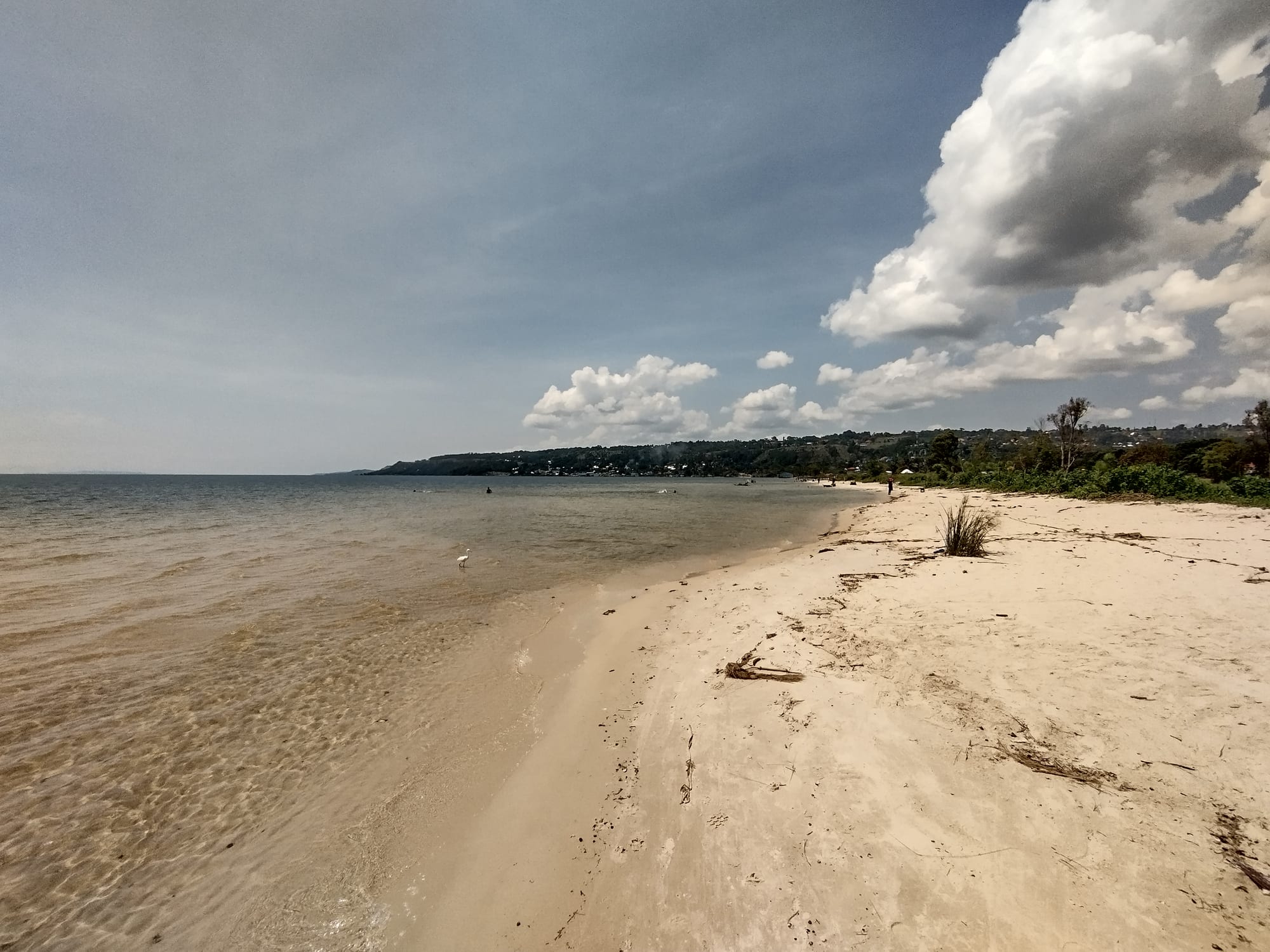
A wide sandy beach curving along calm lake water, with wooded green hills and scattered buildings on the far shore under tall clouds

Mwanza & Lake Victoria, Tanzania

Bukoba

The Lake Victoria shore at Bukoba, where sandy beaches run north towards the wooded hills of Kagera. (Bugsinmyfood / Wikimedia Commons · CC BY-SA 4.0)

The main town of Kagera Region, on the western shore of Lake Victoria a short way south of the Ugandan border. A German colonial post that became a lake port and the market centre of the Haya banana and coffee country, it is a low, green, rainy place of sandy lake beaches, church institutions and ferry and air links across the water to Mwanza.

Neighbourhoods

  • The town centre
    • First-time visitors
    • Markets
    • Close to transport

    A small grid of low streets a little back from the water, holding the market, the banks, the bus stand and most of the shops and eating places. Everything in it is within a few minutes' walk, and the older administrative buildings from the colonial period stand among newer concrete blocks.

    Open in Maps
  • The lake shore
    • Beaches
    • Quiet and residential
    • Sunsets

    The flat strip between the town and the water, with sandy beaches, football pitches and a scatter of hotels and bars facing the lake. It is where the town walks in the late afternoon, and where the port and the small boat landings are.

    Open in Maps
  • Nyamukazi
    • Local life
    • Fishing harbour

    A low-lying fishing settlement on the spit north of the town centre, where boats are pulled up on the sand and the day's catch is sorted and dried. It is an ordinary working neighbourhood rather than a sight, and floods in heavy rain.

    Open in Maps
  • The hills above the town
    • Views
    • Quiet and residential

    Bukoba sits below an escarpment, and the residential wards climbing it hold schools, church institutions and newer houses. The road up towards Kagera's interior gives the long view back over the roofs, the beaches and the open lake.

    Open in Maps

Things to do

In and around the town

  • Kaitaba Stadiumattraction

    Bukoba's football ground, home of Kagera Sugar, and the busiest place in town on a match day.

    Open in Maps
  • Bukoba Airporttransit hub

    The domestic airport about a kilometre from the centre, first built by the British in the 1940s and rebuilt between 2008 and 2016, with flights that make the lake crossing in a fraction of the road or ferry time.

    Open in Maps

Short trips from the town

  • Minziro Forest Reservepark

    A reserve of seasonal swamp forest along the Kagera River, gazetted in 1947 and continuous with the Malabigambo forest across the Ugandan border, of a forest type found nowhere else in Tanzania and well known to birdwatchers.

    Open in Maps
  • Kagera Riverattraction

    A headwater of the Nile that forms the region's borders with Rwanda and Uganda before emptying into Lake Victoria, crossed on the road north-west of Bukoba.

    Open in Maps
  • Rubondo Island National Parkpark

    A forested island national park in the lake, with chimpanzees, sitatunga antelope, hippos and quiet shoreline walks.

    Open in Maps
  • Burigi-Chato National Parkpark

    Tanzania's fourth-largest national park, declared in 2019, of wooded savanna, hills and the long Lake Burigi, with sitatunga antelope in its swamps and very few visitors.

    Open in Maps

Eat and drink

Long-standing places and food districts in Bukoba. Hours, ratings and directions come from your maps app, always current.

Markets

  • Bukoba central marketmarket

    The town's produce market, piled with matoke bananas, beans, groundnuts, tomatoes and dried fish, and the place to find senene grasshoppers by the bag in season.

    Open in Maps

Food districts

  • The lake-shore grillsneighborhood

    Simple bars and grills along the shore serve lake fish — tilapia fried whole or stewed in tomato and onion — with chips, rice or ugali, and cold drinks at sunset.

    Open in Maps
  • Town-centre eating housesneighborhood

    Small local restaurants around the market and bus stand serving matoke with beans or meat sauce, pilau, chapati and chai through the day.

    Open in Maps

Experience Bukoba

History

The hills behind Bukoba were the country of the Haya, whose small kingdoms — Kiziba, Kyamtwara, Ihangiro, Bugabo and others — were ruled by royal clans with close ties to the kingdoms of what is now Uganda, and who are credited with making carbon steel two thousand years ago in pre-heated furnaces. The lake shore was a landing place for canoe traffic between the western bays long before any European arrived.

Emin Pasha founded Bukoba in 1890 as the first German military station on Lake Victoria, and it became the administrative centre of the north-western corner of German East Africa, with a harbour, a fort built in 1901 and Catholic and Protestant mission stations that gave the district its long reputation for schools. In June 1915 British forces crossed the lake from Kisumu to destroy the town's wireless station and sacked Bukoba — the first Entente victory in German East Africa.

Under British rule Bukoba grew as a coffee port: the Haya cooperatives of Kagera sent robusta out by lake steamer to Mwanza and on by rail, and the town became a byword in Tanganyika for education and for producing clergy, teachers and civil servants. Independence, the Kagera war with Idi Amin's Uganda, which began with the bombing of Bukoba in October 1978, the arrival of several hundred thousand Rwandan refugees in the region in 1994, and the first documented AIDS cases in Tanzania, recorded in Kagera in 1983, all marked the district. A magnitude 5.9 earthquake on 10 September 2016 destroyed 840 houses in the town and seriously damaged more than 1,200 others, killing 19 people across the area. It remains a modest regional capital, tied to the lake, the border and the coffee trade.

Culture & Customs

Bukoba is the town of the Haya, whose language belongs with those of southern Uganda rather than with Swahili's coastal relatives, and whose culture is built around the banana garden — the kibanja, a permanent plot of bananas, coffee and fruit trees handed down within a family. Coffee itself carries meaning beyond the cash crop: cooked and dried cherries, chewed and shared, have long been a gesture of welcome and a part of ceremony and reconciliation.

Christianity is deeply established. The Catholic church has been the dominant institution in Kagera for more than a century, with Lutheran congregations alongside it, and the calendar of church feasts, choir competitions and school events shapes much of public life. Bukoba's schools and seminaries have sent a steady stream of graduates into the professions, and the town's self-image rests on that history of education as much as on the lake.

Music and dance draw on the old court traditions of the Haya kingdoms, with drums and flutes at weddings and public celebrations, while younger people listen to the same Bongo Flava heard across Tanzania and to Ugandan and Congolese music that crosses the border easily. Football is followed closely, Kagera Sugar being the local club. Greetings are unhurried, elders are addressed with shikamoo, and the pace of the town is deliberately slow.

Daily Life

About 145,000 people lived in Bukoba at the 2022 census, far fewer than in Mwanza across the lake. It is a government and service town: the regional administration, hospitals, schools and church institutions are among the largest employers, alongside trade, transport and fishing.

The countryside around it is densely farmed and the town lives from it. Bananas and beans come in daily from the hills, and coffee is the cash crop, bought, processed and exported through cooperatives and private buyers. Fishing brings in tilapia, Nile perch and dagaa, dried on racks along the shore. Cross-border trade with Uganda to the north, including daily commuting into Rakai District, moves goods in both directions, and money sent home by people working in Dar es Salaam or abroad matters to many families.

The day starts early at the fish landings and the market and slows through the hot middle hours; the late afternoon brings people onto the beaches and the football pitches. Current concerns are familiar ones in Kagera: rain and flooding in the low-lying wards near the water, the price paid for coffee, pressure on the lake's fish stocks, and the long-term effects of the earthquake on older buildings.

Food

Bukoba eats differently from most of Tanzania. The staple is matoke — green cooking bananas, peeled, steamed in their own leaves and mashed — served with beans, groundnut sauce, meat stew or fish rather than with the maize ugali that dominates elsewhere. A meal without bananas is barely a meal in the Haya countryside, and dozens of banana varieties are grown for cooking, roasting, juice and beer.

Fish from Lake Victoria is the other pillar. Sato, the tilapia, is fried whole or simmered in tomato and onion; sangara, the Nile perch, is cut into steaks; and dagaa, small silver fish dried in the sun, are fried with tomato and onion and eaten with ugali or matoke. Grills along the shore cook the day's catch over charcoal.

The town's best-known delicacy is senene — bush crickets that swarm in the rainy months and are caught at night, cleaned, and fried with salt and onion until crisp. They are sold by the bag in the market and at bus stops, and are a Kagera gift to relatives elsewhere in the country.

To drink there is chai with milk and sugar, fresh banana and passionfruit juice, and the home-brewed banana beer and distilled spirit of the villages. Kagera coffee, the district's export, is increasingly roasted and drunk locally as well.

Planning tools

Budget

Bukoba is inexpensive. It sees few foreign visitors, so prices are set by local trade: guesthouses in the centre are cheap, a handful of lakeside hotels cost more, and meals in town are among the cheapest in Tanzania. The costs that add up are transport — the flight or ferry across the lake and hired boats to the islands.

Daily Budget Midrange
USD 70–140 (lakeside hotel, restaurant meals, taxis and a hired boat)
Daily Budget Shoestring
USD 25–50 (guesthouse, local food, shared transport and the market)

Carry enough cash for boat hire and small guesthouses, which rarely take cards, and compare the flight with the ferry to Mwanza, as the fares are not far apart.

Best Time to Visit

June to August and the drier weeks around January are the easiest months, with warm days and less mud on the rural roads of Kagera. Bukoba is one of the wetter towns in Tanzania and rain can fall in any month, often as short heavy afternoon storms rather than all-day drizzle.

Suggested Number of Days

The town itself is small and a day or two covers it comfortably. Allow three or four to add the lake islands, the coffee and banana villages of the hills and a slow crossing of the lake, and more again if travelling on towards Uganda or Rwanda.

First Visit
1–2 days
With Surroundings
3–4 days

Transportation

The centre is walkable and most local journeys are by motorcycle taxi (boda boda), shared minibus (dalla dalla) or taxi. Buses run south and west into Kagera Region and on towards the Ugandan and Rwandan borders, and boats leave the shore for the nearby islands.

Agree fares before setting off, avoid long-distance road travel after dark, and insist on a life jacket on any small boat.

Airport & Station Connections

Bukoba Airport lies about a kilometre from the centre, with domestic flights that take a fraction of the time of the alternatives. Ferries link Bukoba with Mwanza across Lake Victoria, running overnight, and buses make the long road journey around the lake or north to the Ugandan border.

Walkability

Very walkable. The centre, the market and the lake shore sit within about a kilometre of one another on flat ground, and the beach makes a natural walking route. Pavements are patchy and unlit after dark, and the climb to the wards on the escarpment is steep enough that most people take a boda boda.

Safety

Bukoba is a quiet town with little crime beyond opportunistic theft around the market, the bus stand and the beaches after dark. The lake is the distinctive risk: small boats are often overloaded, and weather can change quickly on open water. Malaria is present year-round, and bilharzia is a risk in shallow water near settlements and reeds.

Avoid swimming in the lake near settlements or reeds, travel by road in daylight, and steer clear of demonstrations. Take malaria precautions year-round. Check current official travel advice before travelling.

Climate

Warm and humid all year, tempered by the lake and an altitude of about 1,100 metres, and notably rainy: the town has a tropical monsoon climate with two wet seasons, milder than most places of that type because of its height. Temperatures vary little from month to month.

Summer
December to March is warm and wet, with days around 27–29°C and heavy afternoon storms
Winter
June to August is the driest and slightly cooler stretch, with days around 25–27°C and nights near 17°C

Local Customs

Kagera is strongly Christian, largely Catholic, and church life is prominent. Greetings come before business, and shikamoo is the respectful greeting to an elder. Dress is modest by local habit rather than religious rule, and shorts on adults are unusual in town. Most of the surrounding countryside is Haya-speaking, but Swahili is understood everywhere.

Ask before photographing people, fishing boats or market stalls, accept banana beer or chai politely if offered, and keep beachwear to the beach.

Common Payment Methods

The currency is the Tanzanian shilling. There are banks and ATMs in the town centre, though they can be unreliable, and cards are accepted only at the larger hotels. Almost everything else — market stalls, boats, boda bodas, guesthouses — is cash, so it is worth drawing money before heading into the villages.