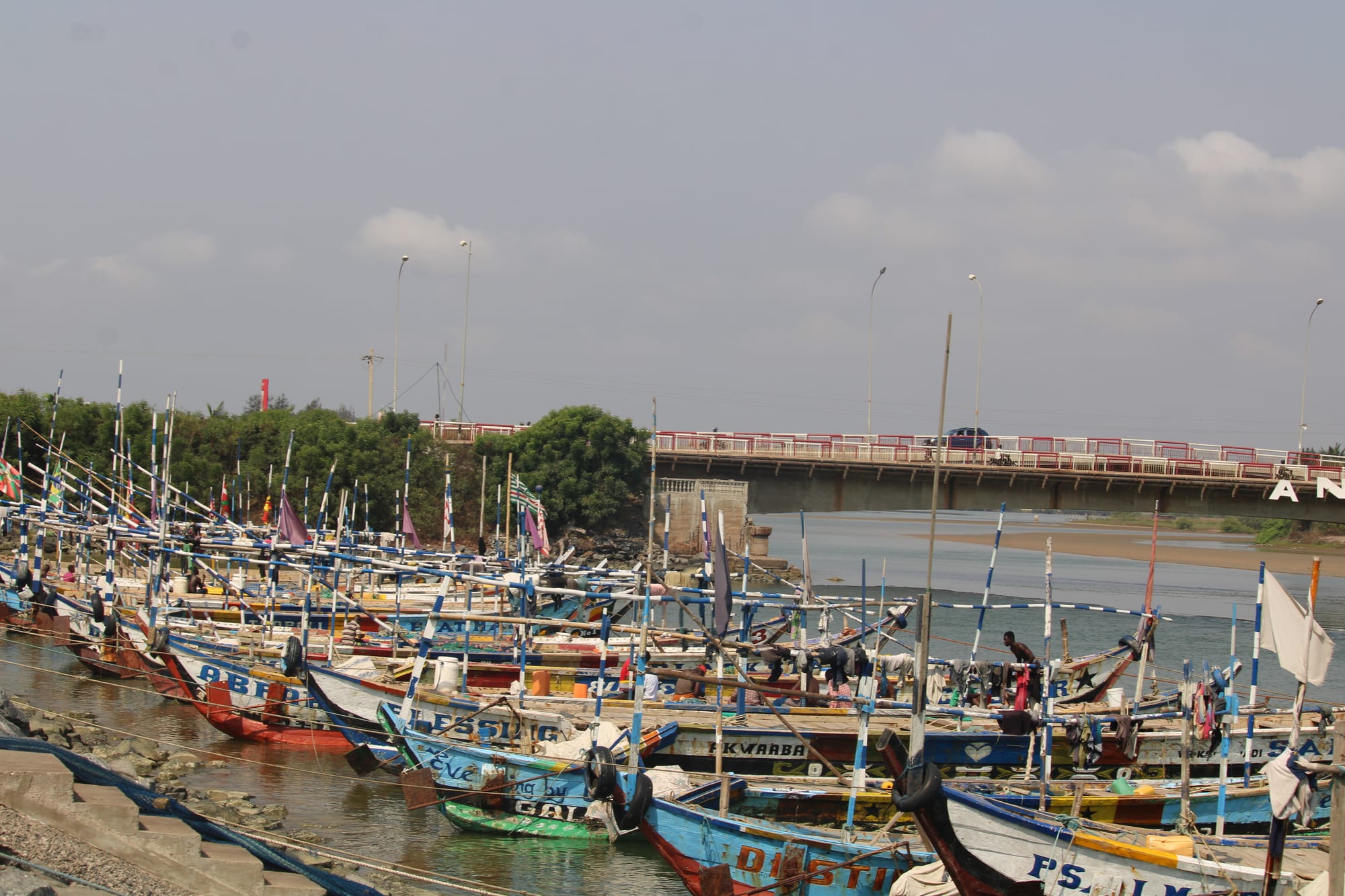
Rows of painted wooden fishing pirogues drawn up on a sandy bank beside a lagoon, with a road bridge behind

Lomé, Kpalimé & the South, Togo

Aného

Fishing pirogues drawn up beside the lagoon at Aného, below the road bridge. (Alfrednadjere / Wikimedia Commons · CC BY-SA 4.0)

A coastal town in south-eastern Togo, built on a narrow strip between the Atlantic surf and a lagoon, about 45 km east of Lomé and close to the border with Benin. Founded by Guin migrants from the Gold Coast, enriched and scarred by the Atlantic slave trade, and the first seat of German administration in Togoland, it is now a quiet fishing town of faded colonial houses.

Neighbourhoods

  • The old town between lagoon and sea
    • First-time visitors
    • Historic district
    • Walks

    The colonial core on the sand spit, where two-storey merchant houses, mission buildings and administrative offices from the Brazilian and German periods stand in varying states of repair. Streets are short, shaded and quiet, and the sea is audible from most of them.

    Open in Maps
  • The lagoon shore and the fishing beach
    • Local life
    • Fishing boats
    • Photography

    The working edge of the town, where pirogues are drawn up on the sand, nets are hauled in the morning and fish is sold and smoked on the spot. The bridge over the lagoon mouth is the town's busiest crossing point and its best vantage.

    Open in Maps
  • Glidji
    • Sacred sites
    • Festivals
    • Local life

    The traditional Guin capital a short way inland from Aného, the seat of the chieftaincy and the site of the sacred grove where the Epe Ekpe new-year ceremony is held each September. It is a village of compounds and shrines rather than a visitor quarter.

    Open in Maps
  • The coast road east towards Benin
    • Beaches
    • Quiet stays
    • Border crossing

    The strip of palms, sand and small settlements running east from the town to the Beninese frontier, with long empty beaches, a few small hotels and heavy Atlantic surf that is dangerous for swimming.

    Open in Maps

Things to do

The town and the lagoon

  • The old colonial quarterneighborhood

    Streets of 19th-century merchant houses and German-era administrative buildings, many weathered and some ruined, that record the town's period as a trading port and colonial seat.

    Open in Maps
  • The fishing beachbeach

    The shore where pirogues land and long nets are hauled in by teams working in line, with fish sold and smoked beside the boats; the surf is strong and swimming is unsafe.

    Open in Maps
  • The lagoon bridgeviewpoint

    The crossing where the lagoon meets the sea, giving a view over moored pirogues, the sand spit and the town's roofline.

    Open in Maps

Sacred places and ceremony

  • Glidjiattraction

    The Guin chieftaincy village just inland, whose sacred grove is the setting of the Epe Ekpe ceremony, when priests bring out a stone whose colour is read as the fortune of the coming year.

    Open in Maps
  • Peter and Paul Churchlandmark

    The cathedral of the Catholic diocese of Aného, dating from 1898, which with the Protestant church of 1895 was placed on Togo's tentative list for UNESCO World Heritage in 2000.

    Open in Maps

Short trips from the town

  • Lake Togoattraction

    The shallow coastal lagoon west of the town, crossed by pirogue and fished with seine nets, tilapia being the commonest catch, with reed beds and villages along its shores.

    Open in Maps
  • Togovilleattraction

    The village on the northern shore of Lake Togo where Gustav Nachtigal signed the German protectorate treaty with Chief Mlapa III in 1884, with Vodun shrines and a cathedral of 1910 near the former royal house.

    Open in Maps
  • Agbodrafoattraction

    A lakeside town on the coast road, known to the Portuguese as Porto Seguro and a crossing point by pirogue for Togoville, with Woold Homé, a surviving house in which captives were confined before embarkation.

    Open in Maps
  • Loméattraction

    Togo's capital, about 45 km west along the coast road, with its Grand Marché, seafront boulevard and museums.

    Open in Maps

Seasonal events

  • Epe EkpeSeptember

    The Guin new-year ceremony at Glidji, in which priests draw a sacred stone from the grove and read the colour as the fortune of the coming year; it brings the Guin diaspora back to the town.

  • Independence DayApril

    The national holiday of 27 April, marked with official ceremonies and parades in the regional towns.

  • The August dry breakAugust

    The short cooler, drier pause between the two rainy seasons, when the coast is at its most comfortable and the beach busiest at weekends.

Eat and drink

Long-standing places and food districts in Aného. Hours, ratings and directions come from your maps app, always current.

Aného classics

  • Fish from the beachneighborhood

    Fish landed by the pirogues is grilled or fried with chilli and onion and sold near the shore, often with attiéké or fried plantain.

    Open in Maps
  • Lagoon crab and shrimpneighborhood

    Crab, shrimp and small tilapia from Lake Togo and the lagoon are cooked into palm-nut and tomato sauces eaten with pâte.

    Open in Maps

Markets and street food

  • Aného marketmarket

    The town market, with smoked fish, chillies, palm oil, cassava and cloth, and cooked-food sellers working the surrounding streets from early morning.

    Open in Maps
  • Ayimolou and akpan stallsneighborhood

    Roadside basins of ayimolou, rice cooked with beans, and akpan, a soft fermented maize ball, are the town's usual breakfast.

    Open in Maps

Experience Aného

History

Aného was founded around the end of the 17th century by Guin, or Gen, migrants from the Gold Coast, who settled on the sand spit between the sea and the lagoon with related groups at Glidji inland. European traders knew the place as Petit Popo, and it became one of the main outlets of the stretch of shore Europeans called the Slave Coast: captives from the interior were held here and shipped across the Atlantic, and Afro-Brazilian families, many of them returnees from Brazil, built merchant houses and left surnames and a style of architecture still visible in the old quarter.

When Germany declared a protectorate over Togoland in 1884, after the treaty signed at Togoville across the lagoon, Aného became the seat of the new colonial government, serving as the capital of German Togoland from 1885 to 1887; the administration then moved to the nearby town of Zebe, and in 1897 to Lomé. The first railway in the protectorate, the 44 km coast line from Lomé, reached the town in July 1905, but Aného's open roadstead was closed to merchant shipping on the same day, and its trade went west for good. The town served again as the seat of the French occupation administration from 1914 to 1920.

Under French administration and after independence in 1960, Aného declined steadily into a fishing and market town. The sea has taken back part of it: coastal erosion, sharpened by works along the shore, has destroyed buildings and sections of road, and some colonial structures have been lost or abandoned. The town remains the historical and ceremonial heart of the Guin, and its old houses are the clearest surviving record of Togo's coastal trading past.

Culture & Customs

Aného is the centre of Guin identity, and its calendar turns on Epe Ekpe, the Guin new year held at Glidji each September. After a period of ritual silence and preparation, priests enter the sacred grove and bring out a stone; its colour is read as the fortune of the coming year, and the announcement is followed by days of drumming, processions and reunions that draw people home from Lomé, Ghana, Benin and further afield. It is among the best-known ceremonies in West Africa, and it belongs to the town rather than to visitors.

Vodun is practised openly here alongside Catholicism, which the missions established early. Shrines stand at compound gates and on the lagoon shore, convents train initiates, and libations of sodabi accompany most formal occasions. Traditional chieftaincy carries weight in disputes, land matters and ceremony.

The town's other inheritance is Afro-Brazilian. Families returning from Brazil in the 19th century brought names, Catholic devotions, building styles and cooking that mixed into the local culture, and their houses give the old quarter its particular look. Fishing shapes daily manners too: the long beach seine is hauled by teams working together and singing, the catch is divided by custom, and the crews are not to be photographed without asking.

Daily Life

About 25,000 people lived in Aného at a 2005 estimate, with more in the surrounding villages and at Glidji, which together with the town form a single settled area. It is a small place by Togolese standards, much diminished from its colonial importance, and it feels quieter than any town of its size on the road to Lomé.

Fishing is the base of the economy — pirogues on the sea, nets on the lagoon and Lake Togo, and the smoking and trading of the catch, work largely done by women. Trade across the Beninese border just east of the town, market gardening, coconut and palm, transport and the phosphate works along the coast provide the rest. Many families depend on money sent from Lomé or from abroad, and young people leave for the capital.

The day begins on the water and at the market before dawn, slows in the heat of the afternoon, and ends with grilled fish and beer at the roadside. The erosion of the shoreline is the town's largest anxiety, along with the state of the old buildings, irregular electricity and the cost of living. Around the September ceremony the population swells and the town is briefly as busy as it once was.

Food

Fish is the whole basis of eating here. The pirogues land sea fish, and the lagoon and Lake Togo supply tilapia, crab and shrimp; much of it is grilled or fried, and a great deal is smoked over wood fires by women who then trade it inland. Smoked fish flavours most of the sauces, and crab in a palm-nut sauce is a coastal speciality.

The staples are those of the Togolese south: pâte, the stiff maize dough known in Ewe as akoumé, and fufu pounded from yam or cassava, eaten with sauces of adémè made from jute leaves, gboma, a spinach-like green, okra, groundnut or palm nut. Ayimolou, rice cooked with beans, is the standard breakfast, and akpan, a soft ball of fermented maize wrapped in leaf, is sold cool from basins. Ablo, a steamed maize cake, is eaten with fried fish.

Drinks are local and simple: palm wine from the coconut and oil palms of the coast, sodabi distilled from it and used in libations at shrines and funerals, bissap made from hibiscus, ginger juice and bottled lager. Coconut, sold from the heap at the roadside, and pineapple from the coastal plain are the everyday fruit.

Planning tools

Budget

Aného is inexpensive. Accommodation is limited to small hotels in town and a handful of simple places along the coast road, and food from the market and the beach grills costs very little. The largest cost is usually transport: a shared taxi from Lomé is cheap, but a hired car makes the lagoon villages much easier to reach.

Daily Budget Midrange
USD 60–120 (a hotel on the coast road, restaurant meals, a hired car with driver)
Daily Budget Shoestring
USD 20–45 (small guesthouse, market and beach food, shared taxis and zémidjans)

Rooms are few, so arriving without a booking is risky around the September ceremony at Glidji; carry cash, as cash machines are scarce.

Best Time to Visit

November to February is the driest and easiest time on the coast, with the Harmattan bringing haze but little rain. The long rains run from about April to July, and August is a cooler, drier lull. September brings shorter rains and the Epe Ekpe ceremony at Glidji, when the town fills.

Suggested Number of Days

The town itself is small and can be seen in a day. Two or three allow the lagoon villages and the coast as well, or a stay timed to the September ceremony. Transport between the villages is what mostly decides the length of a visit.

First Visit
1 day
With Surroundings
2–3 days

Transportation

The town is walkable end to end, and zémidjan motorbike taxis cover everything else, including the villages inland. Shared taxis and minibuses run west to Lomé and east to the Beninese frontier all day from stands near the market and the bridge. Pirogues cross the lagoon and Lake Togo to Togoville, hired by the boat.

Fares for zémidjans, shared taxis and pirogue crossings are agreed before departure, and a boat hired for a crossing is usually paid for both ways.

Airport & Station Connections

Aného sits on the coast road about 45 km east of Lomé, an hour or so by shared taxi or minibus in normal traffic, and a short way west of the Beninese border crossing on the coast road, which makes it a common first or last stop for overland travellers. The nearest airport is in Lomé.

Walkability

One of the easier Togolese towns to walk: the old quarter, the market, the lagoon and the beach are all within a few hundred metres of each other, and traffic is light away from the coast road. Sand, open drains and the heat are the limits, and the villages inland need a motorbike or a car.

Safety

Aného is quiet, with petty theft and road traffic the ordinary risks. The Atlantic here has a steep shore and strong currents, and swimming from the beach is dangerous; the sea is used for fishing rather than bathing. Coastal erosion has cut into the shoreline and the road east of the town. Malaria is present all year.

The surf and currents along this coast make swimming unsafe, quiet streets and the beach are best avoided after dark, and malaria precautions are needed all year. Check current official travel advice before travelling.

Climate

Hot and humid all year, with the two rainy seasons of the Togolese coast and a drier break in August. The sea breeze keeps afternoons a little below the inland heat, and temperatures vary less between seasons than rainfall does.

Summer
the long rains, about April to July: 24–31°C, humid, with heavy short downpours and a cooler lull in August
Winter
the dry season, about November to March: 23–33°C, sunny, with Harmattan haze from December to February

Local Customs

This is Guin (Mina) country, and Mina is the everyday language alongside Ewe and French. Traditional authority is strong: the chieftaincy at Glidji and the priests of the sacred grove hold real standing, and the September ceremony is a religious event rather than a show. Vodun shrines, groves and processions are approached only with permission, and photography at them is often restricted or charged for.

Permission is asked before photographing shrines, ceremonies or fishing crews, modest dress is expected away from the beach, and visits to Glidji go through a local guide or the chieftaincy.

Common Payment Methods

The currency is the West African CFA franc, pegged to the euro. Aného runs on cash: there are a few bank branches and cash machines, but they cannot be relied on, and cards are accepted almost nowhere outside the larger hotels. Mobile money is widely used by residents, and small notes are needed for transport and the market.