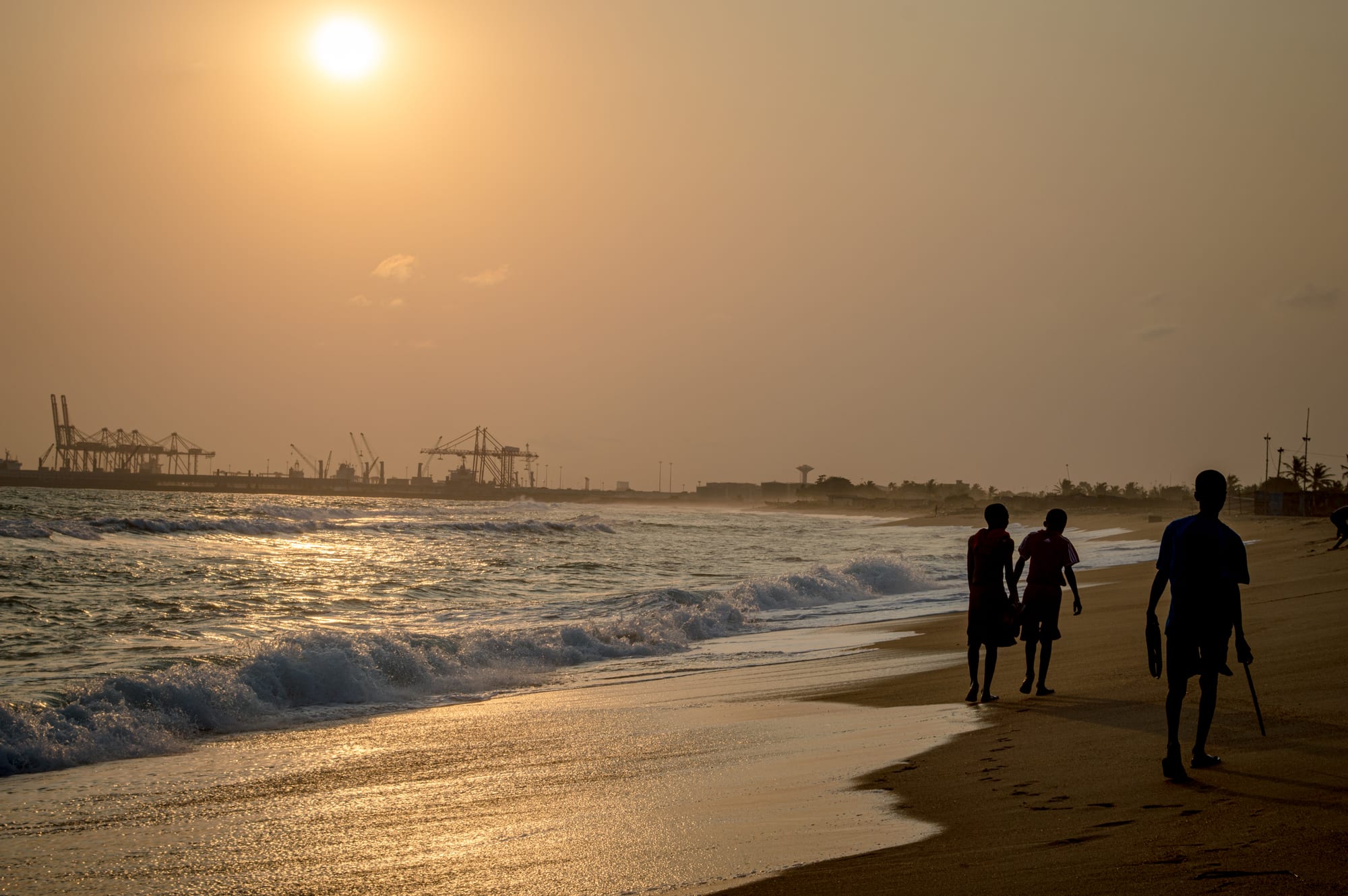
A sandy beach at sunset with breaking waves, walkers on the wet sand and the cranes of a container port on the horizon

Lomé, Kpalimé & the South, Togo

Lomé

The beach at Lomé at sunset, with the cranes of the port in the distance. (Philip Nalangan / Wikimedia Commons · CC BY 4.0)

Togo's capital, on the Gulf of Guinea in the country's south-western corner, so close to Ghana that its western streets end at the border post of Aflao. A small trading town made capital of German Togoland in 1897, it grew on commerce — the Grand Marché and its cloth traders, and a port serving landlocked neighbours — and stays low, sandy and busy along its beach road.

Neighbourhoods

  • The administrative centre and the Grand Marché
    • First-time visitors
    • Markets
    • Historic district

    The old colonial core behind the shore, where the cathedral, the ministries, banks and the Grand Marché stand within a few blocks of each other. It is the busiest part of the city by day, thick with traffic, hawkers and zémidjan motorbike taxis, and empties quickly after dark.

    Open in Maps
  • Kodjoviakopé
    • Close to the Ghana border
    • Quiet and residential

    The western district that runs up to the Ghanaian border crossing at Aflao, with sandy streets of single-storey houses, small embassies and guesthouses. Pedestrians cross into Ghana here all day, and the area keeps a border-town mix of languages and currencies.

    Open in Maps
  • The beach road and Nyékonakpoè
    • Evenings out
    • Beaches
    • Hotels

    The palm-lined boulevard along the ocean east of the centre and the streets behind it, where most of the larger hotels, restaurants and open-air bars are found. The sand is wide and the Atlantic surf is heavy, so the beach is used for walking, football and fishing rather than swimming.

    Open in Maps
  • Bè
    • Local life
    • Markets
    • Sacred sites

    A dense, low-built quarter east of the centre that is one of the oldest settled parts of Lomé and a stronghold of Ewe tradition, with its own market and sacred grove. It has a long record of political protest and a strong neighbourhood identity.

    Open in Maps
  • Tokoin
    • Quiet and residential
    • Close to the airport

    The higher ground north of the centre, holding the main hospital, the university quarter and the airport. It is residential and spread out, a place of walled compounds, schools and small roadside businesses rather than sights.

    Open in Maps
  • Akodessewa and the east
    • Markets
    • Local life

    The eastern approach to the city on the road towards Aného, known for the fetish market that supplies Vodun practitioners with plants, charms and animal parts. Around it are workshops, freight yards and the districts that have grown along the coast road.

    Open in Maps

Things to do

Markets

  • Akodessewa Fetish Marketmarket

    An open-air market on the eastern side of the city selling dried animal parts, plants, statuettes and charms used in Vodun healing and ritual, with practitioners on hand to explain them.

    Open in Maps
  • Grand Marchémarket

    The central covered market and the streets around it, the commercial heart of Lomé and the base of the wax-print cloth traders known as the Nana Benz.

    Open in Maps

Landmarks and museums

  • Palais de Lomémuseum

    The governors' palace built in 1905 for German Togoland, set in a large seafront park, which since 2019 has worked as an arts and cultural centre with exhibition galleries and gardens.

    Open in Maps
  • Sacred Heart Cathedrallandmark

    The red-and-white Catholic cathedral beside the Grand Marché, built by the German colonial authorities in 1901–02 and still one of the city's most recognisable buildings.

    Open in Maps
  • Independence Monumentlandmark

    The monument near the Palais des Congrès marking Togo's independence from France on 27 April 1960, a white bust of a woman holding up a cooking pot set before a figure breaking chains.

    Open in Maps
  • Togo National Museummuseum

    Founded in 1975 and housed in the Palais des Congrès, a national collection of pottery, textiles, musical instruments, masks, calabashes and metalwork.

    Open in Maps
  • Port of Lométransit hub

    The container and bulk port east of the centre, the country's chief seaport and a transit gateway for landlocked Burkina Faso, Niger and Mali, its cranes visible along the shore.

    Open in Maps
  • Stade de Kéguéattraction

    The city's largest stadium, opened in 2000 in the north of the city with room for 25,000, used for football and for large public gatherings.

    Open in Maps

Beaches and walks

  • The beach boulevardbeach

    The ocean road east of the centre, lined with coconut palms, where fishermen haul nets in the morning and the city walks and eats in the evening.

    Open in Maps
  • Lomé–Tokoin Airporttransit hub

    The city's airport, about 6 km north of the centre, the hub of ASKY Airlines and the main way into the country.

    Open in Maps

Short trips from the city

  • Lake Togoattraction

    A shallow coastal lagoon east of the city, crossed by pirogue and fished for tilapia and crab, with villages and shrines along its shores.

    Open in Maps
  • Togovilleattraction

    The village on the north shore of Lake Togo where Gustav Nachtigal signed the 1884 treaty with Chief Mlapa III, with Vodun shrines near the old royal palace and a church of 1910 holding a Marian shrine.

    Open in Maps
  • Agbodrafoattraction

    A lakeside town on the coast road, the crossing point for Togoville, with a surviving slave-trade era house remembered as the Maison des Esclaves.

    Open in Maps
  • Aflaoattraction

    The Ghanaian town on the other side of the border from Kodjoviakopé, whose market and streets merge visually with western Lomé.

    Open in Maps
  • Anéhoattraction

    The former German colonial capital about 45 km east along the coast road, between the sea and a lagoon, with faded colonial buildings and a fishing beach.

    Open in Maps

Seasonal events

  • Independence DayApril

    The national holiday of 27 April, marked in Lomé with parades and official ceremonies.

  • Epe EkpeSeptember

    The Guin new-year ceremony at Glidji near Aného, in which priests read the coming year from the colour of a sacred stone; it draws people from Lomé and the diaspora.

  • Harmattan seasonDecember to February

    The dry months when dust from the Sahara hazes the sky, nights cool a little and the city's outdoor social life is at its busiest.

Eat and drink

Long-standing places and food districts in Lomé. Hours, ratings and directions come from your maps app, always current.

Lomé classics

  • Grilled fish on the beach roadneighborhood

    Open-air grills along the shore serve whole fish and prawns with chilli, onion and attiéké or fried plantain, cooked over charcoal in the evening.

    Open in Maps
  • Ayimolou and street breakfastsneighborhood

    Morning stalls across the city sell ayimolou, rice cooked with beans, alongside akpan, bean fritters and sweet fried dough.

    Open in Maps

Food districts and markets

  • Grand Marchémarket

    The central market, where cloth, spices, smoked fish, chillies and palm oil are sold, with cooked-food sellers working the surrounding streets.

    Open in Maps
  • Marché d'Adawlatomarket

    The market streets of Adawlato, the central quarter beside the Grand Marché, long associated with the wax-print traders and a good place to see what Lomé households actually buy.

    Open in Maps
  • Maquis and bars of Nyékonakpoèneighborhood

    Open-air bars and small kitchens behind the beach road, serving brochettes, grilled chicken, beer and sodabi to a mostly local crowd.

    Open in Maps

Experience Lomé

History

Lomé began as a small Ewe settlement of the Bè people on a sandy shore with no natural harbour, given over to trade with passing ships. Its rise was deliberate rather than natural: the German administration of Togoland, which had ruled from Aného on the eastern lagoon since the 1884 protectorate treaty, moved the capital here in 1897 because the site sat directly on the frontier with the British Gold Coast and could draw the customs trade of both colonies. A wharf on piles, a governor's palace, a cathedral, administrative buildings and the first railways inland to Aného, Kpalimé and Atakpamé followed within a decade.

Allied forces took Togoland at the very start of the First World War, and Lomé passed to French administration under a League of Nations mandate. The town remained the colony's commercial centre and its political one, and it was here that the movement for independence, led by Sylvanus Olympio, gathered force. Lomé became the capital of the independent Republic of Togo in 1960, and Olympio was assassinated in a coup in the city in 1963.

Under the long rule of Gnassingbé Eyadéma the capital grew quickly, spreading north and east over the sand and the lagoons, and its port and free-trade zone were built into the country's economic engine. The city was also the centre of Togo's political conflicts: strikes and a general shutdown in the early 1990s, violence after the disputed election of 2005, mass protests in 2017 and 2018, and demonstrations in 2025 over the constitutional change of 2024 that moved Togo to a parliamentary system.

Culture & Customs

Lomé's defining cultural institution is commerce. The wax-print cloth traders of the Grand Marché, the Nana Benz — named for the Mercedes-Benz cars their success bought — controlled the import of Dutch and later Asian printed cotton across the region and became a symbol of the city and of the economic power of West African market women. Their successors still run the cloth trade, and the patterns, with their proverbial names, remain a language of their own at weddings and funerals.

The city is Ewe and Mina in character, and Ewe and Mina are heard far more than French in the street. Vodun is practised openly alongside Catholicism and Islam: shrines stand at compound entrances, the sacred grove at Bè is a place of ceremony, and the Akodessewa market supplies healers across the region. Funerals are major social occasions, with printed cloth, brass bands and all-night gatherings.

Music runs from the drumming and dance of Ewe traditional ensembles to highlife, coupé-décalé and hip hop in the maquis and clubs behind the beach road. The city has a small but real visual-arts scene, given a public home by the conversion of the old governor's palace into an arts centre, and football is followed with intensity, the national team's fortunes a standing topic in every bar. Manners are formal by regional standards: greetings first, elders addressed carefully, and disputes conducted quietly.

Daily Life

About 837,000 people lived in the city itself at the 2022 census and about 2.19 million in Greater Lomé, which now stretches from the Ghanaian border eastwards along the coast and far inland over old farmland — something close to a quarter of Togo's population in one conurbation. Growth has been fast and largely unplanned, and outer districts of concrete-block houses reach well beyond the paved roads.

The port, the free-trade zone and the re-export trade to Burkina Faso, Niger and Mali are the base of the formal economy, together with the administration, banks and a regional development bank headquartered here. Most people, though, work informally: market trading, transport, workshops, building work, food selling. The zémidjan is both the city's transport system and a first job for many young men.

The day starts before dawn, when markets open and the coolest hours are used for work; the middle of the afternoon is slow; and the evening belongs to the beach road, the open-air maquis and television football. Electricity cuts, flooding in the rains, sand and plastic in the drains, coastal erosion east of the port, and the price of rice, fuel and cement are the running concerns of household life.

Food

Lomé eats pâte — a stiff dough of maize, cassava or yam flour, called akoumé in Ewe — with sauces built on tomato, palm oil or groundnut and thickened with leaves: adémè, made from jute leaves, and gboma, a spinach-like green, are the two the city is fondest of, usually with smoked fish, crab or a little meat. Fufu of pounded yam appears at weekends and on formal occasions.

Being a port and a beach city, Lomé leans on fish. Whole fish grilled over charcoal with chilli and onion, sold with attiéké, fried plantain or chips, is the standard evening meal out, eaten at plastic tables along the shore road. Ayimolou, rice and beans cooked together and served with a peppery sauce, is the working breakfast; akpan, a soft, slightly sour ball of fermented maize, and abolo or ablo, steamed maize cakes, are sold from basins along the street. Djenkoumé, a firm maize dish coloured and spiced and served with chicken, is the dish Togolese put forward as their own, and koklo mémé is grilled chicken rubbed with chilli.

Drinks follow the same pattern of home and import: bissap made from hibiscus, ginger juice, li-ha of malted grain, sodabi distilled from palm wine and used in Vodun libations, tchoukoutou millet beer from the north, and cold bottled lager in every maquis. Coffee grown in the Kpalimé hills is sold in the markets.

Planning tools

Budget

Lomé is inexpensive by international standards but is the most expensive place in Togo. Hotels along the beach boulevard and in the business streets set the upper end; small guesthouses inland are much cheaper. Market food and zémidjan rides cost very little, and the main variable is whether a car with driver is hired for trips along the coast.

Daily Budget Midrange
USD 70–150 (hotel with air-conditioning, restaurant meals, a hired car with driver)
Daily Budget Shoestring
USD 25–50 (guesthouse room, market and street food, shared taxis and zémidjans)

Agree the fare before getting on a zémidjan or into a shared taxi, and carry small notes, since change is often short.

Best Time to Visit

November to February is the driest and easiest time on the coast, though Harmattan dust can haze the air. The long rains run from about April to July, with a drier, cooler lull in August that makes a second window. September and October bring shorter rains and the Epe Ekpe ceremony east of the city.

Suggested Number of Days

Two days cover the markets, the seafront and the museums at an unhurried pace. Four allow the lagoon towns east of the capital and the hills inland as well. Heat, traffic and afternoon downpours all slow movement, so allowing extra time is sensible in the rains.

First Visit
2 days
With Surroundings
4 days

Transportation

Most journeys within the city are made by zémidjan, the motorbike taxis that wait at every junction, or by shared taxis running fixed routes for a set fare. Private taxis can be hired by the hour or the day, and there is no urban rail. Bush taxis and minibuses to Kpalimé, Aného and the north leave from stations on the edges of town.

Shared taxis are flagged down and shared with strangers; say the destination first and confirm the fare before the door closes.

Airport & Station Connections

Gnassingbé Eyadéma International Airport, also known as Lomé–Tokoin, lies about 6 km north of the centre, around twenty minutes by road, and is the hub of ASKY Airlines, with links across West Africa and some long-haul flights. Many visitors instead arrive overland from Accra through the border at Aflao, which the western edge of the city reaches, or along the coast road from Benin.

Walkability

The colonial centre, the cathedral, the Grand Marché and the seafront are walkable together, and the beach boulevard makes a long flat promenade. Beyond that the city is spread out and low, pavements are intermittent, sand and open drains interrupt the streets, and the heat and traffic make walking tiring; most residents use a motorbike taxi for anything over a kilometre or two.

Safety

Lomé is generally calm, but petty theft, bag snatching and pickpocketing occur around the Grand Marché and along the beach road, particularly after dark. Road traffic, and motorbike taxis in particular, are the most common cause of injury. The Atlantic surf here carries strong currents, and swimming from the city beach is dangerous. Political demonstrations have at times been met with force.

Avoid the beach and quiet streets after dark, do not swim in the sea at Lomé, and keep away from demonstrations. Check current official travel advice before travelling.

Climate

Hot and humid all year, but unusually dry for the Gulf of Guinea coast, with two rainy seasons rather than one. Temperatures vary little, between about 23°C at night and 31°C by day, and the sea breeze takes the edge off the afternoons.

Summer
the long rains, about April to July: 24–31°C, humid, with heavy but short downpours; a drier, cooler lull follows in August
Winter
the dry season, about November to March: 23–33°C, sunny, with Harmattan haze and dust from December to February

Local Customs

French is the working language and Ewe and Mina are spoken everywhere in the streets. Greetings matter, and a handshake and an enquiry after health come before business. Dress is modest: shorts and swimwear are for the beach, not the market or an office. Vodun shrines, funerals and ceremonies are part of ordinary life and are not spectacles; permission is needed before photographing them, and photographing people, soldiers, the port or government buildings without asking causes trouble.

Tipping is not obligatory but small amounts are welcomed in restaurants; ask before taking photographs, especially at the fetish market and at shrines, where a fee is usually charged.

Common Payment Methods

The currency is the West African CFA franc, pegged to the euro and shared with seven neighbouring countries. Lomé is the one place in Togo where cards are reasonably useful, at larger hotels and some supermarkets, but almost everything else runs on cash. Cash machines in the centre accept international cards, and mobile money is widely used by residents.