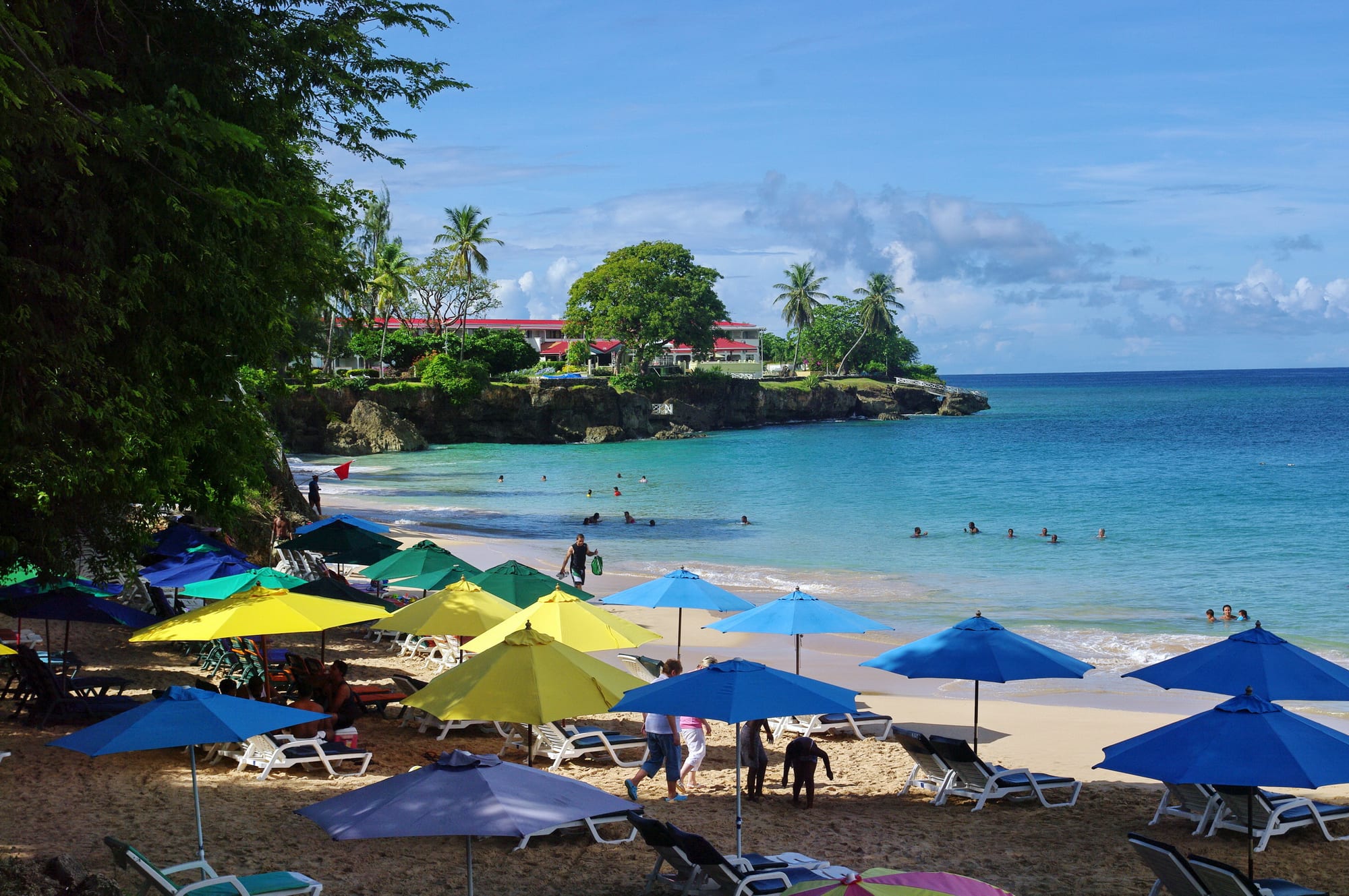
Blue and yellow beach umbrellas on the sand of Store Bay, with swimmers in turquoise water below low cliffs and palms

Trinidad and Tobago

Crown Point

The beach at Store Bay, Crown Point, on the south-western tip of Tobago. (Bgabel / Wikimedia Commons · CC BY-SA 3.0)

A small town on the south-western tip of Tobago, built around the island's international airport and the white-sand beaches of Store Bay and Pigeon Point. Its name recalls the Duchy of Courland, which ruled Tobago in the 17th century; today it is the island's main beach-and-reef tourist area and the starting point for boat trips to the Buccoo Reef.

Neighbourhoods

  • Store Bay and the airport
    • First-time visitors
    • Beaches
    • Close to the airport

    The compact centre of Crown Point, where the airport sits within walking distance of the beach at Store Bay. Hotels, car-hire offices and the restaurants of Milford Road are packed into a small area, and it is possible to walk from the terminal to a hotel.

    Open in Maps
  • Pigeon Point
    • Beaches
    • Water sports
    • Boat trips

    The peninsula north of the airport, about 40 minutes' walk from the restaurant strip, run as a heritage park by the Tobago House of Assembly. Its long white-sand beach and thatch-roofed jetty are Tobago's best-known image, and reef tours leave from here.

    Open in Maps

Things to do

Beaches

  • Store Baybeach

    The casual beach beside the airport, favoured by locals and visiting Trinidadians, with a reef just offshore for divers.

    Open in Maps
  • Pigeon Pointbeach

    Often called Tobago's most beautiful beach, a long strip of white sand with a thatch-roofed jetty, bars, beach-chair rentals and an entry fee, bought for the public by the Tobago House of Assembly in 2005.

    Open in Maps

The reef and the coast

  • Buccoo Reefpark

    One of Tobago's three largest reef systems, a marine park since 1973, where glass-bottom boats take visitors to snorkel over coral and shoals of fish without diving gear.

    Open in Maps
  • Nylon Poolattraction

    A shallow, white-sand pool in the open sea off Pigeon Point, reached by boat, named by Princess Margaret in 1962 for water as clear as nylon stockings.

    Open in Maps
  • Crusoe Caveattraction

    A sea cave in limestone with fossils, named after Robinson Crusoe since at least 1890; it fills at high tide, so it is best seen at low tide.

    Open in Maps

Short trips from the town

  • Scarboroughattraction

    Tobago's capital and ferry port, about 11 km from the airport, its skyline dominated by the 18th-century Fort King George.

    Open in Maps
  • Main Ridge Forest Reservepark

    The forested ridge that runs along the island, legally protected since 1776 and among the oldest protected areas in the world, popular for birdwatching.

    Open in Maps

Seasonal events

  • Buccoo Goat Race FestivalEaster Tuesday, March or April

    Goat racing began in 1925 in Buccoo, the village just up the coast, and the races on Easter Tuesday draw thousands of spectators.

Eat and drink

Long-standing places and food districts in Crown Point. Hours, ratings and directions come from your maps app, always current.

Food streets and beach bars

  • Milford Roadneighborhood

    Crown Point's main restaurant street, with places serving roti, seafood, Caribbean cooking, pizza, pasta and gyros.

    Open in Maps
  • Pigeon Point beach barsneighborhood

    Bars, a restaurant and snack bars within the heritage park.

    Open in Maps

Experience Crown Point

History

Crown Point takes its name not from a crown but from the Duchy of Courland, the Baltic duchy that ruled Tobago in the late 17th century. The island was fought over by the Dutch, Courlanders, English, French, Spanish and Swedes and changed hands 33 times, more than any other place in the Caribbean, before it was secured by Britain. Under British rule sugar, cotton and indigo were produced by enslaved Africans brought to the island.

The sugar economy collapsed after the end of slavery in 1834 and a severe hurricane in 1847, and in 1889 Tobago became a ward of Trinidad. The airport that defines the town began in December 1940, when a 670-metre landing strip was laid here, and it was enlarged with a new terminal in the mid-1980s. In 1963 Hurricane Flora destroyed many of Tobago's plantations, and the island's economy turned towards tourism, which grew up around the airport and the beaches of the south-west.

In 2005, after a controversy over the entry fee charged by its private owner, the Tobago House of Assembly bought the Pigeon Point peninsula for TT$106 million, and it is now run as a public heritage park. In May 2011 the airport was renamed A. N. R. Robinson International Airport in honour of the Tobago-born former president and prime minister.

Culture & Customs

Crown Point is the most visitor-oriented corner of Tobago, but its beaches are also where the island relaxes. Store Bay is the beach favoured by locals and by Trinidadians who come over to visit, while Pigeon Point, with its thatched jetty, has become an internationally recognised signature of Tobago. Liming — relaxed time with friends, food and music — fills the beach bars at sunset.

Tobago's population is mainly of African descent, and the island's culture is distinct from Trinidad's: smaller in scale, more rural and rooted in village life. Just up the coast, the village of Buccoo has held goat races since 1925, started by a Barbadian, Samuel Callendar, on Easter Tuesday, an unofficial holiday in Tobago that draws thousands of spectators.

The sea is central to local identity. The Buccoo Reef, a protected marine park since 1973, is visited by most tourists who come to Tobago, and the island's own Buccoo Reef Trust has worked since 1999 on marine education and the protection of its reefs. The Nylon Pool, a clear, sandy shallow out at sea, was named by Princess Margaret on a visit in 1962.

Daily Life

Crown Point is a small town whose life follows the airport and the beaches. Tobago as a whole had about 61,000 people at the 2011 census, and the south-west, around Crown Point, Store Bay, the Buccoo Reef and Pigeon Point, is its main tourist area, with large stretches of sand dominated by resort-type development. Hotels, car-hire offices, restaurants and tour boats are concentrated here.

Across Tobago, government spending is the largest part of the economy, with the Tobago House of Assembly employing most of the island's workforce; tourism, still a small industry, and fishing follow. In 2011 a 60 per cent fall in arrivals raised questions about plans to expand the airport.

Boats leave Pigeon Point for the reef, Store Bay draws locals, and in the evening people gather at the beach bars and the restaurants of Milford Road. Most residents drive; visitors rely on taxis, the irregular buses to Scarborough and hire cars.

Food

Tobago's signature dish is crab and dumpling. Seafood is central to the island's cooking, and the restaurants of Milford Road serve fish, roti and Caribbean dishes alongside pizza, pasta and gyros for visitors.

The national dishes of Trinidad and Tobago are found here too. Roti — a soft flatbread wrapped around curried chicken, chickpeas, potatoes or vegetables — is the everyday meal, and doubles, curried chickpeas between two small fried flatbreads with tamarind and pepper sauces, are eaten for breakfast on the go. Creole home cooking brings callaloo, made with dasheen leaves, okra and coconut, pelau, rice cooked with pigeon peas and meat, and macaroni pie.

To drink there is fresh coconut water, mauby, a bittersweet drink made from tree bark, sorrel at Christmas, and sea moss. Carib and Stag are the local lagers, and rum shops are found all over the island. A short drive away in Scarborough, cow heel soup and pig tail soup are easy to find, and its Chinese restaurants stay open late.

Planning tools

Budget

Crown Point is Tobago's main tourist area, so prices are higher than in the island's villages, though Store Bay keeps a local, low-key feel. Rooms range from cheap to expensive within a short walk of the airport. The entry fee at Pigeon Point and reef boat tours are the regular extra costs, and a hire car adds to the bill for anyone exploring the island.

Daily Budget Midrange
USD 120–250 (hotel, restaurants, a reef boat tour, a hire car for touring the island)
Daily Budget Shoestring
USD 45–80 (guesthouse, roti and beach snacks, buses and shared taxis)

Reef tours can be picked up at Pigeon Point, and many hotels run a shuttle to the beach there.

Best Time to Visit

The dry season, January to May, is the most settled and popular time, with calm, sunny beach days. The wet season, June to December, brings short, heavy downpours but fewer visitors. Easter Tuesday brings the goat races at nearby Buccoo.

Suggested Number of Days

Three or four days allow time on the beaches and out on the reef. Most visitors use Crown Point as a base for the whole island and stay a week; the number grows for anyone adding the rainforest and the quieter north coast, and shrinks if the visit is a short side trip from Trinidad.

First Visit
3–4 days
With Surroundings
6–7 days

Transportation

Crown Point itself is small enough to walk. Taxis are available, many of them unlicensed — drivers honk at people walking, and a raised hand flags one down. Buses run irregularly to Scarborough via Plymouth, taking about 40 minutes, from the junction at the Pigeon Point road; timetables are not posted at stops. Car-hire offices are clustered around the airport, and a car is the practical way to tour the island.

Agree the fare before getting into a taxi, and check bus times in advance.

Airport & Station Connections

A. N. R. Robinson International Airport, formerly Crown Point International Airport, is in the town itself, within walking distance of the beaches and about 11 km from Scarborough. Flights from Port of Spain take around half an hour or less and run several times a day. The ferry from Trinidad docks at Scarborough, about 20 minutes away by car.

Walkability

Very walkable: the airport, Store Bay, the hotels and the restaurants of Milford Road are close together, and some visitors walk from the terminal to their hotel. Pigeon Point is about 40 minutes on foot from the restaurant street.

Safety

Trinidad has a serious violent-crime problem, with one of the region's higher homicide rates, concentrated in specific parts of Port of Spain (including Laventille, Beetham, and Sea Lots) and linked to gangs and guns; tourists are rarely the target but robberies and carjackings occur. Tobago is much calmer but not crime-free. Petty theft, road conditions and rip currents on some beaches are the everyday risks.

Keep valuables out of sight on the beach and in parked cars, avoid walking alone on dark roads at night, and check for rip currents before swimming. Check current official travel advice before travelling.

Climate

Tropical, hot and humid all year. On Trinidad, the larger island, the annual mean temperature is about 26°C and the average maximum about 34°C. The dry season runs from January to May and the wet season from June to December, with brief, intense downpours. The islands lie mostly south of the main hurricane belt but are not immune.

Summer
the wet season, June to December — hot and humid, with brief, heavy showers; on Trinidad the average maximum is about 34°C
Winter
the dry season, January to May — drier, with fewer showers; on Trinidad the annual mean temperature is about 26°C

Local Customs

Tobago is quieter and more rural than Trinidad, and most of its people are of African descent. Locals, older residents above all, are known for their warmth to visitors. Liming, relaxed time with friends, food and music, is part of daily life, and Store Bay is the beach favoured by locals and visiting Trinidadians.

Keep swimwear for the beach and cover up in town and in shops, and ask before photographing people.

Common Payment Methods

The currency is the Trinidad and Tobago dollar (TT$). Cash is needed for taxis, buses, beach stalls and small shops, and some cafés and restaurants do not accept foreign cards.