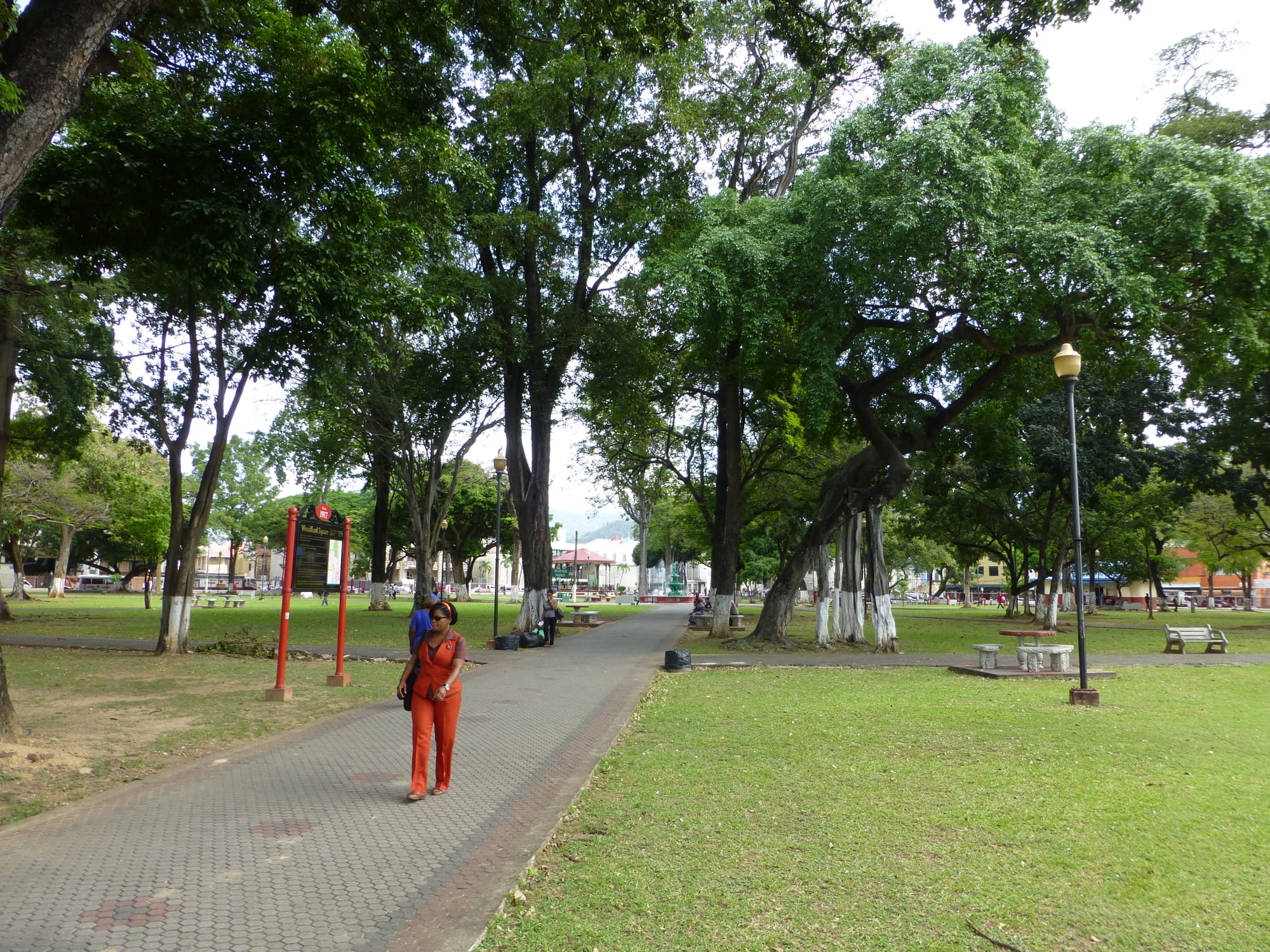
A paved path running under tall shade trees across the lawns of Woodford Square, with a fountain and buildings beyond

Trinidad and Tobago

Port of Spain

Woodford Square, the tree-shaded square at the heart of downtown Port of Spain. (Grueslayer / Wikimedia Commons · CC BY-SA 4.0)

The capital and chief port of Trinidad and Tobago, on the Gulf of Paria below the Northern Range. A Spanish outpost that grew under French settlers and British rule, it is now the country's centre of government, banking and shopping, the home of Carnival and the steelpan, and the western hub of a built-up corridor running east to Arima.

Neighbourhoods

  • Downtown
    • First-time visitors
    • Historic district
    • Close to public transport

    The oldest part of the city, laid out on a grid between South Quay, Oxford Street, the St. Ann's River and Richmond Street. Parliament, the cathedrals, Woodford and Independence squares, the main shopping streets around Frederick Street and several of the country's tallest towers are here, with the City Gate bus and maxi-taxi hub on South Quay.

    Open in Maps
  • Woodbrook
    • Best for food
    • Nightlife
    • Sport

    A former sugar estate of the Siegert family, sold to the town in 1911 and built up as a residential district of gingerbread houses and small squares. Ariapita Avenue is now the city's dining and entertainment strip, and the Queen's Park Oval cricket ground and the national stadium stand at its edges.

    Open in Maps
  • St. James
    • Nightlife
    • Street food
    • Local life

    Settled by Indian indentured labourers in the late 19th century and incorporated into the city in 1938, with many streets named after places in India. Western Main Road, its busy spine of bars and food stalls, is nicknamed 'the city that never sleeps'.

    Open in Maps
  • St. Clair and the Savannah
    • Architecture
    • Quiet and residential
    • Parks

    The upscale district west of the Queen's Park Savannah, home to most of the city's grand mansions, including the Magnificent Seven on Maraval Road, and to a number of diplomatic missions. The Botanic Gardens, the zoo and the President's House lie just across the Savannah to the north.

    Open in Maps
  • Belmont
    • Historic district
    • Carnival history

    The city's first suburb, at the foot of the Laventille Hills, partly settled in the 1840s and 1850s by Africans freed from illegal slave ships. Its narrow, winding lanes hold large old houses built by the Black professional class, and it was the early home of many Carnival designers and bandleaders.

    Open in Maps

Things to do

Famous landmarks

  • The Red Houselandmark

    The Beaux-Arts seat of Parliament beside Woodford Square, rebuilt in 1907 after the original building was destroyed in the Water Riots of 1903.

    Open in Maps
  • The Magnificent Sevenlandmark

    Seven mansions on Maraval Road facing the Savannah, built between 1902 and 1910 in styles from Scottish baronial to Moorish, among them Stollmeyer's Castle, White Hall and Queen's Royal College with its clock tower.

    Open in Maps
  • Independence Squarelandmark

    The long square on reclaimed waterfront land, once the Spanish Plaza de la Marina, with the Brian Lara Promenade at its western end and the Nicholas Tower and the Eric Williams Plaza, some of the country's tallest buildings, along its south side.

    Open in Maps
  • Holy Trinity Cathedrallandmark

    The country's principal Anglican cathedral, built between 1816 and 1823 on Woodford Square.

    Open in Maps
  • Cathedral of the Immaculate Conceptionlandmark

    The Catholic cathedral at the eastern end of Independence Square, begun in 1816 and completed in 1851, seat of the Archdiocese of Port of Spain.

    Open in Maps

Museums and the arts

  • National Museum and Art Gallerymuseum

    The national museum at the top of Frederick Street, founded in 1892 as the Royal Victoria Institute, with petroleum and geological exhibits, a small gallery on Carnival arts and the permanent national art collection.

    Open in Maps
  • Fort San Andresmuseum

    The last surviving Spanish fortification on the island, completed in 1787 offshore and later land-locked by reclamation, restored in 1995 as a museum of the city.

    Open in Maps
  • Little Carib Theatreattraction

    The folk-dance theatre founded in Woodbrook in 1947 by Beryl McBurnie, the first permanent folk-dance company and theatre in Trinidad.

    Open in Maps
  • National Academy for the Performing Artsattraction

    The curving performing arts complex on the south side of the Savannah, opened in 2009, with a large performance hall.

    Open in Maps

Parks and green spaces

  • Queen's Park Savannahpark

    The city's largest open space, about 110 hectares of former sugar land with a 3.5 km perimeter popular with walkers and joggers at sunset, and the main stage of Carnival.

    Open in Maps
  • Royal Botanic Gardenspark

    Gardens established in 1818 just north of the Savannah, one of the oldest botanic gardens in the world, with some 700 trees and a small burial plot of colonial governors.

    Open in Maps
  • Emperor Valley Zooattraction

    The country's only public zoo, opened in 1952 beside the Botanic Gardens and named after the blue emperor butterfly, with native species including the scarlet ibis alongside lions, tigers and giraffes.

    Open in Maps

Sport

  • Queen's Park Ovalattraction

    A cricket ground opened in 1896 with seating for about 20,000, which has hosted more Test matches than any other ground in the Caribbean.

    Open in Maps
  • Hasely Crawford Stadiumattraction

    The national venue for football and athletics, at the western end of Woodbrook by Invaders Bay.

    Open in Maps

Short trips from the city

  • Caroni Swamppark

    The country's largest mangrove forest, south of the city where the Caroni River meets the Gulf of Paria; boat tours go out at dusk, when scarlet ibis fly in to roost.

    Open in Maps
  • Chaguaramasattraction

    The north-western peninsula about 14 km from the city, a former US base reached by a winding coastal road, now a major yachting harbour with the Five Islands offshore.

    Open in Maps
  • Asa Wright Nature Centrepark

    A nature centre and research station in the Arima Valley of the Northern Range, one of the Caribbean's leading birdwatching spots, with 256 bird species recorded.

    Open in Maps

Seasonal events

  • CarnivalThe Monday and Tuesday before Ash Wednesday, February or March

    Costumed mas bands parade through the streets to soca and steel bands after weeks of fetes, with the Parade of Bands, the King and Queen competitions and the Calypso Monarch staged at the Savannah.

  • J'ouvertCarnival, before dawn

    The pre-dawn street parade that opens Carnival on the Monday, with revellers covered in paint, mud or oil, rooted in French Afro-Creole traditions such as Canboulay.

  • PanoramaCarnival season, February or March

    The steelband competition held since 1963, whose finals are played at the Savannah; in the weeks before, bands rehearse nightly in their pan yards.

  • Taste T&T Food FestivalMay

    A food festival at the Jean Pierre Complex where many of the city's restaurants can be sampled.

Eat and drink

Long-standing places and food districts in Port of Spain. Hours, ratings and directions come from your maps app, always current.

Port of Spain classics

  • Doubles stalls on Independence Squaremarket

    Stalls selling doubles — curried chickpeas between two soft fried flatbreads — that often sell out early, and in the evening food stalls for the crowds liming in the square.

    Open in Maps

Food districts and markets

  • Ariapita Avenueneighborhood

    Woodbrook's dining and nightlife strip, with restaurants serving Creole, Indian, Chinese, Lebanese, Italian and other cooking.

    Open in Maps
  • Western Main Road, St. Jamesneighborhood

    A long stretch of bars, eateries and food stalls selling roti, doubles and other local food late into the night.

    Open in Maps
  • Central Marketmarket

    The city's large agricultural market, where produce from the surrounding countryside is traded.

    Open in Maps

Experience Port of Spain

History

The first settlement here was near the Amerindian fishing village of Cumucurapo, "place of the silk cotton trees", in today's Mucurapo, west of the centre. The Spanish posted a garrison at the foot of the Laventille Hills in 1560, and their mud-walled fort was captured by Walter Raleigh's expedition in 1595. The port grew slowly, and only in 1757, when the old capital of San José de Oruña, now St. Joseph, had fallen into disrepair, did the governor move his seat here, making Port of Spain the capital.

The last Spanish governor, José María Chacón, shaped the town. After the Cedula of Population of 1783 encouraged French Catholic settlers to come, eleven streets were laid out westwards from the hills, creating the grid that still survives downtown, and in 1787 he diverted the flood-prone St. Ann's River to run east of the town. In 1797 a British force under Sir Ralph Abercromby landed at what is still called Invaders Bay, and Chacón capitulated. A fire destroyed the town in 1808, after which public buildings were built of brick, and repeated reclamation of the mudflats pushed the shore southwards through the 19th century.

Port of Spain became a city in 1914 and peaked at about 100,000 people in the 1960s. From 1958 to 1962 it was the temporary capital of the West Indies Federation. In July 1990 an armed group seized the Red House and held the prime minister and members of the government hostage for six days, while rioting and looting shook the city. Since then natural gas wealth has helped pay for the International Waterfront development on former port land, even as the population within the city limits has fallen.

Culture & Customs

Port of Spain is the centre of one of the largest Carnivals in the world. Weeks of fetes and band launches lead up to the street parades on the Monday and Tuesday before Ash Wednesday, when costumed mas bands cross the stage at the Savannah, where the Calypso Monarch, the King and Queen of Carnival competitions and the Panorama steelband finals are also held. Calypso, developed by Afro-Trinidadians, has been joined by soca as the music of Carnival, and the mas designer Peter Minshall, one of the city's best-known artists, also helped design Olympic opening ceremonies.

The steelpan developed in Trinidad in the 1930s and 1940s out of earlier Carnival percussion such as tamboo bamboo, and the hills of Laventille on the city's eastern edge are counted as its birthplace. It was declared the national instrument in 1992, and in 2023 the United Nations named 11 August World Steelpan Day. In the weeks before Carnival steel bands rehearse nightly in their pan yards, where anyone can listen.

The city's mix shows in its streets: French-influenced gingerbread houses and wrought-iron balconies beside high-rise towers, Gothic cathedrals, mosques and Hindu temples, a historically Indian St. James and a Syrian-Lebanese community that first settled around Marine Square. Cricket is followed closely at the Queen's Park Oval, and the city claims Brian Lara and the Nobel laureate Derek Walcott. Woodford Square, nicknamed the "University of Woodford Square", is where Eric Williams lectured crowds on independence.

Daily Life

The municipality is small — about 50,000 people by a 2017 estimate — because its boundaries take in little more than the business district and a few neighbouring areas, and its resident population has fallen as offices have replaced homes. Around 250,000 people come into the city each day, and the wider conurbation stretching from Chaguaramas east to Arima has an estimated 600,000. Rush-hour commutes along the East–West Corridor can take two to three hours.

The city is the country's shopping, administrative and financial centre. Most government ministries are here, along with the stock exchange, two of the largest banks in the Caribbean and the head offices of many oil and gas companies, although the refineries and petrochemical plants are further south. The port is the island's largest container port and the terminal for the ferry to Tobago, and a large central market trades produce from the surrounding countryside.

Housing ranges from waterfront apartments and the mansions of St. Clair and Lady Chancellor Road to board houses without indoor plumbing. East Port of Spain, including Laventille, Beetham and Sea Lots, faces poverty and gang violence, and redevelopment schemes have cleared old warehouses and poor housing at the eastern entrance to the city. Evenings revolve around liming, the bars of Ariapita Avenue and Western Main Road, and, for much of the year, the long build-up to Carnival.

Food

Doubles are the city's street breakfast: two soft fried flatbreads, bara, around curried chickpeas, channa, finished with tamarind, mango and pepper sauces, sold from stalls on Independence Square and across the city. Roti is the everyday meal, either as "buss up shut", torn paratha, or as a dhalpuri wrap around curried chicken, chickpeas, potatoes or vegetables. Mango and pineapple chow and West Indian-style curries are other everyday tastes.

Creole home cooking brings callaloo, made with dasheen leaves, okra and coconut; stewed chicken; pelau, rice cooked with pigeon peas and meat browned in caramelised sugar; and macaroni pie. Chinese-Trinidadian and Syrian-Lebanese cooking are part of the city's food too, and the restaurants of Ariapita Avenue serve everything from Creole and Indian to Thai, Japanese and Venezuelan dishes. Bake and shark — fried shark in fried bread with condiments — is the classic beach food at Maracas Bay on the north coast.

Drinks are sweet and local. Mauby is a bittersweet drink made from tree bark, sorrel a deep red drink from the roselle plant, and peanut punch a blend of peanut butter, milk and sugar; coconut water is a local favourite. Carib and Stag are the local lagers, and rum shops are found all over the island.

Planning tools

Budget

Port of Spain is a business and government city more than a resort, and day-to-day prices follow local life: street food is cheap, while hotels and sit-down restaurants are priced for business travellers. Costs jump around Carnival, when rooms are scarce and booked many months ahead. Taxis are relatively expensive, so shared route taxis and maxi taxis keep a budget down.

Daily Budget Midrange
USD 120–250 (hotel, restaurants, taxis or a hire car, day trips to the swamp and the hills)
Daily Budget Shoestring
USD 45–80 (guesthouse, doubles and roti, route taxis and maxi taxis)

Expect much higher prices and minimum stays over Carnival; the Savannah, the Botanic Gardens, the squares and the pan yard rehearsals cost little or nothing.

Best Time to Visit

The dry season, January to April, is the most comfortable time and includes Carnival, held on the Monday and Tuesday before Ash Wednesday in February or March, with Panorama and the pan yard rehearsals in the weeks before. The wet season runs from May to December, with heavy but often brief downpours; this is the quieter, cheaper time to visit.

Suggested Number of Days

Two or three days cover the city itself. Allow four to six to add the north-western peninsula, the mangroves and the Northern Range. Carnival visitors usually stay longer, as the build-up runs for several weeks, and heavy rush-hour traffic makes trips out of the city slower than distances suggest.

First Visit
2–3 days
With Surroundings
4–6 days

Transportation

City Gate on South Quay is the hub for public buses and the private minibuses known as maxi taxis; tickets for public buses are bought before boarding. Route taxis, shared cars on fixed routes, are the other everyday option. Taxis carry number plates beginning with H and look like private cars. A hire car is the practical way to reach the countryside, though traffic on the East–West Corridor is heavy at rush hour. A water taxi links the waterfront with San Fernando.

Check that a car offering a ride has an H number plate; at night use an arranged or app-based taxi rather than walking.

Airport & Station Connections

Piarco International Airport, the main gateway to Trinidad, is about 30 km east of downtown — around 45 minutes by road, longer in the evening rush. Flights from Tobago take about 20 minutes. The inter-island ferry from Scarborough docks at South Quay; fast ferries take about two and a half hours, conventional ferries about five and a half. Cruise ships also call at the port.

Walkability

Downtown is compact and its grid is easy to walk by day, between Woodford Square, Frederick Street and Independence Square. The Savannah is a pleasant walk from downtown, and its 3.5 km perimeter is a popular evening stroll; St. Clair, Woodbrook and St. James are within reach on foot. Visitors are advised not to walk alone after dusk, and the hills and outer districts need transport.

Safety

Trinidad has a serious violent-crime problem, with one of the region's higher homicide rates, concentrated in specific parts of Port of Spain (including Laventille, Beetham, and Sea Lots) and linked to gangs and guns; tourists are rarely the target but robberies and carjackings occur. States of emergency over violent crime were in force for long stretches from December 2024; the latest, declared in March 2026, ended on 17 September 2026. Port of Spain and its surroundings have a higher crime rate than any other part of Trinidad, but the central districts are busy by day.

Avoid Laventille, Beetham and Sea Lots, do not walk alone after dark or display valuables, keep car doors locked, use arranged or app-based taxis, and check what restrictions apply before travelling. Check current official travel advice before travelling.

Climate

A tropical monsoon climate, warm to hot all year with little seasonal change; the surrounding Northern Range keeps the city a little cooler than towns further south. The dry season runs from January to April and the wet season from May to December.

Summer
the wet season, May to December — hot and humid, with heavy showers; temperatures typically range from 19 to 34°C and rarely pass 35°C
Winter
the dry season, January to April — sunny and slightly cooler, especially in January and February; temperatures still typically range from 19 to 34°C, and nights can feel mild between December and February

Local Customs

'Liming' — hanging out with friends, food and music with no particular agenda — is a valued social art, and the evening lime on Independence Square or Western Main Road is part of city life. Banter, called picong, is part of conversation. The city is Christian, Hindu and Muslim, and Divali, Eid al-Fitr, Emancipation Day and Indian Arrival Day are all public holidays. Woodford Square has long been a place for soapbox speakers and preachers.

Dress modestly in churches, mosques and temples, ask before photographing people, and keep beachwear for the beach.

Common Payment Methods

The currency is the Trinidad and Tobago dollar (TT$). Cash is needed for street food, route taxis and small shops.