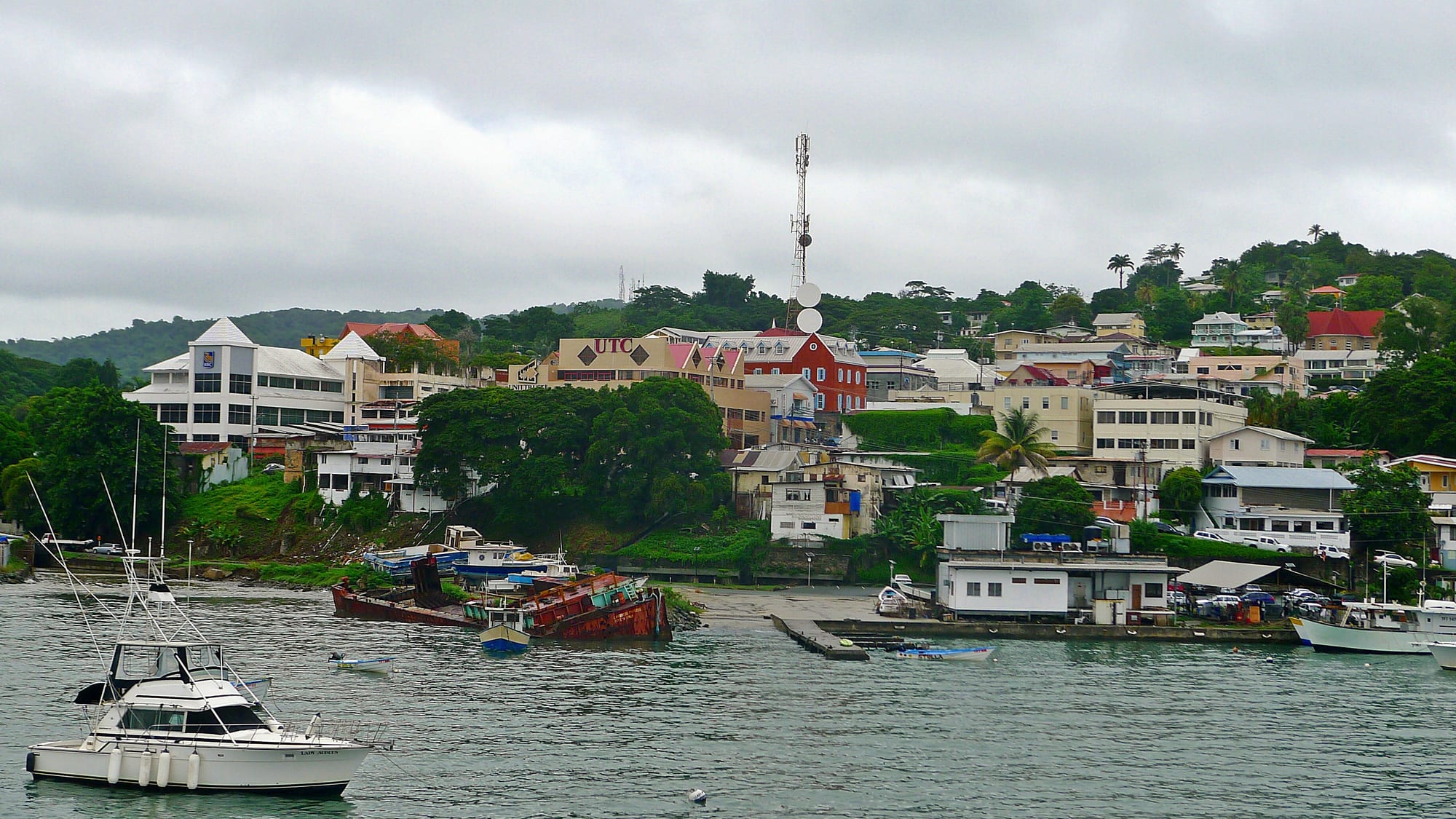
Boats moored in Scarborough harbour below a green hillside of houses, offices and a communications mast under a grey sky

Trinidad and Tobago

Scarborough

The harbour and town of Scarborough, Tobago's capital. (Kalamazadkhan / Wikimedia Commons · CC BY-SA 4.0)

Tobago's capital and main port, on the island's south-western coast below the 18th-century Fort King George. Capital since 1769 and named after the Yorkshire town, it was Port-Louis under the French. Today it is the seat of the Tobago House of Assembly, the island's commercial centre and the landing point for the ferry from Trinidad.

Neighbourhoods

  • Town centre and harbour
    • First-time visitors
    • Close to the ferry
    • Local life

    The commercial heart of Tobago, climbing the hillside above the deepwater harbour where the ferry from Trinidad docks. Government offices, shops, banks, taxi stands and cheap places to eat are packed into a few busy streets, and the town is among the most densely populated in the country.

    Open in Maps
  • Bacolet
    • Quiet and residential
    • Beaches
    • Views

    A suburb on Bacolet Bay just south-east of the centre, below Fort King George. One of the most developed parts of Tobago, it is home to much of the island's well-off society, with villas and hotels for visitors.

    Open in Maps

Things to do

In the town

  • Fort King Georgelandmark

    The 18th-century fortification named after King George III that dominates the town's skyline, with a museum of history and archaeology and wide views over the bay, popular at sunset.

    Open in Maps
  • Scarborough Botanic Gardenspark

    A botanic garden in Tobago's capital.

    Open in Maps
  • Shaw Park Cultural Complexattraction

    A performing arts centre described as the largest performing arts theatre in the Caribbean, which hosted Fast5 netball at the 2023 Commonwealth Youth Games.

    Open in Maps

Short trips from the town

  • Pigeon Pointbeach

    Tobago's best-known beach, near the airport at Crown Point, with white sand, a thatch-roofed jetty and boats out to the reef.

    Open in Maps
  • Buccoo Reefpark

    A coral reef marine park since 1973 on the south-western coast, visited by glass-bottom boat for snorkelling over coral without diving gear.

    Open in Maps
  • Main Ridge Forest Reservepark

    The forested spine of the island, legally protected since 1776 and among the oldest protected areas in the world, known for birdwatching.

    Open in Maps

Eat and drink

Long-standing places and food districts in Scarborough. Hours, ratings and directions come from your maps app, always current.

Scarborough classics

  • Soup and local food in the town centreneighborhood

    Cow heel soup and pig tail soup are easy to find in the town, alongside roti and other local food; most places close early in the evening.

    Open in Maps
  • Chinese restaurantsneighborhood

    Chinese restaurants are among the few places in town that stay open late.

    Open in Maps

Experience Scarborough

History

Tobago was fought over by the Dutch, Courlanders, English, French, Spanish and Swedes, changing hands 33 times, more than any other place in the Caribbean. Scarborough, named after the Yorkshire seaside town, became the island's capital in 1769, replacing Georgetown, while sugar, cotton and indigo estates worked by enslaved Africans spread across the island. Fort King George, an 18th-century fortification named after George III, still dominates the town's skyline. Under French rule, from 1789 to 1814, it was called Port-Louis.

When Britain took the island again in 1814 a new period of sugar production began, but the end of slavery in 1834, a severe hurricane in 1847 and foreign competition ended the sugar trade. In 1889 Tobago became a ward of Trinidad, its own assembly was abolished, and Port of Spain became the capital of the joined colony; Scarborough remained the island's main town.

In 1963 Hurricane Flora destroyed many of Tobago's plantations, and the island turned towards tourism. The Tobago House of Assembly was revived as Tobago's own government in 1980, with its seat in Scarborough. The deepwater harbour, built in 1991, ended the days when ships had to anchor offshore, and the town has since gained a large cultural complex, a library in 2012 and a general hospital in 2014.

Culture & Customs

Scarborough is the economic and cultural centre of Tobago, and its institutions serve the whole island. The Shaw Park Cultural Complex is described as the largest performing arts theatre in the Caribbean, and in 2023 it hosted Fast5 netball at the Commonwealth Youth Games. Fort King George, on the hill above the town, holds a museum of the island's history and archaeology, and its view over the bay makes it a popular place at sunset.

Tobago's population is mainly of African descent, and its culture is distinct from Trinidad's: smaller in scale and more rural, with its own assembly, which sits in the capital. The Tobago Heritage Festival, held each year over the last week of July and the first week of August, celebrates the island's traditions, and Emancipation Day on 1 August is a national holiday.

Liming — relaxed time with friends, food and music — fills the evenings, though most places to eat close early. Bacolet, on the bay below the fort, is home to much of Tobago's well-off society.

Daily Life

Scarborough had an estimated population of 17,537 in 2011, and it is one of the most densely populated towns in Trinidad and Tobago, with suburbs such as Bacolet, Signal Hill, Lambeau and Mount Saint George. It is the eleventh-most-populous town in the country.

Government is the largest employer. Across Tobago, government spending is the biggest part of the economy and the Tobago House of Assembly employs 62 per cent of the labour force. The deepwater harbour receives the ferry from Trinidad, and the town has the island's general hospital and a public library. Tourism and fishing come next; beach and water-sports tourism is concentrated around Crown Point rather than in the town.

The town quietens in the evening, as most places to eat close early, and residents drive or rely on the local taxis, with buses running only every hour and a half or so to the airport side of the island.

Food

Cow heel soup and pig tail soup are easy to find in the town, and roti — a soft flatbread wrapped around curried chicken, chickpeas, potatoes or vegetables — and doubles, curried chickpeas between two small fried flatbreads with tamarind and pepper sauces, are everyday food here as across the country. Tobago's signature dish is crab and dumpling.

Creole home cooking brings callaloo, made from dasheen leaves, okra and coconut; stewed chicken; pelau, rice cooked with pigeon peas and meat browned in caramelised sugar; and macaroni pie. Chinese-Trinidadian cooking is woven into the local diet too, and the town's Chinese restaurants are among the few places that stay open late. There are far fewer places to eat than around Crown Point.

To drink there is mauby, a bittersweet drink made from tree bark; sorrel, at Christmas; sea moss; and coconut water. Carib and Stag are the local lagers, and rum shops are found all over the island.

Planning tools

Budget

Scarborough is cheaper than the beach area around Crown Point, with local food, shops and shared taxis priced for residents. Accommodation ranges from hotels in Bacolet to more affordable rented rooms. Local taxis from the official stands cost far less than hire taxis, and a hire car adds to the bill for anyone touring the island.

Daily Budget Midrange
USD 120–250 (hotel, restaurants, a hire car, reef and rainforest tours)
Daily Budget Shoestring
USD 45–80 (guesthouse or rented room, soups and roti, buses and local taxis)

Use the local taxi stands marked with the direction of travel rather than hire taxis, and buy bus tickets before boarding.

Best Time to Visit

The dry season, January to May, is the most comfortable time, with sunny days and calmer seas for the ferry and the reef. The wet season, from June to December, brings brief, heavy downpours.

Suggested Number of Days

The town itself needs a day at most. As a base for the whole island, allow four to six days; the number depends on how much time goes to the beaches of the south-west, the rainforest and the north-east coast, and on whether the crossing from Trinidad is made by ferry or by air.

First Visit
1 day
With Surroundings
4–6 days

Transportation

Local taxis leave from stands in the town centre marked with the direction they head, west or north, and cost much less than hire taxis. Buses run to Crown Point via Plymouth roughly every hour and a half, taking about 40 minutes; tickets must be bought in advance. The Claude Noel Highway serves the town, and car-hire firms operate in the town. A car is the easiest way to see the rest of the island.

Check that a taxi stand is marked for the right direction, and allow extra time for buses, which are infrequent.

Airport & Station Connections

The ferry from Port of Spain docks at Scarborough's deepwater harbour: fast ferries take about two and a half hours and conventional ferries, which also carry cars, about five and a half; the service is daily but limited, and sailings can be irregular. A. N. R. Robinson International Airport at Crown Point is about 11 km away, roughly 20 minutes by car, with flights from Trinidad several times a day.

Walkability

The centre is compact and walkable, though steep: the town climbs the hill from the harbour, and Fort King George sits at the top. Bacolet is close by, but the beaches and the rest of the island need a car, a taxi or the bus.

Safety

Trinidad has a serious violent-crime problem, with one of the region's higher homicide rates, concentrated in specific parts of Port of Spain (including Laventille, Beetham, and Sea Lots) and linked to gangs and guns; tourists are rarely the target but robberies and carjackings occur. Tobago is much calmer but not crime-free. Petty theft, road conditions and rip currents on some beaches are the everyday risks.

Keep valuables out of sight, use the official taxi stands, avoid walking alone on dark streets at night, and check for rip currents before swimming. Check current official travel advice before travelling.

Climate

Tropical, hot and humid all year. On Trinidad, the larger island, the annual mean temperature is about 26°C and the average maximum about 34°C. The dry season runs from January to May and the wet season from June to December, with brief, intense downpours. The islands lie mostly south of the main hurricane belt but are not immune.

Summer
the wet season, June to December — hot and humid, with short, heavy showers; on Trinidad the average maximum is about 34°C
Winter
the dry season, January to May — drier, with fewer showers; on Trinidad the annual mean temperature is about 26°C

Local Customs

Scarborough is the island's administrative and commercial town, and its streets are busy with residents on errands rather than tourists. Most of Tobago's people are of African descent. Liming — relaxed time with friends, food and music — fills evenings and weekends, and banter is part of daily conversation.

Dress modestly in town, keeping swimwear for the beach, and ask before photographing people.

Common Payment Methods

The currency is the Trinidad and Tobago dollar (TT$). Cash is needed for taxis, buses, street food and small shops, and some cafés and restaurants on Tobago do not accept foreign cards.