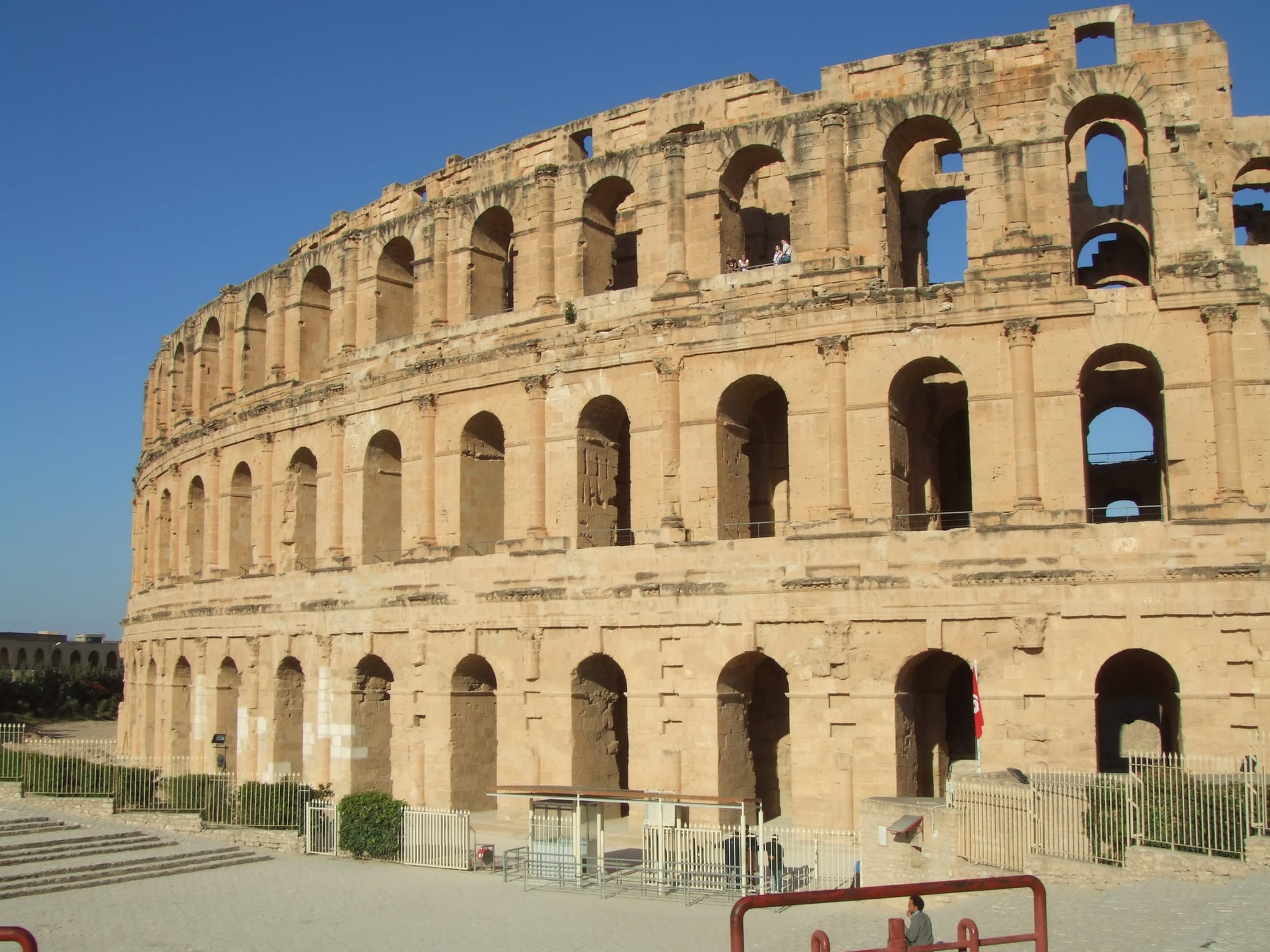
The curving tiered stone facade of a Roman amphitheatre with rows of arches, under a deep blue sky

Sousse, Sfax & the Central Coast, Tunisia

El Djem

The outer wall of the Roman amphitheatre at El Djem. (Hugh Llewelyn / Wikimedia Commons · CC BY-SA 2.0)

A small town on the olive plain between Sousse and Sfax, built over the Roman city of Thysdrus and dominated by one of the largest amphitheatres surviving from the Roman world. The arena, a UNESCO World Heritage Site, stands directly among low modern houses, and a museum on the edge of town holds mosaics lifted from the villas of the ancient city.

Neighbourhoods

  • Around the amphitheatre
    • First-time visitors
    • Historic district
    • Cafés

    The centre of the town, where houses, shops and café terraces stand right up against the Roman walls. Souvenir and carpet stalls line the approach, and the square in front of the arena is the meeting point of the town.

    Open in Maps
  • The museum quarter
    • Museums
    • Quiet and residential

    The southern edge of the town, about a kilometre from the arena, where the archaeological museum sits beside the excavated houses and streets of Roman Thysdrus and the remains of an earlier, smaller amphitheatre.

    Open in Maps
  • The station and the main road
    • Close to public transport
    • Local life

    The workaday part of El Djem along the Sousse–Sfax railway and the main road, with the market, small hotels, bakeries and the louage stand. Most visitors arrive and leave from here.

    Open in Maps

Things to do

Roman El Djem

  • Amphitheatre of El Jemlandmark

    Built in the third century AD in golden stone, one of the largest amphitheatres of the Roman world and a UNESCO World Heritage Site, with tiers, corridors and underground passages still standing.

    Open in Maps
  • El Djem Archaeological Museummuseum

    A museum on the southern edge of town holding Roman mosaics and other finds taken from the villas of Thysdrus, beside the excavated houses themselves.

    Open in Maps
  • Thysdrus excavationsattraction

    The dug-out streets and courtyard houses of the Roman city beside the museum, several with mosaic floors left in place.

    Open in Maps
  • The older amphitheatrelandmark

    The eroded remains of one of two smaller, earlier arenas that Thysdrus used before the great amphitheatre was begun in the 230s.

    Open in Maps

Town life

  • The weekly marketmarket

    A country market of produce, olives, clothing and livestock that fills the streets near the station on its market day.

    Open in Maps

Short trips from the town

  • Mahdiaattraction

    The Fatimid port on a headland to the east, with its dark gateway, old mosque and fishing harbour.

    Open in Maps
  • Sfaxattraction

    Tunisia's second city to the south, with a walled medina still lived in and ferries to the Kerkennah Islands.

    Open in Maps
  • Sousseattraction

    The Sahel's main coastal city to the north, with a UNESCO-listed medina, a ribat and a mosaic museum in its kasbah.

    Open in Maps
  • Great Mosque of Kairouanlandmark

    The ninth-century mosque at the heart of Kairouan, inland to the north-west, one of the oldest in the Islamic world.

    Open in Maps
  • Monastirattraction

    A seaside town up the coast with one of the oldest ribat fortresses in North Africa and a marina.

    Open in Maps

Seasonal events

  • El Djem International Symphonic Music FestivalSummer

    Orchestral concerts staged at night inside the amphitheatre, the town's best-known event and the reason many Tunisians visit in summer.

  • Ramadanvaries with the Islamic calendar

    The fasting month changes the rhythm entirely, with quiet days and busy evenings in the cafés and pastry shops around the arena.

Eat and drink

Long-standing places and food districts in El Djem. Hours, ratings and directions come from your maps app, always current.

El Djem classics

  • Grilled lamb and merguezrestaurant

    The standard meal of the olive plain — charcoal-grilled lamb chops and spiced merguez sausages with salad, bread and harissa — served in the small places around the arena.

    Open in Maps
  • Couscous of the interiorrestaurant

    Semolina steamed over a stew of lamb or vegetables with chickpeas, the everyday festive dish away from the coast.

    Open in Maps

Markets and cafés

  • El Djem marketmarket

    Olives, olive oil, dates, dried chillies for harissa and vegetables from the surrounding plain.

    Open in Maps
  • Cafés facing the arenaneighborhood

    Terraces looking straight at the Roman walls, serving strong coffee and mint tea with pine nuts.

    Open in Maps

Experience El Djem

History

The town stands on Thysdrus, a settlement of Punic origin that grew rich under Rome as the market for the olive oil of the surrounding plain. By the second and third centuries AD it was one of the most prosperous cities of Roman Africa after Carthage, with paved streets, fine courtyard houses floored in mosaic and, on the evidence of its buildings, a population of tens of thousands. Its wealth paid for a series of amphitheatres, the last of them begun in the 230s and never quite finished.

Thysdrus also had a moment at the centre of imperial politics. In 238 landowners angered by taxation rose against the emperor Maximinus Thrax and proclaimed the elderly proconsul Gordian I emperor here, with his son as co-ruler; their reign lasted only weeks, but the revolt led on to the reign of Gordian III. Prosperity faded with the wider crisis of the third century, and later raids and the Arab conquest left the city a village around an enormous ruin.

The amphitheatre survived because it was useful. It served as a fortress in periods of unrest — most famously, by tradition, as the stronghold of the Berber leader known as al-Kahina against the Arab armies — and in 1695 the ruler of Tunis, Mohamed Bey, made an opening in one of its walls to dislodge his brother's followers sheltering inside, which is why one side is open. Stone was quarried from it for centuries. Clearance and restoration began under the French protectorate and continued after independence; the amphitheatre and the archaeological remains were inscribed as a UNESCO World Heritage Site in 1979, and the museum, with mosaics excavated from the Roman houses nearby, followed.

Culture & Customs

El Djem's life is shaped by the monument at its centre. The amphitheatre is not on the edge of the town but in the middle of it, so children play in its shadow, shops face its arches and the arena has been the setting for weddings, processions and, since the 1980s, a summer festival of symphonic music that brings orchestras and Tunisian audiences in from the coast for night concerts under the walls. It has also drawn film-makers looking for a Roman arena.

Outside that season the culture is that of a Sahel farming town: family-centred, religiously observant, with Friday prayers, the weekly market and the olive harvest as the fixed points of the year. Craft traditions here are practical ones — basketwork, olive-wood objects, textiles — and the carpets sold to visitors near the arena usually come from Kairouan.

Residents are used to visitors passing through, which produces a livelier trade in souvenirs and guiding than the size of the town would suggest, without the scale of hustle found at bigger sites. Conversations start easily, French is widely understood alongside Tunisian Arabic, and a stranger asking directions is likely to be accompanied.

Daily Life

About 21,500 people live in El Djem, a market town in the governorate of Mahdia surrounded by one of Tunisia's main olive-growing districts. The rhythm follows the trees: pruning and ploughing through winter and spring, then the harvest from November into January, when the presses run and seasonal labour fills the town. Cereals, almonds and sheep add to the farming, and small workshops, the market, transport and a handful of hotels and cafés make up the rest of the economy along with the archaeological site.

Days start early, empty out in the afternoon heat and resume towards evening, when men gather in the cafés and families walk the main street. Most people live in low modern houses spreading out from the old centre, and many households depend partly on money sent home by relatives working in Sfax, Tunis or Europe.

The strains are those of inland Tunisia: fewer jobs than the coast, rising prices, water that has to be managed carefully in a dry landscape, and young people leaving. Tourism helps but is concentrated in a few hours of the day and a few months of the year, and much of its spending goes to the coastal hotels rather than to the town.

Food

This is olive country, and the oil is the foundation of the cooking: poured over salads, used for frying, mopped up with bread at breakfast and sold loose in the market. The everyday dishes are those of the Tunisian interior rather than the coast. Couscous appears with lamb, vegetables and chickpeas in a stew reddened with tomato and harissa, the chilli and garlic paste that accompanies almost every meal and is made from peppers dried on the plain.

Grilled meat is the treat: lamb chops and merguez, the spiced sausage, cooked over charcoal and served with slatit mechouia, a salad of charred peppers and tomatoes chopped with oil and capers. Lablabi, a bowl of chickpeas in garlicky broth poured over torn bread and topped with an egg, is a cheap and filling breakfast; ojja sets eggs in a spiced tomato and pepper sauce; and brik, a thin pastry parcel of egg and tuna fried until crisp, is eaten as a starter.

Sweets are semolina, almond and date based, including makroudh, the date-filled pastry that Kairouan up the road has made famous, and trays of honeyed cakes sold for religious holidays. Dates from the southern oases, dried figs and almonds from local trees fill the market stalls. Mint tea with pine nuts and strong coffee are drunk all day in the cafés; alcohol is rare in the town.

Planning tools

Budget

El Djem is an inexpensive stop. Most people come for a few hours from Sousse, Mahdia or Sfax, so the costs are the site ticket, which also covers the museum, a cheap lunch and the train or louage fare. The town has only a handful of small hotels, and prices rise a little during the summer festival.

Daily Budget Midrange
USD 70–150 (hotel on the coast, restaurant meals, site tickets, a driver for the day)
Daily Budget Shoestring
USD 25–40 (small hotel, grilled food and café meals, trains and louages)

One ticket normally covers both the amphitheatre and the museum, so keep it after the arena.

Best Time to Visit

March to May and October to November are the most comfortable months on this inland plain, with warm days and bearable sun in the unshaded arena. The summer months are very hot by day but bring the symphonic concerts at night. Winter is mild, quiet and occasionally wet, and the stone looks best in low light at either end of the day.

Suggested Number of Days

The town is small and the two sites are usually seen in a few hours, often as a stop on the railway between the coastal cities. An overnight stay suits anyone coming for a concert or wanting the site early, before the coach parties and the heat.

First Visit
Half a day
With Surroundings
1–2 days

Transportation

The town is small enough to cross on foot, and the museum is about a kilometre from the arena. Trains on the Tunis–Sousse–Sfax line stop here, which is how most independent visitors arrive, and louages and buses run to Sfax, Mahdia, Sousse and Kairouan. Taxis wait near the station and the arena for short local runs.

Confirm return train and louage departures on arrival, as services thin out in the evening.

Airport & Station Connections

El Djem lies on the main railway and road between Sousse and Sfax, about 60 kilometres from each, with Mahdia roughly 40 kilometres east and Kairouan around 70 kilometres north-west. The nearest airports are Monastir and Sfax, with Enfidha and Tunis–Carthage further north; most visitors arrive on a day trip from the coast.

Walkability

Entirely walkable. The amphitheatre is in the middle of the town, a few minutes from the station, and the museum and the excavations are about a kilometre south along a straight road. The ground is flat, but the arena's tiers and passages involve steep, worn steps and there is almost no shade anywhere on the site.

Safety

El Djem is a quiet provincial town with little crime affecting visitors; the nuisances are souvenir sellers and unofficial guides at the arena entrance. The real hazards are physical: uneven stone, unguarded drops on the upper tiers, dark underground passages and severe summer heat in an unshaded site.

Avoid the Chaambi area and the Algerian border zone, and step away from demonstrations. Sturdy shoes, water and a hat make the arena far easier, and the upper tiers need care with children. Check current official travel advice before travelling.

Climate

A semi-arid inland climate, hotter and drier than the coast 60 kilometres away, with very warm summers, mild winters and low rainfall falling mostly between autumn and early spring.

Summer
hot and dry — daytime temperatures often 33–38°C with strong sun and little shade
Winter
mild by day, around 15–18°C, with cool nights and occasional rain

Local Customs

This is a small, conservative town rather than a resort: covered shoulders and knees are the norm, and beachwear is out of place. Greetings are unhurried and hospitality is pressed. Sellers at the arena are persistent but usually good-humoured, and a clear, polite refusal is understood. Asking before photographing people is expected.

Tipping is small — rounding up a bill, or a dinar or two for a guardian who shows something. Alcohol is barely sold in the town.

Common Payment Methods

The currency is the Tunisian dinar, which may not legally be taken out of the country. Cash is needed for almost everything here, including site tickets, cafés, taxis and louages; there are banks and a few ATMs in the centre, but cards are little used outside the larger hotels of the coast.