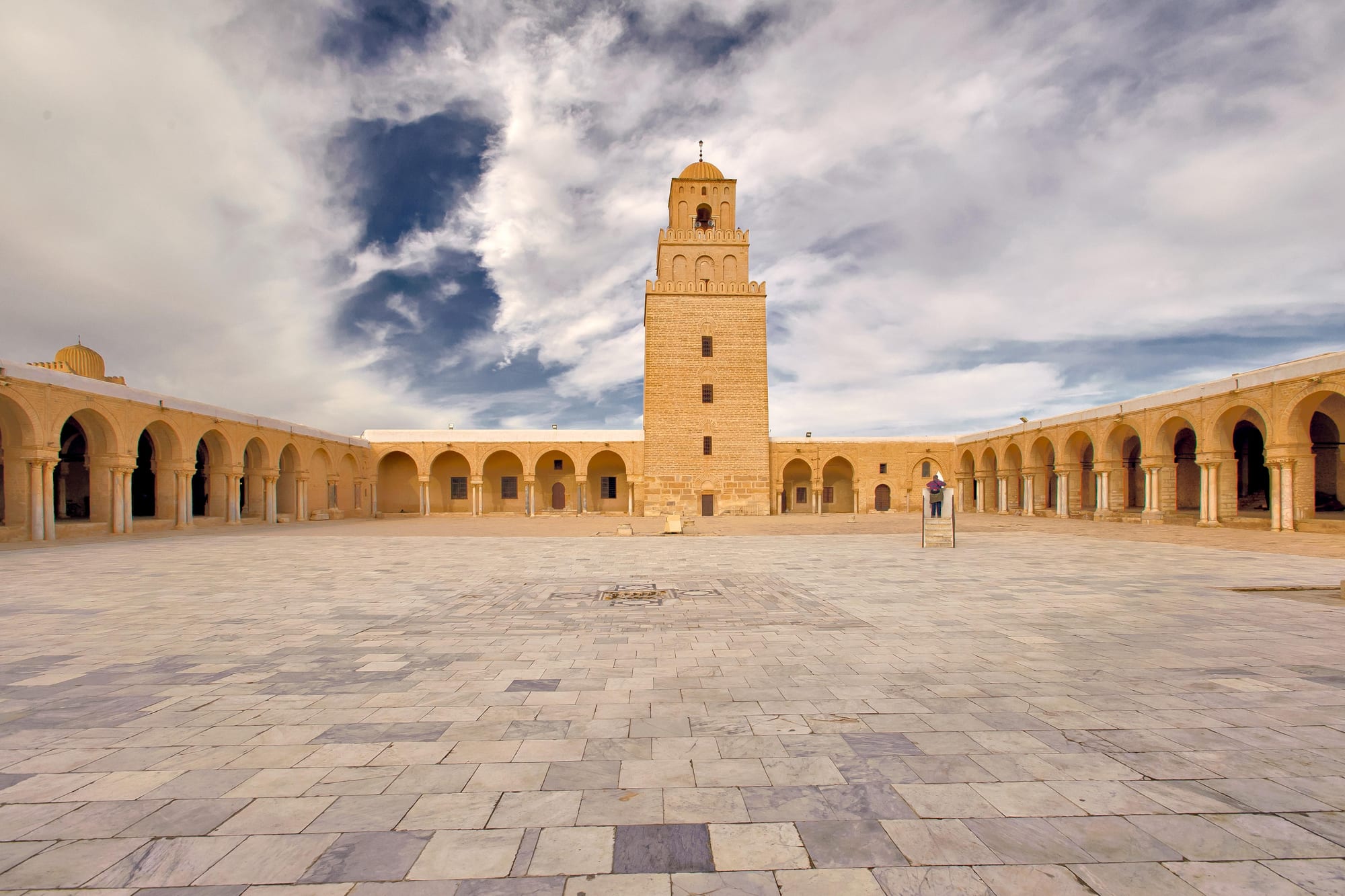
A wide marble-paved courtyard ringed by arcades, with a square stone minaret under a cloudy sky

Tunisia

Sousse, Sfax & the Central Coast

The courtyard and minaret of the Great Mosque of Kairouan. (Ed Kirby / Wikimedia Commons · CC BY-SA 2.0)

Tunisia's east-central belt, from the Sahel coast of Sousse, Monastir and Mahdia and the commercial city of Sfax inland to the holy city of Kairouan and the high steppe of Kasserine and Sidi Bouzid — a region of olive groves, ribat fortresses, beach resorts, the amphitheatre of El Jem and the town where the 2011 revolution began.

Explore Sousse, Sfax & the Central Coast

History

Phoenician and Carthaginian trading posts dotted this coast — Hadrumetum, now Sousse, was among the oldest — and under Rome the olive groves of the Sahel made towns such as Thysdrus rich enough to build the amphitheatre of El Jem in the 3rd century AD. Thysdrus was also where Gordian I was proclaimed emperor in 238. Inland, Sufetula, modern Sbeitla, was where Arab armies defeated the Byzantine governor Gregory in 647, opening the way to the conquest.

Uqba ibn Nafi founded Kairouan around 670 as a military camp, and it became the capital of Ifriqiya. The Aghlabid emirs of the 9th century rebuilt its Great Mosque, completed the ribat of Sousse, and launched the conquest of Sicily from Sousse in 827. The Fatimids founded Mahdia on its headland in the early 10th century as their capital before moving on to Egypt, and in the 11th century the Banu Hilal nomads sacked Kairouan, which never regained its political role.

Under the French, Sfax grew into a port for phosphates and olive oil, and the Sahel became the nursery of the national movement: the Neo Destour party was founded at Ksar Hellal in 1934, and Habib Bourguiba was born in Monastir. The interior was left behind, and that gap shaped modern history. On 17 December 2010, the fruit seller Mohamed Bouazizi set himself alight in Sidi Bouzid; protests spread through the interior, including Thala and Kasserine, before reaching Tunis.

Culture & Customs

People from the Sahel, the coast from Sousse to Mahdia, have long been seen as the country's political and business class, a reputation built under Bourguiba and Ben Ali, both from Sahel towns. Sfaxians are known across Tunisia as hard-working and thrifty traders, a stereotype they tend to accept with pride, while the steppe governorates feel overlooked and say so.

Kairouan is the religious heart of the country, and seven pilgrimages there were once said to equal one to Mecca. The Prophet's birthday, the Mouled, fills its streets with visitors, and the city is famous for its handmade wool carpets, among them the red-brown zarbia. Mahdia is known for its silk weaving, and the Kerkennah Islands keep an old method of fishing with fixed palm-frond traps called charfia.

The festival calendar includes symphonic concerts in the El Jem amphitheatre in summer. Football matters too: Étoile du Sahel of Sousse and CS Sfaxien are among the country's leading clubs.

Daily Life

Sfax, with about 330,000 people in the city and around a million in its governorate, is the second city: an industrious port of olive-oil mills, factories, clinics and family firms. Sousse, with over 200,000, is the capital of the Sahel, with a university, the resort strip and the marina of Port El Kantaoui. Kairouan has about 140,000, Monastir around 100,000 and Mahdia around 50,000, while Kasserine and Sidi Bouzid are the main towns of the steppe.

The coast lives from tourism, textiles and clothing, especially around Monastir and Ksar Hellal, fishing and olive oil; the Sfax plain is one great olive grove. Inland, Sidi Bouzid grows vegetables and fruit, Kasserine lives mainly from farming, and unemployment is well above the coast's.

Life follows the olive calendar, with the harvest from November to January, and the summer, when families move to beach flats. Irregular boat departures for Italy from the Sfax coast are a current issue.

Food

The coast eats from the sea. Sfax is known for its seafood: couscous with fish, octopus from Kerkennah, and charmoula, a sauce of onions and raisins eaten with salted fish. Mahdia and Monastir grill sardines, mullet and bream fresh from their fishing ports.

Olive oil from Sfax and the Sahel goes into everything, from mechouia salad to the ojja of eggs cooked in spiced tomato, and bread is dipped in it at breakfast. On the steppe, lamb, cracked-wheat dishes and flatbreads are the everyday food.

Kairouan is famous across the country for makroudh, diamond-shaped semolina pastries filled with date paste, fried or baked and soaked in syrup or honey; the medina's shops sell them by the kilo. Coffee and mint tea with pine nuts fill the cafés.

Attractions & Natural Wonders

Kairouan, a UNESCO World Heritage Site, is the region's spiritual centre: the Great Mosque, also called the Mosque of Uqba, with its marble courtyard and square minaret; the tiled Zaouia of Sidi Sahab, the shrine of a companion of the Prophet; the Mosque of the Three Doors; the round Aghlabid basins that stored the city's water; and the walled medina of carpet shops.

On the coast, the UNESCO-listed medina of Sousse has its ribat, whose tower gives a view over the town, a Great Mosque, and a kasbah museum of Roman mosaics. Port El Kantaoui, just north, is a purpose-built marina resort with beaches and golf courses. Monastir has its large ribat, the gold-domed Bourguiba mausoleum and a marina, while Mahdia offers the Skifa el Kahla gate, the Fatimid Great Mosque, the Borj el Kebir fortress and white beaches.

El Jem's amphitheatre, a UNESCO World Heritage Site and one of the largest in the Roman world, can be climbed to the upper tiers, and its museum holds fine mosaics from Roman villas. Sfax has an intact walled medina, a busy fish market and ferries to the flat, palm-covered Kerkennah Islands. Inland on the high steppe, Sbeitla has the three temples of its capitol, Byzantine churches and a triumphal arch.

Cities in Sousse, Sfax & the Central Coast

Planning basics

Budget

The coast runs on package tourism, so all-inclusive hotels in Port El Kantaoui, Monastir and Mahdia can be very cheap booked from abroad and poor value walked into. Independent travel is cheap: simple hotels in Sousse, Kairouan and Sfax, grilled-fish lunches and louages. The steppe towns inland have few hotels of any standard.

Daily Budget Midrange
USD 70–150 (good hotel or resort, restaurant meals, site tickets, a driver for a day)
Daily Budget Shoestring
USD 25–45 (simple hotel, street food, louages and the Sahel metro)

Visit El Jem as a stop on the Sousse–Sfax railway, and use the Sahel metro between Sousse, Monastir and Mahdia.

Safety

The coast and Kairouan are generally calm, with touts and petty theft in the medinas the usual nuisance. The 2015 beach attack at Port El Kantaoui led to armed police at resorts. Inland, Western governments advise against travel to the Chaambi mountains near Kasserine, on the Algerian border, where militants have been active, and protests over jobs recur in Kasserine and Sidi Bouzid.

Avoid the Chaambi area and the Algerian border zone, visit Sbeitla by day, and step away from demonstrations. Check current official travel advice before travelling.

Climate

The coast is Mediterranean but drier than the north, with hot summers softened by sea breezes and mild winters. Kairouan, on the plain, is noticeably hotter in summer and colder on winter nights, while the high steppe around Kasserine is the coldest part of the region, with frost and occasional snow on the hills.

Summer
hot, 30–35°C on the coast and often above 38°C in Kairouan and the steppe
Winter
mild on the coast, around 9–18°C; cold nights and some frost inland

Transportation

Monastir and Enfidha airports serve the resorts. The main railway runs from Tunis through Sousse and El Jem to Sfax, and the Sahel metro, a suburban line, links Sousse, Monastir and Mahdia. Louages connect every town, including Kairouan, about an hour from Sousse, and Sfax is around two hours from Sousse by road. Ferries cross from Sfax to the Kerkennah Islands.

Louages from Kairouan reach Sbeitla and Kasserine, but a hired driver is simpler for the steppe.

Best Time to Visit

April to June and September to November suit the Roman sites and Kairouan; the sea is warm enough for swimming from June to October. July and August are high season on the beaches and bring the symphonic music festival to El Jem's amphitheatre. Winter is quiet and mild on the coast.