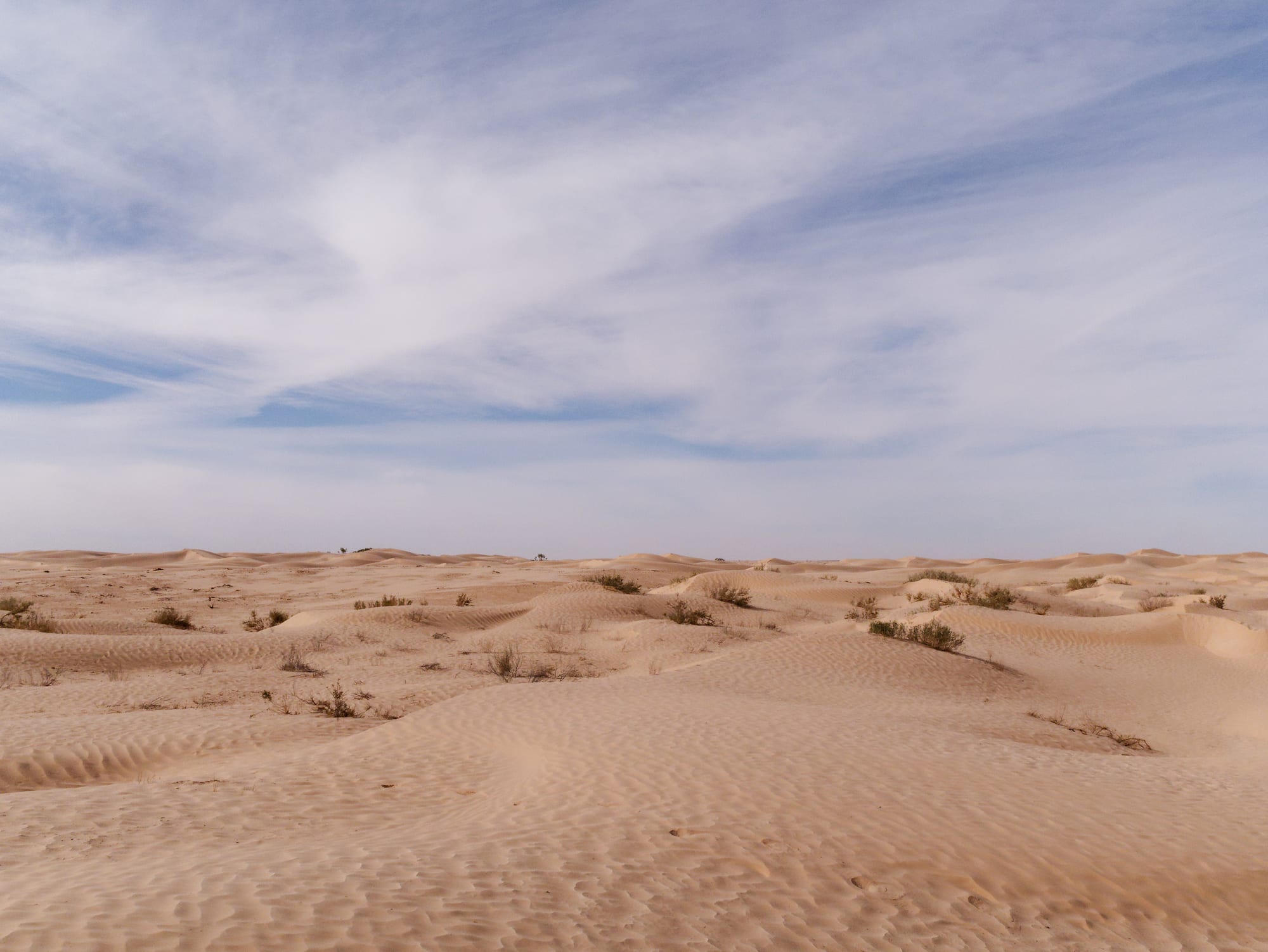
Low rippled sand dunes dotted with dry shrubs stretching to the horizon under streaky white cloud

Tunisia

Djerba & the Sahara South

The first dunes of the Sahara in the desert around Douz. (Pa681998 / Wikimedia Commons · CC BY-SA 4.0)

Tunisia's southern half, from the island of Djerba and the Gulf of Gabès inland across the salt pan of the Chott el Jerid to the palm oases of Tozeur and Nefta, the phosphate towns around Gafsa, the dunes beyond Douz and the hilltop Berber villages and fortified granaries of Matmata and Tataouine.

Explore Djerba & the Sahara South

History

The Capsian culture of prehistoric North Africa takes its name from Capsa, modern Gafsa, and Amazigh peoples have lived in the south since long before the Phoenicians traded along the Gulf of Gabès. Djerba was identified in antiquity with the island of the lotus-eaters in Homer's Odyssey, and under Rome it held the town of Meninx, while Gightis on the mainland opposite and Tacapae, now Gabès, were ports for Saharan caravans. Marius took Capsa during the war against Jugurtha in 106 BC.

After the Arab conquest the south became a refuge for dissident Muslims, and Djerba still has Ibadi communities with their own mosques. In the hills of the Dahar, Amazigh villagers built hilltop settlements and ksour, fortified granaries of stacked vaulted cells, to protect grain from raiders. Spain and the Ottomans fought over Djerba in the 16th century, and after the Ottoman victory in 1560 a tower of skulls stood on the island for three centuries.

The French ran the far south as a military territory and began mining phosphate around Gafsa and Metlaoui from the 1890s. In the Second World War the Axis defenders of the Mareth Line south of Gabès were forced out by the British Eighth Army in 1943. Since independence the south has built beach tourism on Djerba and desert tourism around Tozeur and Douz, but the mining basin has seen repeated unrest over jobs, most notably at Redeyef in 2008.

Culture & Customs

The south is Tunisia's most Amazigh (Berber) part. Amazigh speech survives in villages such as Chenini, Douiret and Tamezret and in parts of Djerba, and the old hilltop villages, pit homes and ksour are the physical memory of that culture. Most people speak Tunisian Arabic, and the tribes of the desert edge, such as the Mrazig of Douz, keep a strong Bedouin identity of camels, horses, poetry and the Sahara Festival each November or December.

Djerba has its own traditions: the Jewish community of Hara Kebira and Er-Riadh is one of the last remaining in the Arab world, and each spring, around Lag BaOmer, pilgrims come to the Ghriba synagogue. Ibadi Muslims, with their plain white mosques, have a long history on the island. Guellala is the island's pottery village.

Traditional costume, weaving of rugs and blankets, silver jewellery and palm-frond basketry remain home crafts. Tozeur's old quarter of Ouled el Hadef is known for brickwork laid in geometric patterns, and Nefta is a centre of Sufi shrines.

Daily Life

Djerba has about 160,000 people, with Houmt Souk the main town and Midoun the tourist centre. Gabès, the biggest mainland town, is an industrial port; Gafsa is the capital of phosphate mining; Médenine, Tataouine and Zarzis are the southeast's main towns; and Tozeur, Kébili and Douz are oasis towns.

The economy rests on dates, especially deglet nour grown in the palm groves of the Jerid and Nefzaoua, tourism on Djerba and in the desert, phosphate mining and processing, olive growing around Zarzis, and cross-border trade with Libya through Ben Guerdane. Pollution from the chemical plants at Gabès, water shortages in the oases and unemployment in the mining basin are the region's constant arguments.

Life is shaped by heat: markets and errands in the early morning, closed shutters after noon, and life resuming in the evening on café terraces. Many southern families depend on members working in Tunis, Libya or France.

Food

Southern cooking is simpler and drier than the coast's. Couscous is often made with lamb, sometimes with kadid, meat salted and dried in the sun. Djerba's signature is rouz jerbi, rice steamed with greens, vegetables and meat or liver in the manner of couscous, and the island's fishermen grill fish and octopus.

Dates are the region's pride, above all the translucent deglet nour, eaten fresh at harvest in autumn and used in sweets. The oases also produce legmi, the sweet sap of the date palm, drunk fresh or left to ferment, as well as henna, pomegranates and vegetables grown under the palms. Gabès is known for its henna.

Tataouine is famous for garn ghzel, small horn-shaped fried pastries filled with almonds, and mint tea, strong and sweet, is poured throughout the day, often after long preparation over coals in the desert camps.

Attractions & Natural Wonders

Djerba, a UNESCO World Heritage Site, is a flat island of palms, menzels (fortified farmsteads) and small white mosques. Houmt Souk has its souks, a fortress and the fishing harbour; Er-Riadh has the Ghriba synagogue with its blue tiles; Guellala has potters and a heritage museum; and the beaches run along the east coast. Djerbahood, in Er-Riadh, turned its lanes into an open-air gallery of street art in 2014.

On the mainland, Matmata's troglodyte homes are dug around pits in the soft earth; the Hotel Sidi Driss was used as the Lars homestead in Star Wars. Nearby Tamezret and Toujane are Amazigh hill villages. Around Tataouine are the great ksour of Ouled Soltane and Hadada and the hilltop villages of Chenini and Douiret, with Roman Gightis on the coast.

West of Gabès, the road crosses the Chott el Jerid, a vast salt pan, to Tozeur, with its old quarter and palm grove, and Nefta with its Corbeille ravine. The mountain oases of Chebika, Tamerza and Midès have waterfalls and canyons on the Algerian border, and the Lézard Rouge train runs through the Seldja gorge near Metlaoui. Douz, the gateway to the Grand Erg Oriental, is the starting point for camel treks and for the oasis and hot spring of Ksar Ghilane.

Cities in Djerba & the Sahara South

Planning basics

Budget

Djerba has the full range from cheap medina guesthouses in Houmt Souk to all-inclusive beach hotels. On the mainland, simple hotels in Tozeur, Douz, Tataouine and Matmata are cheap, and costs come from excursions: camel rides and nights in desert camps from Douz, four-wheel-drive tours to the mountain oases, and drivers for the ksour.

Daily Budget Midrange
USD 75–170 (good hotel or camp, restaurant meals, a guided desert excursion or 4x4 day)
Daily Budget Shoestring
USD 25–40 (small hotel or guesthouse, local food, louages)

Agree camel and 4x4 prices in writing before setting off, and bring cash — cash machines are scarce beyond the main towns.

Safety

Djerba, Tozeur, Douz and Matmata are generally calm and used to visitors. The Ghriba synagogue was bombed in 2002 and attacked again in 2023, and security is heavy there. Western governments advise against travel to the far south and the Libyan border area, including around Ben Guerdane, where militants attacked in 2016, and to the military zone south of Tataouine. Heat and getting lost in the desert are the practical dangers.

Keep away from the Libyan border zone and the desert military zone, use licensed guides for the Sahara, and carry water. Check current official travel advice before travelling.

Climate

Desert inland and semi-arid on the coast. Summers are fierce, with Tozeur, Kébili and Gafsa often above 40°C, while Djerba and Gabès stay a little milder beside the sea. Winter days are sunny and warm, but desert nights drop close to freezing, and sandstorms blow in spring.

Summer
very hot, 38–45°C inland; around 32–35°C on Djerba with a sea breeze
Winter
sunny days of 16–22°C; cold desert nights, sometimes near 0°C

Transportation

Djerba–Zarzis airport takes international and Tunis flights, and Tozeur has a smaller airport. A causeway links Djerba to the mainland at Zarzis and a short ferry crosses to Jorf. Louages and buses connect Gabès, Médenine, Tataouine, Matmata, Kébili, Douz and Tozeur, but the ksour, Berber villages and mountain oases are far easier with a car or a driver. Trains run from Tunis to Gabès, Gafsa and Tozeur.

Hire a car or driver for the ksour and mountain oases, carry water, and never drive into the dunes without a guide.

Best Time to Visit

October to April for the desert, the oases and the ksour, when days are warm and nights cold; the Sahara Festival in Douz is usually held in November or December. Djerba's beach season runs from May to October. July and August are too hot for desert trips, and spring can bring sandstorms.