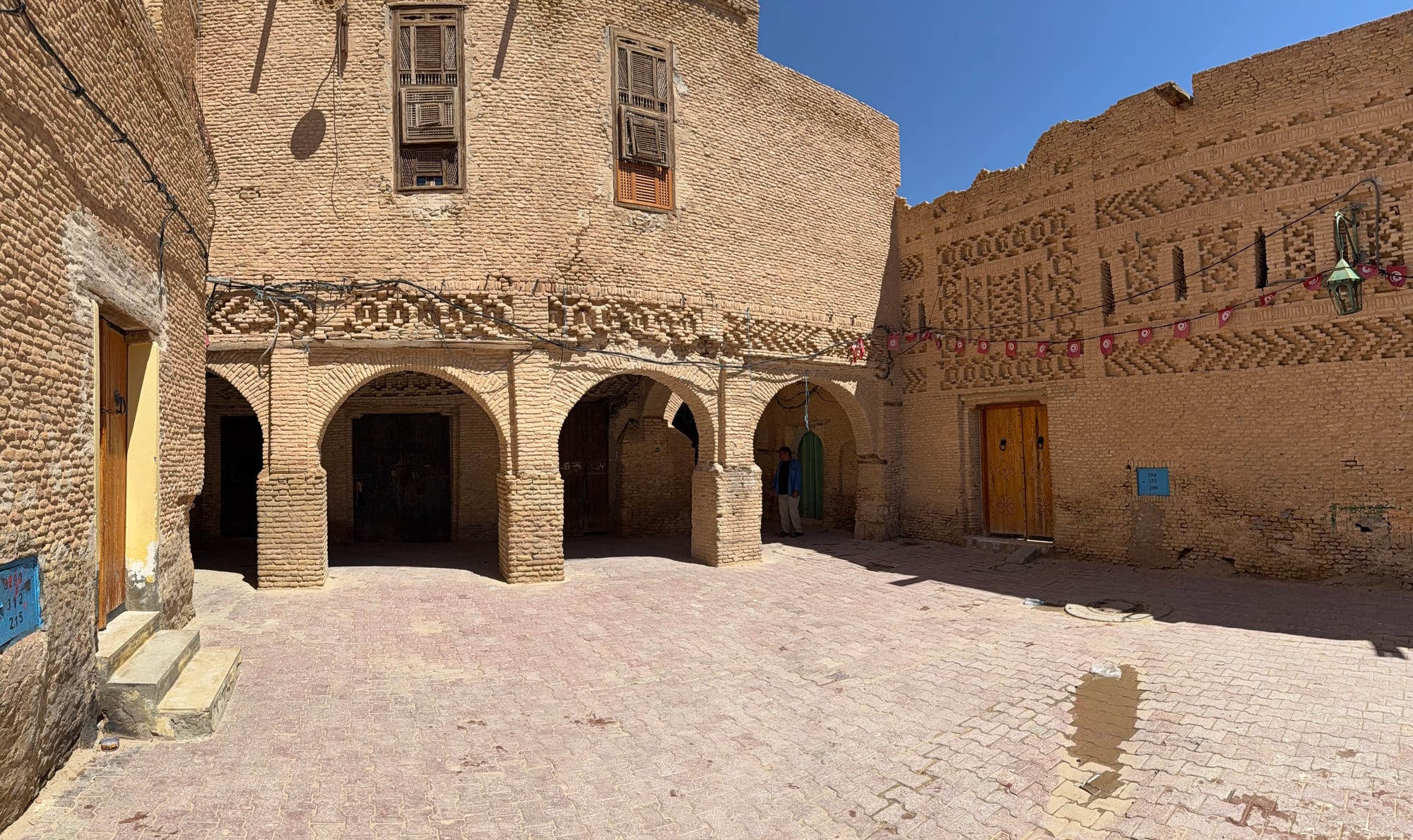
A small square in an old quarter with walls of sand-coloured brick laid in raised geometric patterns and an arcade of low arches

Djerba & the Sahara South, Tunisia

Tozeur

Patterned brickwork around a courtyard in the Ouled el-Hadef quarter of Tozeur. (Rawen Ab / Wikimedia Commons · CC BY-SA 4.0)

The main oasis town of south-western Tunisia, set between the salt pans of the Chott el Djerid and the Chott el Gharsa at the edge of the Sahara. A large date palm grove waters the town, and its old quarter of Ouled el-Hadef is built of sand-coloured bricks laid in geometric relief. Tozeur is the base for the mountain oases and the desert west of it.

Neighbourhoods

  • Ouled el-Hadef
    • Historic district
    • Architecture
    • Photography

    The fourteenth-century core of the town, a maze of narrow shaded lanes between walls of yellow brick set in projecting geometric patterns. Small workshops, craft shops and a few guesthouses occupy the old courtyard houses, and the quarter is quiet outside the middle of the day.

    Open in Maps
  • The town centre and Avenue Habib Bourguiba
    • First-time visitors
    • Best for food
    • Close to transport

    The modern spine of Tozeur, lined with cafés, banks, bakeries, travel agencies and the louage and bus stations. Most of the town's everyday life happens here, and the market and the entrance to the palm grove are both a short walk away.

    Open in Maps
  • The palmeraie and the hotel zone
    • Quiet and residential
    • Hotels
    • Walks

    South and west of the centre the palm grove spreads for kilometres, cut by irrigation channels and sandy tracks beneath the date palms. The larger hotels stand along its edge, set apart from the town and within easy reach of the groves.

    Open in Maps

Things to do

The town

  • Ouled el-Hadefneighborhood

    The old quarter, whose brick façades are laid in raised lozenges and geometric bands — a local technique that has made Tozeur's medina the best known of its kind in Tunisia.

    Open in Maps
  • The Tozeur palmeraiepark

    A palm grove of hundreds of thousands of date palms fed by springs and channels, with pomegranates, figs and vegetables grown in the shade beneath them; tracks and horse-drawn carriages cross it.

    Open in Maps
  • Dar Cherait Museummuseum

    Founded in 1990 as the first private museum in Tunisia, showing Tunisian art, furniture, costume, jewellery and reconstructed interiors.

    Open in Maps
  • Belvedere rocksviewpoint

    The belvedere park of Ras El Aïn west of the town, rock mounds above the springs that feed the oasis, used as a lookout over the palm grove and the salt pan beyond.

    Open in Maps

Short trips from the town

  • Chott el Djeridattraction

    The great salt lake south-east of the town, dry and crusted white for most of the year and crossed by a raised causeway; mirages are common in the heat.

    Open in Maps
  • Neftaattraction

    An oasis town about 25 kilometres west, known for its Sufi shrines and for the Corbeille, a deep hollow of springs ringed by palms.

    Open in Maps
  • Chebikaattraction

    A mountain oasis about 50 kilometres north-west, where a spring runs through a gorge below the abandoned stone village on the hillside.

    Open in Maps
  • Tamerzaattraction

    The largest of the mountain oases, about 70 kilometres north-west near the Algerian border, with a canyon, waterfalls and an old town abandoned after floods in 1969.

    Open in Maps
  • Midèsattraction

    A mountain oasis about 75 kilometres north-west, set above a narrow gorge on the Algerian frontier.

    Open in Maps
  • Ong Jemelattraction

    A camel-shaped rock formation in the desert beyond Nefta, near the standing set built as Mos Espa for Star Wars: Episode I.

    Open in Maps

Seasonal events

  • Date harvestautumn

    The deglet nour harvest fills the palm grove and the packing sheds from October, and fresh dates appear in the markets and on café tables.

  • Eid al-Fitrat the end of Ramadan, moving earlier each year

    The holiday closing the fasting month, when families gather, sweets are prepared and much of the town's business pauses for several days.

  • International Festival of OasesNovember and December

    Tozeur's main annual festival, held in the town and drawing performers and visitors from across the Jerid.

  • Desert seasonOctober to April

    The cooler months bring visitors, excursions into the dunes and evenings in the camps around the oases; midsummer is very quiet by comparison.

Eat and drink

Long-standing places and food districts in Tozeur. Hours, ratings and directions come from your maps app, always current.

Tozeur classics

  • Deglet nour datesmarket

    The translucent honey-coloured date grown in the Jerid oases, sold fresh on the branch in autumn and pressed into pastes and sweets the rest of the year.

    Open in Maps
  • Oasis couscous and lambrestaurant

    Southern couscous, often with lamb and sometimes with kadid, sun-dried salted meat, served in the family restaurants of the town centre.

    Open in Maps

Markets and cafés

  • Tozeur marketmarket

    The town's produce market, with dates, olives, harissa, spices, vegetables from the oasis gardens and palm-frond baskets.

    Open in Maps
  • Cafés on Avenue Habib Bourguibacafe

    Shaded pavement terraces where mint tea with pine nuts, strong coffee and sheesha are taken through the long afternoons and into the evening.

    Open in Maps

Experience Tozeur

History

Tozeur stands on the site of Tusuros, a Roman town on the road along the edge of the Chott el Djerid, which was itself built on a far older oasis settlement fed by springs. Its position made it a natural halt: the caravan routes that carried gold, salt and slaves north from the Sahara came out of the desert here, and the oasis could water and feed both people and animals. Under Rome the town was a frontier post and the seat of a bishopric; after the Arab conquest of the seventh century it became a market town of the Jerid, the palm-grove district that gives the region its name.

In the Middle Ages Tozeur was a centre of trade and religious learning, and in the fourteenth century the Ouled el-Hadef quarter was laid out by a local family in the style that still defines the town: walls of sun-dried and fired brick set in projecting geometric patterns, a technique thought to derive from the way palm wood and older mud construction were ornamented. The oasis was run by an elaborate and closely regulated system of irrigation channels, dividing the water of the springs among families by fixed shares — a system recorded in detail by medieval writers.

The town came under Ottoman and then French administration, the latter running the far south as a military territory and linking Tozeur to the coast by road and rail for the date trade. Since independence, dates and tourism have shaped its growth: deglet nour became a major export crop, and from the 1960s the town acquired hotels, an airport and a role as the base for desert excursions, while the nearby desert was repeatedly used as a film location.

Culture & Customs

Tozeur's identity is that of the Jerid — an oasis society built around water rights, date palms and the families that hold them. The old quarter is the physical expression of it, and the brickwork of Ouled el-Hadef is a craft still practised, with modern hotels and public buildings copying its patterns. Palm wood, fronds and fibre are worked into roofs, doors, fences, baskets and mats, and weaving of woollen blankets and rugs continues in the town.

Religious life is strong and quieter than on the coast. Nefta, a short way west, is a centre of Sufi shrines and pilgrimage, and marabout tombs stand at the edges of the groves around Tozeur itself. Poetry and music of the desert south, and the long traditions of hospitality that go with them, are still part of local occasions: weddings fill several days, and guests are pressed with tea and dates.

The town is also used to outsiders. Generations of travellers, film crews and tour groups have passed through, and a whole local economy of guides, carriage drivers, hotel workers and craft sellers has grown around them; the film sets in the desert beyond Nefta are part of the town's modern folklore. Locals draw a clear line between the oasis, which is theirs and worked daily, and the desert beyond it, which is treated with respect and not entered lightly.

Daily Life

About 37,000 people live in Tozeur, the capital of its governorate, and the surrounding communes of the Jerid add tens of thousands more. Life divides between the old quarter and the low modern streets around the main avenue, with newer housing spreading towards the airport and the palm grove's edge. Many households still own or work a plot in the oasis even when their income comes from elsewhere.

The economy rests on dates and tourism. Deglet nour from the Jerid is one of Tunisia's best-known agricultural exports, and the packing and shipping season sets the pace of the autumn; hotels, guides, carriage drivers, craft shops and desert excursions provide much of the rest of the work, and suffer whenever visitor numbers fall. Water is the constant worry: springs that once flowed freely have been replaced by deep boreholes, the water table has dropped, and the salinity of soils on the chott's edge is a live issue for date farmers.

The day is shaped by heat. Markets, errands and work in the groves are done early; the streets empty in the early afternoon; and the cafés and the main avenue fill again after sunset, especially in summer, when much of social life is nocturnal. Young people leave for Sfax, Tunis or abroad, and unemployment in the south is a persistent grievance.

Food

Southern Tunisian cooking is plainer than the coast's, built on what the oasis and the flocks provide. Couscous is the centrepiece, steamed and served with lamb or with vegetables from the gardens under the palms, and sometimes with kadid, meat salted and dried in the sun to keep without refrigeration. Lamb and kid are grilled over charcoal or slow-cooked in a covered pot, and chorba, a spiced broth with fine pasta, is the standard start to a meal, especially in Ramadan.

Dates run through everything. The deglet nour, translucent and honey-sweet, is eaten fresh at harvest, dried for the year, pressed into paste for makroudh — the date-filled semolina sweet — and boiled down into syrup. Rtob, the softer, half-ripe stage of the fruit, is a delicacy that rarely travels. The palms also give legmi, the sap drawn from the crown of the tree, drunk sweet and fresh in the morning or left to ferment into a cloudy alcoholic drink.

The national staples are all here: harissa on the table, brik filled with egg and tuna, lablabi for breakfast, mechouia salad of charred peppers and tomatoes, and olives from the groves north of the chott. Mint tea, poured strong and sweet and often sprinkled with pine nuts or almonds, is the social drink, served after long preparation over coals in the desert camps and on every café terrace in town.

Planning tools

Budget

Tozeur is inexpensive. Simple hotels and guesthouses in the town cost little, and local food is cheap; the money goes on excursions — a four-wheel-drive day to the mountain oases or the desert, or a hired car to reach them independently.

Daily Budget Midrange
USD 75–170 (comfortable hotel near the palm grove, restaurant meals, a guided 4x4 day or a hire car)
Daily Budget Shoestring
USD 25–40 (small hotel or guesthouse, local restaurants, louages and buses)

Agree the price of any 4x4 or camel excursion before setting off, and carry cash: cash machines exist in the town centre but not in the villages around it.

Best Time to Visit

October to April, when days are warm and clear and the desert is comfortable. The date harvest runs through the autumn. Midsummer is extreme, with daytime temperatures regularly above 40°C, and spring can bring sandstorms that close in the horizon for a day or two.

Suggested Number of Days

A day or two covers the old quarter, the palm grove and the edge of the salt pan. Allow three or four to include the mountain oases and the desert west of the town, which are a long half-day or full day each.

First Visit
1–2 days
With Surroundings
3–4 days

Transportation

The town itself is small enough to cross on foot or by cheap local taxi, and horse-drawn carriages work the palm grove. Louages and buses connect Tozeur with Nefta, Kébili, Gafsa, Douz and Tunis, and a train line reaches the town from the north. The mountain oases and the desert tracks are far easier with a hire car, a taxi hired for the day or a guided four-wheel drive.

Do not drive off the made roads into sand or onto the salt pan without a guide and a proper vehicle; surfaces that look firm often are not.

Airport & Station Connections

Tozeur has its own international airport, Tozeur–Nefta, just outside the town. Trains run from Tunis to Tozeur, and louages and long-distance buses link the town with Tunis, Gafsa, Gabès, Kébili and Douz; Tunis is a long day away by road. Many visitors arrive by hired car on the road across the Chott el Djerid from Kébili and Douz.

Walkability

The centre is easy to walk: the market, the main avenue and the old quarter of Ouled el-Hadef are within a few hundred metres of each other, and the lanes of the old town are too narrow for cars. The palm grove begins at the southern edge of town and can be walked on its tracks, though it is large. Heat, glare and sandy verges make midday walking hard from May to September.

Safety

Tozeur is a calm town used to visitors, and the usual issues are minor: persistent offers of tours and taxis, and overcharging without an agreed price. The real dangers are environmental — heat, dehydration, sun and getting lost or bogged in the desert and on the salt pan, which should only be crossed by the made road or with a guide.

Keep away from the Libyan border zone and the desert military zone, use licensed guides for the Sahara, and carry water. Prices for carriages, guides and excursions are best agreed in advance. Check current official travel advice before travelling.

Climate

Desert climate, with very little rain in any month and a wide gap between day and night temperatures. Skies are clear most of the year, and the palm grove is noticeably cooler than the open ground around it. Sand-laden winds are most common in spring.

Summer
very hot and dry, frequently above 40°C by day, with warm nights
Winter
sunny days of about 16–20°C, with nights that can fall close to freezing

Local Customs

The Jerid is more conservative than Tunisia's coast. Covered shoulders and knees are appreciated in the town and expected around mosques and shrines, which are generally not open to non-Muslims. Hospitality is strong, and an invitation to tea is genuine rather than always a sales approach, though guides and carriage drivers do compete hard for custom.

Ask before photographing people, agree prices for carriages, guides and excursions in advance, tip around 10 per cent in restaurants, and expect alcohol to be limited to hotels and licensed restaurants and to be discreet during Ramadan.

Common Payment Methods

The currency is the Tunisian dinar, which cannot legally be taken in or out of the country. Hotels and car hire take cards, but shops, cafés, markets, taxis and guides work in cash, and cash machines are confined to the town centre, so draw money before heading into the oases.