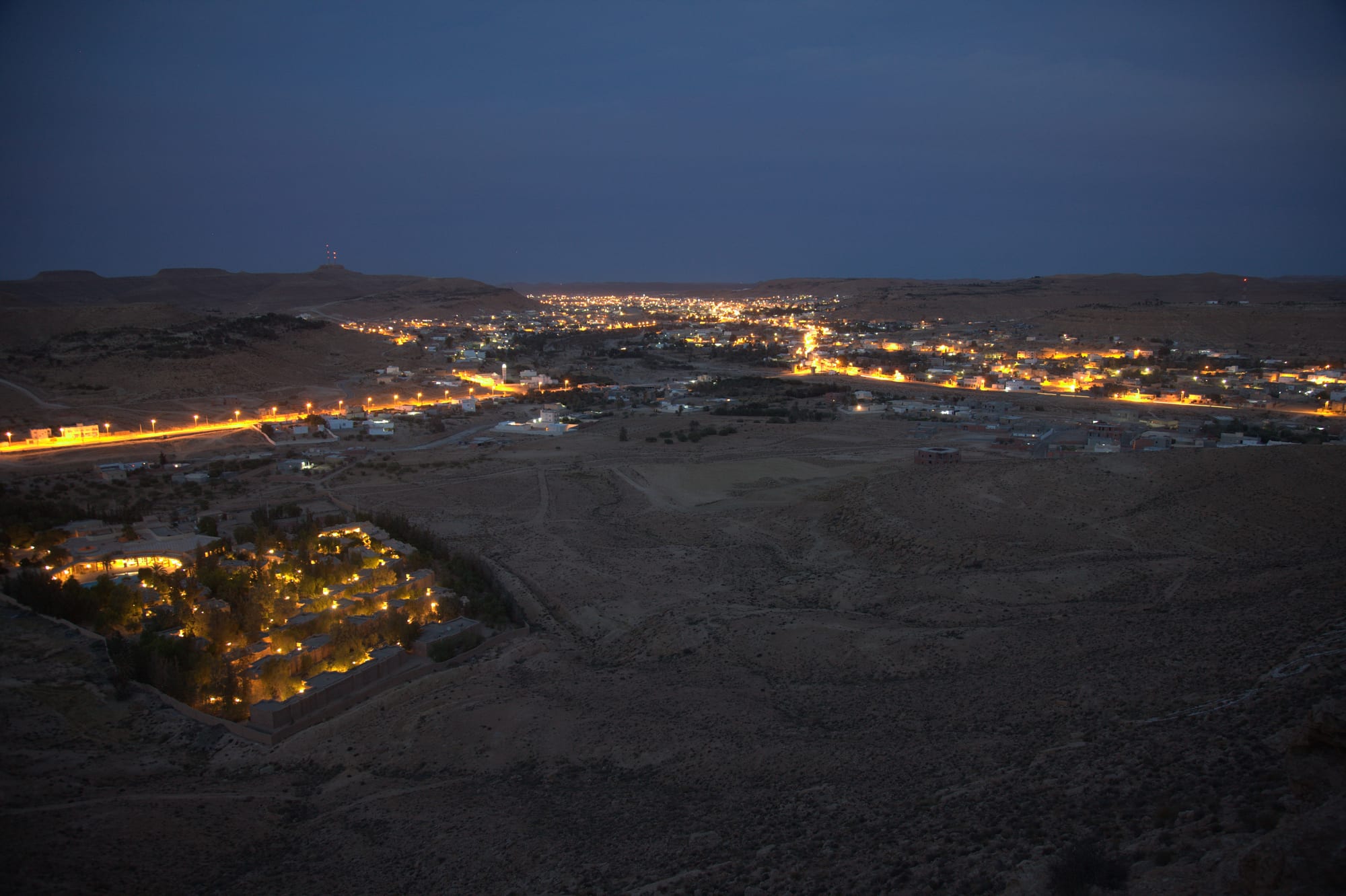
A low desert town strung with orange street lights spread along a valley between bare hills under a deep blue night sky

Djerba & the Sahara South, Tunisia

Tataouine

Tataouine at night, seen from the hills above the town. (Averater / Wikimedia Commons · CC BY-SA 3.0)

The main town of Tunisia's far south-east, set in the dry hills of the Dahar where the plateau breaks up into ridges and gorges. It is a market and administrative centre rather than a sight in itself, and serves as the base for the ksour — the fortified Amazigh granaries of stacked vaulted cells — and the hilltop villages of Chenini and Douiret nearby.

Neighbourhoods

  • The town centre
    • First-time visitors
    • Markets
    • Close to transport

    A compact grid of low buildings around the main avenue, with cafés, bakeries, banks, the market and the louage station. Everyday business rather than sightseeing fills it, and it is busiest in the early morning and again after dark.

    Open in Maps
  • The market quarter
    • Markets
    • Best for food
    • Local life

    The blocks around the weekly market, where traders from the surrounding villages sell sheep, grain, dates, spices, blankets and household goods. Food stalls and simple restaurants work the same streets, and the pace changes completely between market days and the rest of the week.

    Open in Maps
  • The hillside edges
    • Quiet and residential
    • Views

    Newer housing climbs the low ridges around the town, giving views out over the roofs to the dry hills and the desert beyond. The larger hotels are on this side, set apart from the centre and within reach of the roads to the ksour.

    Open in Maps

Things to do

In and around the town

  • Tataouine weekly marketmarket

    A large country market for livestock, grain, dates, spices, woollen blankets and palm-frond work, drawing villagers from across the Dahar hills.

    Open in Maps
  • The town's ksourlandmark

    Several fortified granaries stand on the ridges at the edge of Tataouine itself, smaller and less visited than those further out but easier to reach on foot or by short taxi ride.

    Open in Maps

The ksour

  • Ksar Ouled Soltanelandmark

    Under 20 kilometres south-east, the best preserved of the granaries: two courtyards ringed by vaulted store cells stacked several levels high, with its earliest construction dated to 1699, and used in The Phantom Menace as the slave quarters of Mos Espa.

    Open in Maps
  • Ksar Hadadalandmark

    A village about 23 kilometres north whose ksar of whitewashed vaulted cells, partly converted for visitors, was also a filming location for The Phantom Menace in 1999.

    Open in Maps
  • Ghomrassenattraction

    A town about 18 kilometres north in a steep valley of cliffs and cave dwellings, long known for emigrant traders and for its fried doughnuts.

    Open in Maps

Hill villages

  • Cheniniattraction

    A ruined Amazigh village about 18 kilometres south-west, its houses and ksar strung along a knife-edge ridge above a white mosque, with terraces and cave dwellings below.

    Open in Maps
  • Douiretattraction

    About 17 kilometres south-west, another hilltop ksar above a line of abandoned cave houses, with a restored white mosque halfway along the path.

    Open in Maps
  • Guermessaattraction

    An Amazigh mountain village about twenty kilometres north-west, quieter than Chenini and Douiret, with cave dwellings below and a ksar on the ridge above.

    Open in Maps

Seasonal events

  • Ksour FestivalMarch

    The town's annual festival of southern Amazigh culture, with music, poetry, horsemanship, crafts and processions held in Tataouine and at the ksour around it.

  • Olive and date harvestautumn and early winter

    Olives are pressed on the terraces of the Dahar and dates arrive from the oases, filling the market and the household stores for the year.

  • Eid al-Fitrat the end of Ramadan, moving earlier each year

    The holiday that closes the fasting month, when families come back to the villages, sweets are baked and business pauses for several days.

Eat and drink

Long-standing places and food districts in Tataouine. Hours, ratings and directions come from your maps app, always current.

Tataouine classics

  • Ftaiermarket

    Fried doughnuts, the speciality of nearby Ghomrassen, whose bakers are known across Tunisia, sold hot alongside makroud and zlabia in the pastry shops.

    Open in Maps
  • Southern couscous and lambrestaurant

    Couscous steamed with lamb or goat, sometimes with kadid, salted air-dried meat, served in plain restaurants around the main avenue.

    Open in Maps

Markets and cafés

  • Tataouine marketmarket

    Dates, olives, harissa, spices, grain, cheese and bread alongside blankets and basketwork, with grills and stalls working through the morning.

    Open in Maps
  • Cafés on the main avenuecafe

    Terraces where mint tea with pine nuts and small strong coffees are drunk at length, and where drivers and guides are found between trips.

    Open in Maps

Experience Tataouine

History

Tataouine is a young town in an old landscape. The hills of the Dahar around it have been settled by Amazigh communities for many centuries, who built their villages on defensible ridges — Chenini, Douiret, Guermessa — and stored their grain in ksour, courtyards ringed by vaulted cells stacked several storeys high. The granaries belonged to clans and families, with each cell, or ghorfa, held by a household; Ksar Ouled Soltane is dated in part to 1699. They served semi-nomadic people who moved with their flocks and needed a secure place to keep barley, oil and dates against raiders and drought.

The town itself grew from a French military post established in the 1890s, when the far south was administered as a military territory and a garrison was placed at the foot of the hills. It was long known as Foum Tataouine, the mouth of the springs, and served as the administrative centre for a vast, thinly populated district reaching to the Libyan frontier. Under the protectorate it acquired the reputation of a place of exile and punishment: from 1892 to 1951 it was the garrison town of a French penal infantry unit.

After independence the town became a governorate capital, and the surrounding population steadily moved down from the ridges into it and into roadside villages, leaving the old hilltop settlements half empty. From the 1970s the ksour began to attract visitors, and the region's name entered global popular culture when Star Wars gave a version of it — Tatooine — to a desert planet, with several nearby sites used for filming. Since 2011 the south has also lived with the consequences of instability in neighbouring Libya, including refugee arrivals and disrupted cross-border trade, and Tataouine has seen repeated protests over unemployment and a share of southern oil revenues.

Culture & Customs

The Dahar is one of the strongholds of Amazigh culture in Tunisia. Berber speech survives in Chenini, Douiret and a few other villages, and the ksour, cave dwellings and terraced fields are the physical record of a society organised around clans, shared granaries and the movement of flocks between hills and plain. Families identify strongly with a particular village and ksar even when they have lived in town for generations, and return for weddings, funerals and festivals.

The Ksour Festival is the town's main cultural occasion, filling Tataouine and the granaries with music, sung poetry, horsemanship and craft displays, and drawing performers from elsewhere in the Maghreb. Weddings are long, public affairs with drumming, processions and henna nights, and hospitality is formal: tea is offered immediately, refusal is awkward, and a guest is fed before anything is discussed.

Crafts follow the materials of a dry country — wool woven into blankets and striped cloaks, palm fronds into baskets and roofing, olive wood into tools and bowls, and clay into the jars that lined the granary cells. Emigration is part of the culture too: men from Ghomrassen and the surrounding villages ran shops and bakeries across Tunisia and in France for generations, and money sent home built much of what stands in the town today.

Daily Life

The municipality counted nearly 67,000 people at the 2014 census, and it serves a governorate covering a huge, almost empty stretch of the south. Housing spreads along the valley and up the low ridges, mostly single-storey and built from concrete block, and the villages of the Dahar hold a few thousand more residents apiece — far fewer than a century ago. Households are large, and many depend on relatives working in Tunis, on the coast, in Libya or in France.

Work comes from administration, schools and the army, from sheep and goat herding and olive growing on the terraces, from small-scale trade, and from a modest tourism business around the ksour. The region sits near Tunisia's oil and gas fields — a new field was found south of the town in 2016 — and the gap between that wealth and local unemployment has driven sustained protests. Cross-border commerce with Libya, formal and informal, has long been an important income and has become unreliable.

The rhythm of the week turns on the market, prayers and the school day; the rhythm of the day on the heat, with business done early, shutters closed in the afternoon and the cafés of the main avenue filling after dark. Water is trucked or piped to many villages, and drought years are felt directly in the flocks and the olive crop.

Food

Food in the south-east is plain, dry-country cooking. Barley and semolina dominate: couscous steamed above a stew of lamb, goat or vegetables, and thick barley dishes dressed with olive oil. Kadid — meat salted, spiced and air-dried — is the old way of keeping the meat of a slaughtered animal and is cooked into couscous through the year. Tabouna bread, baked against the wall of a clay oven, is eaten with oil, olives, harissa and fresh curd cheese.

Pastry is the speciality of the district, and above all of Ghomrassen up the road, whose bakers are known across the country for ftaier, fried doughnuts sold hot from the pan, as well as for makroud and zlabia; families from the town have carried those trades to shops all over Tunisia. Dates from the oases to the west, figs, almonds and pomegranates round out the sweet side.

The national dishes are all present — brik, the fried pastry parcel with egg; chorba, a peppery broth with fine pasta that opens meals in Ramadan; lablabi, a chickpea soup poured over torn bread; and mechouia, the salad of charred peppers and tomatoes — with harissa on every table. Mint tea, boiled slowly over coals and poured from a height with pine nuts or roasted almonds in the glass, is drunk all day and is the standard gesture of welcome.

Planning tools

Budget

Tataouine is among the cheapest places to stay in Tunisia: simple hotels and guesthouses, low restaurant prices and small entry fees at the ksour. The real cost is transport, since the granaries and hill villages are scattered and public services to them are sparse, so most visitors hire a car or a taxi with a driver for a day.

Daily Budget Midrange
USD 75–170 (better hotel or a restored ksar guesthouse, restaurant meals, a hire car or a driver for the ksour)
Daily Budget Shoestring
USD 25–40 (small hotel or guesthouse, local restaurants, louages and shared taxis)

Agree the full route and price with a taxi driver before a day of ksour visits, and carry cash: cash machines exist in the town but not in the villages.

Best Time to Visit

October to April, when the hills are walkable and the light on the ksour is at its best early and late in the day. Spring brings the festival season and occasional sandstorms. Midsummer is very hot, and climbing to Chenini or Douiret in July or August is hard going.

Suggested Number of Days

A day is enough for the town itself and one or two ksour. Two or three allow the hill villages and the more distant granaries at an unhurried pace, which is how most people use Tataouine.

First Visit
1 day
With Surroundings
2–3 days

Transportation

The town centre is small and walkable. Louages and buses connect Tataouine with Médenine, Gabès, Djerba and Tunis, and some run to the larger villages, but they are infrequent and return services can be hard to catch. Nearly everyone visiting the ksour hires a car or engages a taxi for the day; the roads are paved to the main sites and rough beyond them.

Fill the tank in town, since fuel stations are few in the hills, and do not take an ordinary car onto the unmade tracks between villages.

Airport & Station Connections

Tataouine lies about 50 kilometres inland from Médenine, roughly an hour by road, and about two hours from Djerba and Gabès. Louages and long-distance buses run from Tunis, which is a long day away, and from the coastal towns. The nearest airport is Djerba–Zarzis, and most independent visitors arrive by hire car.

Walkability

The centre is flat and easily covered on foot, and the market and cafés are within a few streets of each other. The ksour and villages are not walkable from town, and exploring Chenini or Douiret means steep, rough paths and loose stone underfoot, with almost no shade. Sturdy shoes and water are needed for both.

Safety

Tataouine town is calm and used to visitors, with petty theft and pressure from guides the everyday nuisance. Western governments advise against travel to the far south and the Libyan border area, including around Ben Guerdane, and to the military zone south of Tataouine, which is closed to ordinary travel. In the hills, heat, exposure and unfenced drops at the ksour are the practical dangers.

Keep away from the Libyan border zone and the desert military zone, use licensed guides for the Sahara, and carry water. Check current official travel advice before travelling.

Climate

Desert climate softened a little by altitude in the Dahar hills. Rain is scarce and falls mostly between autumn and early spring, sometimes hard enough to flood the wadis for a few hours. Skies are clear most of the year, and the gap between day and night temperatures is wide.

Summer
very hot and dry, often 38–42°C by day, with warm evenings
Winter
sunny days of about 16–20°C, with cold nights sometimes near freezing

Local Customs

This is a conservative, tribal part of Tunisia where Amazigh identity is strong and Berber is still spoken in some villages. Covered shoulders and knees are expected, mosques are generally not open to non-Muslims, and some ksour are still owned and used by families who expect to be asked before anyone climbs into the cells.

Ask before photographing people, homes or a ksar in use, pay the small fees and tips expected at the granaries and villages, and expect alcohol to be limited to hotels rather than town cafés.

Common Payment Methods

The currency is the Tunisian dinar, which cannot legally be taken in or out of the country. Cash machines and a few card terminals are found in the town centre, but villages, guides, taxis and market stalls take cash only, so draw what is needed before setting out for the day.