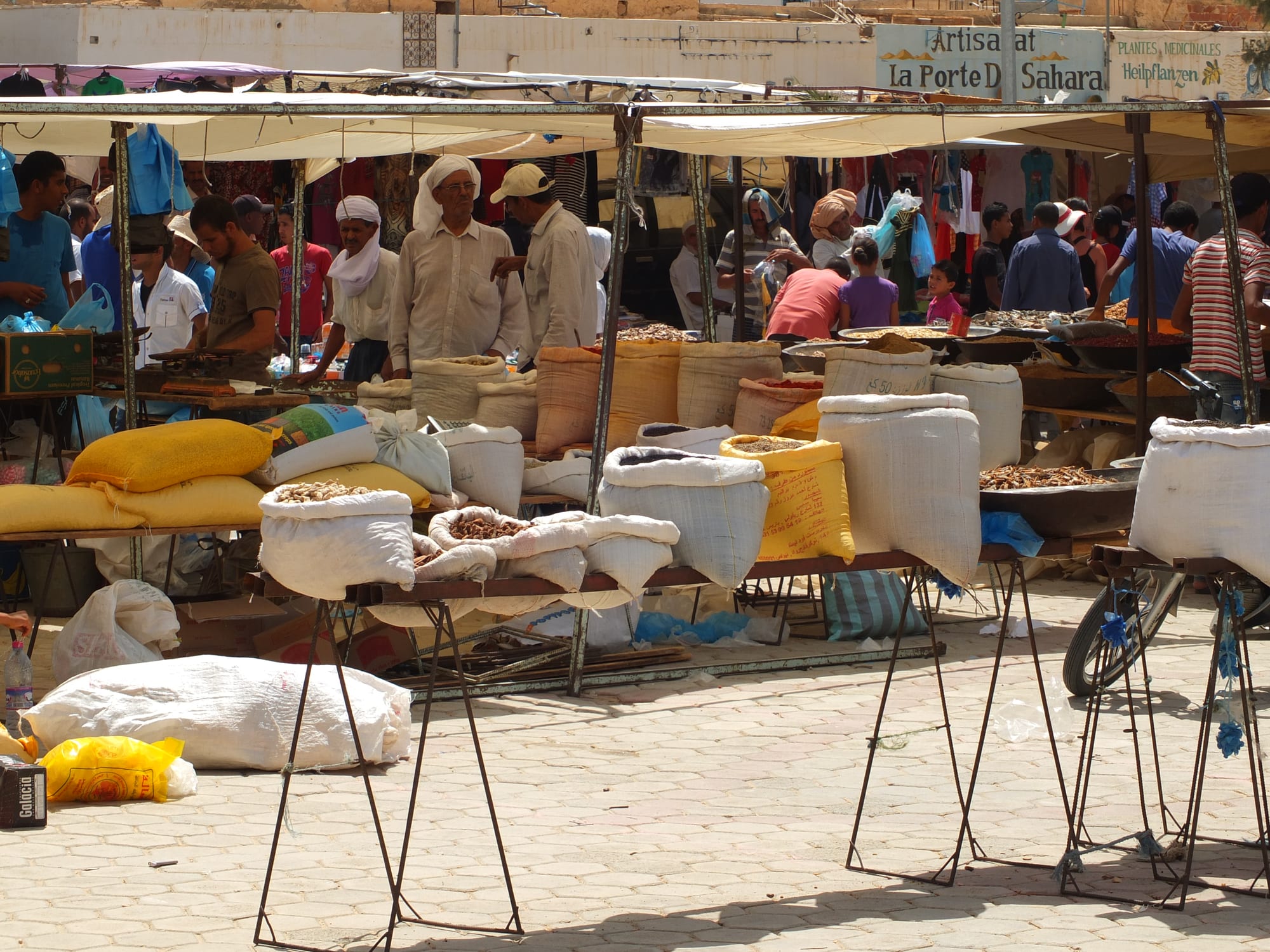
Open-air market stalls under white awnings with wide metal bowls and sacks of grain, nuts and spices, shoppers behind them

Djerba & the Sahara South, Tunisia

Douz

Sacks and bowls of grain, nuts and spices at the market in Douz. (Ad Meskens / Wikimedia Commons · CC BY-SA 4.0)

A market town in the Nefzaoua oases of southern Tunisia, standing where cultivated land gives out and the dunes of the Grand Erg Oriental begin. Long known as the gateway to the Sahara, it is the home of the Mrazig, a people of Bedouin descent, and the base for camel treks and desert excursions, with a weekly market and a festival of desert life in December.

Neighbourhoods

  • The town centre and the market square
    • First-time visitors
    • Markets
    • Best for food

    A compact grid of low buildings around the arcaded market square, with cafés, bakeries, craft shops and the louage stand. The square is quiet for much of the week and crowded on market day, when traders come in from the surrounding oases and the desert edge.

    Open in Maps
  • The palm grove
    • Quiet and residential
    • Walks

    A grove of several hundred thousand date palms wraps around the town, cut by sandy lanes and irrigation channels with vegetable plots beneath the trees. Houses and small guesthouses stand along its edges, and it is noticeably cooler than the open ground.

    Open in Maps
  • The dune edge and the camp zone
    • Desert trips
    • Hotels

    South of the palm grove the ground turns to sand and the first dunes of the Grand Erg Oriental rise within walking distance of the town. The larger hotels and the departure points for camel and four-wheel-drive trips are on this side.

    Open in Maps

Things to do

The town

  • Douz weekly marketmarket

    The town's market day fills the main square with livestock, dates, spices, blankets, palm-frond goods and desert clothing, drawing sellers from the whole Nefzaoua.

    Open in Maps
  • Museum of the Saharamuseum

    A small museum of desert life, with tents, saddles, tools, jewellery and costume of the Mrazig and other nomadic groups.

    Open in Maps
  • The Douz palm grovepark

    Hundreds of thousands of date palms, watered from boreholes, with vegetables, pomegranates and figs grown in their shade; sandy tracks run through it from the town.

    Open in Maps

The desert

  • Grand Erg Orientalattraction

    The great sand sea that runs from here deep into Algeria; its northern dunes begin at the southern edge of Douz and are the reason the town exists as a departure point.

    Open in Maps
  • Camel trekking from Douzattraction

    Trips of a few hours to several days with camels and guides into the dunes, usually sleeping at desert camps — the town's best-known activity, arranged through local operators.

    Open in Maps

Short trips from the town

  • Chott el Djeridattraction

    The vast salt pan north-west of the town, crossed by the road towards Tozeur and white with crusted salt for most of the year.

    Open in Maps
  • Kebiliattraction

    The governorate capital about 30 kilometres north, an old caravan town that was a centre of the trans-Saharan slave trade, with its own large palm groves.

    Open in Maps
  • Ksar Ghilaneattraction

    A remote oasis with a warm spring and a Roman fort, about 80 kilometres east across the sand, reached by four-wheel drive.

    Open in Maps

Seasonal events

  • International Festival of the SaharaDecember

    Several days of camel and horse racing, sloughi hounds, desert poetry, music and craft displays on the sand ground outside the town, with roots in a camel festival first held in 1910 and its present form dating from 1967.

  • Date harvestautumn

    The deglet nour crop is cut, sorted and packed from October, and the palm grove and the market are at their busiest.

  • Desert seasonOctober to April

    The cooler months bring the camel treks, the desert camps and most of the town's visitors; in high summer the dunes are too hot for trekking.

Eat and drink

Long-standing places and food districts in Douz. Hours, ratings and directions come from your maps app, always current.

Douz classics

  • Couscous with lamb and kadidrestaurant

    Southern couscous served with lamb, and sometimes with kadid, meat salted and air-dried, in the family restaurants around the centre.

    Open in Maps
  • Bread baked in sandrestaurant

    An unleavened loaf buried in hot sand and embers to bake — a Bedouin method still demonstrated and eaten at desert camps around the town.

    Open in Maps

Markets and cafés

  • Douz marketmarket

    Dates by the sackful, dried fruit and nuts, harissa, spices, olives and woven blankets, with food stalls working through the morning.

    Open in Maps
  • Cafés on the market squarecafe

    Arcaded terraces where mint tea with pine nuts and small strong coffees are drunk slowly, and where guides and drivers gather between trips.

    Open in Maps

Experience Douz

History

Douz grew where the Nefzaoua oases meet the sand. Springs at the edge of the Chott el Djerid basin allowed date palms and gardens, and the settlement served as the last watering point for caravans heading south and east across the Grand Erg Oriental — routes that carried dates, salt, cloth and, for centuries, slaves between the Sahel and the Mediterranean coast. The Roman limes ran through this country, and the fort at Ksar Ghilane out in the sand marks its southern reach.

The town's modern identity belongs to the Mrazig, descendants of the Banu Sulaym, who reached Tunisia from the east by the thirteenth century and long lived between the oasis and the desert, herding camels and sheep and wintering in tents in the erg. Douz was their market and their fixed point: a place to sell livestock and dates, buy grain and cloth, and settle disputes. French administration of the far south as a military territory from the late nineteenth century, and later the policies of the independent state, gradually pulled the nomads into permanent housing around the grove.

Two things changed the town in the twentieth century. Deep boreholes greatly expanded the palm groves and made commercial date growing possible, and the desert itself became a product: the International Festival of the Sahara, begun as a camel festival in 1910 and reshaped into its present form in 1967, turned camel racing, hunting hounds and Bedouin poetry into an annual event, and camel trekking grew into the town's best-known trade. Tourism has risen and fallen sharply with security scares elsewhere in the country, but the title the town gave itself — the gateway to the Sahara — has stuck.

Culture & Customs

Mrazig culture is what distinguishes Douz from the other oasis towns. It is Bedouin in memory and oasis-dwelling in practice: families keep camels even when they farm dates, tents are still put up for weddings and festivals, and the poetry, songs and dances of the desert are performed rather than only recorded. The sloughi, the North African sighthound once used for hunting gazelle, is bred here and shown at the festival, as are horses and racing camels.

The International Festival of the Sahara each December is the town's great public occasion, bringing groups from across Tunisia, Libya and Algeria for several days of racing, music, marriage displays and craft markets on the sand ground outside town. Weddings are the other large gatherings, lasting days and involving the whole neighbourhood, with henna nights, drumming and processions.

Craft work follows desert materials: wool woven into blankets and the striped cloaks men wear against the cold, palm fronds turned into baskets, mats and roofing, and leather and silver worked for saddlery and jewellery. Dress is more traditional than on the coast — turbans and long cloaks are ordinary rather than ceremonial in winter — and social life is strongly divided between male café society and family households. Visitors are common but the town remains small enough that guests are noticed and greeted.

Daily Life

The municipality counted just over 30,000 people at the 2014 census, making it the largest town of the southern Nefzaoua, and villages such as Zaafrane lie along the desert edge nearby. Most housing is single-storey and spread along the grove's margins, and families are large by Tunisian standards; many have relatives working in Tunis, on the coast or abroad and sending money home.

The economy has three legs: dates, livestock and tourism. Deglet nour from the Nefzaoua groves is sold across Tunisia and exported, sheep and camels are raised on the desert margin, and hotels, guides, camel owners and camp operators live on visitors from October to April. That last income is volatile — attacks elsewhere in the country and periods of instability in neighbouring Libya have emptied the town's hotels for seasons at a time — and unemployment among young people is high.

Water shapes everything. The groves depend on deep wells rather than the old springs, the water table has fallen, and salinity and the encroachment of sand onto gardens are constant work: palm-frond fences are planted in lines across the dunes to hold them back. The day starts early in the grove and the market, pauses through the afternoon heat behind shutters, and picks up again at dusk on the café terraces of the square.

Food

Cooking in Douz is desert cooking, plain and built around what keeps. Couscous appears at the centre of most family meals, steamed over a stew of lamb or vegetables; mechoui, whole lamb roasted slowly, marks celebrations; and kadid, meat salted, spiced and air-dried, is stirred into couscous and stews through the year. Chorba, a peppery broth with fine pasta, opens meals, especially during Ramadan, and harissa is on every table.

A local speciality is bread baked in the sand: a flat unleavened dough buried under hot sand and embers, then dusted clean and torn by hand, usually eaten with olive oil, dates or a stew at a desert camp. Dates themselves are the town's staple and its cash crop — deglet nour eaten fresh in autumn, dried for the rest of the year, stuffed with almond paste, or boiled into a dark syrup — and legmi, the sweet sap tapped from a palm, is drunk fresh in the morning.

Camel meat is eaten in the south, sold at butchers in the market and stewed or grilled. Vegetables from the oasis gardens, olives, and strong goat's and sheep's milk cheeses fill out the table. Mint tea, boiled long over coals and poured foaming into small glasses, often with pine nuts or roasted almonds, is drunk all day and is the standard welcome for a guest.

Planning tools

Budget

Douz is cheap to stay in and eat in; the cost of a visit is the desert. Simple hotels and guesthouses in the town are inexpensive, while camel treks with a guide, nights in a desert camp and four-wheel-drive days are what push the daily figure up.

Daily Budget Midrange
USD 75–170 (good hotel or desert camp, restaurant meals, a guided camel trek or 4x4 day)
Daily Budget Shoestring
USD 25–40 (guesthouse or simple hotel, local restaurants, louages, a short camel ride)

Agree the price, route and number of nights of any camel or 4x4 trip in writing before setting off, and bring cash — cash machines are few and none exist beyond the town.

Best Time to Visit

October to April. Days are warm and clear, nights cold, and this is when trekking, camps and the December festival take place. Midsummer days are often above 40°C and unsuited to the dunes, and spring sandstorms can shut down desert trips for a day or two.

Suggested Number of Days

A night or two is enough for the town, the market and a short trip into the dunes. Longer treks and journeys further into the sand add days, and the oases and salt pan to the north extend a stay to three or four.

First Visit
1–2 days
With Surroundings
3–4 days

Transportation

Douz is small enough to walk, with horse carts and cheap taxis for the palm grove and the dune edge. Louages and buses run to Kebili, and from there to Tozeur, Gabès, Gafsa and Tunis, but services thin out in the evening. Beyond the made roads, travel means a four-wheel drive with a guide, or camels.

Never drive into the dunes in an ordinary car or without a guide; sand tracks change with the wind and there is no phone signal in much of the erg.

Airport & Station Connections

Most visitors come by road: Douz lies about 30 kilometres beyond Kebili, roughly two hours from Tozeur across or around the Chott el Djerid, and several hours from Gabès on the coast. Louages and buses link it with Kebili and Tunis, which is a long day away. The nearest airports are at Tozeur and on Djerba, and many people arrive on organised trips from the coast.

Walkability

The town is flat, small and easily walked end to end in twenty minutes, and the first dunes are a walk of a kilometre or two from the southern edge. Streets are sandy rather than paved in places, shade is limited away from the palm grove, and walking is uncomfortable in the middle of the day for much of the year.

Safety

Douz itself is calm and its main nuisance is persistent selling of excursions. Western governments advise against travel to the far south and the Libyan border area, and to the military zone south of Tataouine. The serious risks are in the desert: heat, dehydration, getting lost, and vehicles breaking down far from help, which is why licensed guides, adequate water and a second vehicle matter on longer trips. Nights in the dunes are genuinely cold in winter.

Keep away from the Libyan border zone and the desert military zone, use licensed guides for the Sahara, and carry water. Check current official travel advice before travelling.

Climate

Full desert climate: very little rain in any month, intense sun, and a large drop between day and night temperatures. Winds pick up sand in spring, and the palm grove is several degrees cooler than the open dunes.

Summer
very hot and dry, often above 40°C by day, with warm nights
Winter
sunny days of about 17–21°C, with nights close to freezing in the desert

Local Customs

The Nefzaoua is conservative and tribal, and the Mrazig keep a strong Bedouin identity. Covered shoulders and knees are expected in town, and mosques are generally not open to non-Muslims. Hospitality is a point of honour: tea is offered constantly and refusing outright is awkward, while bargaining over excursions is normal and expected to stay courteous.

Ask before photographing people, camels or homes, tip guides and camp staff at the end of a trip, expect alcohol to be limited to hotels rather than cafés, and be discreet about it during Ramadan.

Common Payment Methods

The currency is the Tunisian dinar, which cannot legally be carried in or out of the country. A few cash machines serve the town centre and hotels may take cards, but guides, camps, taxis, cafés and the market run on cash, so draw enough before leaving Kebili or Tozeur.