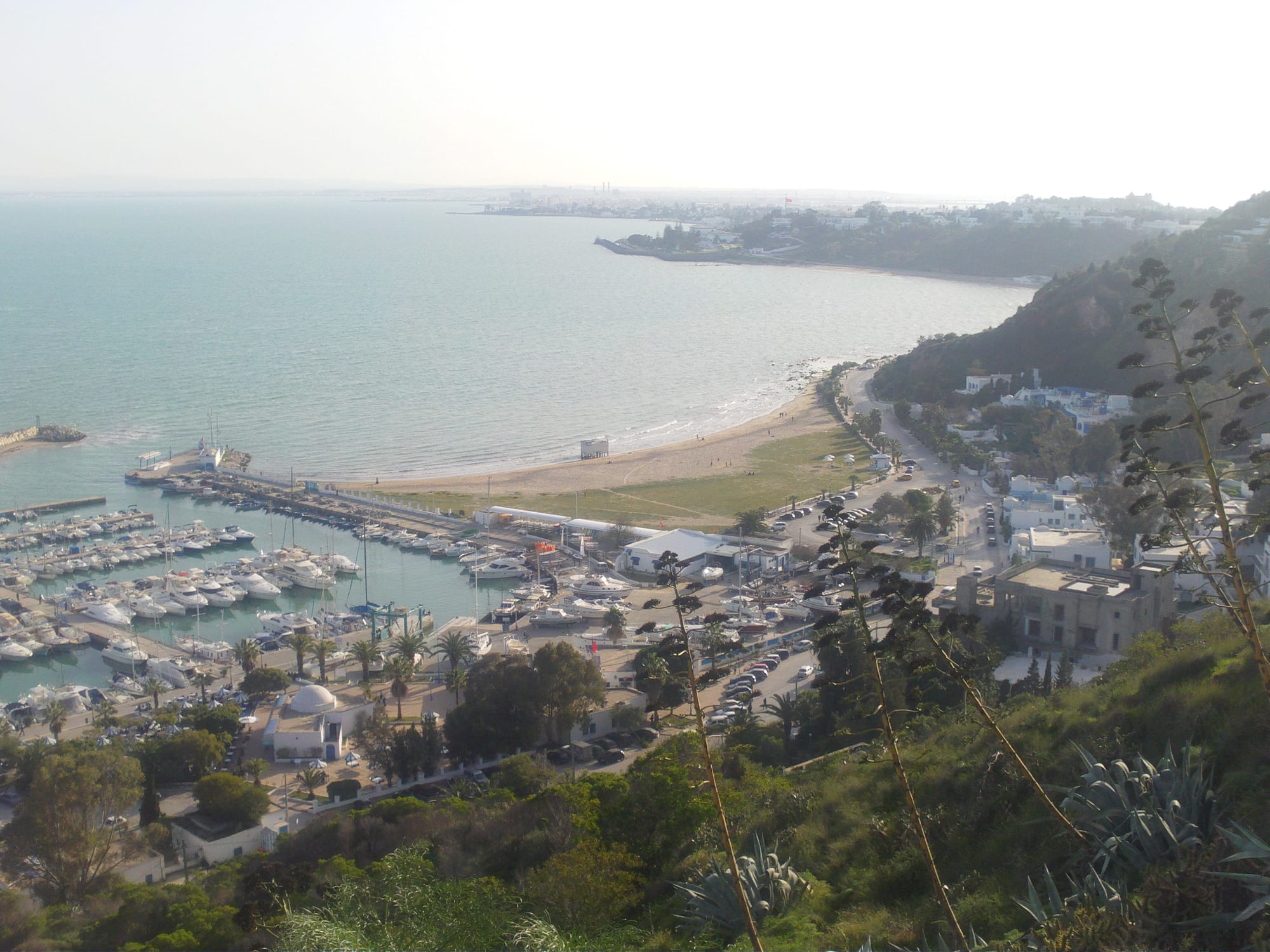
Hillside view over the marina and sandy bay below Sidi Bou Said, with the Gulf of Tunis and a distant coastline

Tunisia

Tunis & the North

The marina and beach below Sidi Bou Said, looking across the Gulf of Tunis. (Kamoun Alaeddinne / Wikimedia Commons · CC BY-SA 3.0)

Tunisia's northeastern corner around the capital, taking in Greater Tunis, the ruins of Carthage and Sidi Bou Said on the Gulf of Tunis, the Cap Bon peninsula with Hammamet and Nabeul, and the port of Bizerte beside the Ichkeul wetlands — the country's political, economic and cultural centre and its most densely settled region.

Explore Tunis & the North

History

Phoenician settlers from Tyre founded Carthage on the Gulf of Tunis, traditionally in 814 BC, and from its two harbours built a trading empire across the western Mediterranean. Its wars with Rome ended in 146 BC, when the city was destroyed; a century later Rome refounded it as the capital of the province of Africa, and it became one of the largest cities of the western empire and a centre of early Christianity, the see of Cyprian and a city Augustine knew as a student. Kerkouane, a small Punic town on the tip of Cap Bon, was probably abandoned during the First Punic War and never rebuilt, which is why its houses survive.

After the Arab conquest at the end of the 7th century, the new rulers favoured the neighbouring town of Tunis. The Hafsid dynasty made it their capital from the 13th century, filling the medina with madrasas and souks around the Zitouna Mosque. Spain and the Ottomans fought over the coast in the 16th century; Spain held La Goulette until 1574, and under the Husainid beys, who ruled from 1705, Tunis grew into a cosmopolitan port with Jewish, Italian and Maltese quarters.

The French protectorate from 1881 laid out a European new town beside the medina and turned Bizerte into a major naval base. After independence, Bizerte was the scene of fighting in 1961 before France finally withdrew in 1963. Tunis was the stage for the final days of the 2011 revolution, which ended with Ben Ali's departure on 14 January, and it has remained the centre of the country's politics since, including the contested changes after 2021.

Culture & Customs

The capital sets the national tone: French-speaking in offices and universities, Tunisian Arabic (Derja) in the street, and a café life that runs from the old coffee houses of the medina to the terraces of La Marsa. The medina keeps its guild traditions, above all the chechia makers, whose red felt caps are sold in a souk of their own, and the Rachidia institute, founded in 1934, keeps alive the Andalusian-rooted malouf music.

Sidi Bou Said takes its name from a Sufi saint whose shrine stands at the top of the village, and its blue-and-white look became protected in the early 20th century, encouraged by the Baron Rodolphe d'Erlanger, whose palace now houses a centre for Arab and Mediterranean music. Painters including Paul Klee and August Macke passed through the region in 1914.

Cap Bon has its own identity: Nabeul is the capital of Tunisian pottery, and its families distil orange blossom and rose water each spring. Hammamet became a retreat for artists and writers in the early 20th century, and its summer festival runs in the open-air theatre at the Dar Sebastian villa. The Carthage festival fills the Roman theatre with concerts each July and August. Bizerte, with its Andalusian heritage and its fishermen's old port, keeps a quieter, provincial pride.

Daily Life

Greater Tunis — the governorates of Tunis, Ariana, Ben Arous and Manouba — holds around 2.8 million people, nearly a quarter of the country, spread from the medina to sprawling suburbs and new districts around the lagoon. Bizerte has over 100,000 people, and Nabeul and Hammamet are the main towns of Cap Bon.

The capital concentrates government, banks, universities, hospitals and most private employers; Ben Arous and the ring of industrial zones hold factories, and Bizerte has its port, refinery and shipyards. Cap Bon is farming country for citrus, vegetables, peppers and vines, and Hammamet lives from tourism. Zaghouan is more rural, with cereals and olives in the hills.

Days start early with coffee and a quick breakfast, offices empty by the afternoon in summer, and evenings belong to cafés and the corniche. The pressures are the national ones felt most sharply here: rising prices, shortages of some subsidised goods, graduate unemployment, emigration of doctors and engineers, and commuting on overloaded roads and trains.

Food

The capital's cooking gathers the whole country, but the north has its own specialities. La Goulette's restaurants are known for grilled fish and for the fricassé, a small fried bread roll stuffed with tuna, egg, potato, olives and harissa. Kaftaji, a fried mix of peppers, pumpkin and egg chopped with harissa, and lablabi, a chickpea soup poured over bread, are Tunis street staples.

Cap Bon is Tunisia's pantry. Nabeul is known for its harissa, the chilli paste dried and pounded from local peppers, and for orange-blossom water used in sweets and coffee. Kelibia gives its name to a dry muscat wine, and vineyards around Mornag, south of Tunis, are among the country's best known.

Sweets are a Tunis passion: baklawa, samsa triangles of almond and filo, bambalouni, the sugared doughnut sold hot in Sidi Bou Said, and Zaghouan's kaak warka, a ring of pastry filled with almond paste and rose water. Café drinks are mint tea with pine nuts and a short coffee perfumed with orange blossom.

Attractions & Natural Wonders

In Tunis, the UNESCO-listed medina runs from the Bab el Bhar gate through souks of perfume, gold and chechias to the Zitouna Mosque, with palaces such as Dar Ben Abdallah and the domed Tourbet el Bey, the Husainid beys' tomb. Avenue Habib Bourguiba and the colonial new town lie below it. The Bardo National Museum, in the western suburbs, holds Roman mosaics from sites across the country, including a famous portrait of Virgil.

Carthage, a UNESCO World Heritage Site, is spread through leafy suburbs: the Byrsa hill with its museum and view, the circular Punic military port, the Tophet sanctuary, the Roman villas and theatre, and the Antonine Baths on the shore. Sidi Bou Said sits on the cliff beyond, with cafés above the marina, and La Goulette and La Marsa complete the coastal line.

Cap Bon stretches north-east: Hammamet's walled medina and kasbah above the beach, Nabeul's pottery workshops and Friday market, the Punic town of Kerkouane, a UNESCO site, the hilltop fortress of Kelibia, and the Roman quarry caves of El Haouaria at the tip. Inland, Zaghouan has the Roman Water Temple, source of the aqueduct that supplied Carthage.

To the north-west, Bizerte has its old port with fishermen's houses, and a kasbah, with beaches around Raf Raf and the lagoon village of Ghar el Melh. Nearby, Ichkeul National Park, a UNESCO World Heritage Site, pairs a lake and marshes with the Jebel Ichkeul hill; ducks, geese and flamingos winter there.

Cities in Tunis & the North

Planning basics

Budget

The north is where Tunisia is most expensive, though still cheap by Mediterranean standards. Boutique guesthouses in the Tunis medina and Sidi Bou Said, seafront restaurants in La Goulette and La Marsa, and the big Hammamet resorts cost the most; Bizerte, Nabeul and the Cap Bon towns are cheaper, and the TGM light rail and louages cost very little.

Daily Budget Midrange
USD 85–190 (medina guesthouse or Hammamet hotel, restaurant meals, site tickets, taxis)
Daily Budget Shoestring
USD 30–50 (simple hotel in central Tunis or Nabeul, street food, TGM and louages)

Stay in the city and visit Carthage, Sidi Bou Said and La Marsa in a day on the TGM; resort hotels in Hammamet are far cheaper out of season.

Safety

The north is the calmest and most policed part of the country. Everyday problems are pickpockets and bag-snatching in the medina, at the TGM stations and on Avenue Habib Bourguiba, persistent touts in Sidi Bou Said, and chaotic city traffic. The 2015 attack at the Bardo Museum brought heavy security to major sites, and demonstrations in central Tunis are best avoided.

Keep bags closed in crowds, avoid political gatherings, and take care crossing roads in Tunis. Check current official travel advice before travelling.

Climate

The wettest and mildest part of the country's coast: hot dry summers, mild rainy winters, and a greener countryside than anywhere south of it. Tunis can pass 40°C when the hot sirocco wind blows from the Sahara, while Bizerte and the tip of Cap Bon are windier and a little cooler.

Summer
hot and dry, often 30–35°C in Tunis, occasional hotter spells; sea breezes on the coast
Winter
mild and wet, roughly 8–17°C, with grey days and heavy showers

Transportation

Tunis–Carthage airport is a short taxi ride from the centre. The TGM light rail runs from Tunis Marine through La Goulette and Carthage to Sidi Bou Said and La Marsa, and the metro léger trams cover the city. Trains and louages link Tunis with Bizerte, Nabeul and Hammamet in roughly an hour to an hour and a half, and a car is the easy way to tour Cap Bon and reach Ichkeul and the Zaghouan hills.

Use yellow taxis in Tunis and ask the driver to switch on the compteur (fare counter); the TGM is the simplest way to reach Carthage and Sidi Bou Said.

Best Time to Visit

April to June and September to October: warm days, sea swimming from June, and the city pleasant to walk. July and August are hot and the beaches at Hammamet, La Marsa and Bizerte fill with Tunisian families, with open-air festival concerts at Carthage and Hammamet. Winter is quiet, rainy at times, and good for the museums and Roman sites.