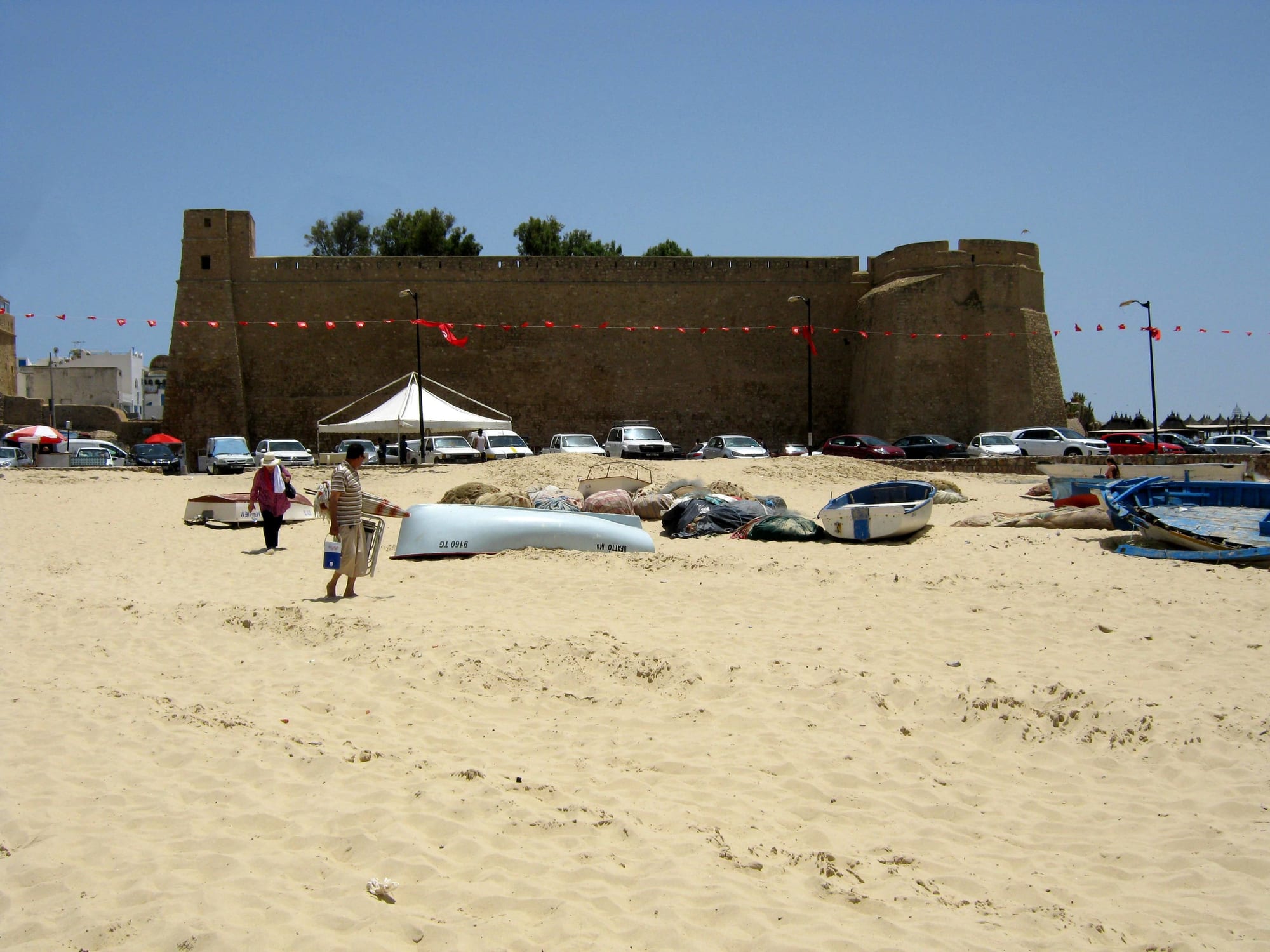
Sandy beach with small fishing boats drawn up in front of the high stone walls of Hammamet's kasbah under a clear blue sky

Tunis & the North, Tunisia

Hammamet

The walls of the kasbah rising straight from the beach at Hammamet. (Георгий Долгопский / Wikimedia Commons · CC BY-SA 4.0)

A seaside town at the base of the Cap Bon peninsula, about 65 km south-east of Tunis, built around a walled medina and a kasbah that stand directly on the sand. Foreign artists and writers made it a retreat in the early 20th century, and it later became Tunisia's best-known beach destination, with a long strip of hotels and the purpose-built marina district of Yasmine Hammamet.

Neighbourhoods

  • The medina and the old town
    • First-time visitors
    • Historic district
    • Beaches

    A small walled quarter of whitewashed lanes, craft shops and cafés wrapped around the kasbah, with the fishing beach on one side and the harbour on the other. It is compact enough to cross in a few minutes, and the streets just outside it hold the town's everyday shops and market.

    Open in Maps
  • The hotel strip
    • Beaches
    • Families
    • Resorts

    The low-rise hotels north and south of the centre stand behind their own stretches of sand among gardens of jasmine, bougainvillea and citrus. Building height has long been limited here, so the strip stays green and horizontal rather than built up, though it is a taxi or a long walk from the old town.

    Open in Maps
  • Yasmine Hammamet
    • Nightlife
    • Families
    • Marina

    A purpose-built resort district a few kilometres south of the town, laid out around a marina with a promenade of restaurants, bars and shops and Medina Mediterranea, a modern quarter built to look like a medina. It is busiest in summer and quiet out of season.

    Open in Maps
  • Hammamet Sud and the inland streets
    • Quiet and residential
    • Local life

    Where most residents actually live, behind the coast road in streets of low houses, bakeries and garages that run back towards the citrus and pepper fields. Prices are lower here and the rhythm is local rather than seasonal.

    Open in Maps

Things to do

The old town and the shore

  • The kasbahlandmark

    The fortress above the beach, rebuilt over older defences; its ramparts give a view along the bay and over the flat roofs of the medina.

    Open in Maps
  • The medinaneighborhood

    A walled quarter of narrow whitewashed lanes, studded doors, small mosques and craft shops, still partly lived in rather than given over entirely to visitors.

    Open in Maps
  • Hammamet beachbeach

    A long crescent of pale sand running from the medina walls past the hotel gardens, with shallow, sheltered water and fishing boats pulled up at the town end.

    Open in Maps
  • Pupputlandmark

    The remains of a Roman town and its large necropolis on the southern edge of Hammamet, with mosaic floors from houses and tombs.

    Open in Maps
  • Yasmine Hammamet marinaattraction

    A marina and promenade a few kilometres south of the centre, the focus of the resort district's restaurants, boat trips and evening crowds.

    Open in Maps

Short trips from the town

  • Nabeulattraction

    The pottery capital of Tunisia about 12 km north, with workshops, a Friday market and a museum of Roman mosaics from ancient Neapolis.

    Open in Maps
  • Kerkouanelandmark

    A UNESCO World Heritage Site on the Cap Bon coast, about 75 km away by road — a Punic town abandoned during the Punic Wars and never rebuilt, so its streets, houses and bathrooms survive.

    Open in Maps
  • Korbousattraction

    A small spa village on the Gulf of Tunis side of Cap Bon, known since Roman times for hot springs that run down to the sea.

    Open in Maps
  • Zaghouan Aqueductlandmark

    Long arcaded stretches of the Roman aqueduct that carried spring water from Zaghouan to Carthage stand in the plain inland from the town.

    Open in Maps

Seasonal events

  • Hammamet International FestivalJuly and August

    Concerts, dance and theatre staged in the open-air theatre in the gardens of the Dar Sebastian cultural centre, held each July and August since 1964.

  • Orange blossom seasonspring

    The citrus groves of Cap Bon flower in March and April, and the towns around Hammamet distil orange-blossom water for sweets and coffee.

  • Summer beach seasonJuly and August

    Tunisian families take over the beaches and the corniche alongside foreign visitors, and the town stays busy late into the night.

Eat and drink

Long-standing places and food districts in Hammamet. Hours, ratings and directions come from your maps app, always current.

Where to eat in Hammamet

  • The medina and the fishing harbourneighborhood

    Small restaurants around the old walls and the harbour serve grilled fish, seafood couscous and brik, with tables set out in the lanes in summer.

    Open in Maps
  • Yasmine Hammamet marinaneighborhood

    The resort district's promenade of restaurants and cafés, mostly aimed at visitors, with pizza and grills alongside Tunisian dishes.

    Open in Maps
  • Hammamet central marketmarket

    The town's produce market, piled with Cap Bon peppers, tomatoes, citrus, olives and fish, and the cheapest place to eat a sandwich at lunchtime.

    Open in Maps
  • Nabeul's harissa and pottery marketmarket

    The Friday market in the neighbouring town, known for chillies and harissa as well as the glazed pottery made in the workshops around it.

    Open in Maps

Experience Hammamet

History

Hammamet grew up around a Roman town called Pupput, which stood on the coast just south of the modern centre and prospered from farming and the road along the Cap Bon shore; its cemeteries and mosaic floors are still being excavated. The Arabic name means 'the baths', and after the Arab conquest a small walled settlement took shape beside the sea. Walls went up around the town in the 13th century and the medina took its present shape in the 15th, with the kasbah rebuilt and enlarged by successive rulers who used this stretch of coast to watch for raiders.

For centuries it was a modest place of fishermen, gardeners and citrus growers, overshadowed by Nabeul and by Tunis. Its second life began between the wars, when foreign residents discovered it: Georges Sebastian built a white villa, Dar Sébastian, in a garden above the gulf, and it became the best-known house on this stretch of coast. Writers, painters and film people followed, and the villa came to stand for the town's reputation as a retreat.

After independence the villa passed to the state and became the International Cultural Centre, whose open-air theatre still holds the summer festival. Tunisia's tourism drive from the 1960s turned the coast north and south of the medina into a hotel strip, kept low and screened by gardens under building rules that limited height. The Yasmine Hammamet resort district, built from the late 1990s around a new marina, extended the town southwards. Tourist numbers fell after 2011 and again after 2015, recovered later in the decade, and the town remains one of the mainstays of Tunisian tourism.

Culture & Customs

Hammamet has two rhythms. In summer it belongs to visitors, Tunisian and foreign: the corniche fills after dark, the cafés run late, and music carries from the marina. Out of season it returns to being a farming and fishing town where everyone knows the market traders and the same men play cards in the same cafés each afternoon.

Its cultural reputation rests on the villa Georges Sebastian built and on the festival that grew around it. Since the 1960s the open-air theatre in its gardens has staged Tunisian and international theatre, dance and music through July and August, and the centre also runs workshops and exhibitions. The town's older fame as a haunt of artists and writers between the wars is still a point of local pride.

Jasmine is the town's emblem. Sprigs are bound into small white posies, called machmoum, sold at street corners on summer evenings and worn behind the ear or tucked into a shirt, a habit shared with the rest of the Cap Bon coast. The surrounding countryside supplies it, along with orange blossom distilled in spring. Craft traditions are close at hand rather than in the town itself: Nabeul's potters and the region's weavers supply many of the shops inside the medina walls. Manners are the coastal Tunisian norm — unhurried greetings, insistent hospitality and bargaining conducted with good humour.

Daily Life

Reported figures for the town's population vary widely, from about 100,000 upwards, and the number of people here multiplies in July and August. Most residents live inland from the coast road in Hammamet Sud and the streets behind the market rather than in the medina, which has partly emptied of families as shops, guesthouses and holiday homes have taken over its houses.

Tourism is the main employer: hotels, restaurants, excursion agencies, taxis and the marina businesses, with a large seasonal workforce that arrives from other governorates for the summer. Around it, Cap Bon farming continues — citrus, peppers, tomatoes and vines — along with fishing from the small harbour and building work that has spread new apartment blocks across the town's edges. Nabeul, the governorate capital, provides the administration, hospitals and pottery workshops.

The working day starts early and pauses through the hot afternoon; shops reopen towards evening and stay open late in summer. Life is lived outdoors from May to October, on the beach in the daytime and along the corniche at night. The pressures are the seasonal ones: work that disappears in winter, dependence on bookings made abroad, pressure on water supply in high summer, and coastal erosion that has narrowed parts of the beach.

Food

The kitchen here is the Cap Bon one: heavy on the peninsula's peppers, tomatoes and citrus, with fish from the harbour. Grilled sea bream, sea bass and mullet are the standard restaurant order, often with slata mechouia, a salad of charred peppers and tomatoes pounded with garlic, olive oil, tuna and egg. Seafood couscous, with fish or octopus and a broth reddened by harissa, appears on Fridays and at family meals.

Harissa itself comes from just up the road: Nabeul is the centre of Tunisian chilli growing, and the paste is pounded with garlic, caraway and coriander. It goes into ojja, eggs cooked in spiced tomato and pepper sauce with merguez or shrimp, and into kamounia and other stews. Brik, the fried pastry parcel of egg and tuna, is eaten as a starter everywhere, and street stalls sell fricassé rolls and kaftaji.

Cap Bon is also fruit country, and the spring orange harvest supplies both the market and the stills that make orange-blossom water, used in pastries and stirred into coffee. Local wines from the peninsula's vineyards, including dry muscat from Kelibia, are served in licensed restaurants, and bambalouni, the hot sugared doughnut, and almond samsa are the sweets sold along the seafront.

Planning tools

Budget

Hammamet runs largely on package tourism, so hotel rates booked from abroad can be very low and walk-in prices poor value, especially in summer. Independent travel is cheap: small hotels in the old town, market food, louages to Nabeul and Tunis. Out of season the hotel strip empties and prices fall sharply.

Daily Budget Midrange
USD 85–190 (comfortable hotel on the strip, restaurant meals, taxis and a day trip)
Daily Budget Shoestring
USD 30–50 (small hotel or guesthouse, market food and sandwiches, louages)

Rooms are far cheaper between October and April; the beach, the medina and the walk around the kasbah walls cost nothing.

Best Time to Visit

May, June, September and October give warm days, swimmable sea and a town that is busy but not crowded. July and August are hot and full, with the summer festival and Tunisian holidaymakers. Winter is mild, showery and very quiet, with many hotels and beachfront restaurants closed for the season.

Suggested Number of Days

The town itself is small and can be seen in a day, but most visitors come for the beach and stay longer. Four or five days suit those who want the rest of Cap Bon and the Roman sites inland as well.

First Visit
2–3 days
With Surroundings
4–5 days

Transportation

The town is small enough to walk, and yellow taxis are cheap for the hotel strip and Yasmine Hammamet. Louages, the shared vans, run constantly to Nabeul, about 12 km away, and to Tunis, and a coach service runs from the bus station in the capital. A hire car is the practical way to tour Cap Bon.

Ask taxi drivers to use the compteur (fare counter); horse-drawn carriages along the seafront are a tourist ride with a negotiated price, not transport.

Airport & Station Connections

Enfidha–Hammamet airport lies about 40 km south-west and handles most charter and low-cost flights to the resorts; Tunis–Carthage is roughly 70 km north and has more scheduled services. Both are an hour or less by road. Louages and trains connect the town with Tunis and with Sousse, and hotels arrange transfers.

Walkability

The old town is flat, compact and made for walking, and the beach gives a continuous route along the bay. Distances open up beyond it: the hotel strip stretches for several kilometres and Yasmine Hammamet is a few kilometres further, too far to walk comfortably in summer heat. Pavements along the main road are patchy and traffic is fast.

Safety

Hammamet is one of the calmer places in the country and its hotel strip is well patrolled. The usual nuisances are insistent shop and excursion touts in the medina and along the seafront, overcharging by taxis without a meter, and petty theft on crowded beaches. Currents can be strong on windy days, and few beaches are supervised outside the hotel fronts.

Keep bags closed in crowds, avoid political gatherings, and take care crossing roads in Tunis. Valuables are better left in the hotel than on the sand, and the taxi meter is worth agreeing before setting off. Check current official travel advice before travelling.

Climate

Mediterranean, with hot dry summers cooled by a sea breeze and mild wet winters. The bay faces east, so mornings are bright and the water is usually calm; the hot sirocco wind from the south can raise temperatures sharply for a day or two in summer.

Summer
hot and dry, generally 29–34°C by day, with warm sea from June to October
Winter
mild and damp, roughly 9–17°C, with showers and some windy spells

Local Customs

Beachwear belongs on the beach and at the hotel; covered shoulders and knees are expected in the medina, the market and the town's streets, and required at mosques. Bargaining is normal in craft shops and the market, though politely and without heat. Greetings come before business, and a refusal of tea or coffee is often repeated three times before it is accepted. Ask before photographing people.

Tip about 10 per cent in restaurants and round up taxi fares. Alcohol is served in hotels and licensed restaurants but not in most town cafés, and is less visible during Ramadan.

Common Payment Methods

The Tunisian dinar is a closed currency: it cannot be obtained abroad or legally carried in or out, so money is changed on arrival and reconverted before leaving. Hotels, larger restaurants and the marina shops take cards; the market, small cafés, taxis and louages want cash. ATMs are easy to find in the town centre and at Yasmine Hammamet.