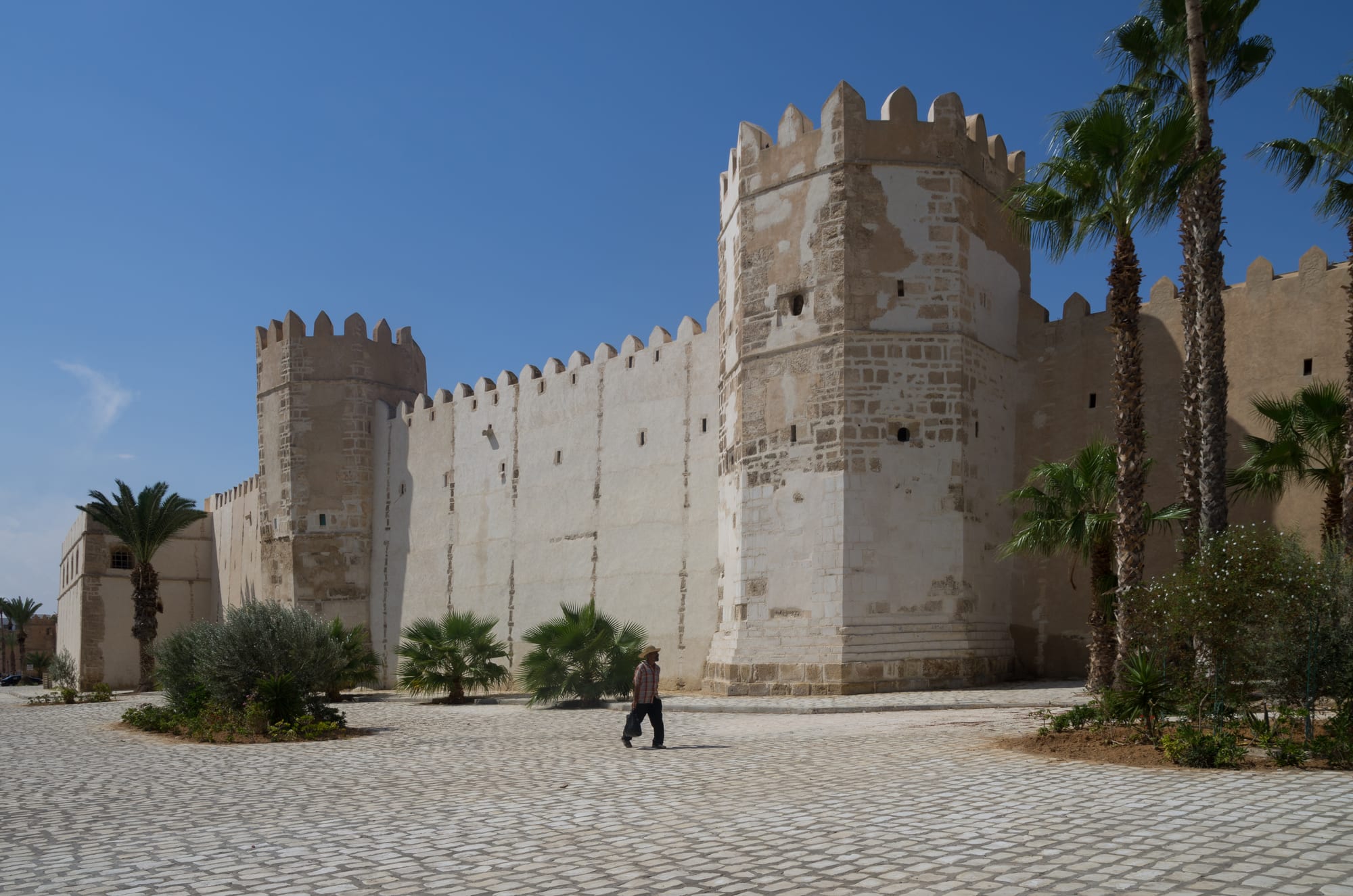
Pale crenellated city walls with round towers above a paved square planted with palms, under a clear blue sky

Sousse, Sfax & the Central Coast, Tunisia

Sfax

The ramparts of the medina of Sfax. (El Golli Mohamed / Wikimedia Commons · CC BY-SA 4.0)

Tunisia's second city, a working port on the Gulf of Gabès at the centre of the country's olive oil trade and phosphate industry. Its walled medina is still a lived-in quarter of workshops and markets rather than a restored tourist district, the French-built centre lies outside the walls, and ferries cross from the harbour to the flat Kerkennah Islands.

Neighbourhoods

  • The medina
    • First-time visitors
    • Historic district
    • Markets

    The walled old city north of Bab Diwan, one of the least altered in North Africa: lanes of metalworkers, carpenters, dyers and grocers, the Great Mosque at its centre and the kasbah in a corner of the ramparts. It is a working quarter, busiest in the morning and quiet after the shops close.

    Open in Maps
  • The ville nouvelle
    • Cafés
    • Close to public transport
    • Shopping

    The grid of avenues laid out under the French protectorate between the medina walls and the port, with the town hall and its museum, banks, cinemas, patisseries and most of the hotels. The railway station and the main louage stations are on its edges.

    Open in Maps
  • The port and the corniche
    • Waterfront
    • Seafood
    • Ferries

    The commercial and fishing harbours and the ferry quay for the Kerkennah Islands, with a fish market beside them. The seafront road runs north-east past cafés towards the beaches and the suburb of Chaffar's holiday flats.

    Open in Maps
  • Sakiet Ezzit and the northern suburbs
    • Quiet and residential
    • Local life

    The spreading residential districts north of the centre, with apartment blocks, olive groves between them, the university campuses and shopping streets. This is where most Sfaxians actually live.

    Open in Maps

Things to do

The old city

  • Great Mosque of Sfaxlandmark

    The ninth-century congregational mosque at the centre of the medina, rebuilt several times, with a tiered minaret rising over the surrounding roofs.

    Open in Maps
  • The ramparts and Bab Diwanlandmark

    The crenellated walls that still enclose the old city, pierced by the great southern gateway that carries the main flow of people in and out.

    Open in Maps
  • Kasbah of Sfaxmuseum

    The fortress in the south-west corner of the walls, now a museum of traditional architecture, with a tower giving a view over the medina roofs.

    Open in Maps
  • Dar Jellouli Museummuseum

    A seventeenth-century merchant's house in the medina, arranged as a museum of Sfaxian domestic life, with painted woodwork, tiled rooms, costume and household objects.

    Open in Maps
  • The medina souksmarket

    Streets of trades grouped together — blacksmiths, tinsmiths, carpenters, perfume and spice sellers, and a covered cloth market — that supply the city rather than tourists.

    Open in Maps

The modern city and the shore

  • Sfax fish marketmarket

    The morning auction and stalls near the harbour, where the catch from the gulf and the Kerkennah fleets is sold.

    Open in Maps
  • The cornicheviewpoint

    The seafront promenade north-east of the port, lined with cafés and busy with families in the evening.

    Open in Maps

Short trips from the city

  • Kerkennah Islandsattraction

    A low, palm-covered archipelago in the Gulf of Gabès east of the city, reached by car ferry from the port, known above all for fishing and for its octopus.

    Open in Maps
  • Thynaattraction

    The remains of the Roman town of Thaenae on the coast about 12 kilometres south of the city, with bath-houses, mosaics and traces of the Roman walls.

    Open in Maps
  • Amphitheatre of El Jemlandmark

    The third-century Roman arena north of Sfax, one of the largest surviving anywhere and a UNESCO World Heritage Site.

    Open in Maps
  • Mahdiaattraction

    The Fatimid port on a headland up the coast, with its dark gateway, old mosque and fishing harbour.

    Open in Maps

Seasonal events

  • The olive harvestNovember to January

    The plain around the city turns to picking and pressing, and new season oil appears in the markets and the mills.

  • Ramadanvaries with the Islamic calendar

    The fasting month reverses the city's hours, with a quiet working day and crowded streets, cafés and pastry shops through the night.

Eat and drink

Long-standing places and food districts in Sfax. Hours, ratings and directions come from your maps app, always current.

Sfax classics

  • Fish couscousrestaurant

    Semolina steamed over a stock of grouper or other fish with vegetables and chillies, the dish Sfax is best known for across Tunisia.

    Open in Maps
  • Charmoula with salted fishrestaurant

    A dark sweet-sharp sauce of onions cooked down with raisins and spices, eaten with dried or salted fish, traditional in the city at Eid.

    Open in Maps
  • Kerkennah octopusrestaurant

    Octopus from the islands, dried or stewed, along with grilled sea bream, mullet and prawns from the gulf.

    Open in Maps

Markets and food streets

  • The medina food souksneighborhood

    Spice, olive, dried fruit and grocery lanes inside the walls, with bakeries and small kitchens serving lunch to the workshops.

    Open in Maps
  • Sfax fish marketmarket

    Where the city buys its seafood, with stalls that will send a chosen fish to be grilled nearby.

    Open in Maps
  • Patisseries of the ville nouvelleneighborhood

    French-influenced cake shops alongside trays of semolina, almond and date pastries, a Sfaxian speciality at festivals.

    Open in Maps

Experience Sfax

History

Sfax was founded in the ninth century by the Aghlabids on or beside the site of the Roman town of Taparura, at a point on the coast where the olive plain met a sheltered gulf. Its Great Mosque dates from that century, and the walls that still ring the old city were built and rebuilt by successive rulers. Unlike the ribat towns up the coast it grew as a merchant city rather than a garrison, trading olive oil, wool, cloth and grain across the Mediterranean and south into the Sahara.

That commerce brought both wealth and attack. Roger II of Sicily took the city in 1148 and the Normans held it until 1156, the Spanish occupied it in the sixteenth century, Venetian fleets bombarded it in the 1780s, and under the Ottomans its merchants and corsairs traded and fought with Malta and the Italian ports. Sfax resisted the French landing of 1881 and was bombarded and taken by force, an episode the city remembers; under the protectorate it grew fast, gaining a modern quarter outside the walls, a deep-water port, and railways carrying phosphate from the Gafsa mines for export.

The Second World War brought heavy Allied bombing in 1943, which destroyed much of the European town and damaged the port, and after independence in 1956 the city rebuilt as Tunisia's industrial second centre: olive-oil mills, chemical and phosphate processing plants, fishing and food factories, and later a university. Sfax took a prominent part in the strikes and protests of 2010–11. Industry has left its mark on the environment, and the long clearance of the phosphogypsum waste tipped beside the shore has been a civic campaign for decades.

Culture & Customs

Sfaxians are known across Tunisia as hard-working, thrifty and commercially shrewd, a reputation the city wears with pride and jokes about freely. It is a place of family firms, apprenticeships and long-established trades, where the medina's workshops pass down metalwork, carpentry and weaving, and where wealth tends to be invested rather than displayed. The city has also produced a large share of the country's doctors, engineers and business families, and its diaspora keeps close ties.

Civic identity is strong and slightly separate from the Sahel coast to the north. Sfax is more conservative and more religious in daily life than Sousse or Monastir, with less tourism to shape it, and the medina is a place of commerce and prayer rather than souvenirs. CS Sfaxien, the city's football club, is one of the leading teams in Tunisia and Africa, and match days dominate the city's weekends.

Cultural life centres on the university, cinemas and theatres in the ville nouvelle, and the city's craft and food traditions. Sfax's status as a regional capital of trade has long made it a crossroads for people from the interior and the south, and in recent years for migrants from West Africa, which has changed the sound of some of its streets and markets.

Daily Life

About 342,000 people live in the city itself and some 955,000 in the governorate, making the Sfax area the second-largest urban region in the country. The economy is genuinely productive rather than administrative: olive oil above all, with the surrounding plain holding millions of trees and the mills and export houses to process the crop, alongside chemical and phosphate plants, fishing, food processing, textiles, construction and a large medical sector.

Most residents live in the suburbs that sprawl north and west among the olive groves, and commute in by car, louage or bus; the medina is now mainly workshops and shops, its houses increasingly divided or let. The working day starts early, pauses in the afternoon and resumes into the evening, and Sunday, rather than Friday, is the quiet day for much of the commercial city.

The city's issues are industrial and environmental as much as economic: air and sea pollution from the chemical works, the phosphogypsum tips by the shore, and pressure on water. The coast near the city has also become a route for irregular sea crossings towards Europe, which has drawn police operations and international attention.

Food

Sfax has the largest fishing port in Tunisia, and fish is at the heart of its cooking. The city's signature is fish couscous: semolina steamed above a pot of grouper or other white fish with vegetables, chickpeas and chilli, served in quantity on Fridays and at family gatherings. Grilled sea bream, mullet, prawns and octopus from the Kerkennah boats fill the restaurants around the port, and salted, dried and preserved fish are part of the pantry, eaten with charmoula, the dark sauce of onions slow-cooked with raisins and spices that is a Sfaxian dish at Eid.

Olive oil is the other foundation. The plain outside the city produces around 40 per cent of Tunisia's olive oil, more than any other region; oil is bought by the litre from mills and market stalls, and it goes into everything, from slatit mechouia of charred peppers and tomatoes to the bread dipped at breakfast. Harissa, brik, lablabi and ojja are eaten here as elsewhere in Tunisia, and the city has a particular fondness for spicy cooking.

Sfax is also known for its pastries and sweets, where French patisserie sits beside semolina and almond work: makroudh, baklava-style layered pastries, kaak warka, a ring of almond paste in thin pastry made for weddings, and masfouf, sweetened couscous with nuts and dried fruit. Mint tea with pine nuts and strong coffee are drunk through the day, and fresh almond milk is a summer drink.

Planning tools

Budget

Sfax is a business city rather than a resort, so its hotels are priced for traders and its restaurants for residents. Rooms in the centre are good value, food is cheap outside a few seafood places, and the ferry to Kerkennah costs very little. Prices rise when trade fairs fill the city's hotels.

Daily Budget Midrange
USD 70–150 (good hotel, seafood dinners, museum tickets, a driver for the day)
Daily Budget Shoestring
USD 25–45 (simple hotel, medina food, buses, louages and the ferry)

Seafood is sold by weight, so the price is worth settling before the fish is cooked.

Best Time to Visit

March to May and October to November are the most comfortable, and the olive harvest from November gives the city and the surrounding plain their busiest, most characteristic season. Summer is hot and humid, and August is quiet as families leave for the coast and the islands. Winter is mild with occasional rain.

Suggested Number of Days

The medina and the museums occupy a day or two, and the city is compact enough to cover on foot. Adding the islands offshore or the Roman sites inland stretches a stay to three or four days.

First Visit
1–2 days
With Surroundings
3–4 days

Transportation

The centre and the medina are walkable, and taxis are cheap and plentiful for the suburbs and the port. City buses serve the outer districts, trains run north along the coast to Sousse and Tunis and inland towards Gafsa, and louages leave for the south and the interior. Car ferries cross to the Kerkennah Islands from the harbour.

Traffic is heavy and parking difficult inside the ring of the old walls, so a hire car is better left outside the centre.

Airport & Station Connections

Sfax–Thyna International Airport lies a few kilometres south-west of the city with a limited schedule, so most air travellers arrive through Tunis–Carthage, about 270 kilometres north, or Monastir. Trains and buses from Tunis take around four to five hours, Sousse is roughly two hours by road, and louages run south to Gabès and Djerba.

Walkability

The medina is small enough to cross in twenty minutes, though its lanes are crowded with handcarts and mopeds and its surfaces uneven. The French grid outside the walls is easy and flat, and the port is a short walk from Bab Diwan. Beyond that the city sprawls and the suburbs need a taxi, and summer humidity makes long walks tiring.

Safety

Sfax is a workaday city with little violent crime affecting visitors; pickpocketing in the crowded souks and around the port is the usual risk, and unlit medina lanes are best avoided late at night. Traffic is the most common hazard.

Avoid the Chaambi area and the Algerian border zone, and step away from demonstrations. Valuables are best kept out of sight in the souks and around the port. Check current official travel advice before travelling.

Climate

A hot semi-arid coastal climate on the Gulf of Gabès, drier than northern Tunisia, with long hot summers eased a little by sea breezes, mild winters and low rainfall concentrated between autumn and spring.

Summer
hot and humid — usually 31–36°C by day, with warm nights and sea haze
Winter
mild — mostly 10–18°C, with occasional rain and cool nights

Local Customs

Sfaxians have a national reputation for hard work, thrift and driving a hard bargain, and business here is direct. The city is more conservative than the resort coast: modest dress is expected, beachwear only at the shore, and religious sites require covered shoulders and knees, with non-Muslims generally limited to the courtyards of mosques. Greetings are unhurried, and asking before photographing people or workshops is expected.

Tipping is modest — rounding up bills or a dinar or two. Alcohol is served in a limited number of hotels and restaurants rather than generally.

Common Payment Methods

The currency is the Tunisian dinar, which cannot legally be taken out of the country. Banks and ATMs are common in the ville nouvelle, and hotels, larger restaurants and shops take cards, while the souks, the fish market, taxis, louages and the ferry expect cash.