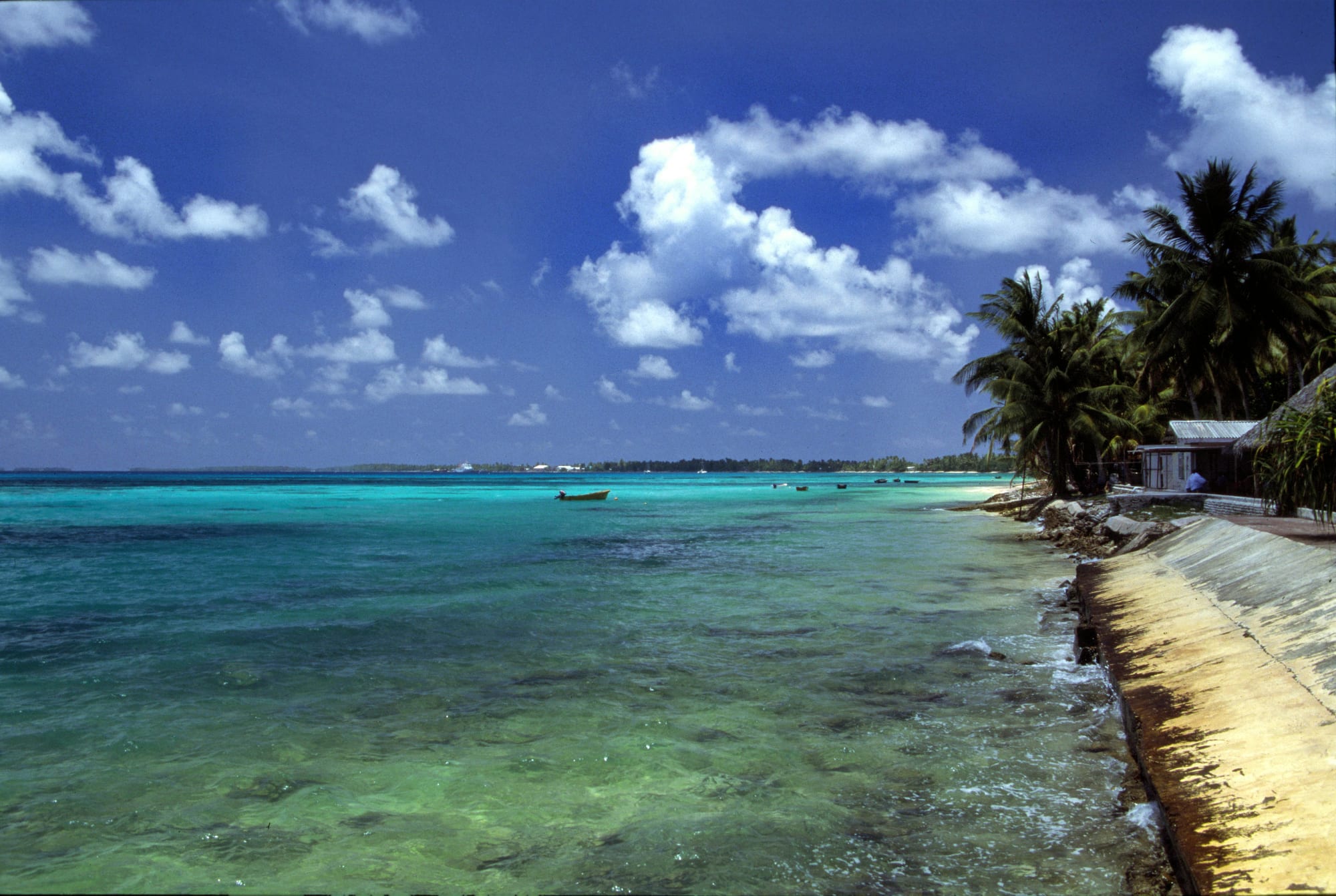
Clear green lagoon water beside a concrete sea wall, with coconut palms and a tin-roofed house on the shore

Tuvalu

Funafuti

The lagoon shore of Funafuti atoll, Tuvalu. (Stefan Lins / Wikimedia Commons · CC BY-SA 2.0)

The capital atoll of Tuvalu, a ring of low islets around a wide lagoon in the central Pacific. Almost all of its people live on Fongafale, a strip of land rarely more than a few hundred metres across, where government offices, shops and houses crowd along one road and the airstrip serves as the town's open ground.

Neighbourhoods

  • Vaiaku
    • First-time visitors
    • Government and services
    • Close to the airstrip

    The administrative centre on the lagoon side of Fongafale, with the government building, the parliament, the bank, the main hotel and the terminal of the airstrip within a couple of hundred metres of each other. Most visitors stay and eat here.

    Open in Maps
  • Alapi and Fakaifou
    • Local life
    • Shops

    The densely built villages north of Vaiaku, where most of the atoll's population lives in small houses between the lagoon and the ocean shore. Kiosks, churches, the school and community halls line the road, and the lanes between them are narrow.

    Open in Maps
  • Tengako and the northern end
    • Quiet and residential
    • Walks

    The long thin tail of Fongafale running north past pig pens, gardens and old wartime remains to a causeway and the uninhabited islets beyond. It is quieter, greener and open to the ocean on one side and the lagoon on the other.

    Open in Maps
  • Funafala and the southern islets
    • Seclusion
    • Beaches

    A small settlement on the southern islet of Funafala, reached by boat across the lagoon, where a handful of families live among coconut palms. There are few services, and the shoreline is the main reason to go.

    Open in Maps

Things to do

Fongafale and Vaiaku

  • Funafuti International Airporttransit hub

    The country's only airport, whose single 1.5 km runway runs along the widest part of the island and becomes the town's playing field, meeting place and evening promenade when no aircraft is due.

    Open in Maps
  • Parliament and the government buildinglandmark

    Tuvalu's parliament sits in Vaiaku beside the main government offices, a cluster that holds most of the national administration within one short block.

    Open in Maps
  • The lagoon shore and sea wallviewpoint

    The lagoon side of Fongafale, with boats pulled up, children swimming off the wall and sunsets across the water, is where much of daily life takes place.

    Open in Maps
  • Darwin's Drill boreholeslandmark

    Boreholes were drilled on Fongafale for the Royal Society of London in 1896, 1897 and 1898 to test Charles Darwin's explanation of how coral atolls form.

    Open in Maps

Across the lagoon

  • Funafuti Conservation Areapark

    A protected area of reef, lagoon and uninhabited islets on the western side of the atoll, established in 1999, with nesting green turtles, a black noddy colony and reef snorkelling.

    Open in Maps
  • Tepukabeach

    An uninhabited islet about 18 km west of Fongafale, just north of the conservation area, with palms, a beach and a wartime bunker, visited by boat.

    Open in Maps
  • Funafalabeach

    The southern islet of the atoll, home to a few families and a church, with a shaded shoreline and sheltered lagoon water, a standard day trip from the capital.

    Open in Maps

Seasonal events

  • Tuvalu Independence Day1 October

    The anniversary of independence in 1978, marked on 1 October with an annual sports festival on Fongafale, parades, church services and dancing.

  • Christmas and the church calendarDecember and January

    Services, choirs, feasts and community gatherings run for weeks, and the pace of the capital slows to match them.

  • Fatele eveningsyear-round, most often around holidays

    Competitive group singing and dancing in the falekaupule, the community hall, with drumming on a wooden box and rising tempo, held for celebrations and visitors alike.

Eat and drink

Long-standing places and food districts in Funafuti. Hours, ratings and directions come from your maps app, always current.

Funafuti classics

  • Funafuti Lagoon Hotelrestaurant

    The hotel on the lagoon in Vaiaku, long known as the Vaiaku Lagi Hotel, whose restaurant and bar are the main place in the country for a sit-down meal of fish, rice and imported staples.

    Open in Maps
  • Kiosks and takeaways along the main roadrestaurant

    Small family-run kiosks and canteens sell rice dishes, fried fish and chicken, noodles, doughnuts and cold drinks; choice is limited and changes with what the last ship brought.

    Open in Maps

Fish and produce

  • The fish landing and lagoon boatsmarket

    Tuna, reef fish and flying fish are sold directly from the small boats on the lagoon shore, and this is the freshest food on the atoll.

    Open in Maps
  • Island shopsmarket

    A handful of general stores stock mostly imported rice, flour, tinned meat, biscuits and frozen chicken, alongside local coconuts, pandanus and pulaka when available.

    Open in Maps

Experience Funafuti

History

Funafuti was settled by Polynesian voyagers, and Tuvaluan tradition traces the atoll's founding families to Samoa. Each island of the group governed itself through its chiefs and its council of elders, with long-standing links of marriage and voyaging between the atolls. Whalers and traders appeared in the 19th century, and in 1863 Peruvian slaving ships took people from several Tuvaluan islands, a loss still remembered. Missionaries of the London Missionary Society arrived from the 1860s and made Christianity the framework of island life.

Britain declared a protectorate in 1892 and the islands, then called the Ellice Islands, were joined with the Gilbert Islands in a colony administered from Tarawa. Between 1896 and 1898 the Royal Society drilled boreholes on Funafuti to test Darwin's theory that atolls grow on subsiding volcanic foundations; the cores supported him. During the Second World War, American forces occupied the atoll in 1942 and built the airstrip across Fongafale, quarrying coral from pits that left hollows in the island for decades and making the place a base for the Gilberts campaign.

In 1974 the Ellice Islanders voted to separate from the Gilberts, and Tuvalu became independent on 1 October 1978, with Funafuti as its capital. Government, shipping and schooling concentrated here, and people moved in from the outer islands, so the atoll's population has grown several times over since independence while the land has not.

Culture & Customs

Tuvaluan culture is communal and church-centred. The falekaupule, the open community hall of each island, is both a meeting place and the seat of the elders' authority, and important matters are settled there by discussion rather than vote. On Funafuti each outer-island community keeps its own hall and association, so the capital functions as a gathering of communities from every island of the group, each with its own customs, dances and dialect differences.

The best-known form is the fatele: a song repeated with rising speed and volume, sung by rows of seated singers while others drum on a wooden box and dancers move in front, often as a friendly competition between island communities. Hymn singing is equally central, and the Ekalesia Kelisiano Tuvalu, the Congregational church descended from the London Missionary Society, includes most of the population. Handicraft — pandanus mats, fans, baskets, shell necklaces — is largely women's work and is given as well as sold.

Manners are quiet and indirect: greetings matter, self-promotion does not, and sharing food and labour is expected rather than praised. Sport is followed keenly, above all the volleyball, football and te ano ball games played on the runway in the evening. Tuvaluans abroad, mainly in New Zealand, Fiji and Australia, keep close ties home, and remittances and returning relatives are part of the atoll's social calendar.

Daily Life

About 6,000 people live on Funafuti, more than half of Tuvalu's population of roughly 11,000, on an islet whose land is a few hundred metres wide at most and whose highest natural ground is only a few metres above sea level. Housing is crowded in Alapi and Fakaifou, water comes from rainwater tanks because there is no groundwater fit to drink, and space for gardens, pigs and waste is contested.

Government is the main employer, alongside the bank, schools, the hospital, shops and the port. National income relies on fishing licences sold to distant-water fleets, revenue from the .tv internet domain, a sovereign trust fund set up in 1987, aid, and the wages of Tuvaluan seafarers working on foreign ships. Almost all food and fuel arrives by ship, so prices and supply follow the shipping schedule.

The day begins early and slows in the afternoon heat; the airstrip fills with walkers, cyclists and games in the evening. The atoll's defining issue is the sea: low-lying ground floods on king tides, storm surge reaches houses, and coastal works have reinforced shorelines and reclaimed land beside the lagoon. Tuvalu has made the subject central to its diplomacy, and a treaty with Australia signed in 2023, the Falepili Union, provides a special migration pathway for a limited number of Tuvaluans each year.

Food

Funafuti's traditional diet is fish and coconut with starchy roots. Tuna, reef fish and flying fish are grilled, boiled in coconut cream or eaten raw with lime, and the coconut supplies drinking water, cream, oil and toddy tapped from the flowering stem. Pulaka, a swamp taro grown in dug pits and known elsewhere as giant swamp taro, is the prestige crop, served at feasts alongside taro, breadfruit, bananas and pandanus fruit. Pigs and chickens are kept for occasions rather than everyday meals.

Cooking methods are simple: an open fire, a pot, or the umu, an earth oven of hot stones for feast food. Sweet dishes lean on coconut and pandanus; fekei, a pudding of grated root crops and coconut cream, appears at gatherings. Toddy, fermented or fresh, is the traditional drink, and imported tea and instant coffee are now standard.

Everyday eating has shifted heavily to imports. Rice, flour, tinned fish and corned beef, instant noodles, biscuits and frozen chicken make up much of the shop stock, which changes with each cargo ship, and the health consequences — obesity and diabetes are common across the Pacific — are a government concern. Restaurants are very few: the hotel in Vaiaku, a small number of canteens and kiosks, and food brought out for community events in the falekaupule, where a shared feast is still the way anything important is marked.

Planning tools

Budget

Funafuti has almost no tourist industry, so costs are set by scarcity rather than by luxury: a small hotel and a few guesthouses, a handful of eating places and imported food carried in by ship. Day-to-day spending is low once accommodation is paid for, and the flights from Fiji are the dominant expense of any trip.

Daily Budget Midrange
USD 130–220 (the main hotel, meals out, a boat trip to the conservation area)
Daily Budget Shoestring
USD 60–110 (guesthouse room, kiosk meals and shop food, walking or a borrowed bicycle)

Book a room before flying, bring Australian dollars in cash, and expect very limited choice in food and rooms.

Best Time to Visit

May to October is drier, a little less humid and better for boat travel across the lagoon. November to April brings heavier rain, westerly squalls and the cyclone risk. King tides flood low ground at certain points in the lunar cycle in any month. There is otherwise little seasonal change.

Suggested Number of Days

Two or three days are enough to see the inhabited part of the atoll, and four or five allow boat trips and time on the lagoon. In practice the flight schedule, which runs only a few times a week, fixes the length of a stay more than anything else.

First Visit
2–3 days
With Surroundings
4–5 days

Transportation

There are no buses. People walk, cycle or ride motorcycles along the single road that runs the length of Fongafale, and a few pickups and taxis operate in the capital. Boats cross the lagoon to the outlying islets, and a government ship serves the outer islands of Tuvalu on an irregular multi-day schedule.

Hire a motorcycle or bicycle through accommodation, and arrange lagoon boat trips a day or two ahead, since they depend on weather and on the boat being free.

Airport & Station Connections

Funafuti International Airport, in the middle of the capital, handles the only scheduled flights: Fiji Airways services from Suva and from Nadi, running a few times a week and in daylight only. There is no other regular way in apart from occasional ships, so arrival and departure dates are effectively set by the airline's timetable.

Walkability

The inhabited strip is flat and narrow, and the centre of the capital can be crossed in minutes on foot. The road runs about 12 km from end to end of Fongafale, which is a long walk in the heat and humidity, so most residents use a motorcycle or bicycle. There are no footpaths and little shade.

Safety

Crime is very low and the community is close-knit; theft of unattended belongings is the main everyday risk. The serious hazards are environmental: cyclones and storm surge between November and April, king-tide flooding through the porous coral ground, and strong currents in the reef passages outside the lagoon. Medical care is limited to a small hospital, and serious cases are flown to Fiji.

Swim inside the lagoon rather than in the passages, follow weather and tide warnings, take care crossing the runway when the warning sounds for an arriving flight, and carry insurance that covers medical evacuation. Check current official travel advice before travelling.

Climate

Tropical, hot and humid all year, with temperatures usually between about 28 and 31°C and little seasonal variation this close to the equator. A wetter season with squalls and cyclone risk runs November to April; May to October is drier and steadier under the trade winds.

Summer
hot, humid and wet — summer in the southern hemisphere runs December to February, with days around 30 to 31°C, the heaviest rain and the highest cyclone risk
Winter
warm and drier — June to August is barely cooler, with days around 29 to 30°C, more wind, less rain and calmer lagoon water

Local Customs

Tuvalu is strongly Christian, and Sunday is quiet: church in the morning, family meals after, and little activity or noise. Dress is modest, with shoulders and knees covered away from the beach; women generally wear skirts or dresses in the villages. Shoes come off before entering a house or a falekaupule, and decisions on each island rest with its council of elders.

Ask before photographing people, houses or church services, seek permission through the island council or a guide before landing on conservation islets, and keep Sundays quiet. Tipping is not expected.

Common Payment Methods

Tuvalu uses Australian banknotes, along with its own coins, and the Tuvaluan dollar is pegged at parity to the Australian dollar. It is a cash economy: the National Bank of Tuvalu in Vaiaku is the only bank, card acceptance is minimal and cash machines cannot be relied on, so visitors should arrive with enough Australian dollars for the whole stay.