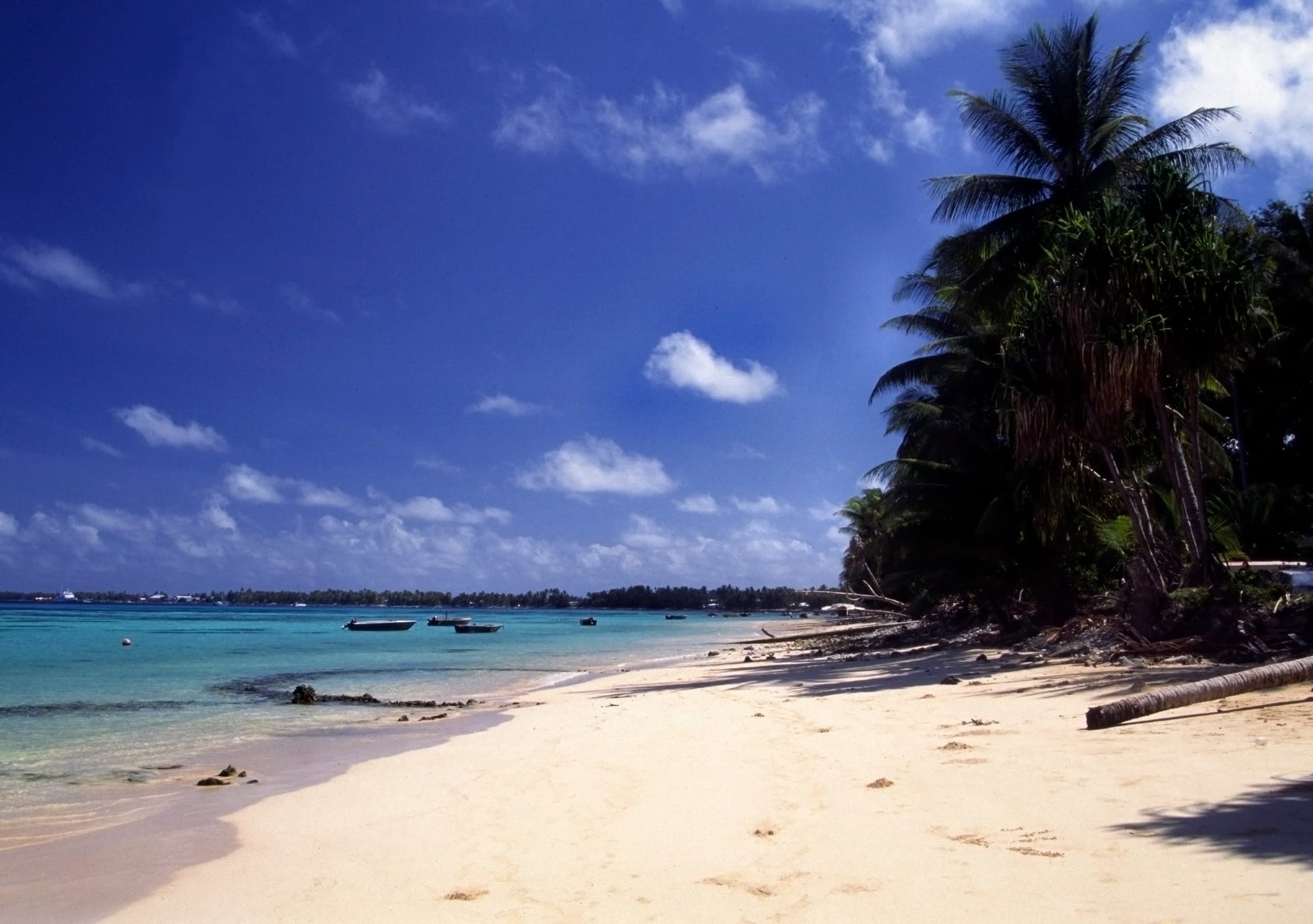
An empty beach of pale sand curving beside a shallow turquoise lagoon with a few small boats at anchor, shaded by coconut palms and pandanus under a deep blue sky

Tuvalu

A palm-shaded sand beach on Funafuti atoll, with small boats moored in the turquoise lagoon. (Stefan Lins / Wikimedia Commons · CC BY 2.0)

A nation of nine tiny coral islands strung across the central Pacific — one of the smallest and least-visited countries on Earth, barely above the sea, and a leading voice on the existential threat of climate change.

Explore Tuvalu

History

Tuvalu was settled by Polynesian voyagers, probably from Samoa and Tonga, around two to three thousand years ago, and each island developed as a small, largely self-governing community under chiefs. Between 1862 and 1863 Peruvian "blackbirding" ships took away a large share of some islands' people to meet a labour shortage in Peru — about 170 from Funafuti and about 250 from Nukulaelae — and Christian missionaries, beginning with the deacon Elekana in 1861 and the London Missionary Society, converted the islands and reshaped their social life.

Britain declared a protectorate over the Ellice Islands, together with the Micronesian Gilbert Islands to the north, in 1892, and later a colony. The two groups were culturally distinct — Polynesian Ellice, Micronesian Gilberts — and in a 1974 referendum the Ellice Islanders voted overwhelmingly to separate. The Ellice Islands became Tuvalu, independent within the Commonwealth in 1978; the Gilberts became Kiribati.

As an independent state, Tuvalu has leaned on a narrow set of revenues: fees paid by foreign fleets to fish its huge exclusive economic zone, the leasing of its internet country code ".tv" to broadcasters and streaming companies, a sovereign trust fund built up with donor help, remittances from Tuvaluan merchant seafarers, and aid. Rising seas have become the defining national issue, and in November 2023 Tuvalu signed the Falepili Union treaty with Australia, which offers permanent residency to up to 280 Tuvaluans a year alongside climate funding and security arrangements. Around 8,700 Tuvaluans applied for the Australian visa in 2025 and 280 were granted. The government is also pursuing a "digital nation" project to preserve the state's identity and records even if the land becomes uninhabitable.

  • Tuvalu: The Country the Sea Is Taking — Nine tiny coral atolls with a highest point of less than five metres — a Polynesian society raided by slavers, ruled from a distant British colony, separated from the Micronesians it was governed with, and now the world's clearest test case of a nation losing its land to rising seas

Culture & Customs

Tuvaluan society is organised around the island community and the extended family, with a strong ethic of sharing and consensus. Each island has a falekaupule, a traditional assembly and meeting hall where decisions are taken and feasts held, and chiefs (aliki) retain ceremonial and social authority alongside the elected government.

Christianity, overwhelmingly the Congregationalist Church of Tuvalu, is central: Sundays are for worship and rest, church choirs and fundraising events are major social occasions, and religious observance shapes dress and behaviour. The fatele, in which women dance in lines while the men sit facing them beating time on mats and wooden boxes, the song repeated louder and faster as it goes, is the signature performance at any celebration.

Land is held by family groups and is deeply tied to identity, which is part of what makes the prospect of relocation so painful. Modesty in dress, respect for elders, and participation in communal work are expected of residents and visitors alike.

  • Tuvalu: Faster and Louder in the Maneapa — A Christian nation by its own constitution, a meeting hall at the heart of every island, and a dance-song that starts in a hush and ends in a roar — the customs of one of the world's smallest countries

Daily Life

The 2022 census counted 10,643 people, more than half of them on Funafuti, the capital atoll, where the population has concentrated as people move from the outer islands for jobs, school, and health care. The islands together cover only about 25 square kilometres of land, and Funafuti's inhabited islet is often only a couple of hundred metres wide.

The public sector, fishing-licence income, and remittances sustain the cash economy; subsistence fishing and the cultivation of pulaka (a swamp taro grown in dug pits), coconut, breadfruit, and bananas feed households. Imported rice, flour, and tinned food are staples, and diet-related illness is a growing problem. Fresh water comes mainly from rain catchment, supplemented by desalination on Funafuti, so droughts are serious.

Daily life is quiet and communal — fishing, gardening, church, volleyball and ano (a local ball game) on the airstrip in the evening, and the arrival of the plane or the supply ship as a recurring event.

  • Tuvalu: A Day Set by the Tide and the Plane — A population of just over 10,000 spread across nine coral islands, a public sector that employs most paid workers, and an evening volleyball game played, quite literally, on the runway between the lagoon and the sea

Food

Tuvaluan food is based on fish, coconut, and a few starchy staples. Reef and deep-water fish are eaten grilled, boiled in coconut cream, or raw with lime; pulaka and taro, breadfruit, bananas, and pandanus fruit fill out the plate. Pork is eaten mostly at feasts and celebrations, and root crops such as pulaka are cooked in an earth oven.

Coconut in all its stages is central — drinking nuts, grated flesh, cream, and the sweet sap, drunk as toddy or boiled down into syrup. Imported white rice, flour, sugar, and tinned meat and fish are now everyday foods, especially on Funafuti.

There is little in the way of restaurants; visitors mostly eat at their guesthouse, at the small hotel, or from island shops and kiosks. Church and community feasts are the great communal meals.

Attractions & Natural Wonders

Tuvalu is not a sightseeing destination in the usual sense; the appeal is the experience of one of the world's smallest, remotest, and most low-lying nations. On Funafuti, the main activities are walking or cycling the length of the atoll, swimming and snorkelling in the lagoon, watching daily life around the airstrip, and seeing what remains of the Second World War, when American forces landed in October 1942 and islanders helped build the airfield that is now the international airport.

The Funafuti Conservation Area, created in 1999 on the western side of the atoll, protects 33 square kilometres of reef, lagoon, and uninhabited islets that are nesting grounds for green turtles and hold a breeding colony of black noddies. It is reached by boat from the capital and is the country's main organised excursion.

The outer islands — among them Nanumea and Nanumaga in the north, and Nukufetau and Nukulaelae — are true coral atolls and reef islands with tiny populations, visited only by those willing to travel on the irregular supply ship and stay with local families, seeing a way of life almost untouched by tourism.

  • Tuvalu: Four Attractions and Natural Wonders — A runway that doubles as the community's football pitch and evening gathering place, and a nation so low-lying it has become the world's clearest symbol of the threat rising seas pose to entire countries

Planning basics

Budget

Tuvalu has almost no tourist infrastructure — a couple of simple hotels and guesthouses on Funafuti, no resorts, and few restaurants. Costs are driven by the difficulty and expense of getting there and by the fact that almost everything is imported. Once on the island, day-to-day spending is low.

Daily Budget Midrange
USD 130–220 (the main hotel, meals out, a boat trip to the conservation area)
Daily Budget Shoestring
USD 60–110 (guesthouse, small local eateries and shops, walking or borrowed bike)

Book accommodation before you fly, bring cash, and accept that choice is very limited; the trip is about the place, not the facilities.

Visa Requirements

Most visitors get a visa on arrival for a maximum stay of one month, on production of a passport valid for at least six months; citizens of some countries pay no fee, others pay AUD 100, and a number of nationalities are visa-exempt altogether. Flights are so limited that your onward booking effectively fixes your stay.

Typical Stay
One month, granted on arrival

Your departure is tied to the flight schedule — plan the whole trip around the Suva–Funafuti service.

Safety

Tuvalu is safe, with very little crime and a strong community fabric. The real hazards are environmental — cyclones, storm surges, king-tide flooding, and strong ocean currents outside the lagoon — and the very limited medical care: the hospital on Funafuti handles basics only, and serious cases need evacuation abroad.

Health
Dengue occurs; there is no malaria; medical facilities are minimal, so comprehensive evacuation insurance is essential

Follow weather and tide warnings, swim inside the lagoon rather than in ocean channels, and carry insurance that covers evacuation to Fiji or beyond.

Climate

Tropical and humid, around 28–31°C all year. A wetter season with more storms runs roughly November to April, overlapping the South Pacific cyclone risk; May to October is drier and a little less humid. King tides periodically flood low ground even in calm weather.

Dry Season
May–October
Wet Season
November–April (cyclone risk, king-tide flooding)

Transportation

Fiji Airways operates the only regular international flights, between Suva, Nadi, and Funafuti International Airport — whose single 1,524-metre runway, daylight-only for want of lighting, doubles as the island's common ground for sport and socialising when no plane is due. Between the outer islands, a government supply ship makes irregular multi-day voyages. On Funafuti, people walk, cycle, or ride motorbikes along the one main road.

Confirm the Suva flight well ahead and keep plans flexible; reaching the outer islands means committing to the ship's slow, uncertain schedule.

Best Time to Visit

May to October, the drier season, offers the most settled weather and easier boat travel around the lagoon. Avoid the cyclone months. There is little seasonal variation in what there is to do.

Events
Tuvalu Independence Day (1 October); Christmas and church calendar events, which dominate community life; island-specific feast days

Currency

Tuvalu uses Australian banknotes alongside its own coins, issued since 1976; the Tuvaluan dollar is a unit of account pegged to the Australian dollar at parity rather than a separate currency, and there is no central bank. It is a cash economy; there is limited card acceptance and the ATM situation is unreliable, so bring Australian dollars in cash.

Symbol
$
Currency Code
AUD — Australian dollar (with local coins)

Language

Tuvaluan, a Polynesian language, is spoken by almost everyone; on the island of Nui people speak Gilbertese, the language of Kiribati, as well, a legacy of settlement from the Gilbert Islands. English is an official language, used in government and taught in schools, though not much in everyday speech.

Languages
Tuvaluan and English