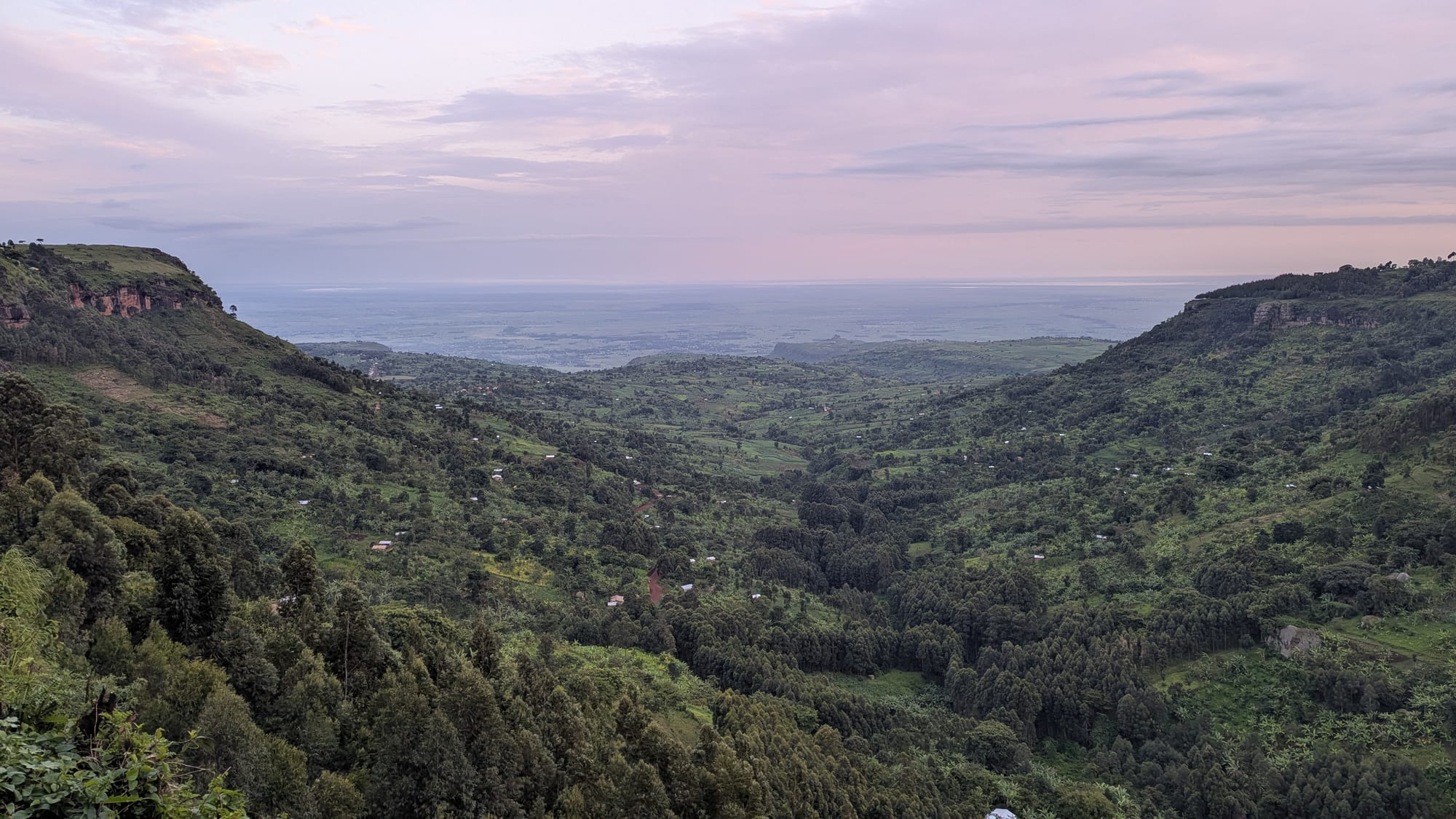
A green valley below rocky cliffs on a mountain slope, with farms and scattered houses and hazy plains beyond

Jinja & Eastern Uganda, Uganda

Kapchorwa

The escarpment near Sipi Falls in Kapchorwa District, looking out from the slopes of Mount Elgon over the plains below. (Kateregga1 / Wikimedia Commons · CC BY-SA 4.0)

A small hill town on the northern slopes of Mount Elgon in eastern Uganda, set above a cliff-edged escarpment that looks out over the Karamoja plains. It is the main town of the Sebei sub-region and the home of the Sabiny people, a base for the Sipi Falls walks and the Elgon trails, and the centre of a district known for Arabica coffee and for long-distance runners.

Neighbourhoods

  • Town centre
    • First-time visitors
    • Markets
    • Transport

    A short stretch of main road with shops, banks, the market, the district offices and the stages where shared taxis and boda-bodas wait for Mbale. Almost everything in town is within a few minutes' walk of it, and the street ends in views down the escarpment.

    Open in Maps
  • Sipi
    • Waterfalls
    • Walks
    • Quiet stays

    A roadside village on the Mbale side of the district, below the cliffs where the Sipi falls drop. Most visitors to the area stay on this stretch of hillside, among coffee gardens and banana plots, and walk to the falls from there.

    Open in Maps
  • The escarpment farms
    • Quiet and residential
    • Coffee farms
    • Views

    The ridges and terraces around the town, planted with Arabica coffee, bananas, maize and beans and dotted with homesteads. Footpaths link the farms, and the edge of the plateau gives long views north over the dry plains of Karamoja.

    Open in Maps

Things to do

Waterfalls and walks

  • Sipi Fallstrail

    A series of three waterfalls stepping down the cliffs west of the town, the tallest dropping about 95 metres, linked by guided walks through coffee farms and banana gardens.

    Open in Maps
  • Kapchorwa marketmarket

    The town's trading place for produce off the mountain — bananas, maize, beans, potatoes and coffee — busiest on market days and the simplest introduction to the Sebei countryside.

    Open in Maps

Short trips from the town

  • Mount Elgon National Parkpark

    The Ugandan side of an extinct shield volcano, with montane forest, bamboo, caves and high moorland of giant groundsel, entered from trailheads around the mountain.

    Open in Maps
  • Mount Elgonlandmark

    The mountain itself, an eroded volcano on the Kenyan border whose broad caldera and 4,321-metre Wagagai peak are reached on treks of several days.

    Open in Maps
  • Mbaleattraction

    Eastern Uganda's main city, at the foot of Mount Elgon, with the region's biggest market, its banks and hospitals and the bus connections to Kampala.

    Open in Maps
  • Kween Districtattraction

    The upland district east of Kapchorwa, higher and colder, with farms running along the rim of the mountain towards the Kenyan border.

    Open in Maps

Eat and drink

Long-standing places and food districts in Kapchorwa. Hours, ratings and directions come from your maps app, always current.

Kapchorwa classics

  • Malewarestaurant

    Smoked and dried shoots of mountain bamboo from the Elgon forest, boiled and cooked with groundnut paste into a thick sauce — the dish the mountain is known for across Uganda.

    Open in Maps
  • Kalo and groundnut saucerestaurant

    Stiff millet bread, often mixed with cassava flour, eaten by hand with groundnut or simsim sauce, beans or greens in the small eating houses along the main street.

    Open in Maps

Markets and coffee

  • Kapchorwa marketmarket

    Produce off the mountain slopes — matoke, maize, beans, avocados, potatoes and coffee — sold from stalls and spread cloths in the middle of town.

    Open in Maps
  • Arabica coffee from the Elgon slopesneighborhood

    The washed Arabica grown on these slopes is sold abroad as Bugisu or Mount Elgon coffee; farms around Sipi roast and brew small batches for visitors who walk through them.

    Open in Maps

Experience Kapchorwa

History

The Sabiny, a Kalenjin-speaking people related to communities across the border in Kenya, have farmed and herded the northern shoulder of Mount Elgon for centuries, growing millet and keeping cattle on the high ground while the Bantu-speaking Bagisu occupied the wetter southern and western slopes. The escarpment's edge gave both defence and a view over the plains, and the Sebei lived with periodic raiding from the pastoral peoples of the drier country to the north.

British administration reached the mountain at the turn of the twentieth century, largely through the Ganda general Semei Kakungulu, whose base at Mbale became the regional centre. A small station grew at Kapchorwa as the administrative point for the Sebei, and mission schools and churches followed. Arabica coffee, planted on the slopes from the colonial period onward, gave the district its cash crop and tied its fortunes to world coffee prices.

Sebei County became Kapchorwa District on 1 February 1962, months before independence, and the town has been a district headquarters ever since; Bukwo was split off in 2005 and Kween in 2010, and the three together make up the Sebei sub-region. Tarmac reached the escarpment road late, and for much of the twentieth century the town was a half-day's journey from Mbale. The growth of walking tourism around the Sipi falls from the 1990s, the gazetting of the Ugandan side of Mount Elgon as a national park in 1992, and the international success of Ugandan distance runners from these hills have all raised the town's profile well beyond its size.

Culture & Customs

Kapchorwa is the centre of Sebei identity. Kupsabiny is spoken at home and in the market, and the Sabiny keep a strong sense of kinship with Kalenjin communities over the Kenyan border, with whom they share language, cattle culture and a reputation for running. Christianity is the dominant religion, and church choirs and Sunday services structure the week in town and village alike.

Initiation has long marked the passage into adulthood on both sides of Mount Elgon, and is held in seasons rather than continuously. The best-known of these traditions is Imbalu, the circumcision of Bagisu boys on the western slopes, held in even-numbered years and accompanied by kadodi music and dance. Female genital cutting, historically practised in this area, is a criminal offence in Uganda, and campaigning against it by government bodies, churches and local organisations has been concentrated on the Sebei districts.

The hills above the town are one of the great nurseries of African distance running. Stephen Kiprotich, who won Uganda's Olympic marathon title in 2012, and Joshua Cheptegei, the world-record holder over 5,000 and 10,000 metres, both come from Kapchorwa District, and training groups can be seen on the ridge roads in the early morning. Altitude, a running culture shared with Kenya's Rift Valley and a network of local camps keep the tradition going, and athletics is followed here with the attention football gets elsewhere.

Daily Life

Kapchorwa is a small town — about 12,900 people by the last official estimate, in a district put at some 114,100 — and its rhythm is that of a district headquarters surrounded by farms. Offices, a hospital, schools, banks and the market employ a small salaried class; everyone else lives from the land.

Coffee is the money crop. Washed Arabica from these slopes is sold on as Mount Elgon or Bugisu coffee, bought by traders and cooperatives at the roadside in the harvest months, and its price shapes school fees and building work across the district. Alongside it people grow bananas, maize, beans, Irish potatoes, wheat on the higher ground and vegetables for the Mbale market, and keep cattle, goats and poultry. Tourism around Sipi supports guides, lodge staff, cooks and boda-boda riders.

Days begin early and cold, with mist on the ridges, and the town fills as produce comes in from the hills. Land is the pressing issue: plots are small and subdivided between sons, farming has pushed up towards the forest boundary, and the national park's edge is a long-running source of dispute with communities that once used the forest for bamboo, firewood and grazing. Young people leave for Mbale and Kampala for work, and the roads and power supply, both improved in recent years, still lag behind the lowland towns.

Food

Eating here is mountain food, plainer and more millet-based than the banana cooking of central Uganda. Kalo, a stiff bread of millet flour often mixed with cassava, is the staple, torn by hand and dipped in sauce; posho, the maize-meal version, is equally common, and matoke, steamed green bananas, appears alongside. Sauces are built on groundnut paste (binyebwa), simsim (sesame), beans, cowpea leaves and other greens, with chicken, goat or beef on better days.

The dish the Elgon slopes are known for is malewa: young shoots of mountain bamboo, cut in the forest, smoked and dried to keep, then boiled and finished with groundnut paste into a dense, smoky sauce. It travels down the mountain to Mbale and Kampala as a delicacy and is served at ceremonies here. Roasted maize, boiled eggs, chapati and the rolex — a chapati rolled around a fried egg with tomato and onion — fill the street-food role in town, and avocados and passion fruit are abundant and cheap.

Coffee is grown everywhere but drunk less than tea: African tea, boiled with milk and ginger, is the standard hot drink, though farms around Sipi now roast and serve their own beans. Traditional drinks include millet beer, shared from a pot through long straws at gatherings, and banana brews, while bottled lagers and waragi, the general name for local spirits, are sold in the town's bars.

Planning tools

Budget

Kapchorwa is inexpensive even by Ugandan standards. Guesthouses in town are basic and cheap, the lodges and campsites on the Sipi hillside cost more, and meals are local and small in price. The real costs are guides for the falls and the mountain, park fees for Mount Elgon, and hired transport, since public transport up and along the escarpment is slow.

Daily Budget Midrange
USD 80–160 (hillside lodge, restaurant meals, a guided walk or private transfer)
Daily Budget Shoestring
USD 20–40 (simple guesthouse or campsite, local food, shared taxis and boda-bodas)

Carry cash shillings — the mountain villages have no card payment — and agree a price with a guide before setting out for the falls or the park gate.

Best Time to Visit

The drier months of June to August and December to February give firmer paths, safer river crossings and clearer views over the plains. The waterfalls are fullest in and just after the wet months, when trails turn slippery and the upper slopes are often in cloud. The coffee harvest runs through the second half of the year.

Suggested Number of Days

A day or two covers the town and the walks on the escarpment below it. Allow three or four to add the national park and a longer stay on the hillside, and considerably more for a full trek to the caldera and back.

First Visit
1–2 days
With Surroundings
3–4 days

Transportation

Shared minibus taxis and boda-boda motorbikes run between Kapchorwa, Sipi and Mbale and along the ridge road east towards Kween and Bukwo. Vehicles leave when full rather than to a timetable, and the road climbs steeply in bends up the escarpment. Walking and hired motorbikes cover the farms and villages off the tarmac.

Roads on the escarpment are steep and slippery after rain; travel by day, and ask for a helmet on a boda-boda or use a shared taxi instead.

Airport & Station Connections

Most people arrive by road from Mbale, about 65 kilometres away and roughly an hour and a half up the mountain, on buses and shared taxis from the Mbale stages. Kampala is about 310 kilometres off by road, on the highway through Jinja and Mbale. The nearest international airport is Entebbe.

Walkability

The town itself is walkable end to end in a quarter of an hour, and there are no traffic problems to speak of. Everything beyond it is hill walking: paths to the falls, the coffee farms and the villages are steep, muddy after rain and unlit at night, and distances that look short on a map take much longer on the slope.

Safety

Kapchorwa is a quiet town and the everyday risks are practical ones — motorbike accidents on the escarpment road, slippery paths and unguarded drops near the waterfalls, and petty theft in crowds on market days. Heavy rain on Mount Elgon's steep, cleared slopes has caused landslides elsewhere on the mountain, and streams rise fast after storms.

Uganda is generally safe for tourists on the main routes, with petty theft, road accidents, and boda-boda crashes the everyday risks. Walk to the falls with a local guide, keep back from wet cliff edges, and avoid the upper slopes during heavy rain. Check current official travel advice before travelling.

Climate

High on the escarpment the town is cool and green, much milder than the plains below, with rain spread through much of the year and mist rolling up the escarpment in the afternoons. Nights are cold enough for a jacket all year round.

Summer
June to August is mild and often wet, roughly 12–25°C, with cloud on the higher slopes
Winter
December to February is the main dry season, roughly 10–26°C, sunny by day and cold at night, with clear views over the plains

Local Customs

This is Sebei country, and Kupsabiny is the first language, with English and Swahili used in offices and trade. Greetings come before business, and elders are addressed first. Dress is modest in town and in villages, and churches are well attended on Sundays. Farmers are generally happy to explain their coffee, but homesteads and people should not be photographed without asking.

Tipping is not expected in local eating houses, though guides for the falls and the mountain are usually given something; ask before photographing people, ceremonies or homes, and dress modestly away from the lodges.

Common Payment Methods

The currency is the Ugandan shilling. Cash is the normal means of payment in the town, the market and the villages; the larger lodges may take cards or US dollars, but this cannot be relied on. There are banks and a few ATMs in the town centre, and mobile money agents are widespread, but the surest plan is to draw cash in Mbale before coming up.