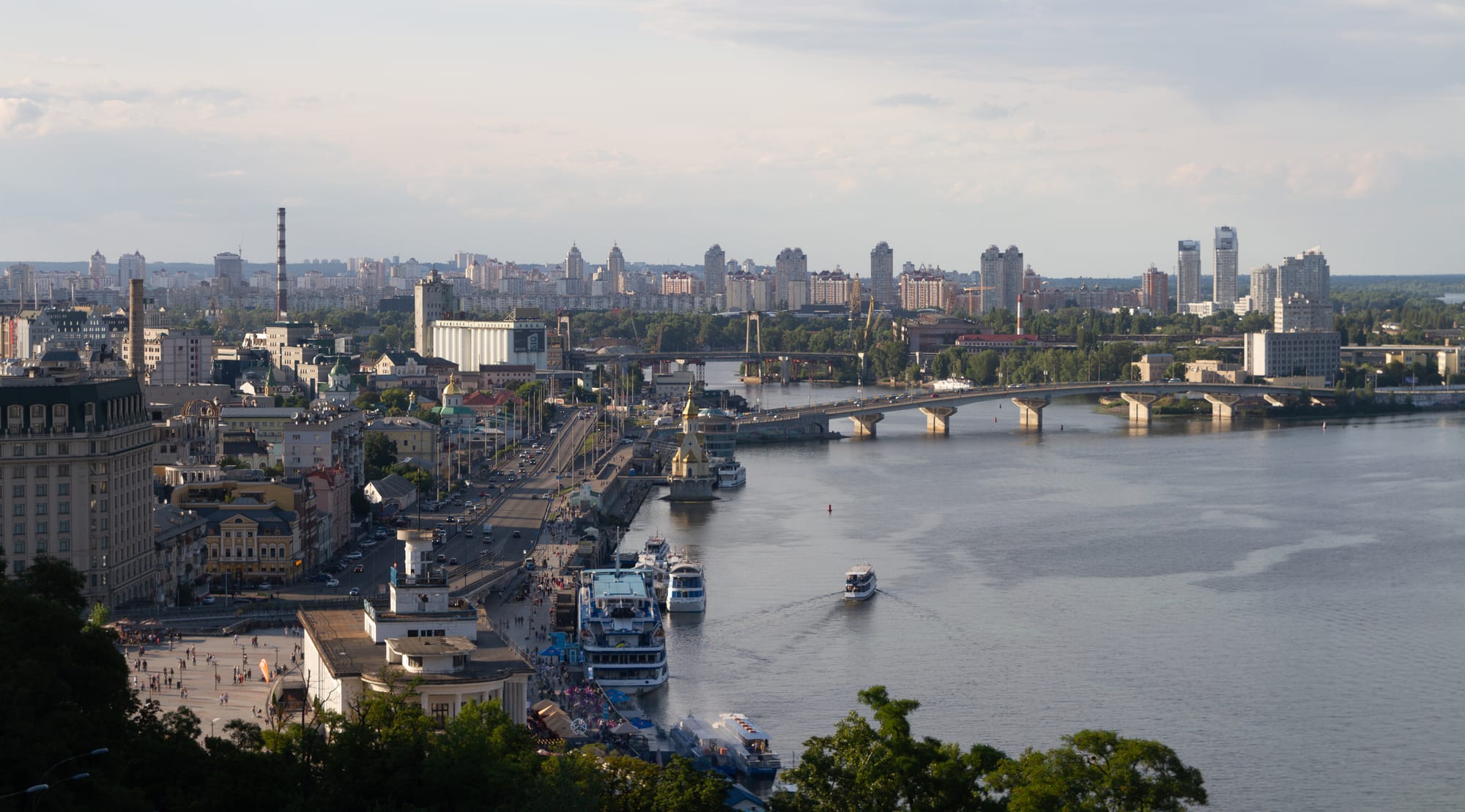
Kyiv's Podil district and river quay seen from a hillside, with boats on the wide Dnieper, a bridge and high-rises beyond

Kyiv & Northern Ukraine, Ukraine

Kyiv

Poshtova Square, the Podil district and the Dnieper seen from the hills of Kyiv's Upper Town. (Maksym Kozlenko / Wikimedia Commons · CC BY-SA 4.0)

Ukraine's capital, on both banks of the Dnieper — the seat of medieval Kyivan Rus, with the gold-domed Saint Sophia Cathedral and the cave monastery of the Pechersk Lavra above the river. Russian forces were driven back from its outskirts in 2022, and the city has been struck from the air frequently since. This page is written to explain the city, not to encourage travel.

Neighbourhoods

  • Upper Town
    • First-time visitors
    • Historic district

    The historic heart on the hills of the right bank, where Saint Sophia Cathedral, St Michael's Golden-Domed Monastery and the Golden Gate stand within walking distance of one another. The cobbled Andriyivskyy Descent winds down from St Andrew's Church towards Podil.

    Open in Maps
  • Podil
    • Historic district
    • Best for food
    • Riverside

    The old merchant quarter on the low ground beside the Dnieper — its name means 'lower' — and the core of the city in the Lithuanian period. Kontraktova Square, the Zhytniy market and Poshtova Square are here.

    Open in Maps
  • Khreshchatyk and Maidan
    • First-time visitors
    • Close to public transport
    • Nightlife

    The main street, rebuilt after the Second World War, running to Maidan Nezalezhnosti, the square of the 2004 and 2013–14 protests. The Bessarabskyi Market stands at its south-west end.

    Open in Maps
  • Pechersk
    • Museums
    • Parks
    • Quiet and residential

    The district of government buildings, parks and the most expensive property in the city, running south along the Dnieper bluffs past Mariinskyi Park to the Kyiv Pechersk Lavra, the Second World War museum and the Motherland Monument.

    Open in Maps
  • Obolon
    • Quiet and residential
    • Riverside

    A large residential district in the north of the right bank, where newly built apartment buildings line the Dnieper. It is home to the Obolon brewery.

    Open in Maps

Things to do

Famous landmarks

  • Saint Sophia Cathedrallandmark

    The 11th-century cathedral of Yaroslav the Wise, with Byzantine mosaics and frescoes inside a later Baroque exterior; it forms a UNESCO World Heritage Site with the Lavra, placed on the List of World Heritage in Danger in 2023.

    Open in Maps
  • Kyiv Pechersk Lavralandmark

    The Monastery of the Caves on the bluffs above the Dnieper, with gilded churches, the Great Bell Tower and underground passages holding the burials of monks, a place of pilgrimage for centuries.

    Open in Maps
  • St Michael's Golden-Domed Monasterylandmark

    A monastery with a blue-walled cathedral and gold domes, demolished under Soviet rule in the 1930s and rebuilt after independence.

    Open in Maps
  • Golden Gatelandmark

    The main gate of the 11th-century fortifications of Yaroslav the Wise's Kyiv, whose name is also used for a nearby theatre and metro station.

    Open in Maps
  • St Andrew's Churchlandmark

    Bartolomeo Rastrelli's 18th-century Baroque church, set high on a hill at the top of the Andriyivskyy Descent.

    Open in Maps
  • Maidan Nezalezhnostilandmark

    Independence Square, the central square on Khreshchatyk and the stage of the Orange Revolution and the 2013–14 protests.

    Open in Maps
  • Motherland Monumentlandmark

    The monumental Soviet-era statue above the Dnieper, part of the Second World War museum complex, whose Soviet emblem on the shield was replaced by the Ukrainian trident in 2023.

    Open in Maps

Museums and memorials

  • National Art Museum of Ukrainemuseum

    The main collection of Ukrainian art, from icons to 20th-century painting, in a columned building near Mariinskyi Park.

    Open in Maps
  • National Museum of the History of Ukraine in the Second World Warmuseum

    The memorial complex on the right-bank hills in Pechersk commemorating the Eastern Front of the Second World War, beneath the Motherland Monument.

    Open in Maps
  • National Museum of Folk Architecture and Folkwaysmuseum

    An open-air museum of 133.5 hectares in Pyrohiv, on the southern edge of the city, with wooden houses, churches and windmills brought from across Ukraine.

    Open in Maps
  • Babyn Yarlandmark

    The ravine where German forces murdered tens of thousands of Kyiv's Jews in September 1941, and many more people during the occupation, now a memorial site.

    Open in Maps

Streets and walks

  • Andriyivskyy Descentneighborhood

    A steep cobbled street linking the Upper Town with Podil, lined with old houses, galleries and souvenir stalls.

    Open in Maps
  • Khreshchatykneighborhood

    The city's main street, rebuilt after its buildings were blown up and burned in 1941, running from European Square through the Maidan to Bessarabska Square.

    Open in Maps
  • Kyiv Funiculartransit hub

    The short funicular railway up the steep hillside from Poshtova Square in Podil to St Michael's Square in the Upper Town.

    Open in Maps
  • Volodymyrska Hillpark

    A hillside park above Podil, crowned by the monument to Volodymyr the Great, the baptizer of Rus', with views over the Dnieper.

    Open in Maps

Parks and the river

  • Mariinskyi Parkpark

    A park founded in 1874 beside the Mariinskyi Palace, after which it is named.

    Open in Maps
  • Trukhaniv Islandpark

    An island in the Dnieper opposite the centre, reached by a pedestrian bridge, with city beaches, cafés and sports grounds.

    Open in Maps
  • National Botanical Gardenpark

    The Academy of Sciences' botanical garden, founded in 1936 and covering about 120 hectares, with plant zones from the Carpathians to the Far East and the Vydubychi Monastery in its grounds.

    Open in Maps

Music and sport

  • National Opera of Ukraineattraction

    The national opera and ballet theatre on Volodymyrska Street, a Renaissance Revival building by Victor Schröter opened in 1901.

    Open in Maps
  • Olimpiyskiy National Sports Complexattraction

    The national stadium in the city centre, often used by Dynamo Kyiv and the venue of the Euro 2012 final.

    Open in Maps

Seasonal events

  • Kyiv Daylast weekend of May

    The city's holiday, established in 1982, traditionally marked with street performances by actors and musicians and an evening firework display.

  • Independence Day24 August

    The national holiday marking the 1991 declaration of independence, in some years marked with a military parade in Kyiv.

Eat and drink

Long-standing places and food districts in Kyiv. Hours, ratings and directions come from your maps app, always current.

Food districts and markets

  • Bessarabskyi Marketmarket

    A market hall built in 1910–12 to a design by Henryk Julian Gay, at the south-west end of Khreshchatyk.

    Open in Maps
  • Zhytniy Marketmarket

    Podil's food market on Verkhnii Val Street, close to Kontraktova Square.

    Open in Maps
  • Podil's restaurants and cafésneighborhood

    The streets around Kontraktova Square in the old merchant quarter, with restaurants, cafés and bars close to the river.

    Open in Maps
  • Around Khreshchatykneighborhood

    The central streets around the main boulevard and Bessarabska Square, with canteens serving Ukrainian staples beside cafés and bars.

    Open in Maps

Experience Kyiv

History

Kyiv probably existed as a commercial centre as early as the 5th century, and legend names its founders as three brothers, Kyi, Shchek and Khoryv, and their sister Lybid, who are commemorated by a monument on the Dnieper embankment. A Slavic settlement on the trade route between Scandinavia and Constantinople, it paid tribute to the Khazars until Varangians took it in the mid-9th century. It became the capital of Kyivan Rus, whose ruler Volodymyr adopted Christianity in 988 and whose son Yaroslav the Wise built Saint Sophia's Cathedral.

The Mongol siege of 1240 left the city in ruins, and for centuries it lost most of its influence. Under Lithuanian rule its core was the riverside district of Podil, below a castle on Zamkova Hora. Kyiv prospered again in the industrial boom of the late Russian Empire, reaching about 250,000 people by 1900, and after the wars of 1917–21 became part of Soviet Ukraine, whose capital it became in 1934.

The Second World War devastated it. Soon after German troops arrived in 1941, Soviet agents dynamited most of the buildings on Khreshchatyk, and at Babyn Yar the occupiers murdered tens of thousands of the city's Jews in September 1941; more than 100,000 people are estimated to have been killed there. Kyiv became the capital of independent Ukraine in 1991, and its Maidan was the stage for the Orange Revolution of 2004 and the protests of 2013–14. In February 2022 Russian forces tried to seize the city but were repelled on its outskirts; since their retreat from the region in April 2022, Kyiv has been subject to frequent air strikes. In September 2023 UNESCO placed Saint Sophia and the Lavra on its List of World Heritage in Danger.

Culture & Customs

Kyiv is the country's political, religious and cultural centre. Its sacred sites, the Kyiv Pechersk Lavra and Saint Sophia Cathedral, have drawn pilgrims for centuries, and the city regards itself as the cradle of Eastern Slavic Christianity. The Lavra has been at the centre of the dispute between the independent Orthodox Church of Ukraine and the church formerly tied to Moscow.

Language has become a marker of identity. Both Ukrainian and Russian were long spoken here; Ukrainian is the official language, and many streets, squares and metro stations bearing Russian names have been renamed, especially since 2022. Theatres, galleries, clubs and cafés have kept working between alerts, and a volunteer culture of fundraising and support for the army runs through the city.

The calendar has its own markers. Kyiv Day, established in 1982, is celebrated on the last weekend of May with performers in the streets and fireworks, and the open-air museum at Pyrohiv preserves the folk architecture and folkways of the regions of Ukraine within the city limits. Football is followed closely: Dynamo Kyiv, which often plays at the Olimpiyskiy stadium, was the most successful club in the history of the Soviet Top League, and Obolon Kyiv also plays in the top league. The capital's monuments are being reread too — the Soviet emblem on the Motherland Monument's shield was replaced with the Ukrainian trident in 2023.

Daily Life

As of January 2022 the population of Kyiv was 2,952,301, making it the largest city in Ukraine and one of the most populous in Europe; it straddles both banks of the Dnieper, with the historic centre on the hilly right bank and large residential districts on the left.

Kyiv has the highest level of business activity in the country. Its economy rests on government, finance and services, high-tech industries and many universities and higher education institutions, after the decline of the Soviet-era armaments industry. The most expensive property is in Pechersk and around Khreshchatyk, while new apartment buildings in districts such as Obolon along the Dnieper are also sought after.

Life under martial law sets the rhythm. Air raids by drones and missiles are frequent, so many people spend hours in corridors, shelters or metro stations, whose underground stations serve as bomb shelters; during alerts the metro stops crossing the river. A night-time curfew empties the streets, and strikes on the power grid have caused power cuts. Between alerts people go to work and school, cafés and shops open, and the city keeps a determined normality.

Food

Kyiv has given its name to two well-known dishes. Chicken Kyiv is a chicken fillet pounded and rolled around cold butter, coated with egg and breadcrumbs and fried or baked; its origins are disputed, but it is particularly popular across the former Soviet states. The Kyiv cake, tort Kyivskyi, has been made in the city since 6 December 1956 by the former Karl Marx Confectionery Factory, now part of Roshen: two light layers of meringue with hazelnuts, a buttercream-like filling and a chocolate glaze, sold in a box decorated with a horse chestnut leaf, a former emblem of the city.

Everyday Ukrainian cooking is easy to find: borshch, varenyky dumplings, kholodets meat aspic, holubtsi cabbage rolls and mlyntsi pancakes are widely served in the city's restaurants.

The Bessarabskyi Market, a hall built in 1910–12 at the south-west end of Khreshchatyk, and the Zhytniy Market in Podil are among the city's markets. Beer is brewed in the city by Obolon, one of its notable enterprises, and the streets of Podil and the centre hold most of the cafés and bars.

Planning tools

Budget

Kyiv has the highest apartment prices in Ukraine, though everyday prices are low by the standards of most European capitals. None of this is a reason to travel: wartime risk, disruption and insurance that usually excludes Ukraine outweigh price.

Daily Budget Midrange
USD 80–160 (pre-war guide: mid-range hotel, restaurant dinners, taxis)
Daily Budget Shoestring
USD 35–55 (pre-war guide: hostel, canteen meals, metro)

Do not plan leisure travel while the war continues; ordinary travel insurance usually excludes Ukraine.

Best Time to Visit

In peacetime, late spring and September were the most pleasant months, with Kyiv Day at the end of May and warm summer evenings on the riverbanks. At present the season does not matter: air-raid alerts and strikes on the capital continue through the year.

Suggested Number of Days

In peacetime a first visit to a city this large took three or four days, and five or six with trips into the surrounding region. Under martial law, alerts, shelter time and a night curfew make every plan slower and less certain.

First Visit
3–4 days
With Surroundings
5–6 days

Transportation

The Kyiv Metro is the fastest way around and covers most, but not all, of the city, alongside buses, minibuses, trolleybuses, trams, taxis and a funicular. During air-raid alerts metro trains do not cross the Dnieper, and the underground metro stations serve as bomb shelters.

If in the city, allow for interrupted journeys during alerts and know where the nearest shelter or metro station is.

Airport & Station Connections

Ukraine closed its airspace to civilian flights on 24 February 2022, and Boryspil International Airport, about 30 km from the city, has been shut since; commercial air travel was still suspended in August 2025. Kyiv is reached overland, by train or by direct bus from neighbouring countries such as Poland, Hungary, Slovakia and Moldova.

Walkability

The Upper Town, Khreshchatyk and Podil are close enough to explore on foot, linked by steep streets, stairs, the Andriyivskyy Descent and the funicular. The city is very large and hilly, with the Dnieper dividing it, so longer distances need the metro.

Safety

Most governments advise against all travel to most or all of Ukraine. Following the Russian retreat from the region in April 2022, Kyiv has been subject to frequent air strikes by drones and missiles. Martial law is in force, with a night-time curfew.

Install an air-raid alert app, go to a shelter or the nearest metro station when sirens sound, observe the curfew and never touch debris. Check current official travel advice before travelling.

Climate

A temperate continental climate with warm summers and cold, often snowy winters. The highest temperature on record is 39.4°C, in July 1936, and the lowest −32.9°C, in January 1951.

Summer
warm — June to August mean temperatures range from about 14 to 25°C
Winter
cold — December to February mean temperatures range from about −5 to −1°C

Local Customs

Ukrainian is the official language and the one used by service staff, and many streets, squares and metro stations with Russian names have been renamed, especially since 2022. Tipping in restaurants has been growing more common. Commemorations of the fallen and fundraising for the army are part of everyday life.

Churches and monasteries such as the Lavra are places of worship; behave quietly inside. Do not photograph military sites, air-defence activity or the aftermath of strikes.

Common Payment Methods

The currency is the hryvnia. Cards and contactless payment are widely accepted, including at metro gates; some cash is useful during power cuts, when card terminals can go offline.