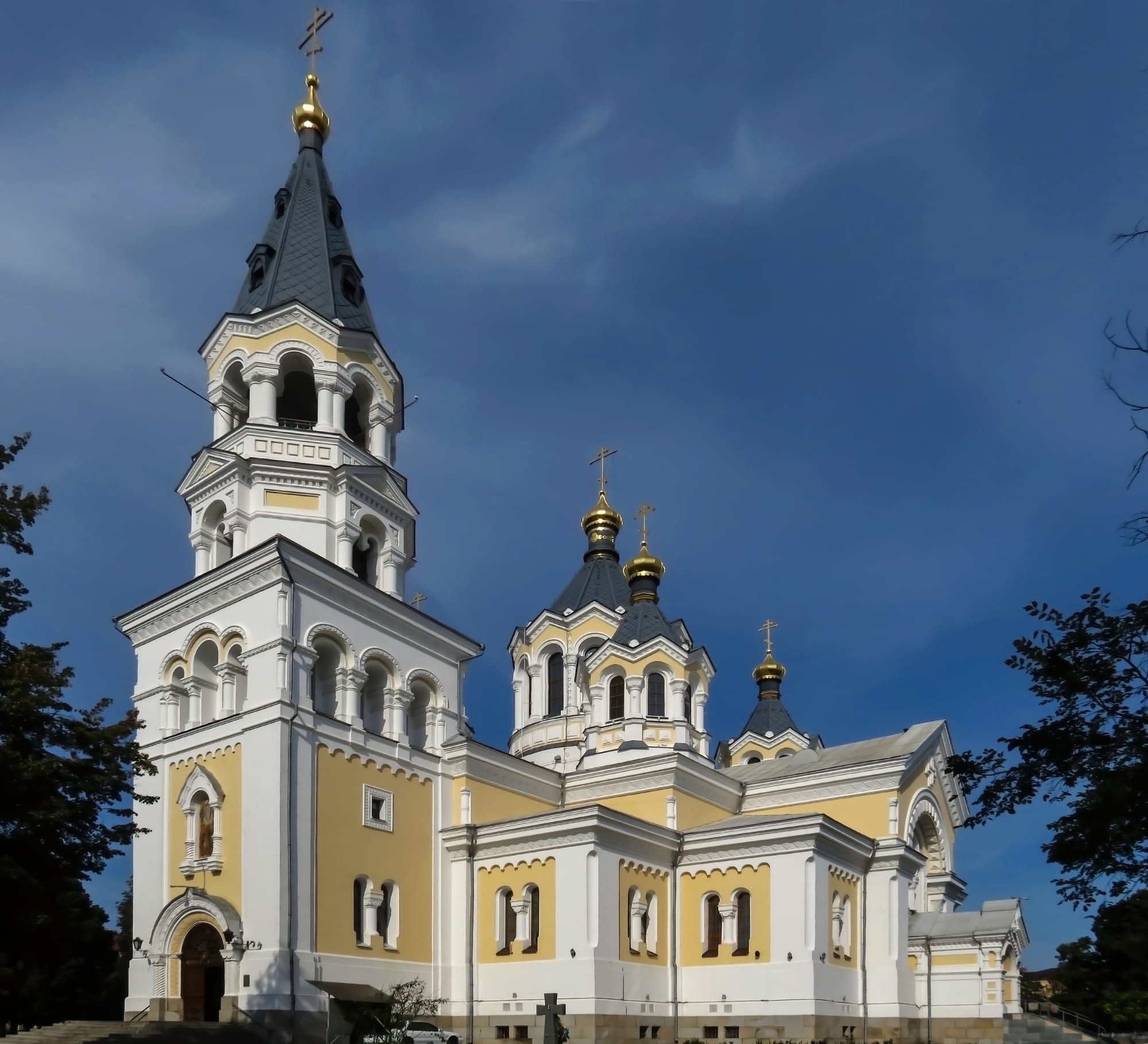
A cream and white Orthodox cathedral with a tall bell tower and dark domes topped with gold, under a deep blue sky

Kyiv & Northern Ukraine, Ukraine

Zhytomyr

The Transfiguration Cathedral on Peremohy Square in Zhytomyr. (V1snyk / Wikimedia Commons · CC BY-SA 4.0)

A regional capital in the forests of Polissia, west of Kyiv, built on rocky hills above the Kamianka river, by the Teteriv — a city with a long Polish and Jewish history, the birthplace of the rocket designer Serhiy Korolyov and home to a museum of cosmonautics in his name. This page is written to explain the city, not to encourage travel.

Neighbourhoods

  • Old town and Sobornyi Maidan
    • First-time visitors
    • Historic district

    The old part of the city stands on three rocky hills above the Kamianka — Okhrimova, Zamkova and Petrovska — around Sobornyi Maidan, the main square from which the streets radiate. The Catholic Saint Sophia Cathedral and the small Zamkova Hora park, with its founding stone, are here.

    Open in Maps
  • Mykhailivska Street
    • Shops and cafés
    • Walking

    The best-known street in the centre, about 500 metres east of Sobornyi Maidan, closed to most traffic and running between Kyivska Street and Velyka Berdychivska Street, with Korolyov Square and the oblast council building at its southern end.

    Open in Maps
  • The Teteriv riverside
    • Parks
    • Riverside
    • Quiet and residential

    The river that forms the city's southern edge, with Gagarin Park, the best-known park in Zhytomyr, on its northern bank, and rocky banks, a reservoir dam and the Korbutivskyi Hydropark further upstream to the south-west.

    Open in Maps

Things to do

Landmarks and churches

  • Saint Sophia Cathedrallandmark

    The principal church of the Roman Catholic Diocese of Kyiv-Zhytomyr, first built in 1746–48, rebuilt in classical style after a fire in 1768 and keeping a Baroque interior; closed for years under Soviet rule, it was restored after 1991.

    Open in Maps
  • Transfiguration Cathedrallandmark

    The Orthodox cathedral on Peremohy Square, built in 1866–74 and considered a symbol of the city.

    Open in Maps
  • Zamkova Horapark

    A small quiet park just west of Sobornyi Maidan, with a boulder whose inscription marks the hill where Zhytomyr is said to have been founded in 884.

    Open in Maps
  • Mykhailivska Streetneighborhood

    The pedestrian street at the heart of the centre, lined with shops and cafés.

    Open in Maps

Museums

  • Korolyov Museum of Cosmonauticsmuseum

    A museum of rocketry and space flight named after Serhiy Korolyov, the Soviet space programme's chief designer, who was born in the city, with about 11,000 exhibits including the Soyuz 27 descent module, a sample of lunar soil and a Lunokhod 2 rover.

    Open in Maps
  • Zhytomyr Regional Museummuseum

    The regional museum of local history, one of the oldest in Ukraine, which traces its origins to 1865, on Zamkova Hora.

    Open in Maps
  • Museum of Naturemuseum

    A nature museum housed in the Holy Cross Church on Kafedralna Street, a building in the Byzantine-Russian style.

    Open in Maps

Parks and the river

  • Gagarin Parkpark

    The best-known park in Zhytomyr, in the south of the city on the northern bank of the Teteriv.

    Open in Maps
  • Chotyry Braty rockviewpoint

    A protected rock outcrop on the right bank of the Teteriv near the dam of the Zhytomyr reservoir, on the south-western edge of the city.

    Open in Maps
  • Korbutivskyi Hydroparkpark

    A riverside leisure park on the banks of the Teteriv reservoir, on the south-western edge of the city.

    Open in Maps

Short trips from the city

  • Berdychiv Carmelite Monasterylandmark

    The monastery of the Discalced Carmelites in the town of Berdychiv, south of Zhytomyr, begun in 1634 on a fortress given to the order.

    Open in Maps

Eat and drink

Long-standing places and food districts in Zhytomyr. Hours, ratings and directions come from your maps app, always current.

Zhytomyr food and drink

  • Cafés on Mykhailivska Streetneighborhood

    The pedestrian street in the centre, with cafés and small restaurants among its shops.

    Open in Maps
  • Restaurants around Sobornyi Maidanneighborhood

    The old centre on the hills above the Kamianka, where restaurants serving Ukrainian dishes sit close to the cathedrals.

    Open in Maps

Experience Zhytomyr

History

Legend holds that Zhytomyr was founded about 884 by Zhytomyr, a prince of the Slavic Drevlian tribe, and the date is cut into a large boulder on Zamkova Hora, the hill where the town is said to have begun. The old city grew on three rocky hills above the Kamianka river, on the route that linked Kyiv with the west through Brest, and that position made it a crossroads of trade and of peoples.

By the time it became part of the Russian Empire in 1778, Zhytomyr had a large Jewish community and was a centre of the Hasidic movement; in 1861 Jews made up nearly a third of the population, and the city became the official Jewish centre of the southern Pale of Settlement, with a rabbinical school that operated until 1873. It was also a centre of Polish life: a Polish theatre opened in 1808, the Catholic cathedral and a large Polish cemetery founded in 1800 still stand, and the oblast remains the main centre of the Polish minority in Ukraine.

The 20th century broke both communities. Jews were killed in pogroms in 1919; in 1936 the Soviets deported part of the Polish population to Kazakhstan, and during the NKVD's Polish Operation many were persecuted and executed. German forces set up a ghetto in August 1941, and the Jewish community of the region was largely destroyed in the Holocaust. In the 2022 Russian invasion, Zhytomyr and its surroundings were hit by several air and missile strikes, including one on 2 March 2022 that damaged homes, a thermal power plant and two hospitals and killed at least two people.

Culture & Customs

Zhytomyr's most famous son is Serhiy Korolyov, the chief designer of the Soviet rocket and space programme, who was born here. The house of his birth became a memorial in 1970, the museum of cosmonautics in his name gained independent status in 1987 and moved into its present building in 1991, and one of the city's two districts, Koroliovskyi, is named after him; the other is Bohunskyi. The pianist Sviatoslav Richter and the composer Borys Lyatoshynsky were also born in the city, and the regional philharmonic bears Richter's name.

The city has two state theatres, a philharmonic, more than ten museums and a planetarium. Its religious life reflects its history: the Roman Catholic Saint Sophia Cathedral is the seat of the diocese of Kyiv-Zhytomyr and became a place of pilgrimage after it was restored in the 1990s, and on Independence Day in 2025 it hosted an ecumenical prayer service for peace attended by the president. Orthodox cathedrals stand close by, and the Jewish community today numbers about 5,000.

Ukrainian is overwhelmingly the language of the city: in a 2023 survey 82 per cent of residents said they spoke it at home and 14 per cent Russian.

Daily Life

Zhytomyr's population was 261,624 in a 2022 estimate. The city is laid out on a mostly radial street plan centred on Sobornyi Maidan, with Kyivska Street running north-east to the railway and bus stations, Velyka Berdychivska Street to the south-east and Pokrovska Street to the north; the Teteriv river forms most of its southern edge, and forests surround it on every side.

Industry is a large employer. A confectionery factory that has operated since 1944 is one of the leaders of the Ukrainian confectionery market, there is a large pharmaceutical factory, and the city's armoured vehicle plant has been one of the main repair facilities in Ukraine since the start of the Russo-Ukrainian war, running on three shifts. The city is also the administrative centre of its oblast, with universities and regional institutions.

Daily life follows the pattern of the country under martial law. Air-raid alerts interrupt work and school, strikes have hit the city since 2022, and power cuts caused by attacks on the grid are part of the year. Between alerts, people walk Mykhailivska Street, and in summer the parks and the banks of the Teteriv fill up.

Food

Zhytomyr lies in Polissia, the forest country that covers the northern parts of the Zhytomyr, Kyiv, Chernihiv, Rivne and Volyn regions, and its cooking draws on fishing and gathering — berries, mushrooms and grasses. The signature Polissian dish is deruny, potato pancakes, and verhuny, crisp fried dough pastries, are another favourite. Blueberries are a widespread product, traditionally eaten with milk, bread and sour cream.

Many dishes are known by local names: tomachi is mashed potato, hartanachka millet porridge with meat and potatoes, krupnyk a soup of millet, mushrooms and whey, and bukhty white-flour pastries with raisins and berries. Polissian borshch includes sugar beet, beet kvas, cabbage, mushrooms, potatoes and fresh herbs, and festive tables traditionally carry borshch, kysil, pancakes with sour cream and kvasovka, a millet porridge with dried fruit. Pies, soft pancakes and breads, some of them made for religious rituals, complete the region's baking.

The city is also known across Ukraine for confectionery, made at the factory that has worked here since 1944. Cafés and restaurants cluster on Mykhailivska Street and around Sobornyi Maidan.

Planning tools

Budget

In peacetime Zhytomyr cost noticeably less than Kyiv, as the regional cities of the north generally do. None of this is a reason to travel: wartime risk and insurance that usually excludes Ukraine outweigh price.

Daily Budget Midrange
USD 70–140 (pre-war guide: mid-range hotel, restaurant dinners, taxis)
Daily Budget Shoestring
USD 30–50 (pre-war guide: hostel or simple guesthouse, canteen meals, buses)

Do not plan leisure travel while the war continues; ordinary travel insurance usually excludes Ukraine.

Best Time to Visit

In peacetime, late spring and early autumn suited walks along the Teteriv and in the city's parks. At present the season does not matter: the city has been struck from the air since 2022 and air-raid alerts are frequent.

Suggested Number of Days

In peacetime one or two days covered the centre, the museums and the riverside, with another for nearby towns. Under martial law, alerts and travel restrictions make any plan uncertain.

First Visit
1–2 days
With Surroundings
2–3 days

Transportation

The city is a major transport hub on the historic route from Kyiv to the west. Local public transport links the centre with the outer districts, and the centre itself is compact.

Allow for interrupted journeys during air-raid alerts and know where the nearest shelter is.

Airport & Station Connections

There are no civilian flights in Ukraine. Zhytomyr lies on the road and railway west from Kyiv; the railway station and the main bus station are north-east of the centre, at the end of Kyivska Street.

Walkability

The centre is easy on foot: Sobornyi Maidan, Zamkova Hora, the cathedrals and Mykhailivska Street lie within a few hundred metres of each other, and Gagarin Park and the river are a longer walk south. The hills above the Kamianka make some streets steep.

Safety

Most governments advise against all travel to most or all of Ukraine. Zhytomyr and the surrounding area have been hit by several Russian air and missile strikes since 2022, including an airstrike on 2 March 2022 that damaged homes, a thermal power plant and two hospitals.

Take air-raid alerts seriously, go to shelter when sirens sound, and never touch debris. Check current official travel advice before travelling.

Climate

A temperate continental climate, with warm summers, cold snowy winters and forests on every side of the city.

Summer
warm — July, the warmest month, averages about 17.8°C
Winter
cold — January, the coldest month, averages about −4.4°C

Local Customs

Ukrainian is the language of daily life: in a 2023 survey 82 per cent of residents spoke it at home. The city has both Orthodox and Roman Catholic cathedrals and a Polish community, and churches of both are working places of worship.

Behave quietly in churches, and do not photograph military sites, factories or the aftermath of strikes.

Common Payment Methods

The currency is the hryvnia. Cards and contactless payment were used widely even before the war; some cash is useful during power cuts, when card terminals can go offline.