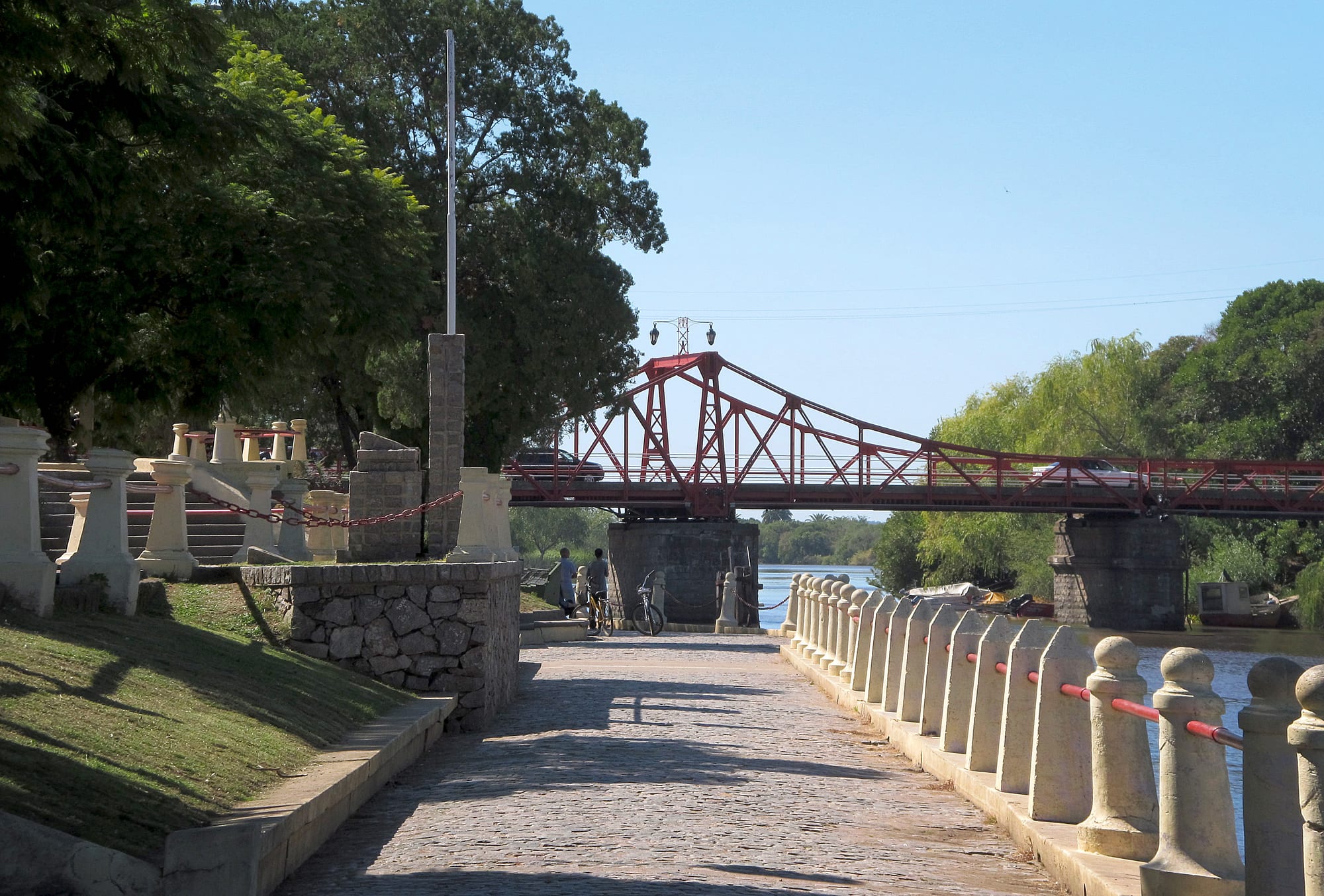
A cobbled riverside walk with stone balustrades leading to a red iron swing bridge over a calm stream lined with trees

Montevideo & Colonia, Uruguay

Carmelo

The swing bridge over the Arroyo de las Vacas in Carmelo. (Pablo Torrado / Wikimedia Commons · CC BY-SA 3.0)

A small river town in Colonia Department, where the Arroyo de las Vacas meets the Río de la Plata near the mouth of the Uruguay River. Founded by José Artigas in 1816 — the only town he founded in person — it is known for its wineries, its hand-turned swing bridge of 1912 and its boats across the delta to Tigre in Argentina.

Neighbourhoods

  • Town centre
    • First-time visitors
    • Local life
    • Close to public transport

    A compact grid on the north bank of the Arroyo de las Vacas, with two squares — Plaza Artigas, with the foundation monument, the Templo Histórico del Carmen and the town museum, and the more central commercial square. Calle 19 de Abril, the main shopping street, runs south to the bridge.

    Open in Maps
  • The riverfront and the south bank
    • Beaches
    • Sunsets
    • Quiet

    Across the swing bridge, the small southern part of town has the yacht club and a port for private boats, Playa Seré beach, a park and a small zoo. Sunsets over the river, with Argentina on the far side, draw people to the water in the evening.

    Open in Maps
  • The countryside and vineyards
    • Wineries
    • Golf
    • Countryside

    Vineyards, farms and estancias surround the town, and the stretch of the Uruguay River towards Nueva Palmira, around Punta Gorda and Zagarzazú, holds a golf course and a small airport. A car or bicycle is needed to get around.

    Open in Maps

Things to do

In town

  • Carmelo swing bridgelandmark

    An iron swing bridge over the Arroyo de las Vacas, opened on 1 May 1912 and turned by hand — considered the first swing bridge in South America. Drifting ships struck it in 2018, and it reopened in 2019.

    Open in Maps
  • Templo Histórico del Carmenlandmark

    The historic church on Plaza Artigas, built in 1830, beside the foundation monument.

    Open in Maps
  • Archivo y Museo del Carmenmuseum

    The town museum and archive on Plaza Artigas, with objects and documents from the old village of Las Víboras and the Calera de las Huérfanas, including the birth records of the three elder brothers of José de San Martín.

    Open in Maps
  • Teatro Uamáattraction

    The town theatre, whose name means 'friend' in the extinct Chaná language once spoken in Uruguay.

    Open in Maps

The river

  • Playa Serébeach

    A river beach on the south bank beside a park, known for sunsets over the Río de la Plata.

    Open in Maps
  • Juncal Islandviewpoint

    An island where the Uruguay River enters the Río de la Plata, just north-west of the town, which once held a notorious prison.

    Open in Maps

Around the town

  • Calera de las Huérfanasattraction

    The ruins of the main house of the colonial Estancia de las Vacas, a Jesuit lime works and ranch, of which Carmelo was once an outpost.

    Open in Maps
  • Carmelo's wineriesattraction

    Family wineries in the countryside around the town offer visits and tastings, and sell their wine.

    Open in Maps

Eat and drink

Long-standing places and food districts in Carmelo. Hours, ratings and directions come from your maps app, always current.

Food and wine

  • Calle 19 de Abril and the centreneighborhood

    Parrillas, pizzerias, cafés and a surprising number of bars in the small town centre.

    Open in Maps
  • Winery tastingsrestaurant

    Wineries outside the town sell their bottles and serve tastings.

    Open in Maps

Experience Carmelo

History

Spanish explorers built the short-lived Fuerte de San Lázaro in this area as early as 1527, abandoning it by 1530. In 1611 Hernando Arias de Saavedra, the governor of Asunción, landed cattle near the mouth of the Arroyo de las Vacas — the "stream of the cows". The site became an outpost of the great colonial Estancia de las Vacas, whose headquarters and lime kilns stood at the place now called the Calera de las Huérfanas.

A village had grown up by the stream before independence, but the present town was founded by José Gervasio Artigas on 12 February 1816. It is the only town that the national hero founded in person, a fact Carmelo still claims with pride. It was raised to the status of a city in 1920.

The river shaped its growth. The Arroyo de las Vacas served as the town's port, and in 1912 a swing bridge, turned by hand, was opened across it to link the town with its small southern district. The bridge has become Carmelo's emblem: in December 2018 a strong current swept three ships awaiting scrapping against it, cutting the southern neighbourhood off by road, and it reopened after repairs in February 2019.

Culture & Customs

Carmelo's identity rests on its founder and its river. Plaza Artigas holds the monument to the town's foundation, the Templo Histórico del Carmen of 1830 and the town archive and museum, whose collection includes the birth records of the three elder brothers of José de San Martín, the Argentine independence hero. The Capilla San Roque dates from 1869, and the town theatre is called Uamá, meaning "friend" in the extinct Chaná language once spoken in Uruguay.

Evenings belong to the riverfront. People gather at the water to watch the sun go down over the Río de la Plata, with Argentina on the far side, and the yacht club and the small beaches of the south bank fill in summer. Ties with Argentina are close: boats run across the delta to Tigre, and many visitors come from the other side.

Wine is the newer source of pride. The countryside around the town is noted for its wineries, many of them small family businesses, and wine tourism has joined golf and the river as the reasons most visitors come. The town has a local football club, Carmelo Fútbol Club, founded in 2021.

Daily Life

The 2023 census counted about 20,000 people in Carmelo, in Colonia Department. Agriculture and the businesses that serve it remain the base of the economy, alongside wineries, the river port and tourism.

Most people live in the grid of streets north of the Arroyo de las Vacas, around the two squares and the main shopping street, Calle 19 de Abril. The small district across the swing bridge holds the yacht club, the beach, a park and a small zoo. Along the river towards Nueva Palmira, a luxury hotel, a golf course and a small airport serve visitors at Zagarzazú and Punta Gorda.

The pace is unhurried, organised around family, mate, the evening walk by the water and the weekend asado. Summer brings visitors from Montevideo and Argentina to the beaches and wineries, and the town is quieter the rest of the year. For many residents, the boats to Tigre and the buses to Colonia and Montevideo are the main links with the wider world.

Food

Carmelo eats as the rest of Uruguay does. Parrillas grill beef, sausages and offal over wood embers for the asado, the chivito steak sandwich is a staple, and pizza and pasta reflect the country's Italian roots. Bakeries sell bizcochos, small sweet and savoury pastries eaten with mate, and dulce de leche fills alfajores and most desserts.

What sets the town apart is wine. Wineries in the surrounding countryside make Tannat, the dark, tannic red grape that has become Uruguay's flagship, alongside other varieties, and many sell bottles and hold tastings. Tannat's firm tannins suit the grilled beef that dominates local tables.

Colonia Department is also dairy country, and the hard cheese sold across Uruguay as queso Colonia comes from the Swiss and Waldensian farming colonies of the same department, along with butter and dulce de leche from local farms. In town, the bars and parrillas around the centre are where residents eat out, and in summer meals move outdoors to the riverside.

Planning tools

Budget

Carmelo is noticeably cheaper than Colonia del Sacramento or Montevideo for rooms and meals. The main extra costs are winery tastings and lunches, which are charged separately, and a hire car or bicycle for reaching the vineyards. Upmarket country hotels nearby raise the top end.

Daily Budget Midrange
USD 120–240 (mid-range hotel, restaurant dinners, a winery visit, a hire car for a day)
Daily Budget Shoestring
USD 45–75 (hostel bed, bakery and parrilla meals, a hired bicycle)

Ask about tasting charges when arranging a winery visit; a bicycle is enough for the town and nearby river.

Best Time to Visit

October to April is best, with warm days for the river beaches and the vineyards in leaf; the grape harvest falls in late summer. Summer here is December to February. Winter is quiet, cool and damp.

Suggested Number of Days

A night or two covers the town and the riverfront. Allow an extra day for the wineries and the countryside, especially without a car, since the vineyards are spread out around the town.

First Visit
1–2 days
With Surroundings
2–3 days

Transportation

The town centre is compact enough to walk. Some of what draws visitors — the wineries, the quarries and the river shore towards Nueva Palmira — is spread across the countryside, so a car, motorbike or bicycle helps. Bicycles can be hired in town.

Cross the swing bridge on foot to reach the beach and yacht club on the south bank.

Airport & Station Connections

Buses connect Carmelo with Colonia del Sacramento, Montevideo and other Uruguayan towns, and Route 21 runs through it between Colonia and Nueva Palmira. A regular boat service runs from the port on the Arroyo de las Vacas across the Río de la Plata and through the Paraná delta to Tigre, near Buenos Aires.

Walkability

Easy on foot: the two squares, the main street, the riverfront and the bridge are all within a short walk of each other, and the streets are flat and quiet. The wineries and countryside need wheels.

Safety

Uruguay is among the safest countries in Latin America, though property crime and, in some Montevideo neighbourhoods, violent crime have risen with drug-trafficking activity. Carmelo itself is a quiet, very safe town; the main risks are on the roads and the water.

Take care on country roads after winery tastings, and swim only where others do on the river beaches. Check current official travel advice before travelling.

Climate

Humid and temperate, with four seasons. Summer is December to February; winter is June to August. Rain falls in every month, and the pampero wind from the south-west can bring sudden cool spells.

Summer
warm and humid, around 26–30°C by day across the region, with breezes off the river
Winter
cool and damp, around 6–15°C across the region, with strong winds and occasional frost inland

Local Customs

Life is slow and sociable: late lunches and dinners, mate shared from a gourd, and evenings by the river. Greetings are informal, often a kiss on the cheek among acquaintances. Townspeople are proud that Artigas himself founded Carmelo.

Leave around 10 per cent in restaurants when service is good; dress is casual everywhere.

Common Payment Methods

The currency is the Uruguayan peso. Cards are widely accepted and ATMs are found in the centre; carry some cash for small shops and rural wineries. US dollars are taken for larger purchases in tourist areas.