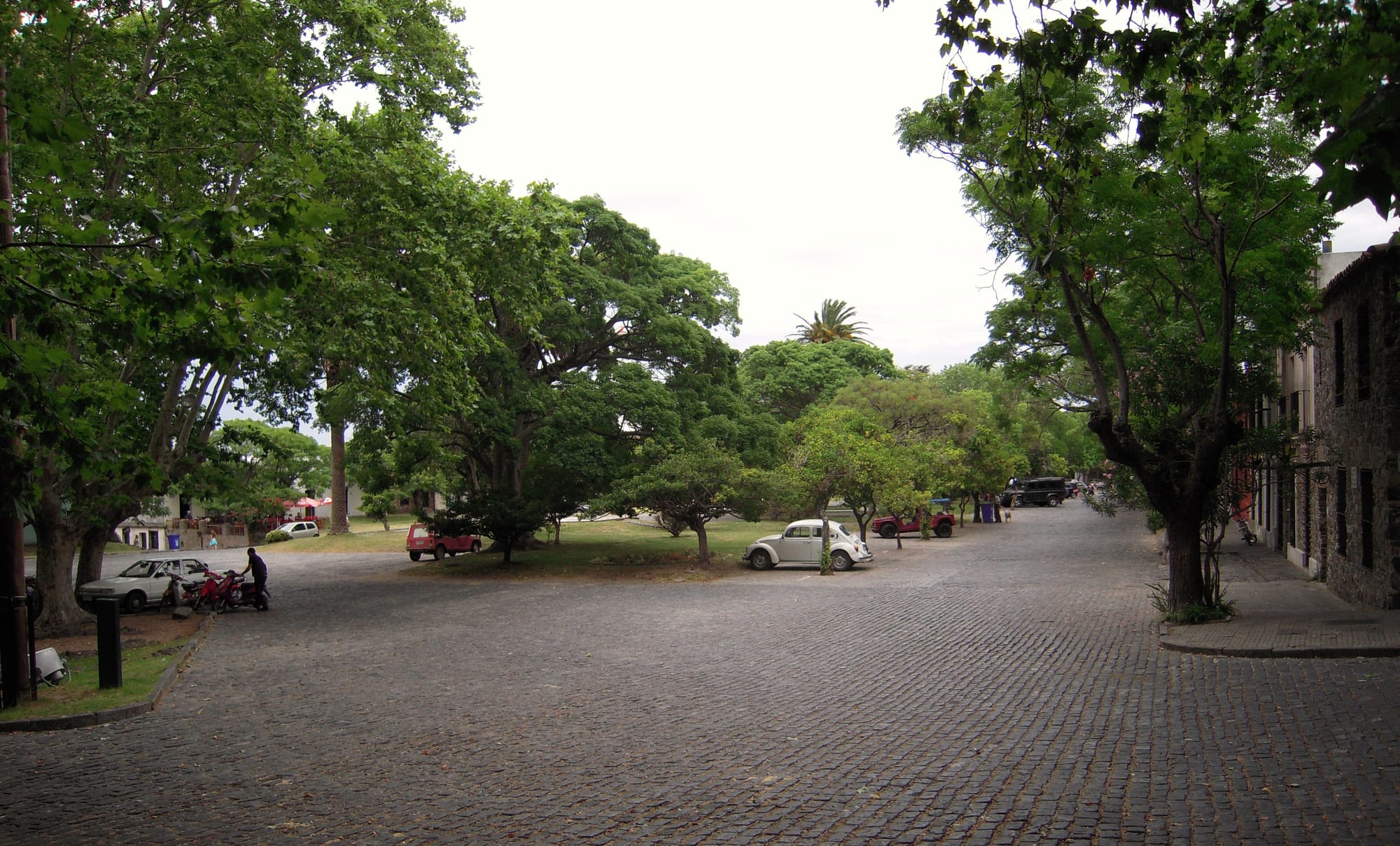
A wide cobbled square shaded by large green trees, with old stone houses on one side and cars parked under the trees

Montevideo & Colonia, Uruguay

Colonia del Sacramento

The Plaza Mayor in the historic quarter of Colonia del Sacramento. (Helge Høifødt / Wikimedia Commons · CC BY-SA 3.0)

One of Uruguay's oldest towns, on a point in the Río de la Plata facing Buenos Aires. Founded by the Portuguese in 1680 as a smuggling outpost and fought over with Spain for a century, it keeps a small old quarter of cobbled lanes and stone houses, a UNESCO World Heritage Site, beside a quiet modern department capital.

Neighbourhoods

  • Barrio Histórico
    • First-time visitors
    • Historic district
    • Museums

    The 16-hectare Portuguese old town on the tip of the peninsula, a UNESCO World Heritage Site, with an irregular plan of cobbled lanes fitted to the terrain, the tree-lined Plaza Mayor, the lighthouse and a string of small museums. Restaurants and boutiques fill its old houses, and the ferry terminal is within walking distance.

    Open in Maps
  • Downtown and Avenida General Flores
    • Shopping
    • Close to public transport
    • Local life

    The newer town laid out by the Spanish on a checkerboard grid beyond the old walls. Avenida General Flores is its main street, with shops, banks and supermarkets, and the bus and ferry terminals sit at its edge near the port.

    Open in Maps
  • The riverfront and Real de San Carlos
    • Beaches
    • Quiet and residential
    • Sunsets

    A beachfront promenade runs north-west for about four kilometres past residential streets, small beaches and a few hotels and restaurants, ending at Real de San Carlos with its old bullring and racecourse.

    Open in Maps

Things to do

The historic quarter

  • Calle de los Suspiroslandmark

    The 'Street of Sighs', a historic street in the old quarter.

    Open in Maps
  • Colonia del Sacramento Lighthouseviewpoint

    A lighthouse of 1857 built on the ruins of the convent of San Francisco Xavier, near the Plaza Mayor; it can be climbed for views over the town and the river.

    Open in Maps
  • Basílica del Santísimo Sacramentolandmark

    The town's parish church, the Basilica of the Holy Sacrament, in the historic quarter; the parish dates from 1680 and the present church from 1810.

    Open in Maps
  • Portón de Campolandmark

    The city gate with its wooden drawbridge, marking the line of the old Portuguese wall across the peninsula.

    Open in Maps

Museums

  • Portuguese Museummuseum

    An 18th-century house showing Portuguese furniture, jewellery, uniforms and old maps of Portuguese naval expeditions.

    Open in Maps
  • Municipal Museummuseum

    The Casa del Almirante Brown, rebuilt by the Spanish in 1835, with objects and documents from the town's different periods and cultures; one ticket bought here covers the town's small museums.

    Open in Maps
  • Tile Museummuseum

    A small museum of 19th-century tiles in the old quarter, with a tiled map of Colonia as it looked in 1762 on the Paseo San Gabriel nearby.

    Open in Maps

Beyond the old town

  • Plaza de Toros Real de San Carloslandmark

    A bullring built in 1909 and closed after bullfighting was banned in 1912, abandoned for a century and restored in 2021 as a venue for concerts and sport.

    Open in Maps
  • Anchorena National Parkpark

    A national park on the estate left to the state by the Argentine landowner Aarón de Anchorena, which also serves as a presidential retreat, about 30 km away by Route 21.

    Open in Maps

Eat and drink

Long-standing places and food districts in Colonia del Sacramento. Hours, ratings and directions come from your maps app, always current.

Food districts

  • Restaurants of the Barrio Históriconeighborhood

    Parrillas, cafés and restaurants in old stone houses around the Plaza Mayor and the lanes leading to the water, many with tables outside.

    Open in Maps
  • Avenida General Floresneighborhood

    The everyday main street of the newer town, with chivito bars, pizzerias, bakeries and ice-cream shops used by residents.

    Open in Maps

Experience Colonia del Sacramento

History

Colonia del Sacramento was Portugal's attempt to fix the southern border of Brazil on the Río de la Plata. In January 1680 Manuel Lobo arrived with five ships carrying about 400 soldiers, craftsmen and stonecutters and founded the settlement opposite Buenos Aires. The Spanish governor of Buenos Aires answered with a force of thousands that captured the town that August; a treaty in 1681 handed it back to Portugal. Smuggling into Spanish territory and hunting wild cattle in the countryside became the colony's economy.

For almost a century the town passed back and forth. Spanish forces besieged it in 1704–05 during the War of the Spanish Succession, until the colonists were evacuated by sea; the Treaty of Utrecht returned it to Portugal. Another attack failed in the war of 1735–37, the Treaty of Madrid of 1750 was never carried out, and Spain took and then returned the town again in the 1760s before the Treaty of San Ildefonso in 1777 made it Spanish. Most of the Portuguese wall across the peninsula was pulled down that year, and more in 1859. Portugal and then Brazil ruled the town again after 1816, when the whole territory became the province of Cisplatina.

After Uruguayan independence the town grew north and east on a regular grid, while the Portuguese quarter kept its irregular street plan. In 1995 the Barrio Histórico was added to the UNESCO World Heritage List.

Culture & Customs

The historic quarter is a lesson in two empires. Portuguese lanes follow the slope of the land, with low stone houses and cobbles laid in the 17th century, while the Spanish town beyond the wall was planned in a checkerboard. Small museums — Portuguese, Spanish, municipal, indigenous, tile and naval — tell the story of the frontier, and the Casa Nacarello beside the main square is also run as a museum.

The town looks across the river to Buenos Aires, and visitors from Argentina shape much of its life, from weekend crowds in the old quarter to the family ties shared across the water. Watching the sun go down over the Río de la Plata, often from the Bastión de San Pedro at the south-western tip, is an evening ritual.

At Real de San Carlos, north of the centre, the bullring was built in 1909 and closed when bullfighting was banned in 1912. After a century of decay it was restored in 2021 and now hosts concerts and sporting events. Around Independence Day on 25 August, a festival with horse racing is held at the racecourse beside it. Mate and the weekend asado are as central here as anywhere in Uruguay.

Daily Life

The 2023 census counted about 32,000 people in Colonia del Sacramento, the capital of Colonia Department. Beyond tourism, the town makes textiles and has a free-trade zone, a polytechnic centre and the department's government offices.

The port is a gateway between Uruguay and Argentina. Three ferry lines run to Buenos Aires, and the crossings carry millions of passengers a year, so the town's rhythm follows the boats: busy around arrivals and departures and at weekends, calm in between. Most residents live in the newer town around Avenida General Flores and the residential streets along the riverfront rather than in the old quarter, where many houses are now restaurants, shops and small hotels.

Days are unhurried, with late meals, evening walks on the waterfront and mate shared on benches by the river. Winter is quieter, with fewer visitors in the old town. The waterfront promenade, the small river beaches and the plazas are where residents spend summer evenings and weekends.

Food

Colonia eats much as the rest of Uruguay does. Parrillas grill beef, sausages and offal over wood embers; the chivito, a steak sandwich layered with ham, cheese and egg, is a standard order; and pizza and fresh pasta show the country's Italian roots. Fainá, a thin chickpea-flour flatbread, is eaten with pizza, and ice-cream shops are popular on summer evenings.

The department is dairy country. Its Swiss and Waldensian farming colonies inland make hard cheeses, including the one sold across Uruguay simply as queso Colonia, and farm butter and dulce de leche turn up on local tables. Tannat, Uruguay's flagship red grape, is grown in vineyards in the department and is the usual wine with grilled meat.

In the old quarter, restaurants occupy colonial houses with tables in the lanes and on the squares; on Avenida General Flores the cafés, bakeries and bars are where residents eat. Mate accompanies everything between meals, often with bizcochos, small pastries from the bakery.

Planning tools

Budget

Colonia charges a premium for its historic quarter, especially at weekends and on Argentine holidays when visitors cross from Buenos Aires. Rooms and restaurants in the old town cost the most; the newer town is cheaper for meals and shopping. A single ticket covers the small museums.

Daily Budget Midrange
USD 120–240 (mid-range hotel or posada, restaurant dinners, museum ticket, a hired golf cart or bicycle)
Daily Budget Shoestring
USD 50–80 (hostel bed, chivitos and bakery meals, walking and local buses)

Visit on a weekday, when rooms are cheaper and the lanes quieter, and avoid changing money at banks with high fees.

Best Time to Visit

October to April is warm enough for the riverfront and sunsets over the water. Weekends and Argentine holidays bring day-trippers from Buenos Aires; weekdays are calmer. Winter is cool and quiet, and fog on the river sometimes delays the ferries.

Suggested Number of Days

Many visitors come for a day from Buenos Aires or Montevideo, but an overnight stay shows the old town at its quietest. Since the museums close on different days of the week, seeing all of them takes two days, and the countryside up the river adds more.

First Visit
1–2 days
With Surroundings
2–3 days

Transportation

The historic quarter and downtown are best seen on foot. Local buses run from the old town past the bus terminal to Real de San Carlos, and companies near the bus and ferry terminals hire out cars, golf carts, bicycles and motorbikes for the riverfront and beaches.

A hired golf cart or bicycle is the simplest way to cover the four-kilometre riverfront.

Airport & Station Connections

Three ferry companies cross from Buenos Aires, a trip of roughly an hour to an hour and a half, docking within walking distance of the old town; millions of passengers cross the river each year. Buses from Montevideo's Tres Cruces terminal take two and a half to three and a half hours. Colonia Airport, 6 km away, handles general aviation only.

Walkability

Very walkable: the historic quarter is small, the ferry and bus terminals are close by, and the waterfront path is flat. The old cobblestones are rough and uneven, so sturdy shoes help. Real de San Carlos is a little over 4 km from downtown — a bus, bicycle or cart ride.

Safety

Uruguay is among the safest countries in Latin America, though property crime and, in some Montevideo neighbourhoods, violent crime have risen with drug-trafficking activity. Colonia itself is very safe and quiet; the main hazards are uneven cobbles and traffic on the narrow lanes.

Watch footing on the cobbles, especially when wet, and keep belongings secure on busy ferry days. Check current official travel advice before travelling.

Climate

Humid and temperate, with the river keeping the town milder than the interior. Summer is December to February; winter is June to August. Rain falls in every month, and the pampero wind from the south-west can drop temperatures sharply.

Summer
warm and humid, around 26–30°C by day across the region, cooled by breezes off the river
Winter
cool, damp and windy, around 6–15°C across the region, with occasional river fog

Local Customs

Life is relaxed and unhurried, with late lunches and dinners. Mate is everywhere, carried in a thermos and shared from a gourd. Greetings are warm and informal, often a kiss on the cheek among acquaintances. Many visitors are Argentine, and the town feels closely tied to Buenos Aires.

Leave around 10 per cent in restaurants when service is good, and ask before photographing people outside their homes in the old quarter.

Common Payment Methods

The currency is the Uruguayan peso. Cards are widely accepted and ATMs are common; US dollars are taken for larger purchases in tourist areas. Some banks on Avenida General Flores charge high fees for changing money.