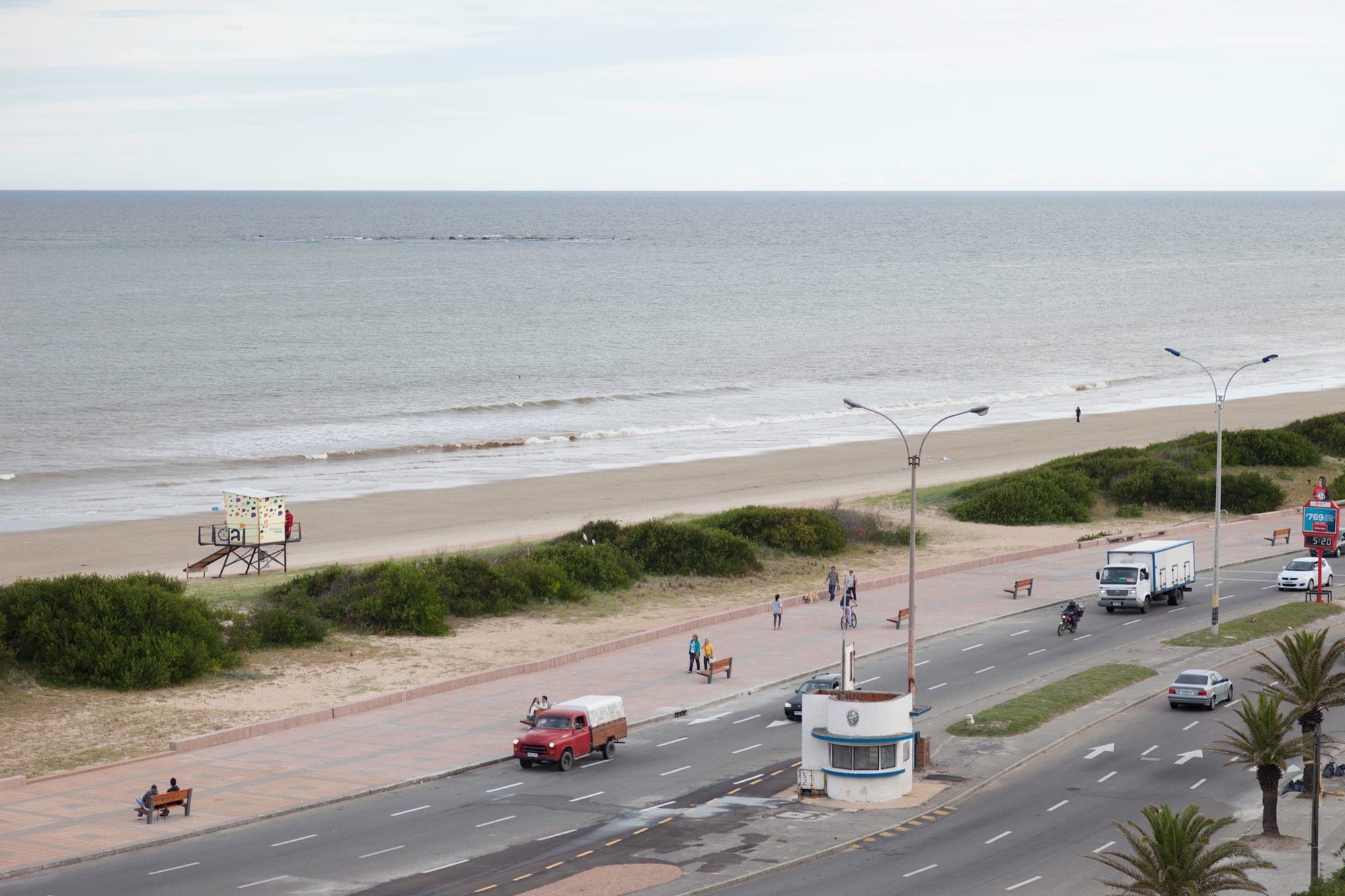
A wide sandy beach and grey water beside a seafront promenade and coastal road, with a lifeguard hut and dunes

Uruguay

Montevideo & Colonia

The rambla and beach at Carrasco, on Montevideo's Río de la Plata shore. (Jimmy Baikovicius / Wikimedia Commons · CC BY-SA 2.0)

Uruguay's populous south-west, running along the Río de la Plata from the capital's suburbs through the market gardens and vineyards of Canelones and the dairy country of San José to the old river port of Colonia del Sacramento — home to well over half the country's people, its government, its wine and its Swiss and Waldensian farming colonies.

Explore Montevideo & Colonia

History

The lowlands along the Río de la Plata were the territory of Charrúa and Chaná bands until Europeans fought over the river mouth. Portugal planted Colonia del Sacramento in 1680 as a smuggling base facing Buenos Aires, and for nearly a century the town changed hands between Portugal and Spain through sieges and treaties before the Treaty of San Ildefonso in 1777 left it Spanish. Spain answered the Portuguese threat by founding Montevideo in the 1720s under Bruno Mauricio de Zabala, settling it with families from Buenos Aires and the Canary Islands and walling it into a naval fortress.

British troops stormed Montevideo in 1807 and held it for several months, printing the city's first newspaper before withdrawing. In 1811 Artigas won his first major victory over the Spanish at Las Piedras, now a Canelones city, and during the Guerra Grande Montevideo held out through the siege of 1843–51, defended by Colorados, French and Italian volunteers — Giuseppe Garibaldi among them — and earning the name "New Troy".

From the late 19th century Italian and Spanish immigrants made Montevideo a port city of meat-packing plants and wool warehouses, while Swiss families founded Nueva Helvecia in 1862 and Waldensians from Piedmont settled Colonia Valdense a few years earlier. In the 1960s the Tupamaro urban guerrillas operated mainly in the capital; the army had defeated them by 1972, and on 27 June 1973 President Bordaberry dissolved parliament with military backing, answered by a general strike of about two weeks. Under the dictatorship that followed, thousands of political prisoners passed through the Penal de Libertad in San José department, and Montevideo became the centre of the opposition that brought democracy back in 1985.

Culture & Customs

Montevideo is where Uruguay's urban culture was made. Candombe, the drumming tradition of the descendants of enslaved Africans in the Barrio Sur and Palermo, is listed by UNESCO as intangible heritage, and its drum troupes practise on the streets on Sunday evenings. Carnival belongs to the murga, choirs in painted faces and costume who deliver satirical songs about the year's politics on neighbourhood stages and at the Teatro de Verano. Tango is shared with Buenos Aires, and "La Cumparsita", perhaps the best-known tango, was written by a Montevideo student, Gerardo Matos Rodríguez, in 1916.

Memory is public here. Every 20 May a silent march walks down Avenida 18 de Julio carrying photographs of those who disappeared under the dictatorship, and the Museo de la Memoria in the Prado documents the period. The Rural del Prado show each September brings the country's cattle breeders into the capital.

Further west the culture is more rural and more mixed. Nueva Helvecia keeps Swiss festivals, chalet-style buildings and shooting clubs, and Colonia Valdense has Waldensian Protestant churches — unusual in a country of Catholic origin. Colonia department faces Buenos Aires across the river, and its towns feel closer to Argentina than anywhere else in the country, with Argentine weekenders and many shared family ties.

Daily Life

Montevideo department has about 1.3 million people and Canelones more than half a million, many of them in commuter towns such as Ciudad de la Costa, Las Piedras and Pando that have grown into the capital. San José and Colonia have well over 100,000 each; Colonia del Sacramento, San José de Mayo, Carmelo and Juan Lacaze are their main towns.

The capital runs the country's government, banking, port, universities and technology firms, while Canelones is its larder, with market gardens, poultry, fruit orchards and vineyards on small family plots. San José and Colonia are dairy country, sending milk to the big cooperative plants, and Colonia also has tourism, a free-trade zone and the port traffic to Buenos Aires.

Days start late and run late: mate in the car or on the bus, lunch around one, dinner at nine or ten. Summer weekends mean the Rambla, the beaches of the Costa de Oro and family barbecues. Current worries include crime and drug gangs in Montevideo's periphery, the cost of housing, and the capital's water supply after the drought of 2023 left brackish water in the taps.

Food

The Mercado del Puerto in Montevideo is the showcase of the parrilla, but everyday eating in the capital is Italian at root: fresh pasta on Sundays, sorrentinos and ravioles with tuco (tomato sauce), and pizza by the slice with fainá. Bakeries sell bizcochos, small sweet and savoury pastries eaten with mate, and the Martín Fierro dessert — a slice of cheese with quince paste — ends many meals. Tortas fritas, fried dough, are the rainy-day snack.

Canelones supplies the capital with vegetables and fruit, and its vineyards around Juanicó, Progreso, Las Piedras and Canelón Chico produce much of Uruguay's wine. Tannat is the flagship red, often blended with Merlot or Cabernet, and Albariño is the white that has drawn most attention. Many wineries are still run by the families of Italian, Basque and Spanish immigrants who founded them.

In Colonia department the Swiss and Waldensian colonies make hard cheeses of Swiss type, including the one sold across Uruguay simply as queso Colonia, and farm shops sell butter, dulce de leche and cured meats. The coast adds fried fish.

Attractions & Natural Wonders

Montevideo's Ciudad Vieja has the Ciudadela gate, Plaza Independencia with Artigas's mausoleum beneath his statue, the Teatro Solís opera house of 1856 and the Mercado del Puerto. Beyond it lie the Palacio Legislativo, the Estadio Centenario built for the 1930 World Cup, the Prado's parks and villas, the Sunday flea market on Tristán Narvaja, and, across the bay, the Cerro with its hilltop fortress. The Rambla follows the Río de la Plata coast for more than 20 kilometres, from Ciudad Vieja past Pocitos to the beach suburb of Carrasco.

Colonia del Sacramento's historic quarter, a UNESCO World Heritage Site, has the Calle de los Suspiros, the lighthouse beside the ruined San Francisco convent, the Basílica del Santísimo Sacramento and small museums in Portuguese and Spanish houses. North of the town, Real de San Carlos has a brick bullring from 1910, used for only a few years before bullfighting was banned. Further up the river are Carmelo, founded by Artigas, and the Calera de las Huérfanas, the ruins of a Jesuit lime works and estancia.

Canelones' wineries welcome visitors for tastings and lunches around Juanicó, Progreso and Las Piedras. On its Costa de Oro, resort towns such as Atlántida and La Floresta line the shore, and Eladio Dieste's brick church at Estación Atlántida is a UNESCO World Heritage Site. San José has the cliffs and beach of Kiyú, and inland Colonia the Swiss town of Nueva Helvecia and Colonia Valdense.

Cities in Montevideo & Colonia

Planning basics

Budget

This is the most expensive part of Uruguay after the eastern resorts. Montevideo's hotels and restaurants are priced close to southern Europe, and Colonia del Sacramento charges a premium for its historic quarter, especially at weekends when visitors cross from Buenos Aires. The Canelones and San José countryside, Carmelo and the Swiss colonies are noticeably cheaper, and wineries charge separately for tastings and lunches.

Daily Budget Midrange
USD 120–240 (mid-range hotel, restaurant dinners, a winery visit, a hire car for a day or two)
Daily Budget Shoestring
USD 50–80 (hostel bed, market and parrilla lunches, city and intercity buses)

Visit Colonia on a weekday, when rooms are cheaper and the lanes quieter, and book winery lunches ahead.

Safety

Colonia, Carmelo, the Swiss colonies and the Canelones countryside are very safe. Montevideo has most of the country's crime: pickpocketing and bag snatching in Ciudad Vieja and on Avenida 18 de Julio, theft from cars, and violent crime linked to drug gangs in some outer neighbourhoods well away from visitor areas. Traffic on the coastal highways is fast.

Take a taxi or app car after dark in Ciudad Vieja and around the port, keep phones out of sight on the Rambla, and leave nothing in parked cars. Check current official travel advice before travelling.

Climate

Humid and temperate, with the river keeping the coast milder than the interior. Summers are warm with sea breezes, winters cool, grey and windy, and the pampero from the south-west can drop temperatures sharply in a few hours. Rain falls in every month, and fog sometimes closes the river crossing to Buenos Aires in winter.

Summer
warm, 26–30°C by day, humid, cooled by breezes off the river
Winter
cool and damp, 6–15°C, with strong winds and occasional frost inland

Transportation

Montevideo is the national hub: Carrasco airport lies just over the Canelones line, and the Tres Cruces terminal sends buses to every town. Colonia is about two and a half hours west by bus and an hour or so from Buenos Aires by fast ferry; ferries also link Montevideo with Buenos Aires. Buses run often along the Canelones coast and to San José, but the wineries and the Swiss colonies are easiest with a car or a tour.

Buy ferry tickets ahead for Friday and Sunday crossings; in Colonia's historic quarter walking or a hired bicycle or golf cart is simplest.

Best Time to Visit

October to April suits the whole region. The grape harvest in Canelones runs from February into March, Carnival fills Montevideo's stages and streets from late January to early March, and the Prado agricultural show is held in September. Montevideo empties in the second half of January as residents head east, while Colonia is busiest at weekends and on Argentine holidays. Winter is quiet but fine for museums and theatres.