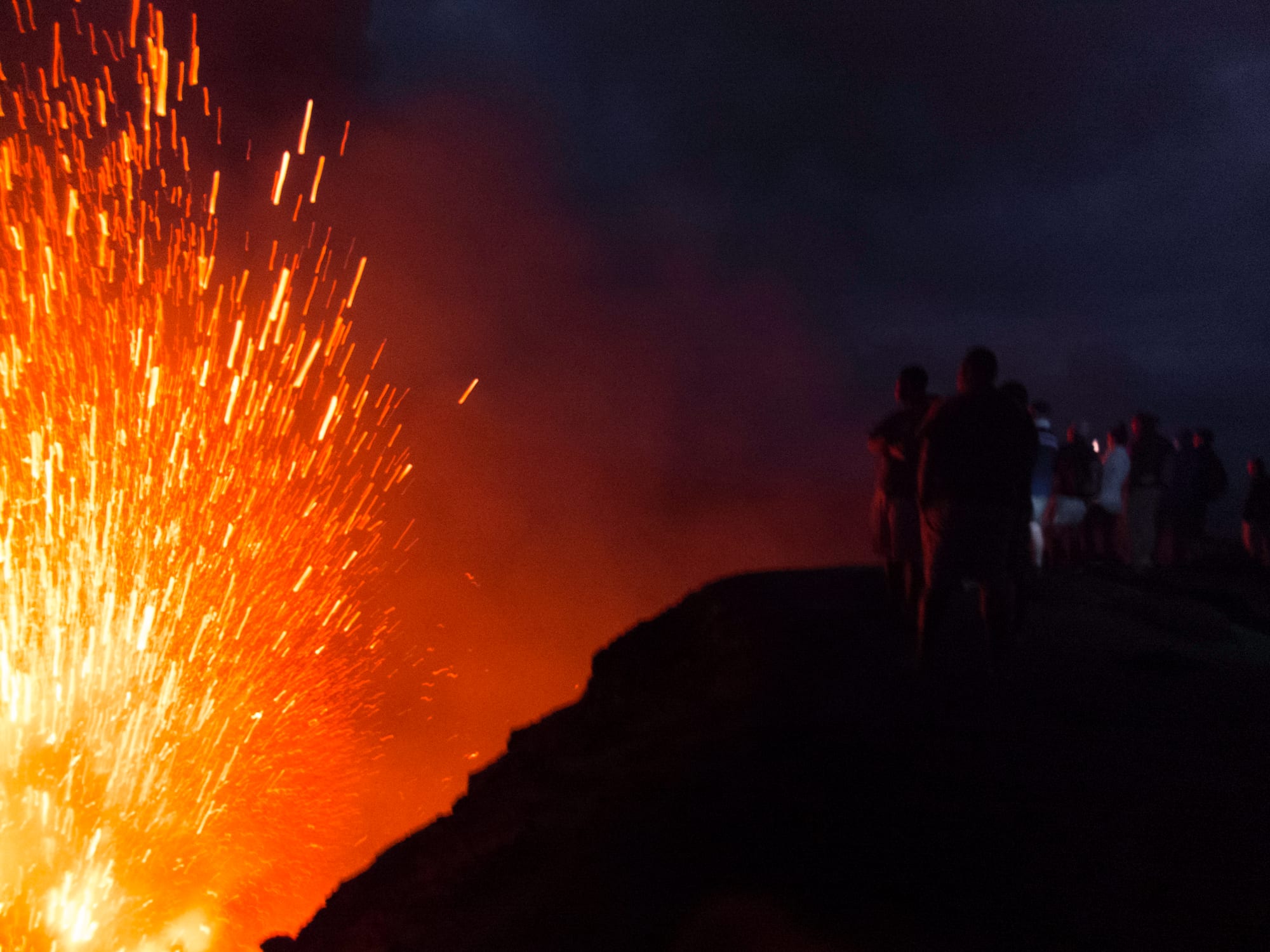
A fountain of orange lava bursting from a dark crater at night, with onlookers standing in silhouette on the rim

Vanuatu

Tanna

An eruption at the crater of Mount Yasur on Tanna, seen from the rim at night. (Vincent Albanese from Rooty Hill, Australia / Wikimedia Commons · CC BY 2.0)

An island in southern Vanuatu, dominated by Mount Yasur, an active volcano whose crater rim can be reached by road and on foot. Around it lie an ash plain, coffee and kava gardens and villages where customary law, dress and ceremony remain strong, with the small town of Lenakel on the west coast.

Neighbourhoods

  • Lenakel and the west coast
    • First-time visitors
    • Shops and services
    • Market

    The island's largest town and its main port of entry, with the provincial capital of Isangel beside it and the road north to the airstrip. It is small and low-built, and most services on Tanna exist only here.

    Open in Maps
  • White Grass
    • Resorts
    • Coast walks
    • Close to the airport

    The coast about 8 km north of Lenakel, where the airstrip and much of the island's tourist accommodation stand on a raised, scrubby shoreline. Sunsets over the sea and easy transfers are the attraction rather than a swimming beach.

    Open in Maps
  • Sulphur Bay and the volcano side
    • Volcano trips
    • Custom life

    The east of the island below Yasur, where the ash plain meets the sea and villages live with the volcano's noise and grit. Sulphur Bay is the centre of the John Frum movement, and the village claims the volcano as part of its territory.

    Open in Maps
  • Port Resolution
    • Beaches
    • Yachts
    • Quiet

    The inlet on the south-eastern tip of the island where James Cook anchored in August 1774 and which he named after his ship, now a sheltered anchorage used by yachts, with bungalows run by local families.

    Open in Maps
  • The highlands and Middle Bush
    • Custom villages
    • Gardens and coffee

    The interior ridges, cooler and wetter, with gardens of yam, taro and kava, coffee plantings and villages that keep customary dress and ceremony. Roads are rough tracks and visits are usually arranged through a guide or a lodge.

    Open in Maps

Things to do

Mount Yasur and the ash plain

  • Mount Yasurlandmark

    One of the world's most accessible active volcanoes, about 360 metres high, with a road and a short walk to a crater rim where explosions of lava can be seen at close range when the alert level allows.

    Open in Maps
  • The ash plainviewpoint

    The grey desert of ash and sand between the volcano and the coast, crossed by four-wheel-drive tracks. Siwi Lake lay here until heavy rain burst it down the valley into Sulphur Bay in April 2000, destroying the village without loss of life.

    Open in Maps

Villages and custom life

  • Yakel kastom villageneighborhood

    A village in the south of the island whose people keep customary dress, houses and ceremony, and which receives visitors by arrangement; its people made up the cast of the 2015 film Tanna.

    Open in Maps
  • Sulphur Bayneighborhood

    The coastal village below the volcano that is the main centre of the John Frum movement, which arose on Tanna no later than the late 1930s.

    Open in Maps
  • Yaohnanenneighborhood

    A village in the south of the island, with Yakel the home of the Prince Philip movement, whose followers believed the Duke of Edinburgh to be the son of a mountain spirit of local legend.

    Open in Maps

Coast and the south

  • Port Resolutionattraction

    The inlet where Cook's Resolution anchored in August 1774, drawn to the island by the glow of the volcano, now a quiet anchorage on the south-eastern tip.

    Open in Maps
  • Green Pointbeach

    The beach where, in the account told on the island, John Frum first appeared as a spirit at night and told the people to return to kastom.

    Open in Maps
  • Mount Tukosmeraviewpoint

    The taller, long-extinct volcano south-west of Yasur, associated in custom belief with the god Keraperamun and rising above the island's central highlands.

    Open in Maps

Seasonal events

  • John Frum DayFebruary

    Followers hold a Tanna Army parade at Sulphur Bay every 15 February, the date on which they believe John Frum will return, with marching and dancing.

  • Independence Daylate July

    Vanuatu's national day on 30 July is marked in Lenakel with parades, sport, string bands and custom dance groups.

  • Dry-season volcano visitsMay to October

    The drier months make the ash-plain tracks easier and the crater viewing more reliable, and most visitors come in this half of the year.

Eat and drink

Long-standing places and food districts in Tanna. Hours, ratings and directions come from your maps app, always current.

Tanna classics

  • Island food in Lenakelmarket

    Laplap baked in leaves, island cabbage, rice, fish and root crops are the everyday food of the island's largest town, sold alongside the fruit, peanuts and kava root brought down from the highlands.

    Open in Maps
  • Village feasts and lodge kitchensrestaurant

    Bungalows and lodges cook island food for guests, often the stone-oven laplap and fish or chicken that villages serve at ceremonies, since the island has few standalone restaurants.

    Open in Maps

Kava and coffee

  • Nakamalsneighborhood

    Kava is one of the island's main crops, and the nakamal is where men gather at dusk to drink it freshly pounded, in near silence; village rules on who may attend vary.

    Open in Maps
  • Tanna coffeecafe

    Coffee is one of the island's cash crops, grown in the highlands, and plantings can be seen along the inland roads.

    Open in Maps

Experience Tanna

History

Tanna has been settled for around three thousand years, and its communities developed a dense system of custom authority, based on named titles, dancing grounds, exchange of pigs and kava, and networks of paths linking villages across the island. Europeans arrived in 1774, when James Cook anchored in the bay he named Port Resolution, described the glow of the volcano, and recorded the island's name from tana, the word for 'earth' in the Kwamera language.

Sandalwood traders, labour recruiters taking men to Queensland and Fiji, and Presbyterian missionaries followed in the 19th century, though the missionaries were repeatedly chased off the island between the 1840s and the 1860s. That pressure shaped the island's best-known modern movement: from the late 1930s, followers of John Frum rejected mission control and colonial authority and revived custom practice, and the movement gained further force during the Second World War when American forces and their material wealth appeared in the New Hebrides. It remains active at Sulphur Bay, with 15 February as its day.

Tanna was a stronghold of custom politics around independence in 1980, and the island has kept a distinctive place in national life since. Cyclone Pam in March 2015 devastated the island, destroying houses, crops and infrastructure; five of the eleven deaths recorded in Vanuatu at the time were on Tanna. Tourism centred on Yasur has grown steadily, along with coffee and kava as cash crops, and the island's film Tanna, made in 2015 with a cast from the Yakel villagers, was nominated for the Academy Award for Best Foreign Language Film.

Culture & Customs

Kastom is not a heritage display on Tanna but the working framework of village life. Chiefs and title-holders control land and ceremony, disputes are settled at the nakamal, and the exchange of pigs, mats, yams and kava marks marriages, deaths and the resolution of quarrels. Ceremonies bring allied villages together on the dancing grounds for nights of dancing and exchange.

Kava is central to life on the island. The root is grown, prepared and drunk according to custom, the nakamal is a men's gathering place in most villages, and the rules on who may enter and drink vary from place to place. Custom dress — grass skirts for women, the namba for men — is still worn daily in a number of highland villages, whose people also grow the island's yams and kava and receive visitors under agreed terms.

Alongside this runs Christianity, mainly Presbyterian, and the movements that grew in opposition to mission rule: the John Frum movement at Sulphur Bay and the Prince Philip movement around Yaohnanen and Yakel, whose adherents believe in the divinity of Prince Philip, Duke of Edinburgh, and mourned his death in 2021. Music is string band and gospel; football and school sport fill the afternoons; and Bislama links speakers of the island's five languages.

Daily Life

About 30,000 people live on Tanna, making it one of the most populous islands in Vanuatu, and nearly all of them in villages rather than towns. Lenakel, the largest town and the island's port of entry, holds most of its shops and services, with the provincial offices next door at Isangel, so people travel in from across the island for supplies, medicine and shipping, often by truck along tracks that deteriorate in the wet season.

The economy is based on gardens. Households grow yam, taro, manioc, island cabbage and bananas for themselves and kava, coffee, coconuts and vegetables for sale, kava and coffee being the main cash crops. Fishing supplements the diet on both coasts. Tourism around the volcano provides work as drivers, guides, cooks and hosts, and money from relatives working in Port Vila or on seasonal schemes in Australia and New Zealand supports many families.

The day runs from first light in the gardens to the nakamal at dusk, with school, church and market in between. Electricity is limited outside Lenakel and the lodges, water comes from springs and tanks, and mobile coverage is patchy. The persistent concerns are cyclone recovery, road conditions, the cost and reliability of flights, access to health care and secondary schooling, and the balance between custom authority and the demands of a growing cash economy.

Food

Tanna's cooking is island food with volcanic soil behind it. Laplap, the national dish, is made from grated yam, taro or breadfruit mixed with coconut cream, wrapped in banana leaves and baked in a stone oven, sometimes with chicken, beef or fish laid inside. Yams matter beyond nutrition: they are grown for ceremony and exchange as much as for eating. Island cabbage, the leaf of a shrub cooked like spinach, accompanies almost everything.

Cooking is done on open fires and in the stone oven. Pigs, chickens and, more rarely, cattle are killed for ceremonies rather than everyday meals; reef fish and pelagic catch come from both coasts. Fruit is plentiful in season — pawpaw, mango, banana, citrus, pineapple and breadfruit — and peanuts and highland vegetables come down from the interior.

Two drinks define the island. Kava, pounded fresh from the root and drunk in the nakamal at dusk, is drunk in near silence and grown across the island as a cash crop. Coffee from the highlands is roasted and sold around Vanuatu under the island's name. Imported rice, flour and tinned fish fill out the everyday diet, as they do throughout the country.

Planning tools

Budget

Tanna is cheap to eat on and expensive to move around. Village bungalows and guesthouses cost little; the coastal lodges cost far more. The dominant items are the flight from Port Vila, four-wheel-drive transfers over rough tracks, the volcano access fee charged by the landowning community, and guides for village visits, all of which are paid in cash.

Daily Budget Midrange
USD 150–320 (lodge or resort, meals included, the volcano trip with a driver and guide, domestic flights)
Daily Budget Shoestring
USD 55–100 (village bungalow or guesthouse, market meals, shared transport)

Bring enough vatu in cash for the whole stay, since almost nothing on the island takes cards.

Best Time to Visit

May to October is drier and easier: tracks to the volcano and the villages are passable, seas are calmer and rain is less likely to spoil a crater visit. November to April is hot, wet and prone to cyclones, especially from January to March, when roads turn to mud. Volcanic activity varies at any time of year.

Suggested Number of Days

Two or three days are enough for the volcano and one or two other parts of the island. Four or five allow the east coast, the highlands and slower travel over rough roads, plus a margin for weather, volcanic alert levels and changes to flights.

First Visit
2–3 days
With Surroundings
4–5 days

Transportation

There is no public transport worth the name. Four-wheel-drive trucks and minibuses run between Lenakel, the airstrip and nearby villages, and most visitors travel with a driver arranged by their accommodation. The road across the island to the volcano and the east coast is rough and slow, and journeys of 30 km can take well over an hour.

Arrange vehicles and guides in advance through a lodge or village host, and allow much more time than distances suggest, especially after rain.

Airport & Station Connections

Whitegrass Airport, 8 km north of Lenakel, takes domestic flights from Port Vila, with occasional services to other southern islands. Cargo and passenger ships call at Lenakel from the capital on an irregular schedule, and yachts anchor at Port Resolution. Flights are small and are often rescheduled.

Walkability

Lenakel can be walked in a few minutes, and coast paths near White Grass and Port Resolution are pleasant on foot. Everything else is far apart on steep, dusty or muddy tracks with no footpaths, so walking is not a practical way to get about the island; village visits themselves involve short walks.

Safety

Crime is rare and villages are hospitable. The hazards are the volcano and the terrain: Yasur erupts several times an hour and throws out rock and ash, and access is governed by an alert level from 0 to 5, set by the Vanuatu Geo-Hazards Observatory, which notes that an eruption may occur at any level. Mosquito-borne illness is a risk, cyclones strike in the wet season — Cyclone Pam devastated the island in March 2015 — and roads are rough. Medical facilities on the island are very limited.

Visit the crater only with a licensed guide, obey the posted alert level and stay on the marked viewing area, take medical advice on malaria precautions before travelling, follow cyclone warnings, and carry insurance that covers medical evacuation. Check current official travel advice before travelling.

Climate

Tropical but a little cooler than northern Vanuatu, with the highlands cooler and wetter again. The wet season from November to April brings heavy rain, humidity and cyclone risk; May to October is drier and breezier. Wind direction determines where the volcano's ash and fumes fall.

Summer
hot and humid — summer runs December to February in the southern hemisphere, with coastal days around 29 to 31°C and the heaviest rain
Winter
warm by day, cool at night — June to August days are typically around 24 to 26°C on the coast, with nights near 17 to 19°C and cooler air inland

Local Customs

Custom law is strong on Tanna, and land, reefs, the volcano and the paths to it belong to communities that charge fees and set conditions for access. Several villages keep customary dress and ceremony and receive visitors by arrangement only. The John Frum movement and the Prince Philip movement, both rooted on the island, are living beliefs held by real communities. Sunday is a church day in Christian villages, and kava is drunk quietly at dusk in the nakamal.

Always ask before photographing people, villages or ceremonies and expect to pay an agreed fee, use a local guide for village and volcano visits, dress modestly away from resorts, and treat local religious movements with the same respect as any other faith.

Common Payment Methods

The currency is the vatu (VUV). Card acceptance is limited to a couple of lodges; everything else, including the volcano fee, transport, guides and village bungalows, is cash. Cash machines cannot be relied on, so money is best drawn in Port Vila before flying.