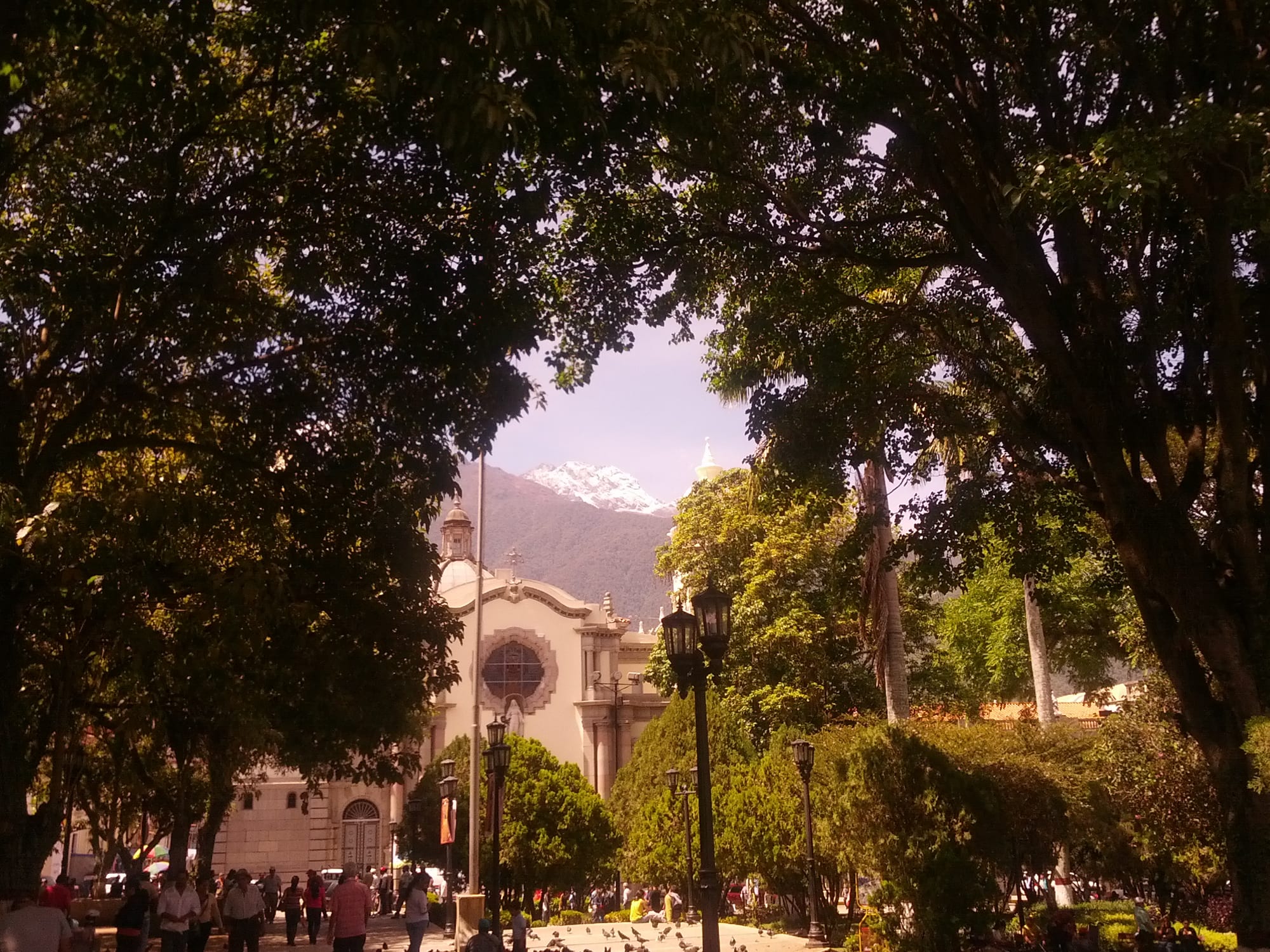
Trees framing the pale cathedral facade on Plaza Bolívar in Mérida, with a snow-capped peak above

Mérida & the Andes, Venezuela

Mérida

Pico Bolívar seen from Plaza Bolívar in Mérida, above the cathedral. (Jarrypalomino / Wikimedia Commons · CC BY-SA 3.0)

An Andean city on a long terrace above the Chama river, founded in 1558 and facing Pico Bolívar, Venezuela's highest mountain. The University of the Andes gives it a student population and a lively, bookish tone, and the cable car to Pico Espejo made it the country's base for mountain trips before the crisis. This page is written to explain the city, not to encourage travel.

Neighbourhoods

  • The historic centre
    • First-time visitors
    • Historic district
    • Museums

    The grid around Plaza Bolívar, the cathedral and the Archbishop's Palace is the main commercial and cultural area, with most of the city's museums, libraries, churches and shops.

    Open in Maps
  • Plaza Las Heroínas
    • Close to the cable car
    • Budget stays
    • Nightlife

    The square at the base station of the cable car, ringed by markets, craft shops and small bars, with the city's cluster of backpacker guesthouses in the streets around it.

    Open in Maps
  • Milla
    • Quiet and residential
    • Parks

    The area north-east of the centre around Plaza Milla and the Milla church, with a few guesthouses and, further north, the small zoo at Los Chorros de Milla.

    Open in Maps
  • Ejido
    • Local life
    • Quiet and residential

    A separate, fast-growing city that has grown almost to meet Mérida, joined to it by a long avenue and a busy bus route.

    Open in Maps

Things to do

Landmarks and the centre

  • Mérida Cable Carviewpoint

    Opened in 1960 and rebuilt as the Mukumbarí, with new service from October 2016, it climbs from 1,577 metres in the city to Pico Espejo at 4,765 metres — the highest and second longest cable car in the world.

    Open in Maps
  • Cathedral of Méridalandmark

    The Metropolitan Cathedral on Plaza Bolívar, built from 1805 and altered until 1960, with stained glass and religious art, beside the Archbishop's Palace and Archdiocesan Museum.

    Open in Maps
  • University of the Andeslandmark

    Venezuela's second-oldest university, whose faculties and students are spread through the city and shape its everyday life.

    Open in Maps
  • Plaza Las Heroínaslandmark

    The square at the foot of the cable car, surrounded by markets and craft shops.

    Open in Maps

Parks

  • Beethoven Parkpark

    A park in the north of the city, opposite the Museum of Modern Art, known for a flower-clock and a mechanical carillon with wooden elves that played melodies, though the park has fallen into neglect and both clocks are out of order.

    Open in Maps
  • Parque La Islapark

    A 3.5-hectare park on the site of a former coffee plantation, built in 1960, with orchid gardens and the city's largest convention centre.

    Open in Maps
  • Los Chorros de Milla Zoopark

    A small zoo in the far north of the city, where the Milla waterfalls once flowed, keeping animals native to Venezuela and the Andes.

    Open in Maps

Markets

  • Mercado Principalmarket

    The main market, known for folk art and crafts, regional food and produce, with stalls of fresh fruit and vegetables.

    Open in Maps

Mountains and short trips

  • Sierra Nevada National Parkpark

    Created in 1952 to protect the Sierra Nevada de Mérida, the park holds the tallest peaks of the Venezuelan Andes and rises directly behind the city.

    Open in Maps
  • Pico Bolívarviewpoint

    Venezuela's highest mountain, at 4,978 metres, visible from the city and climbable only on foot from the top of the cable car at Pico Espejo.

    Open in Maps
  • Sierra La Culata National Parkpark

    The national park facing the Sierra Nevada across the valley, a high páramo of frailejones, mosses and shrubs, declared in 1989.

    Open in Maps
  • Los Alerosattraction

    A theme park created in 1984 that recreates a typical Andean town of the 1930s, near Tabay north-east of the city.

    Open in Maps
  • Jajíattraction

    A restored colonial village of whitewashed houses and a church on a square, in the hills west of Mérida.

    Open in Maps
  • Laguna de Mucubajípark

    A glacial lake at about 3,600 metres in the Sierra Nevada National Park, listed as a wetland of international importance in 2007.

    Open in Maps

Seasonal events

  • Fiesta de San Benito12–31 January

    Processions of drummers and street dancing in honour of St Benedict.

  • Feria del SolFebruary, with Carnival

    The city's international fair, also called the Bullfighting Carnival of America, with bullfights, concerts, parades, exhibitions and the election of the Queen of the Sun.

  • Vasallos de la Candelaria2 February

    Dances honouring the Virgin of Candelaria, with children taking part and dancing in the streets.

  • Paradura del NiñoJanuary to early February

    Families 'stand up' the infant Jesus in the Christmas crib with prayers, songs, fireworks, wine and cake.

Eat and drink

Long-standing places and food districts in Mérida. Hours, ratings and directions come from your maps app, always current.

Mérida classics

  • Heladería Coromotocafe

    An ice-cream parlour with 860 flavours on its books, a former world record, of which around 60 to 75 are on sale each day — from avocado, its first hit, to garlic and chilli.

    Open in Maps
  • Mercado Principalmarket

    The main market sells regional food, produce and groceries alongside its folk art and crafts.

    Open in Maps

Food districts

  • Around Plaza Las Heroínasneighborhood

    Cafés, simple restaurants and bars around the cable-car square, serving trout dishes, fresh fruit drinks and coffee.

    Open in Maps

Experience Mérida

History

Captain Juan Rodríguez Suárez founded Mérida on 9 October 1558, during a mining expedition from Pamplona in New Granada, and named it after his home town of Mérida in Extremadura. The foundation had not been authorised, and in 1560 the authorities of New Granada sent Juan de Maldonado to arrest him and regularise the new city. For much of the colonial era Mérida was governed from Bogotá rather than Caracas, before becoming part of the Captaincy General of Venezuela.

A seminary founded in 1785 grew into the University of the Andes, and the city played an active part in the War of Independence; Bolívar marched through it on his Admirable Campaign in 1813. One of its oldest churches, from the 18th century, had to be rebuilt in 1907 after an earthquake, and the present cathedral was built over a century and a half, from 1805 until 1960.

The 20th century opened Mérida to the rest of the country. An airport was inaugurated on the city's outskirts in 1946, the cable car to Pico Espejo opened to the public in 1960, and with these and the trans-Andean highway, tourism and services displaced farming as the economic base. The population tripled after 1971, and the university made Mérida one of the country's leading educational centres. Commercial flights at the city airport, by then surrounded by housing, were suspended from 2008 to 2013 after a crash, and the original cable car shut in 2008 for a reconstruction that ended in 2016.

Culture & Customs

The University of the Andes sets the city's tone. Students make up a large share of the population, and bookshops, cheap cafés, research centres and an outdoorsy, politically active campus life give Mérida a character unlike any other Venezuelan city. Its mountain setting also draws people to a variety of extreme sports.

Catholic custom runs deeper here than on the coast. The Paradura del Niño, in which families stand up the infant Jesus in the crib with songs, prayers, fireworks, wine and cake, runs from January into early February; the Fiesta de San Benito, from 12 to 31 January, brings drummers' processions and street dancing; and on 2 February the Vasallos de la Candelaria dance for the Virgin. Holy Week brings a living passion play, and the old year is burned in effigy at New Year.

The Feria del Sol, held in February alongside Carnival, is the city's great fair, known as the Bullfighting Carnival of America, with bullfights in the 16,000-seat bullring built in 1967, concerts, parades and the election of a festival queen. Mérida is proud of its many parks and squares — at least a dozen squares and two dozen parks.

Daily Life

The 2011 census counted about 200,000 people in the city and about 390,000 in the metropolitan area, which takes in Ejido, Tabay and neighbouring municipalities. The city is squeezed onto a long, sloping terrace between rivers, so it has grown lengthwise: its south-eastern part, once the land of sugar-cane haciendas, has filled with family houses and grown almost to meet Ejido.

The economy rests on the university, government, commerce and, historically, tourism, which fell sharply during the crisis. The surrounding mountains supply potatoes, vegetables and farmed trout to the whole country, and busetas carry thousands of people between Ejido and the centre each day.

Mornings start cool and early, with students crossing the city to classes, and the evenings are sharp enough for a jacket. Like the rest of the Andean states, Mérida has lived through long power cuts and fuel queues, and many young people have emigrated, often overland into Colombia.

Food

The Andean breakfast is the pisca andina, a broth of potatoes, egg, spring onion and coriander, served with the arepa de trigo, a small, dense wheat-flour arepa quite different from the maize arepa of the rest of Venezuela. Pastelitos, fried pastries filled with spiced meat, are another everyday snack. Trout farmed in the cold mountain streams is the local fish, cooked in many ways in cafés across the city.

Andean cheeses include fresh white cheese and smoked queso ahumado, and Mérida is known for its sweets, above all the dulces abrillantados, sugar-glazed figures of milk fudge in bright colours. The Mercado Principal sells regional food, produce and folk art.

Heladería Coromoto became famous for the sheer number of its ice-cream flavours — 860 at one count — after its founder found that avocado, launched as a novelty, was a hit; garlic and chilli followed. Fresh fruit juices and strong coffee are drunk everywhere, and miche, the Andean spirit, is taken against the cold.

Planning tools

Budget

Before the crisis Mérida was Venezuela's backpacker base, with guesthouses and tour agencies around Plaza Las Heroínas. It is cheaper than Caracas, and posadas charge modest rates in US dollars, but fuel shortages in the Andean states drive up the cost of any road transport, and cash machines rarely work for foreign cards.

Daily Budget Midrange
USD 80–180 (better posada or hotel, a private driver and guide, the cable car)
Daily Budget Shoestring
USD 30–60 (simple posada near Las Heroínas, market meals and trout, shared jeeps where running)

Bring all the US dollars needed in small notes.

Best Time to Visit

December to March brings the clearest mountain views and the best walking; rain falls mainly from April to November, when cloud often hides the peaks. January and February are the city's festival season, with the Feria del Sol and the Paradura del Niño. Security and fuel supplies matter more than the weather.

Suggested Number of Days

Two to three days suit the city itself. With the mountains, the páramo villages and the national parks, a week is more realistic; altitude needs gradual acclimatisation, and slow, landslide-prone roads add time.

First Visit
2–3 days
With Surroundings
5–7 days

Transportation

Busetas, small buses, run across the city and to Ejido and Tabay, and jeeps serve mountain villages. The long, narrow terrace means most journeys run along a few main avenues. Fuel shortages make all road transport unreliable.

Use a trusted driver for trips out of the city, travel only in daylight and confirm fuel before any drive.

Airport & Station Connections

Mérida's own Alberto Carnevalli Airport, in the middle of the city, has had long closures and few flights, so most people arrive by road or via Juan Pablo Pérez Alfonzo Airport at El Vigía, in the lowlands an hour or more away by road. Long-distance buses use a terminal a few kilometres from the centre. Most international arrivals come through Maiquetía near Caracas, damaged by the earthquakes of June 2026 and reopened at about half capacity in August 2026.

Walkability

The centre is a compact grid, and Plaza Bolívar, Plaza Las Heroínas and the main market are within walking distance of each other, though streets climb and drop across the terrace. Ejido and Tabay need a bus or car.

Safety

Crime in the Andean towns is lower than in Caracas, but the region's border with Colombia is dangerous, road checkpoints are frequent and fuel shortages are severe. Altitude sickness is a real risk on the cable car, which climbs to over 4,700 metres, and on the peaks.

Most governments advise against all or all-but-essential travel. Anyone who does go should avoid the Colombian border areas, climb the high peaks only with an established guide, ascend gradually, and avoid all demonstrations. Check current official travel advice before travelling.

Climate

At about 1,600 metres, Mérida is cooler than most Venezuelan cities, with an average around 22°C and little change through the year. Days usually reach about 24°C and nights can be more than 10°C colder. The páramo and peaks above the city are cold, with frost and occasional snow.

Summer
the wet season, roughly April to November: daytime highs around 24°C, frequent afternoon rain and cloud on the peaks
Winter
the dry season, December to March: clear mornings, daytime highs around 24°C and cool nights, sometimes below freezing in the páramo

Local Customs

Andinos are seen as more reserved and formal than other Venezuelans, and Catholic custom runs deep: the Paradura del Niño and saints' days are family events. Restaurant bills may include a service charge; where they do not, a tip of around 10 per cent is customary.

Dress modestly in churches, bring warm layers for the evenings and the mountains, and never photograph police, soldiers or checkpoints.

Common Payment Methods

The currency is the bolívar, but prices are in practice set and paid in US dollars. Cash machines rarely work for foreign cards, so visitors need enough small, clean US dollar notes for the whole stay.