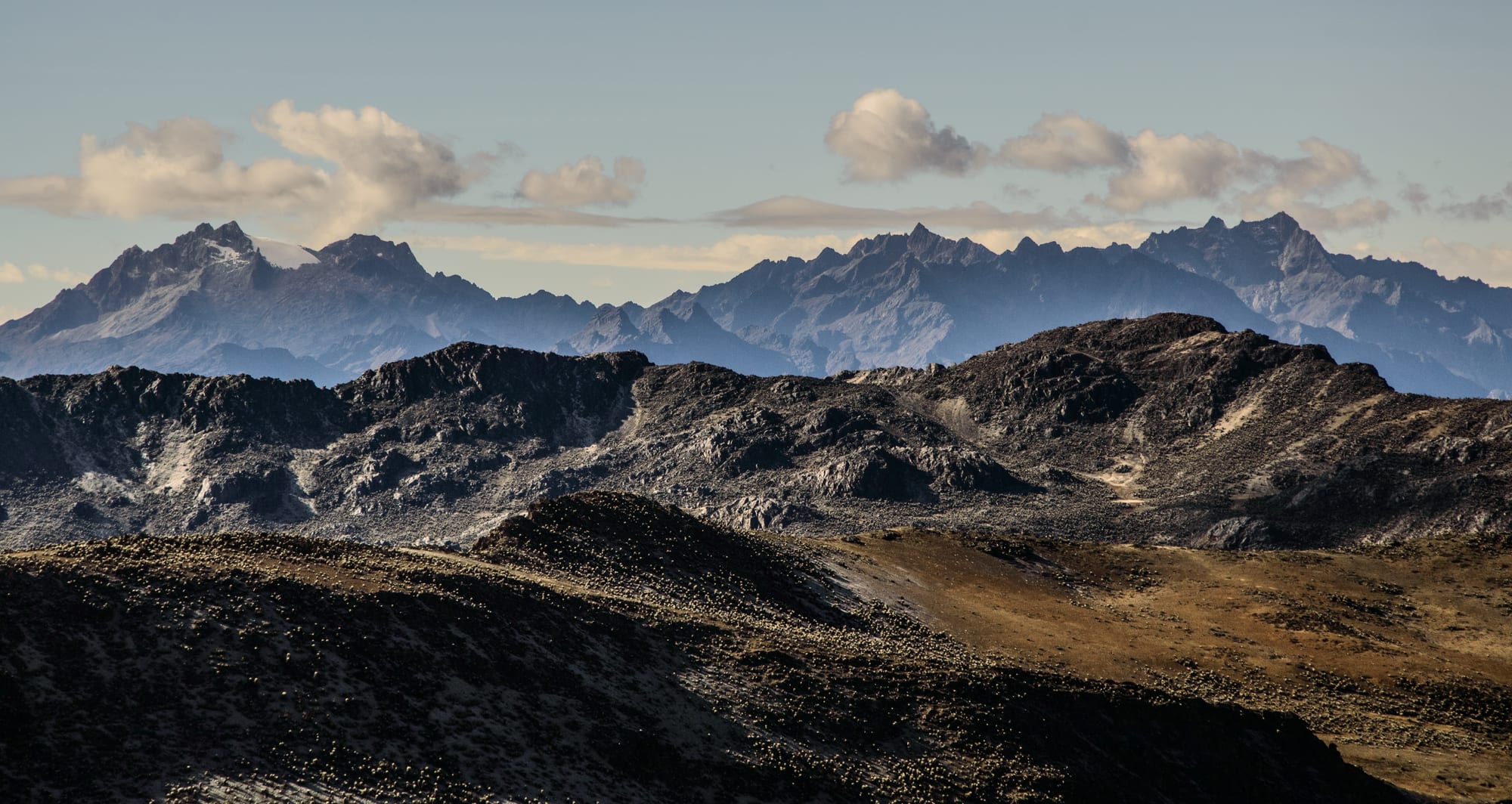
Jagged grey peaks of the Sierra Nevada de Mérida under white clouds, seen across dark rocky páramo ridges

Venezuela

Mérida & the Andes

The high peaks of the Sierra Nevada de Mérida, seen from the Sierra de la Culata National Park. (Adolfo / Wikimedia Commons · CC BY-SA 4.0)

Venezuela's Andean west, where the last spur of the Andes rises above 4,900 metres in the Sierra Nevada de Mérida and falls to the Colombian border at Táchira, the coffee hills of Trujillo and the edge of the Barinas plains — a region of university towns, páramo villages and devout mountain farmers. This page is written to explain the region, not to encourage travel.

Explore Mérida & the Andes

History

The Andean valleys were home to the Timoto-Cuica peoples, farmers who terraced and irrigated the slopes. Spanish captains came over the mountains from New Granada, and Mérida was founded in 1558 and San Cristóbal in 1561. For much of the colonial era the Andes were governed from Bogotá rather than Caracas, and a seminary founded in Mérida in 1785 became the University of the Andes in 1810.

Independence came fiercely here. In 1813 Bolívar crossed from New Granada on his Admirable Campaign, marched through Mérida and issued the decree of "war to the death" in the town of Trujillo. At Santa Ana de Trujillo in 1820 he met the Spanish commander Pablo Morillo to agree an armistice.

In the late 19th and early 20th centuries coffee made the Andes prosperous, and Táchira produced a line of presidents — Cipriano Castro, Juan Vicente Gómez, and later Marcos Pérez Jiménez among them — who ruled Venezuela for much of the half-century after 1899. Barinas, on the plains below, is the home state of Hugo Chávez, born in Sabaneta in 1954, and his family long held its governorship. San Cristóbal was a centre of the 2014 street protests, and the closures and reopenings of the Colombian border since then have shaped Táchira's economy.

Culture & Customs

Andinos are seen by other Venezuelans as reserved, formal and hard-working, and their Spanish is slower and more careful. Catholicism runs deeper here than on the coast. The best-known custom is the Paradura del Niño, when families "stand up" the figure of the infant Jesus in the Christmas crib, with prayers, songs and processions, from January into early February. Mérida honours the Virgin of Candelaria on 2 February with the dances of the Vasallos de la Candelaria.

Trujillo's most loved figure is José Gregorio Hernández, a doctor born in Isnotú in 1864 who treated the poor of Caracas and died in 1919; he was declared a saint of the Catholic Church in 2025, and his image is everywhere in Venezuelan homes. The páramo has its own crafts and its own breed of dog, the Mucuchíes, a national symbol.

Mérida is a student city, and the University of the Andes still sets its tone: bookshops, cheap cafés, mountain sports and a politically active campus. The Feria del Sol, held in early February, brings concerts and bullfights.

Daily Life

Mérida has a few hundred thousand people in its metropolitan area, and San Cristóbal is the other large Andean city. Barinas is the main city of the plains' edge, and Valera and Trujillo are the centres of Trujillo state. In the páramo, villages like Mucuchíes and Apartaderos are small farming communities.

The mountains grow potatoes, carrots, garlic and other vegetables for the whole country on steep terraced fields, along with coffee lower down; trout are farmed in the cold streams, and Barinas raises cattle and pumps oil. Tourism, once a big earner around Mérida, fell sharply during the crisis. In Táchira, life is tied to the border: when it is open, people cross daily to Cúcuta in Colombia to shop, work and study.

The Andean states have suffered some of the country's longest power cuts and fuel queues, which has pushed many young people to emigrate, often overland into Colombia. Days begin early and cold in the mountains, with work in the fields at dawn and villages quiet after dark.

Food

The Andean breakfast is the pisca andina, a broth of potatoes, egg, spring onion and coriander, eaten with the arepa de trigo, a small, dense wheat-flour arepa unlike the maize arepa of the rest of the country. Farmed trout is the regional fish, cooked in many ways, and pastelitos, fried pastries, come filled with spiced meat.

Andean cheeses include fresh white cheese and smoked queso ahumado, and the region is famous for sweets: Mérida's dulces abrillantados, sugar-glazed figures of milk fudge sold in bright colours, and the stalls of the Mercado Principal. Mérida's Heladería Coromoto became known for offering hundreds of ice-cream flavours, some made with unusual ingredients such as avocado. The traditional drink is miche, the Andean spirit, taken against the cold. On the Barinas plains the food turns llanero, with carne en vara, beef roasted on stakes over an open fire.

Attractions & Natural Wonders

Mérida lies on a terrace above the Chama river with the Sierra Nevada rising behind it. The Mukumbarí cable car, rebuilt and reopened in 2016 on the line of the 1960 original, climbs in stages from the city to Pico Espejo at about 4,700 metres, the base for climbs of Pico Bolívar, Venezuela's highest mountain, and Pico Humboldt, whose glacier was the country's last. The Sierra Nevada National Park covers these peaks, and the Sierra de la Culata National Park faces them across the valley.

The trans-Andean road climbs north-east from Mérida through the páramo villages — Tabay, Mucurubá, Mucuchíes, San Rafael de Mucuchíes with its stone chapel, and Apartaderos — to Laguna de Mucubají and the pass at Pico El Águila, over 4,000 metres, among fields of frailejón. Los Nevados, a village reached by rough track, and Jají, a restored colonial village west of Mérida, are the other classic excursions.

In Trujillo, the monument to the Virgen de la Paz stands on a hill above the town, and Isnotú draws pilgrims to José Gregorio Hernández's birthplace; Boconó is a garden town in the coffee hills. San Cristóbal, Táchira's capital, is a busy commercial city of hills and parks. East of the mountains, the road drops to Barinas and the edge of the plains, where the Santo Domingo river runs down from the páramo into cattle country.

Cities in Mérida & the Andes

Planning basics

Budget

Before the crisis the Andes were Venezuela's backpacker base, with posadas and tour agencies in Mérida. The region is cheaper than Caracas, and mountain posadas charge modest rates in US dollars, but fuel shortages hit the Andean states especially hard, driving up the cost of any road transport, and cash machines rarely work for foreign cards.

Daily Budget Midrange
USD 80–180 (better posada or hotel, a private driver and guide, the cable car)
Daily Budget Shoestring
USD 30–60 (simple posada in Mérida, local food, shared jeeps where running)

Bring all the US dollars needed in small notes, and budget for a private driver since fuel shortages make buses unreliable.

Safety

The Andean towns have lower crime than Caracas, but the Táchira border with Colombia is dangerous: armed groups, smugglers and irregular crossings operate there, and the area around San Antonio del Táchira and Ureña is tense. Road checkpoints are frequent, and altitude sickness is a real risk on the cable car and the peaks.

Most governments advise against all or all-but-essential travel. Anyone who does go should avoid the Colombian border areas entirely, climb the high peaks only with an established guide, and ascend gradually. Check current official travel advice before travelling.

Climate

Climate here depends on altitude. Mérida at about 1,600 metres is mild year-round, San Cristóbal is similar, and the lowlands of Barinas are hot. Above about 3,000 metres the páramo is cold and windy, with night frost, and the high peaks carry snow at times. Rain falls mainly from April to November.

Summer
the wet season, roughly April to November: Mérida around 15–25°C with frequent afternoon rain; cloud on the peaks
Winter
the dry season, December to March: clear mornings and cold nights in the páramo, sometimes below freezing

Transportation

Mérida's airport has had long closures and few flights, so most people arrive by road or via El Vigía's airport in the lowlands, about an hour or more away. San Cristóbal is linked to Santo Domingo airport in Táchira. Mountain roads are steep, slow and prone to landslides in the rains, and fuel shortages have been severe in the Andean states.

Assume road journeys will take longer than planned, travel only in daylight, and confirm fuel availability before any drive.

Best Time to Visit

December to March brings the clearest mountain views and the best walking. Mérida's Feria del Sol falls in early February, and the Paradura del Niño Christmas custom runs into February. Security and fuel supplies matter more than the weather.