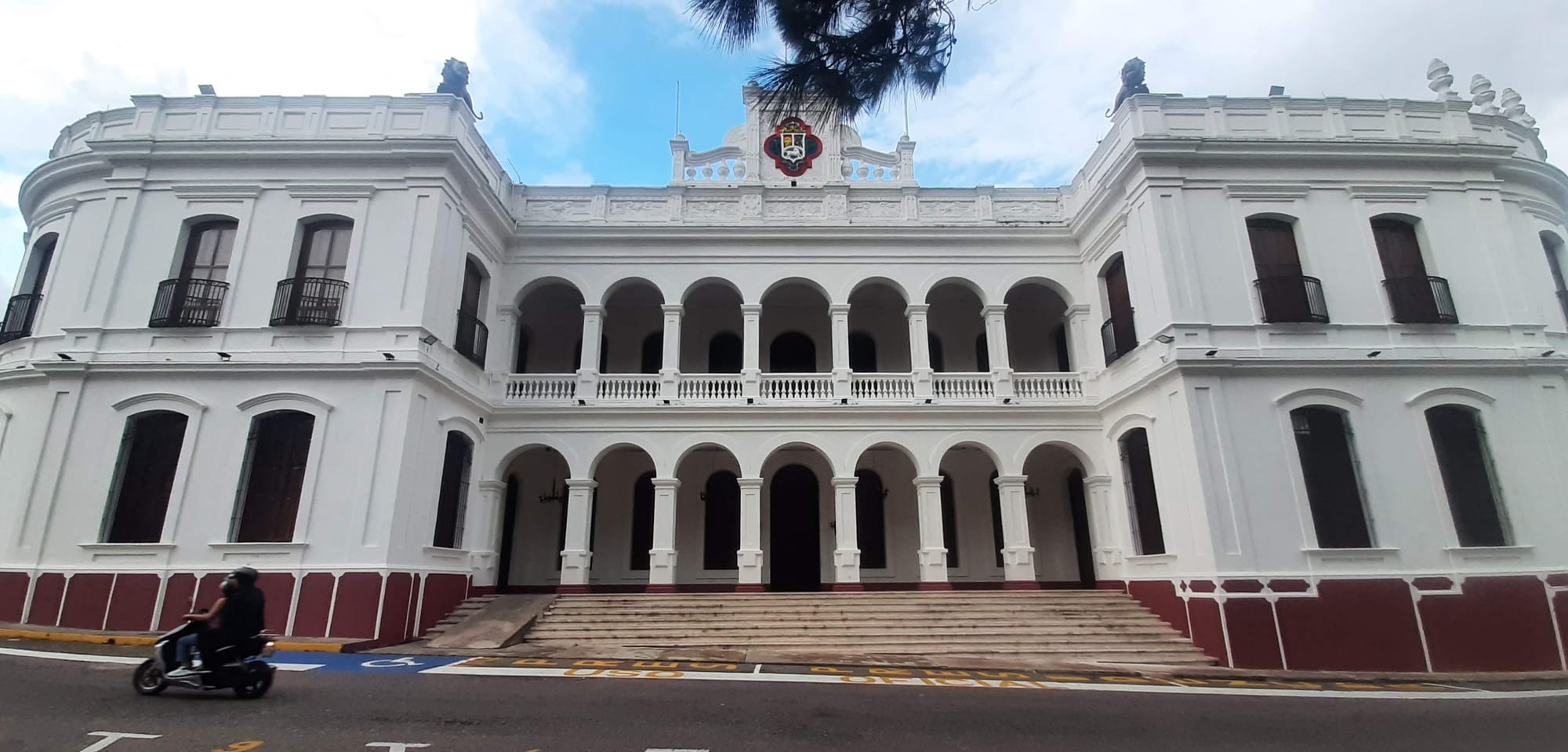
A white two-storey palace with arched colonnades, a central crest and red-painted base, beside a street

Mérida & the Andes, Venezuela

San Cristóbal

The Palacio de Los Leones in San Cristóbal, one of the city's landmark buildings. (Colmenares2000 / Wikimedia Commons · CC0)

The capital of Táchira, on hills above the Torbes river in the Andes about 56 km from the Colombian border. Founded in 1561, it grew rich on coffee and cross-border trade and is known for its January San Sebastián fair and its football. Its economy has risen and fallen with the opening and closing of the border. This page is written to explain the city, not to encourage travel.

Neighbourhoods

  • The centre
    • First-time visitors
    • Historic district
    • Shopping

    The historic and commercial core, cut north to south by the Fifth and Seventh avenues, with Plaza Bolívar, the cathedral and Episcopal Palace, the Palacio de Los Leones and the Centro Cívico office towers.

    Open in Maps
  • Barrio Obrero
    • Nightlife
    • Best for food

    The district with the city's largest concentration of discos, bars and nightspots, and many of its restaurants serving international food.

    Open in Maps
  • Pueblo Nuevo
    • Sport
    • Festivals

    The northern district that grew up around the fairground, with the football stadium, the bullring and the exhibition pavilions of the San Sebastián fair.

    Open in Maps
  • Santa Teresa and Las Lomas
    • Quiet and residential
    • Street food

    Residential districts in the north-west, on the road towards Táriba, with street stalls in Santa Teresa selling morcillas.

    Open in Maps
  • La Concordia
    • Local life
    • Transport

    A district in the south of the city, home to the main bus terminal.

    Open in Maps

Things to do

Landmarks

  • Palacio de Los Leoneslandmark

    The seat of Táchira's state government and legislative council, built between 1925 and 1931 and facing Plaza Sucre.

    Open in Maps
  • San Cristóbal Cathedrallandmark

    The cathedral, first built in 1621 and rebuilt after the earthquakes of 1644 and 1875, with the neocolonial Episcopal Palace beside it; the patron saint's serenade is sung in its atrium.

    Open in Maps
  • Plaza Bolívarlandmark

    The main square, on Seventh Avenue in the centre.

    Open in Maps
  • Casa Steinvorthlandmark

    A 19th-century house built as a headquarters of the coffee trade, later reconstructed.

    Open in Maps

Museums

  • Museo del Táchiramuseum

    The state's main museum, with archaeological and anthropological collections, opened in 1984 in the old Hacienda Paramillo.

    Open in Maps
  • Museo de Artes Visuales y del Espaciomuseum

    A visual-arts museum, known as MAVET, in a listed heritage house.

    Open in Maps

Sport, fairs and parks

  • Estadio Polideportivo de Pueblo Nuevoattraction

    The home of Deportivo Táchira, known as 'the sacred temple of football' in Venezuela, where the national team has had some of its best results.

    Open in Maps
  • Complejo Ferialattraction

    The fairground of Pueblo Nuevo, with the Colombia and Venezuela exhibition pavilions, where most of the San Sebastián fair takes place; the Plaza Monumental bullring is also in Pueblo Nuevo.

    Open in Maps
  • Parque Metropolitanopark

    A city park on Avenida 19 de Abril.

    Open in Maps

Short trips from the city

  • Chorro El Indio National Parkpark

    A national park of páramos east of the city, declared in 1989, with the waterfalls of Chorro El Indio and Chorro El Franklin.

    Open in Maps
  • Táribaattraction

    A neighbouring town founded in 1602, known for the Basilica of Our Lady of the Consolation.

    Open in Maps
  • Rubioattraction

    A coffee town founded in 1794, about 40 minutes' drive away, known as the 'City of Bridges' for the many bridges of its old quarter.

    Open in Maps

Seasonal events

  • Feast of San Sebastián20 January

    The patron saint's day, marked by a mass with visiting bishops and a serenade in the atrium of the cathedral.

  • Feria Internacional de San Sebastiánsecond half of January

    The city's great fair, held in honour of its patron, with events at the fairground, bullfights in the Plaza Monumental and commercial, industrial and livestock exhibitions.

Eat and drink

Long-standing places and food districts in San Cristóbal. Hours, ratings and directions come from your maps app, always current.

San Cristóbal classics

  • Morcilla stalls of Avenida Carabobo and Santa Teresaneighborhood

    Street stalls and cauldrons selling morcillas, blood sausages, a favourite of the city's street food.

    Open in Maps
  • Restaurants of Barrio Obreroneighborhood

    The city's main eating-out district, with restaurants of many cuisines among its bars.

    Open in Maps

Experience San Cristóbal

History

The valley of San Cristóbal was home to indigenous peoples, among them the Táribas to the north. Juan de Maldonado founded the city on 31 March 1561, and the foundation is seen as the first assertion of territorial sovereignty along the natural frontier with New Granada, today Colombia. From the start, rich soil and the closeness of the border made it one of the region's most important centres of trade.

On 18 May 1875 the Cúcuta earthquake, also called the Andes earthquake, severely damaged the city. In the same year the first oil wells in Venezuela were dug by hand in Táchira, at La Petrolea near Rubio. In the late 19th century San Cristóbal became a major centre of the cacao and coffee trade, attracting European immigrants, and in the 1950s a new wave of foreign immigration arrived, drawn by its climate and its freedom from malaria.

Táchira produced a line of presidents who ruled Venezuela for much of the half-century after 1899, among them Cipriano Castro and Juan Vicente Gómez. San Cristóbal was a centre of the 2014 street protests. The closure of the border crossing to vehicles in 2015, shortages of food and fuel, and the total closure of the border in 2019 hit the city's trade hard; the border reopened in October 2021, and vehicle traffic resumed in September 2022, followed by a brief modernisation of the city's infrastructure and services.

Culture & Customs

San Cristóbal's great celebration is the Feria Internacional de San Sebastián, held in the second half of January in honour of the city's patron, whose day, 20 January, is marked with a mass and a serenade in the cathedral's atrium. The fair fills the fairground at Pueblo Nuevo with exhibitions, concerts and bullfights in the Plaza Monumental.

Unlike most of Venezuela, where baseball rules, this is a football city. Deportivo Táchira, founded in 1974, has made more Copa Libertadores appearances than any other Venezuelan club, and plays at the Pueblo Nuevo stadium, known as the sacred temple of Venezuelan football. Its rivalry with Caracas FC is the Clásico Moderno.

Students are a large part of the population, spread across the experimental university UNET, branches of the University of the Andes, the Catholic University of Táchira and many institutes; UNET opened a music degree in 2006. The people of Táchira are described as hard-working, cordial and conservative, devoted to religious and folk traditions, and Barrio Obrero's discos and bars are the centre of the city's night life.

Daily Life

San Cristóbal had about 406,000 people and its metropolitan area about 767,000 according to census figures for 2023, making it the largest city of the Andean region. Neighbouring municipalities such as Cárdenas, with Táriba, and Torbes serve largely as commuter towns.

The economy has long rested on agriculture — coffee, sugar and vegetables — on manufacturing of textiles, leather goods and shoes, and on dairy: Pasteurizadora Táchira is the country's second-largest cheese producer. Commerce built on the border was the other pillar. Colombians, especially from Cúcuta, once came in large numbers; the border closures hit the city's trade hard, and now the flow runs the other way: when the border is open, people from Táchira cross daily to Cúcuta to shop, work and study.

The Andean states have suffered some of the country's longest power cuts and fuel queues, and many young people have left, often overland into Colombia. The centre is busiest by day along the Fifth and Seventh avenues, and the evenings bring people out to Barrio Obrero and to football at Pueblo Nuevo.

Food

San Cristóbal's cooking mixes Andean dishes with those brought by Colombian, Italian, Spanish, Portuguese and other immigrants. The Andean base includes the pisca andina, a breakfast broth of potatoes, egg, spring onion and coriander, the dense wheat-flour arepa de trigo, and bollitos de maíz. Soups and stews include mute andino, a tripe soup also called mondongo, and callos con garbanzos, tripe with chickpeas, along with parrillas, mixed grills of meat.

The city is one of the easiest places in Venezuela to eat in the street, from improvised stalls and cauldrons. Morcillas, blood sausages, are sold along Avenida Carabobo and in Santa Teresa, and pastelitos andinos, fried pastries, come filled with meat and rice, with chicken, or with cheese and bocadillo, a guava paste.

Táchira is dairy and coffee country: local cheese comes from Pasteurizadora Táchira, the country's second-largest cheese producer, and coffee is one of the main crops of the surrounding hills.

Planning tools

Budget

San Cristóbal is cheaper than Caracas, and prices are set in US dollars in practice. Fuel shortages in the Andean states drive up the cost of road transport, and the city's border trade means that prices and the supply of goods change with every opening and closing of the crossing to Colombia.

Daily Budget Midrange
USD 80–180 (better hotel, restaurant meals, a private driver)
Daily Budget Shoestring
USD 30–60 (simple hotel, street food and pastelitos, local buses)

Bring all the US dollars needed in small notes, and budget for a private driver rather than buses for any journey out of the city.

Best Time to Visit

The weather is mild all year. The second half of January brings the Feria de San Sebastián, the city's busiest time; the dry months from December to March are best for the mountains. Security, fuel and the state of the border matter more than the season.

Suggested Number of Days

One or two days are enough for the city itself. Three or four allow for the national park and nearby towns; travel times on mountain roads and fuel shortages make every outing longer than the distance suggests.

First Visit
1–2 days
With Surroundings
3–4 days

Transportation

Two main north–south avenues, the Fifth and the Seventh, carry traffic through the centre, and ring avenues link the outer districts. Buses and taxis serve the city, and the main bus terminal is in La Concordia. Roads in the surrounding Andes are narrow and curving.

Use a trusted driver, travel only in daylight and confirm fuel before any drive outside the city.

Airport & Station Connections

Three airports serve Táchira: Juan Vicente Gómez International at San Antonio del Táchira, on the Colombian border; Mayor Buenaventura Vivas at Santo Domingo del Táchira, the closest; and La Fría. Flights are few and change often. By road the city is about 816 km from Caracas. Cúcuta in Colombia is about 57 km away via San Antonio del Táchira, on a border route that has been closed and reopened several times.

Walkability

The centre's grid and the Fifth and Seventh avenues can be covered on foot by day, but the city spreads across hills and ravines, and districts such as Pueblo Nuevo and Barrio Obrero need a taxi or bus.

Safety

The city has a reputation for lower crime than Caracas, but the Táchira border with Colombia is dangerous: armed groups, smugglers and irregular crossings operate there, and the area around San Antonio del Táchira and Ureña is tense. Road checkpoints are frequent and fuel shortages severe.

Most governments advise against all or all-but-essential travel. Anyone who does go should avoid the Colombian border areas entirely, stay off the roads after dark and avoid all demonstrations. Check current official travel advice before travelling.

Climate

At about 820 metres the city has a mild tropical highland climate, with an average temperature of about 20.5°C; days are typically around 26°C and nights around 16°C, and temperatures rarely pass 28°C. Rain falls mainly from April to November.

Summer
the wet season, roughly April to November: days around 26°C with frequent rain
Winter
the dry season, December to March: days around 26°C, nights around 16°C

Local Customs

Tachirenses are described as hard-working, cordial, conservative and devoted to their religious and folk traditions, and Catholic feasts are important. Football matters here more than in most of Venezuela. Restaurant bills may include a service charge; where they do not, a tip of around 10 per cent is customary.

Dress modestly in churches, and never photograph police, soldiers, checkpoints or border installations.

Common Payment Methods

The currency is the bolívar, but prices are in practice set and paid in US dollars. Cash machines rarely work for foreign cards, so visitors need enough small, clean US dollar notes for the whole stay.