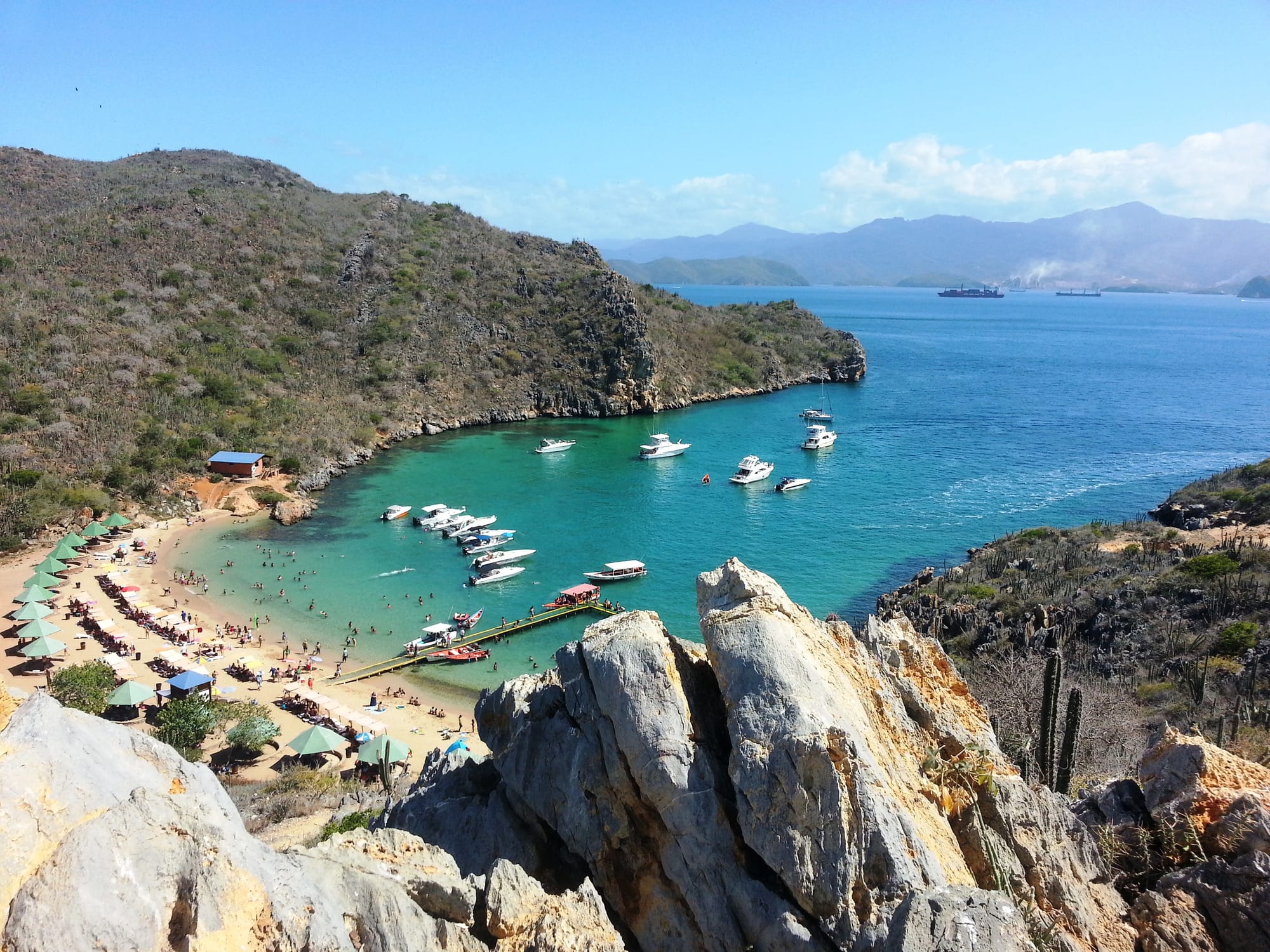
A turquoise cove with moored boats and a sandy beach below dry, cactus-covered hills and pale rocks

Venezuela

Margarita, Mochima & the Caribbean East

The cove at Isla El Faro, one of the islands of Mochima National Park. (Virginia Ortiz / Wikimedia Commons · CC BY-SA 3.0)

Venezuela's eastern Caribbean, from the coral atoll of Los Roques and the island of Margarita to the old pearl and salt coast of Sucre, the oil states of Anzoátegui and Monagas and the Orinoco delta facing Trinidad — the country's first Spanish foothold and its classic beach coast. This page is written to explain the region, not to encourage travel.

Explore Margarita, Mochima & the Caribbean East

History

This coast was Spain's first foothold on the South American mainland. On his third voyage in 1498 Columbus reached the Paria peninsula, and the pearl beds around Cubagua and Margarita soon drew Spanish settlers; Nueva Cádiz on Cubagua was one of the first European towns in South America, built on pearls harvested by enslaved divers and abandoned in the 1540s. Cumaná, first founded in 1515, is described as the oldest continuously inhabited Spanish-founded city in South America. The salt pans of the Araya peninsula were valuable enough that Spain built a great fortress there in the 17th century to keep out the Dutch.

Margarita resisted Spanish forces fiercely in the independence war, earning its state the name Nueva Esparta, "New Sparta". Antonio José de Sucre, Bolívar's most trusted general and the victor of Ayacucho, was born in Cumaná in 1795.

In the 20th century oil changed the mainland: fields around El Tigre and Maturín and the refineries and petrochemical complex near Barcelona and Puerto La Cruz made Anzoátegui and Monagas oil states, and the vast heavy-oil deposits of the Orinoco Belt lie to their south. Margarita was made a free port in the 1970s and became a shopping and beach destination for Venezuelans. Since the collapse of the 2010s, thousands of people have left from the Sucre coast for Trinidad by boat, and some crossings have ended in fatal shipwrecks.

Culture & Customs

Orientales, as eastern Venezuelans are called, have their own fast, clipped Spanish and a strong seafaring identity. Margarita's music includes the galerón and the malagueña, sung in improvised verses to cuatro and guitar, and its fishermen and pearl divers are part of island legend. The island's great devotion is to the Virgen del Valle, venerated across the east, whose feast on 8 September draws pilgrims to her basilica.

Carúpano's carnival is one of the most traditional in the country, with costumes, music and parades. Cumaná is proud of its poets, Andrés Eloy Blanco and José Antonio Ramos Sucre among them.

In the Orinoco delta the Warao, one of Venezuela's larger indigenous peoples, live largely by river and forest: their name is often translated as "canoe people", they build stilt houses above the channels, and they use the moriche palm for food, fibre and hammocks. Their language and ways of life remain strong, though the crisis has brought severe hardship to their communities.

Daily Life

Barcelona, Puerto La Cruz and Lechería form one of the country's larger urban areas, and Maturín is the capital of Monagas. Cumaná and Carúpano are the main towns of Sucre, Porlamar and La Asunción are the centres of Margarita, and Tucupita is the only real town of the delta. Los Roques has a small permanent population on Gran Roque.

Oil is the core of Anzoátegui and Monagas, fishing and tourism of the islands and the Sucre coast, and cacao, coconut and fishing of Paria. Margarita's economy, once built on duty-free shopping, now depends more on domestic tourism and remittances.

The crisis has been felt hard: fishing communities lost fuel for their boats, power and water cuts are common, and emigration to Trinidad and beyond has emptied some coastal villages. The rhythm of the coast still follows the sea — fishermen out before dawn, markets in the morning, beaches crowded at weekends and holidays.

Food

The east eats from the sea. Margarita's emblematic dish is the torta de cazón, a bake of young shark and plantain; the pastel de chucho is a layered bake of stingray, ripe plantain and cheese; and the consomé de chipichipi is a broth of tiny clams. Hervido de pescado, a fish soup with cassava, pumpkin and green plantain, and fried fish with tostones are the standard coastal meals, and the Los Roques posadas serve grilled fish and, in season, lobster.

Paria and the Sucre coast grow some of Venezuela's finest cacao, and Carúpano has shipped it abroad since colonial times; small producers make chocolate from their own beans. Coconut is everywhere, in drinks and sweets. In the delta, Warao cooking relies on fish and on starch from the moriche palm. The arepa and pabellón criollo are eaten across the region, and the east shares the national taste for Christmas hallacas.

Attractions & Natural Wonders

Los Roques, a national park in Venezuela's Federal Dependencies, is an archipelago of about 350 islands, cays and reefs around a great lagoon. Gran Roque, with its colourful posadas and sandy streets, is the only village, and boats take visitors to cays such as Francisquí and Madrisquí for snorkelling, diving and kitesurfing.

Margarita Island has the colonial capital La Asunción, the fortress of Pampatar, the basilica of the Virgen del Valle and the beaches of Playa El Agua and Parguito on its north-east coast. La Restinga National Park protects a mangrove lagoon, and the dry Macanao peninsula forms the island's wild western half. Coche and Cubagua lie to the south.

On the mainland, Mochima National Park covers dry islands and deep bays between Puerto La Cruz and Cumaná, with boats from the village of Mochima to its beaches. Cumaná has the castle of San Antonio de la Eminencia and its old quarter, and across the gulf the Araya fortress stands above pink salt pans. Further east, the Paria peninsula has the forested Paria National Park, the town of Río Caribe and beaches such as Playa Medina. In Monagas, the Cueva del Guácharo near Caripe shelters a colony of oilbirds, and to the south-east the Orinoco delta spreads into channels and mangroves, visited from lodges near Tucupita.

Cities in Margarita, Mochima & the Caribbean East

Planning basics

Budget

Costs vary sharply. Los Roques is the most expensive place in Venezuela, with flights, park fees and posada stays priced for foreign and wealthy Venezuelan visitors. Margarita, once a duty-free shopping island, has hotels at a wide range of prices in US dollars, while mainland posadas in Sucre and the delta are cheaper but need organised transport.

Daily Budget Midrange
USD 120–300 (Margarita beach hotel, or a Los Roques package with flights, posada and boat trips)
Daily Budget Shoestring
USD 40–70 (simple posada on Margarita or the Sucre coast, local food, boat taxis)

Book Los Roques as a package with flights and posada included, and bring enough US dollar cash for the whole stay on the islands.

Safety

Armed robbery is a risk in Puerto La Cruz, Barcelona, Maturín and Cumaná, and Margarita is not free of it. The Gulf of Paria and the waters towards Trinidad are used for smuggling and people-trafficking, and armed attacks on boats have occurred. Oil towns have high crime, and medical care away from the main cities is very limited.

Most governments advise against all or all-but-essential travel. Anyone who does go should avoid boat travel off Paria and the delta except with established operators, stay off the roads after dark, and keep to known beaches. Check current official travel advice before travelling.

Climate

The coast and islands are hot, dry and breezy, with semi-desert cactus scrub on Margarita, Araya and the Mochima islands and Los Roques rarely seeing rain. The Paria peninsula is wetter and green, and the Orinoco delta is hot, humid and flooded for much of the wet season.

Summer
May to November: hot, 27–33°C, with more rain in Paria and the delta; the islands remain mostly dry
Winter
December to April: sunny, windy and dry on the coast and islands, around 25–31°C

Transportation

Margarita's airport at Porlamar and Barcelona's airport have domestic flights, and ferries cross to Margarita from Puerto La Cruz and Cumaná in a few hours. Los Roques is reached by light aircraft. Boats serve the Mochima islands and the delta, where rivers are the roads. Fuel shortages and cancelled flights are common.

Use established ferry and air operators, allow spare days for cancellations, and arrange delta trips only through recognised lodges.

Best Time to Visit

The coast and islands can be visited all year, with steadier weather from December to April, though Christmas, Carnival and Holy Week fill Margarita and the beaches with Venezuelan holidaymakers. Carúpano's carnival and the Virgen del Valle's feast on 8 September are the big events. Security and flights matter more than the season.