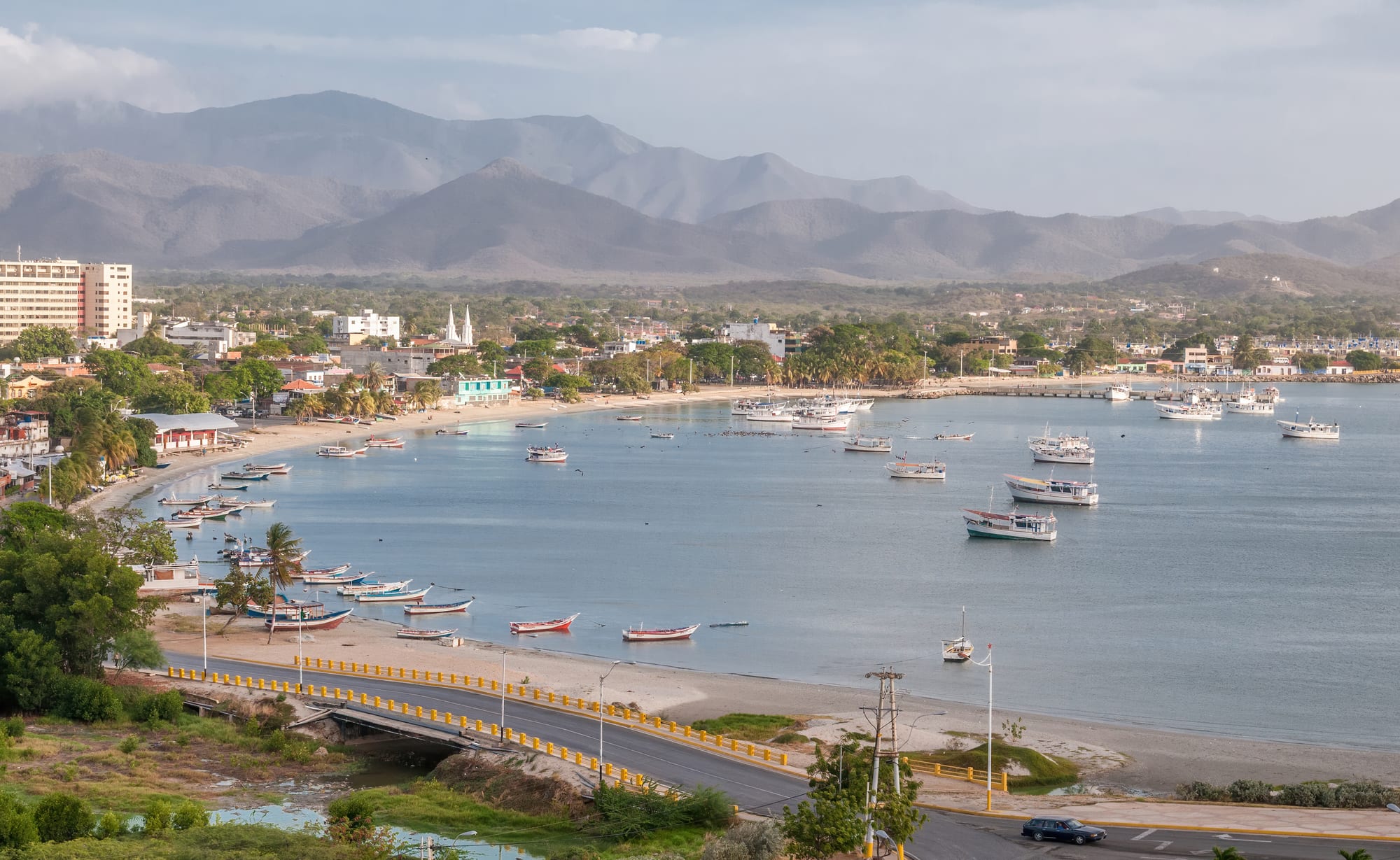
A curving bay with moored fishing boats, a sandy shore and low town buildings below a line of dry grey mountains

Margarita, Mochima & the Caribbean East, Venezuela

Margarita Island

The bay of Juan Griego on the north coast of Margarita, seen from the La Galera fort. (Wilfredor / Wikimedia Commons · CC0)

The largest island of Nueva Esparta state, in the Caribbean off Venezuela's north-east coast — a pearl island in Spanish times, the first territory to stay free in the independence war, and from the 1970s a duty-free port and beach resort for Venezuelans. Its tourism has shrunk sharply since 2010. This page is written to explain the city, not to encourage travel.

Neighbourhoods

  • Porlamar
    • Shopping
    • Close to the airport
    • Local life

    The island's largest city, main port and commercial centre, on the south coast, with two town beaches and most of the services. It is busy and commercial rather than pretty, and the main airport lies a short drive to the west.

    Open in Maps
  • Pampatar
    • Historic district
    • Beaches
    • Shopping

    An old coastal town north-east of Porlamar, founded in 1552, with the fortress of San Carlos de Borromeo on its waterfront, a church whose bell tower has an outside staircase, several beaches and some of the island's larger shopping malls.

    Open in Maps
  • La Asunción
    • Historic district
    • Quiet and residential

    The small state capital, in a green inland valley with a cooler climate than the coast, overlooked by the hilltop castle of Santa Rosa. It is the seat of the regional government and has the island's cathedral.

    Open in Maps
  • Juan Griego
    • Sunsets
    • Local life

    A port town on the north coast, the most northerly port in Venezuela, around a bay of fishing boats. Its church of 1850 and the La Galera fort on the headland above the bay are the town's symbols.

    Open in Maps
  • Playa El Agua
    • Beaches
    • First-time visitors

    One of the island's best-known beach resorts, on the north-east coast: about four kilometres of golden sand lined with palms, backed by a boulevard of restaurants and shops and used by islanders and visitors alike.

    Open in Maps
  • Macanao Peninsula
    • Quiet and rural
    • Nature

    The dry, mountainous western half of the island, joined to the east by a long sandbar, with fishing villages along its coast and far fewer visitors than the developed east.

    Open in Maps

Things to do

Forts and churches

  • Santa Rosa de la Eminencia castlelandmark

    A 17th-century Spanish castle on a hill above La Asunción, built after a French pirate raid, where the independence heroine Luisa Cáceres de Arismendi was held prisoner in 1815–16.

    Open in Maps
  • San Carlos de Borromeo Fortressmuseum

    A colonial fortress on the bay of Pampatar, completed in 1684 against the pirates who raided the island, restored and now a museum.

    Open in Maps
  • Fortín de La Galeraviewpoint

    A small fort on the headland above Juan Griego, the site of a fierce independence battle in the early 1820s and now a lookout over the bay.

    Open in Maps
  • Basilica of Our Lady of El Vallelandmark

    A Gothic Revival basilica in El Valle del Espíritu Santo, home of the Virgen del Valle, patron of eastern Venezuela and of the Venezuelan Navy.

    Open in Maps

Beaches

  • Playa El Aguabeach

    A long palm-backed strand on the north-east coast with a beachfront boulevard, one of the most popular on the island.

    Open in Maps
  • Playa El Yaquebeach

    One of the island's popular beaches, among the roughly 70 along its coastline.

    Open in Maps
  • Playa Parguitobeach

    One of the island's popular beaches, named alongside Playa El Agua.

    Open in Maps

Parks and nature

  • Cerro El Copey National Parkpark

    The island's highest mountains, protected since 1974, where cloud from the trade winds feeds green forest above the desert plains and the island's only permanent water sources.

    Open in Maps
  • Laguna de la Restingapark

    A national park around a large salt lagoon and mangrove channels on the isthmus between the island's two halves, listed as a wetland of international importance and rich in birdlife.

    Open in Maps

Seasonal events

  • Feast of the Virgen del ValleSeptember

    The great feast of eastern Venezuela's patron, when pilgrims from Margarita, Coche and Cubagua and from the mainland come to her basilica.

  • Carnival and Holy WeekFebruary to April

    Holiday seasons when Venezuelans from the mainland fill the island's hotels and beaches.

Eat and drink

Long-standing places and food districts in Margarita Island. Hours, ratings and directions come from your maps app, always current.

Margarita classics

  • Playa El Agua beach restaurantsneighborhood

    The restaurants set under the palms along the beach and its boulevard, serving fried fish and the island's seafood to diners on the sand.

    Open in Maps
  • Porlamarneighborhood

    The island's largest city and commercial centre, with the widest range of places to eat, from arepa counters to seafood restaurants.

    Open in Maps
  • Juan Griegoneighborhood

    The fishing port on the north coast, whose bay is known for its sunsets.

    Open in Maps

Experience Margarita Island

History

The Guaiquerí people lived on the island when Christopher Columbus sighted it in 1498. The pearl beds along its coasts made it valuable at once — pearls came to make up almost a third of all the tribute that the Americas sent to the Spanish Crown — and it became the centre of the province of Margarita, created in 1525. Its wealth drew attackers. In 1561 the rebel conquistador Lope de Aguirre seized the island and killed its governor, and after a French raid in the 1670s the governor ordered the castle of Santa Rosa built above La Asunción; Pampatar's fort was completed in 1684.

In the independence war the island turned against Spain early. It freed itself in 1814 and became the first territory of Venezuela to remain free, despite Pablo Morillo's landing with a large fleet in 1815; Luisa Cáceres de Arismendi, wife of the patriot leader Juan Bautista Arismendi, was held for months in the Santa Rosa castle. In 1816 Bolívar was confirmed as commander-in-chief on the island before his campaigns on the mainland, and the battle of Matasiete on 31 July 1817 is counted the most important of the island's fights. Their resistance gave the state its name, Nueva Esparta, "New Sparta".

In 1974 the island became a duty-free port, and cheap imports brought shoppers, hotels and malls; for decades Margarita was the holiday island of Venezuela, and it hosted baseball's Caribbean Series in 2010 and 2014. The national crisis reversed the boom: tourism fell by about 90 per cent between 2010 and 2020, the state took over the main ferry company in 2011, and the island has lost people to emigration.

Culture & Customs

Margarita's identity is that of a seafaring island: pearl divers and fishermen fill its legends, and its music includes the galerón and the malagueña, sung in improvised verses to cuatro and guitar. Islanders take pride in the independence story told in their state's name, and they draw a clear line between themselves and the navegaos, the mainlanders who have settled here.

Faith centres on the Virgen del Valle, patron of eastern Venezuela and of the navy, whose basilica in El Valle del Espíritu Santo draws pilgrims from Margarita, Coche, Cubagua and the mainland for her feast in September. Catholicism is the main religion, with growing evangelical churches and small Jewish and Muslim communities. The island also has descendants of enslaved West Africans and immigrant families from Lebanon, Syria, Spain, Italy and elsewhere.

Its place in Venezuelan life is as the country's beach and shopping escape: for decades families from Caracas, Maracaibo, Valencia and Barquisimeto came for Christmas, Carnival and Holy Week, filling hotels and beaches. Bolas criollas, the Venezuelan game of bowls, is widely played, and baseball is followed as on the mainland.

Daily Life

Well over 400,000 people live on Margarita, a number that swells in the holiday seasons, though emigration has reduced it in recent years. Most live in the developed east. Porlamar, the largest city, has about 85,000 people in the low season and up to about 125,000 in the high season; Pampatar has about 50,000, and La Asunción, the state capital, about 28,500.

Tourism has long been the main industry, built on the free port, and its collapse after 2010 hit the island hard. Fishing remains important, with catches of snapper, kingfish, mullet, dogfish, sardines, lobster, shrimp and clams. The island has also been described as a centre of organised crime and money laundering, and armed robbery affects residents as well as visitors.

Life follows the coast and the calendar: fishermen go out early, the malls and markets of Porlamar fill in the day, and the beaches crowd at weekends and in holiday seasons, when mainland visitors return. Power, water and fuel shortages are part of daily life as elsewhere in Venezuela.

Food

Margarita eats from the sea. The island's own version of the national dish, pabellón margariteño, replaces the shredded beef of pabellón criollo with shredded, stewed cazón, young shark, served with black beans, rice and fried plantain. The same stewed cazón goes into torta de cazón, a bake layered with egg and slices of fried plantain. Pastel de chucho is a similar bake of stingray, ripe plantain and cheese, and consomé de chipichipi is a broth of tiny clams.

The fish markets and beach restaurants serve the day's catch — pargo (snapper), carite (kingfish), lisa (mullet) and jurel — usually fried and eaten with tostones, flattened twice-fried green plantain. Hervido de pescado, a fish soup with cassava, pumpkin and green plantain, is the standard coastal meal, and guacuco clams, oysters and lobster also reach the table.

Beyond seafood, the island eats as the rest of Venezuela does: arepas for breakfast and at any hour, empanadas, and, at Christmas, hallacas wrapped in plantain leaf. Coconut is everywhere, in drinks and sweets, and strong black coffee is drunk through the day.

Planning tools

Budget

Margarita has hotels at a wide range of prices in US dollars, from simple posadas to large beach resorts left over from the duty-free boom. Daily life is cheap for anyone holding dollars in cash, but flights, private transport around the island and hotels with their own generators and water push costs up.

Daily Budget Midrange
USD 120–300 (beach hotel, seafood meals, a hired driver or car)
Daily Budget Shoestring
USD 40–70 (simple posada, local food, shared taxis and buses)

Bring enough US dollars in small notes for the whole stay, and allow spare days in case flights or ferries are cancelled.

Best Time to Visit

The island is sunny and dry for most of the year, with steadier weather from December to April. Christmas, Carnival and Holy Week fill it with Venezuelan holidaymakers, and September brings the feast of the Virgen del Valle. Security and transport matter more than the season.

Suggested Number of Days

Three or four days give time for the beaches, the colonial towns and the eastern half of the island. Five to seven allow for the quieter west and the smaller islands nearby. Flight and ferry cancellations are common, so a spare day is sensible.

First Visit
3–4 days
With Surroundings
5–7 days

Transportation

The island is about 78 km long, and its towns are linked by roads around the developed east and across the isthmus to the Macanao peninsula. Taxis, hired drivers and local buses are the ways around, and a hire car gives the most freedom. Fuel shortages affect transport here as on the mainland.

Agree taxi fares in advance, and use drivers recommended by the hotel or posada after dark.

Airport & Station Connections

Santiago Mariño Caribbean International Airport lies about 12 km west-south-west of Porlamar and has domestic flights, mainly from Caracas, whose airport at Maiquetía was heavily damaged by the earthquakes of 24 June 2026 and reopened at reduced capacity in August 2026. Ferries cross from Puerto La Cruz and Cumaná on the mainland in a few hours, docking at Punta de Piedras. Cancellations are common, so check what is operating before planning anything.

Walkability

Pampatar's waterfront, the centres of La Asunción and Juan Griego and the boulevard at Playa El Agua are pleasant on foot. The island as a whole is spread out, Porlamar is built around traffic, and getting between towns needs a vehicle. The sun is strong, and walking at midday is tiring.

Safety

Margarita is not free of armed robbery, and the island is affected by organised crime and drug trafficking. Several foreign visitors have been killed in robberies since 2010, at hotels, on boats and in the street. Tourism fell by about 90 per cent between 2010 and 2020, leaving many places quiet. The earthquakes of 24 June 2026 hit the central coast and the north-west rather than the eastern states, but a state of emergency was declared across the country.

Most governments advise against all or all-but-essential travel. Anyone who does go should keep to known beaches, avoid isolated places and carrying valuables, never resist a robbery and stay off the roads after dark. Check current official travel advice before travelling.

Climate

Hot, sunny and dry, with cactus scrub across much of the island and steady trade winds. Rain is rare, falling mostly in the later months of the year, and the Copey hills are greener and cooler than the coast. The sun is strong all year.

Summer
May to November: hot, about 27–33°C, with occasional rain later in the period
Winter
December to April: sunny, windy and dry, about 25–31°C

Local Customs

Islanders call themselves margariteños or neoespartanos, and people from the mainland are teasingly called navegaos. Catholic devotion to the Virgen del Valle runs deep. Beachwear belongs on the beach; churches expect shoulders and knees covered. Bolas criollas, the Venezuelan form of bowls, is a popular pastime.

Tipping of around 10 per cent is welcome where no service charge is added. Never photograph soldiers, police or checkpoints, and ask before photographing people.

Common Payment Methods

The currency is the bolívar digital, but in practice prices on the island are set and paid in US dollars in cash. Card and ATM access for foreigners barely functions, so bring all the cash needed, in small notes.