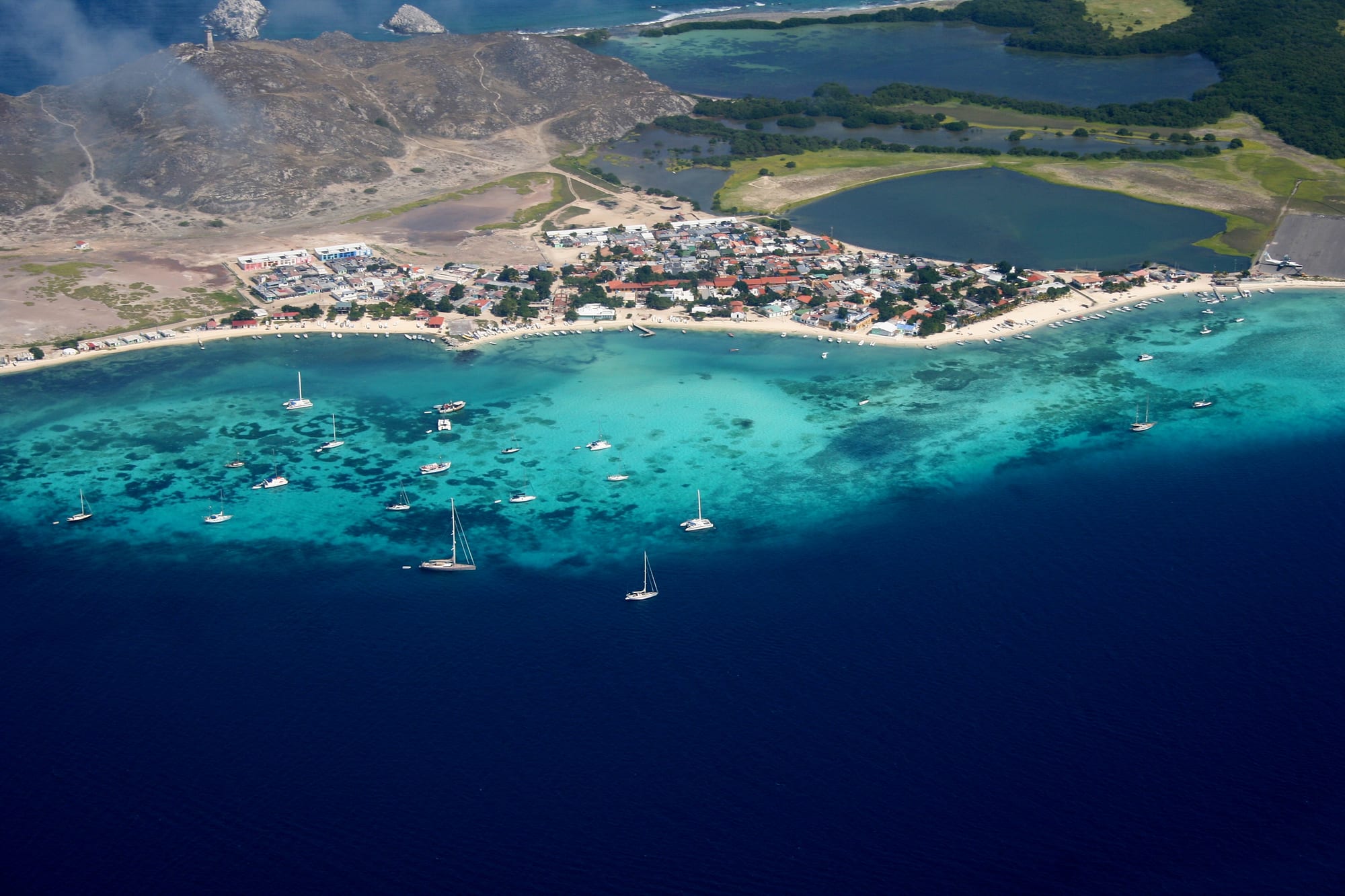
Aerial view of a small village on a sandy shore, with yachts on turquoise shallows, lagoons behind and a rocky hill topped by a lighthouse

Margarita, Mochima & the Caribbean East, Venezuela

Gran Roque

The village of Gran Roque from the air, with the old Dutch lighthouse on the hill at upper left. (Berrucomons / Wikimedia Commons · CC BY-SA 3.0)

The small rocky island at the north-eastern corner of the Los Roques archipelago, some 130 km north of Caracas, where most of the people of this coral national park live — a village of sandy streets and colourful posadas beside an airstrip, from which boats run out to the cays. This page is written to explain the city, not to encourage travel.

Neighbourhoods

  • The village
    • First-time visitors
    • Beaches
    • Quiet and residential

    The only settlement, beside the airstrip and below the island's hills. Its streets are mostly sand, there are almost no vehicles, and the brightly painted houses and posadas, the school, the small harbour and the beach bars are all a few minutes' walk apart.

    Open in Maps
  • The cays
    • Snorkelling
    • Beaches
    • Day trips by boat

    The coral cays and sandbanks scattered around the archipelago's shallow central lagoon, reached by small boat from the village harbour. Most are uninhabited and almost shadeless; boats usually drop visitors for the day and collect them in the afternoon.

    Open in Maps

Things to do

On the island

  • Faro Holandésviewpoint

    The old Dutch lighthouse on the island's eastern hill, built under a contract of 1874 with Luis Oduber of Curaçao; the climb gives views of open sea to the north and the village to the south.

    Open in Maps
  • Los Roques Airporttransit hub

    The small airstrip at the edge of the village, by the sea, whose runway was lengthened on reclaimed land in 2023–24 in a scheme criticised by environmentalists.

    Open in Maps

Cays by boat

  • Madrisquíbeach

    One of the most visited cays because it is so close to Gran Roque, inside the park's recreation zone.

    Open in Maps
  • Cayos Francisquíbeach

    A group of cays a short boat ride from Gran Roque, used for swimming and snorkelling and with windsurfing and kitesurfing kit for hire.

    Open in Maps
  • Crasquíbeach

    A coral cay of the national park with a long white-sand beach, reached by day boat from the village.

    Open in Maps
  • Dos Mosquisesattraction

    Two islands in the south-west of the national park where the Los Roques scientific foundation has its research station and a sea-turtle breeding centre that takes visitors.

    Open in Maps
  • Cayo de Aguabeach

    A cay in the west of the archipelago whose waters lie in one of the park's ecologically sensitive zones, and where archaeological finds have been made.

    Open in Maps

Eat and drink

Long-standing places and food districts in Gran Roque. Hours, ratings and directions come from your maps app, always current.

Gran Roque classics

  • Posada kitchens and village restaurantsneighborhood

    Nearly all visitors stay in posadas, which serve grilled fish and, in season, lobster.

    Open in Maps
  • Beach bars on the village frontneighborhood

    A few bars on the sand in front of the village, where people gather for drinks at sunset.

    Open in Maps

Experience Gran Roque

History

Gran Roque appears on Spanish colonial maps as part of the Captaincy General of Venezuela, though the islands long had no settled population, and in 1836 the Dutch government of Curaçao still counted "the uninhabited islets and rocks" of Los Roques among its dependencies. In the 18th century the Real Compañía Guipuzcoana set up on the islands and gave the first of them their names. Settlers from the Dutch Antilles arrived around the 1880s and left names such as Francisquí, Madrisquí and Crasquí, and in 1874 the government contracted Luis Oduber of Curaçao to build the lighthouse now called the Faro Holandés.

Under Antonio Guzmán Blanco the archipelago became part of the Colón Territory, and in 1895 Gran Roque served as its capital, with a governor sent from Caracas and fewer than a hundred inhabitants. Fishermen from Margarita settled over the following decades: there were 484 people in 1941 and 559 in 1950. In 1972 the government declared Los Roques a national park for its seabirds and marine life, and a scientific foundation set up a research station on Dos Mosquises.

Tourism was at first run by outsiders — wealthy Venezuelans from Caracas and foreigners who bought houses within the park — before posadas spread through the village. In the 1990s Gran Roque became the seat of the park's governing authority, replaced in 2011 by the Francisco de Miranda Insular Territory, run directly by the central government. The airport was modernised in 2019, and its runway was extended on reclaimed land in 2023–24.

Culture & Customs

Gran Roque's culture is that of a fishing village turned guesthouse island. Most of its families trace their roots to Margarita, and the islanders' seafaring life — fishing from small boats, lobster in season — shaped the village before tourism did. The names of many cays, from Francisquí to Selesquí, recall the settlers from Curaçao and the other Dutch islands.

The village itself has a strong visual identity: houses and posadas painted in bright colours, streets of sand, and almost no vehicles, so people walk barefoot from door to door. Life is lived outdoors, on the beach in front of the houses, at the harbour where the boats leave in the morning, and in the beach bars at sunset.

Because the whole archipelago is a national park, conservation is part of daily custom. The park is divided into seven zones, from areas open only to scientists to recreation and service zones, and since 2014 the community has lived under its own Norms of Communal Coexistence agreed with the territorial government. Visitors are expected to respect the zones, the reefs and the turtles.

Daily Life

The archipelago has about 1,500 permanent inhabitants, most of them on Gran Roque; the 2001 census counted 1,209 people. Its growth is limited by the rules of the national park. The island is not part of any state or municipality: it is the capital of Venezuela's Federal Dependencies and of the Francisco de Miranda Insular Territory, governed directly from Caracas, with offices of the parks institute and the National Guard.

Tourism is the economy. The archipelago receives around 70,000 visitors a year, many of them day visitors from Caracas and the mainland, and 96 per cent of tourists stay in posadas, which employ much of the village. Fishing, the work that first brought settlers from Margarita, continues alongside.

The day begins with boats loading at the harbour to take visitors to the cays, and the village is quietest in the middle of the day, when guests are out on the water. Everything from food to fuel arrives by boat or plane, so prices are high and supplies depend on transport from the mainland.

Food

Food on Gran Roque is mostly what the sea provides and what the posadas cook. Grilled fish is the everyday meal, and fresh lobster is the island's speciality in season. Nearly all visitors stay in posadas, and the posadas serve these as their staples. The fish comes from the archipelago's own waters, whose rich marine life was one of the reasons the islands were made a national park in 1972.

Because almost everything else must be flown or shipped in, meals lean on the national staples that travel well: arepas, split and filled, at breakfast; rice, black beans and fried plantain on the plate; and strong black coffee through the day. In the evening the beach bars in front of the village serve cocktails such as mojitos on the sand as the sun goes down, and for many visitors that hour, rather than any meal, is the ritual of the day.

Planning tools

Budget

Los Roques is the most expensive place in Venezuela. Flights, the national park entry fee and posada stays are priced for foreign and wealthy Venezuelan visitors, and almost everything has to be brought in by air or boat. Most people come on packages that combine flights, a posada with meals and daily boat trips to the cays.

Daily Budget Midrange
USD 120–300 (package with flights, posada, meals and boat trips)
Daily Budget Shoestring
USD — no genuine shoestring option; camping in the park's designated areas is the cheapest way to stay

Book flights and posada together as a package, pay the park fee on arrival, and bring enough US dollar cash for the whole stay.

Best Time to Visit

The islands are hot, sunny and dry almost all year, and rain is rare. The dry months from December to April bring the steadiest weather, while Venezuelan holiday periods fill the posadas. Flights and security matter more than the season.

Suggested Number of Days

Three or four nights allow a few days on the cays without rushing; flights are short but infrequent. A week suits those who dive, fish or kitesurf. Cancelled flights are common, so an extra day either side is sensible.

First Visit
3–4 days
With Surroundings
5–7 days

Transportation

There are no cars on Gran Roque — everywhere in the village is reached on foot along sandy streets. Small boats, called lanchas, leave from the village harbour for the cays, usually arranged by the posada, dropping visitors for the day and collecting them in the afternoon.

Agree the pick-up time and place with the boatman before being left on a cay, and take water and shade.

Airport & Station Connections

Los Roques Airport, on the island itself, takes small aircraft only. The flight from the Caracas area takes about 40 minutes, and flights have also run from Porlamar on Margarita; most visitors arrive on light aircraft booked as part of a package. Maiquetía, the Caracas airport, was heavily damaged by the earthquakes of 24 June 2026 and reopened at about half capacity in August 2026. There is no commercial ferry.

Walkability

The village is tiny, flat and car-free, and everything is a short walk apart; many people go barefoot on the sand streets. The lighthouse path climbs a rocky hill with little shade. Beyond the island, every trip is by boat.

Safety

Los Roques has long had a reputation for very little crime, and the National Guard and the parks service are present on Gran Roque. The practical risks are the sun on shadeless cays, boat travel, and the very limited medical care, with any serious case needing a flight to the mainland. Flight cancellations can leave visitors stranded.

Most governments advise against all or all-but-essential travel. Anyone who does go should travel with an established operator, carry strong sun protection and enough cash for an unplanned extra night, and follow the park's zone rules. Check current official travel advice before travelling.

Climate

Hot, sunny and dry, with steady trade winds and very little rain. There is almost no shade on the cays, and the sun is fierce all year.

Summer
May to November: hot, about 27–33°C, with the islands staying mostly dry
Winter
December to April: sunny, windy and dry, about 25–31°C

Local Customs

Gran Roque is a small community, most of whose families came from Margarita to fish, and it runs under community rules agreed in 2014 with the territory's government. Life is relaxed and barefoot, but the whole archipelago is a national park: some zones are closed to all but scientists, and the reefs and wildlife are protected.

Tipping boatmen and posada staff in US dollars is appreciated. Never photograph National Guard personnel or installations, and ask before photographing residents.

Common Payment Methods

The currency is the bolívar digital, but on Los Roques prices are set and paid in US dollars, mostly in cash. Card and ATM access for foreigners barely functions, so bring all the cash needed, in small notes, including for the park fee.