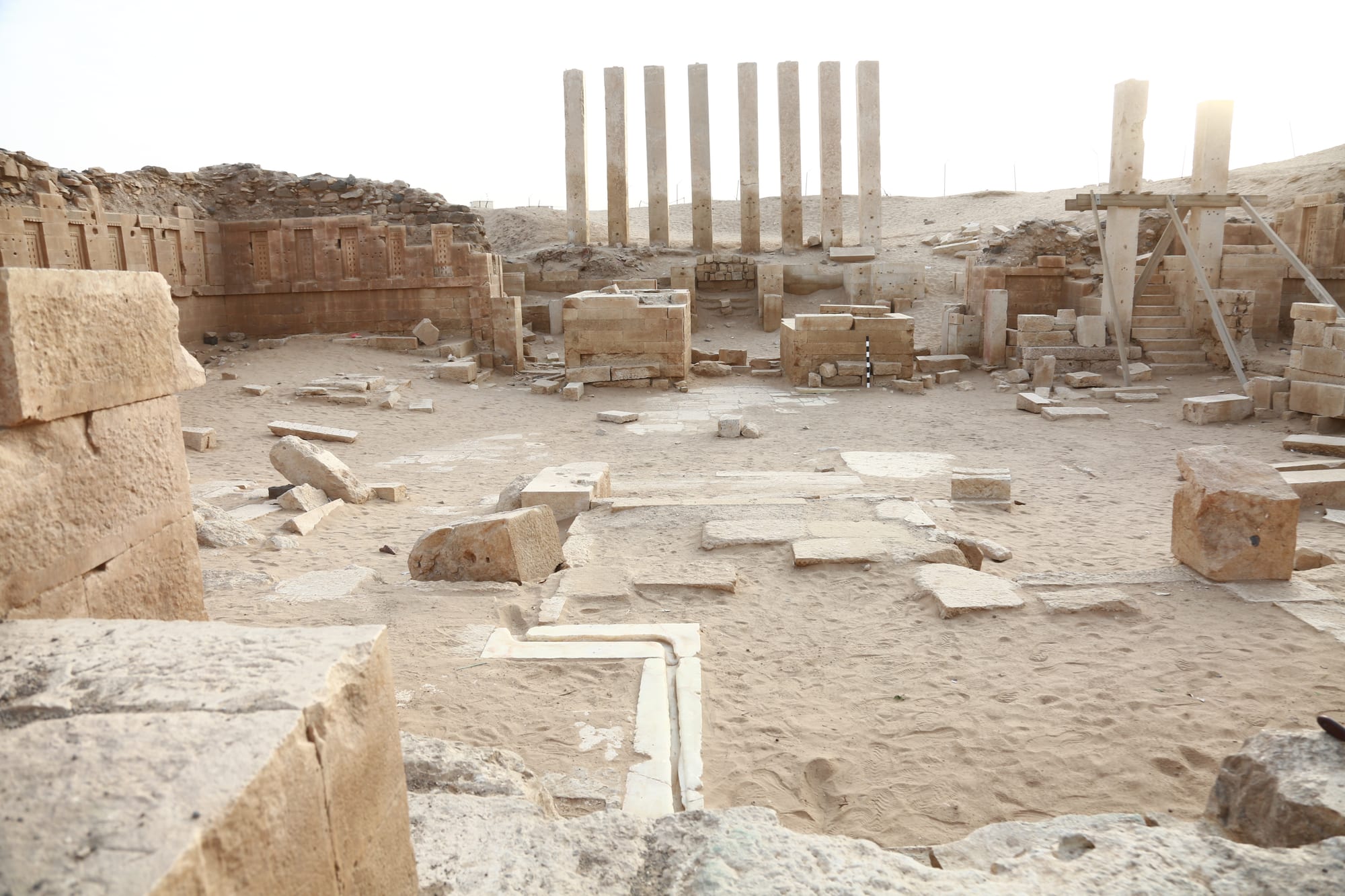
Tall stone pillars standing above the excavated walls and scattered blocks of an ancient temple in pale desert sand

Sana'a & the Northern Highlands, Yemen

Marib

The standing pillars and excavated walls of the Awwam temple in the desert near Marib. (Ali Mohamed / Wikimedia Commons · CC BY-SA 2.0)

A town on the desert edge east of the Yemeni highlands, beside the remains of the ancient capital of Saba and its great dam, whose sluices still stand at either end of a gorge. Temples linked by tradition to the Queen of Sheba lie in the sand nearby. Oil and gas fields made the modern town strategically important. This page is written to explain the town, not to encourage travel.

Neighbourhoods

  • The new town
    • First-time visitors
    • Services and markets

    The modern centre a few kilometres from the ancient site, a low sprawl of concrete shops, markets, mosques, offices and petrol stations along wide roads. It grew from a small settlement into the governorate's main town, and has expanded very quickly since 2015.

    Open in Maps
  • Old Marib
    • Historic district
    • Architecture

    The abandoned mud-brick town on a mound above the oasis, built over the ruins of the ancient Sabaean capital and reusing its inscribed stone blocks. Tall houses stand half-collapsed above the palm gardens.

    Open in Maps
  • The oasis and the dam
    • Scenery
    • Ancient sites

    The irrigated belt of palm gardens and fields along Wadi Adhanah below the gorge, where the stone sluices of the ancient dam survive at either end and a modern dam holds water upstream.

    Open in Maps
  • The desert outskirts
    • Local life

    Beyond the town the country opens into gravel plain and dune country running east towards the Empty Quarter. Settlements, oil and gas installations and, since 2015, large camps for displaced families are scattered across it.

    Open in Maps

Things to do

Ancient Saba

  • Marib Damlandmark

    The great dam of the Sabaean kingdom across Wadi Adhanah, whose massive stone sluice works survive at both ends of the gorge; its final breach, usually dated to 570 or 575, left it unrepaired, and the flood of Arim named in the Qur'an is traditionally linked to the dam's collapse.

    Open in Maps
  • Temple of Awwamlandmark

    Known locally as Mahram Bilqis, the sanctuary of the Sabaean god Almaqah, with a great oval wall, a pillared hall and a vast cemetery, long linked by tradition to the Queen of Sheba.

    Open in Maps
  • Barran Templelandmark

    A smaller Sabaean temple near Awwam, also dedicated to Almaqah, recognisable by its row of tall rectangular pillars standing in the sand.

    Open in Maps
  • Old Mariblandmark

    The deserted mud-brick town on the mound of the ancient capital, its houses built with reused stones carrying South Arabian inscriptions.

    Open in Maps

Further into the desert

  • Sirwahlandmark

    An early Sabaean walled town west of Marib whose temple of Almaqah preserves one of the longest South Arabian inscriptions known.

    Open in Maps
  • Baraqishlandmark

    The ancient Minaean city of Yathill in Al Jawf, north-west of Marib, which keeps much of its high stone wall and its towers standing in open desert.

    Open in Maps

Eat and drink

Long-standing places and food districts in Marib. Hours, ratings and directions come from your maps app, always current.

Eating in the town

  • Grills and rice kitchensneighborhood

    Plain kitchens along the main roads serve grilled meat, rice dishes with lamb or chicken, beans and salad with bread straight from the tannur oven, the standard fare of a desert market town.

    Open in Maps
  • The town marketmarket

    Stalls sell dates from the oasis gardens, honey from the eastern valleys, grain, vegetables trucked from the highlands and bundles of qat brought down from the mountains each day.

    Open in Maps

Experience Marib

History

Marib was the capital of Saba, the South Arabian kingdom that grew rich from the first millennium BC on the caravan trade in frankincense and myrrh moving north towards the Mediterranean. Its wealth rested on water: a great dam thrown across Wadi Adhanah where it leaves the mountains, first built in about the 8th century BC and repaired and heightened for more than a thousand years, which diverted the seasonal floods through sluices onto two large irrigated oases. The temples of Almaqah, the Sabaean moon god, stood outside the city: Awwam, called Mahram Bilqis after the queen whom Arab and biblical tradition connects with Sheba, and the smaller Barran. Saba was later absorbed by the Himyarites, the incense trade shifted to sea routes, and the dam was overtopped for the last time in about 570 and left unrepaired; the Qur'an's flood of Arim and the tradition of a great tribal dispersal are both linked to its collapse.

Medieval and modern Marib was a modest walled town built on the mound of the ancient capital, its houses raised on reused inscribed blocks, in a district where tribal authority counted for more than the state. Oil was found in the region in the 1980s, and a refinery, a gas-fired power station and pipelines followed, along with a new dam built in the 1980s upstream of the ancient one. Seven of the ancient sites around Marib were inscribed together as a UNESCO World Heritage Site in January 2023 and placed at once on the list of World Heritage in Danger. Since fighting reached the governorate in 2015 the town has grown many times over as displaced people arrived from other parts of the country, and it has been repeatedly fought over.

Culture & Customs

Marib belongs to the tribal east rather than to the settled highlands, and identity here rests on descent, the tribe and the reputation of the family. Sheikhs mediate disputes, guarantee agreements and arrange compensation under customary law, which in practice carries as much weight as the courts. A guest's safety is the responsibility of the host, and hospitality — coffee, dates, a shared meal — is given as a matter of honour rather than trade.

Dress and bearing are traditional. Most men wear the futah, a wrapped kilt, or a long thobe with a jacket, and the jambiya in an embroidered belt; weapons are part of male dress at weddings and gatherings. Women wear covering black dress in public, and social life is largely separated by sex, with women's gatherings in the home running parallel to the men's afternoon qat sessions.

Oral culture is strong: tribal poetry composed and traded at gatherings and weddings is a recognised way of arguing, praising and settling scores, and dances performed with the dagger held aloft accompany the drumming at celebrations. The ancient past is present in daily life too, since stones carrying South Arabian inscriptions are built into old houses, and the Queen of Sheba is a figure of local pride as much as of scholarship. Both Eids are the year's great family occasions.

Daily Life

Before the war Marib was a small town of well under twenty thousand people, by the 2005 census, in a thinly populated desert governorate. Since 2015 it has become one of the most crowded places in Yemen: aid agencies have counted vast numbers of displaced people in and around it, living in camps and unfinished buildings on the desert fringe, and the town's population is now many times its pre-war size.

The local economy is unusual for Yemen because of energy. Oil and gas fields, a refinery and a gas-fired power plant lie in the governorate, and the trade, transport and services they generate, together with the markets that supply a huge displaced population and the aid operations that support it, provide most paid work. Farming continues in the oasis gardens along the wadi, where dates, fodder and vegetables are grown with water from wells and the modern dam.

Daily life follows the heat: markets and offices open early, activity fades in the middle of the day, and the afternoon and evening bring the qat sessions and family visits. Electricity, water supply and fuel are unreliable and expensive, prices swing with the currency and the state of the roads, and many families depend on aid, small trade and remittances from relatives working abroad. Schools and clinics operate under severe strain, and the fighting that has repeatedly come close has left mines and unexploded ordnance in the surrounding country.

Food

Marib eats like a desert market town rather than like the highlands. The staple is bread baked against the walls of a tannur, the round clay oven, eaten with beans, eggs and tea in the morning and with stewed or grilled meat later in the day. Rice cooked with lamb, goat or chicken and warm spices is the dish of hospitality and of feasts, and roasting or slow-cooking a whole animal for guests is a matter of honour at weddings and on Eid.

The oasis gardens supply dates, eaten fresh in season and stored pressed for the rest of the year, along with fodder for the goats and sheep whose milk becomes buttermilk, yoghurt and clarified butter. Honey from the valleys east and south of the town is prized across Yemen and commands high prices; it is eaten with bread and butter, stirred into drinks and given as a gift. Flocks and camels mean meat is more central here than in the farming highlands.

Highland dishes travel down the road as well: saltah, the fenugreek-topped stew served in a stone pot, and fahsa, its shredded lamb version, are found in the town's kitchens, with bint al-sahn, the honeyed layered pastry, for celebrations. Qishr, the infusion of coffee husks with ginger, and very sweet tea are drunk through the day, and qat brought from the mountains is chewed in the afternoon. Alcohol is absent.

Planning tools

Budget

There is no tourism economy in Marib. What accommodation exists serves traders, officials, aid organisations and displaced families, and prices in Yemeni rials swing with fuel supply and the falling value of the currency. The war has also made the town one of the most expensive places in the country to rent a room.

Daily Budget Midrange
USD not applicable — the only foreigners present are mostly aid, diplomatic and media staff on organised security arrangements
Daily Budget Shoestring
USD not applicable — the town is not open to ordinary visitors

Do not plan travel here; the only travel to Yemen that functions as tourism is to Socotra, on operator-run packages.

Best Time to Visit

There is no safe time to visit, and the war widened again in 2026. In the years before the war, visitors came in the cooler months between November and February, when the desert is bearable by day and cold at night; summer heat here regularly passes 40°C.

Suggested Number of Days

Length of stay is not a meaningful question here: the town is not open to ordinary visitors, and those foreigners who are present work to security arrangements that decide how long they stay and where they may go.

First Visit
Not applicable
With Surroundings
Not applicable

Transportation

Movement in and around Marib is by private vehicle, shared taxi and truck; there is no public transport system and no railway. Roads run west towards Sana'a and the highlands, north into Al Jawf and south into Al Bayda and Shabwah, but they cross checkpoints run by different armed authorities and, in places, active or recent front lines. Landmines and unexploded ordnance affect ground off the main routes.

There is no safe way to travel within this region; do not attempt overland journeys.

Airport & Station Connections

Marib lies roughly 170 kilometres east of Sana'a by the highland road, a journey that once took a few hours and now crosses front lines and many checkpoints. A civilian airport for the town has been planned since 2018 and built only intermittently, and there is no ordinary commercial air service; Sana'a International Airport has handled only limited, irregular flights during the war and was hit by air strikes in July 2026. There is no ordinary way to arrive.

Walkability

The new town is flat and small enough to cross on foot, but it is built around wide roads and traffic, shade is scarce and summer heat makes walking punishing for much of the year. The ancient sites are spread over several kilometres of open desert and need a vehicle, and ground away from made roads carries a mine and ordnance risk.

Safety

Most governments advise against all travel to Yemen, and Marib has been one of the war's principal battlegrounds, with fighting flaring repeatedly around the town and across the governorate. Risks include arbitrary detention of foreigners, kidnapping, landmines and unexploded ordnance, and attacks by al-Qaeda in the Arabian Peninsula in this part of the country. Health care is severely degraded and the town holds very large numbers of displaced people in camps. Fighting resumed across Yemen in July 2026, after roughly four years of relative calm under a UN-brokered truce, and the war widened further in September 2026.

Do not travel to this region; there is no consular support and no reliable way to leave in an emergency. Check current official travel advice before travelling.

Climate

Marib sits below the highlands on the desert side of the watershed and has a hot desert climate. Rain is scarce and falls mainly as short storms that can send flood water down the wadis from the mountains; dust and haze are common, and nights in winter are cold despite hot days.

Summer
very hot and dry, often above 40°C by day, with warm nights
Winter
mild to warm by day, around 25°C, with cold nights

Local Customs

This is a conservative tribal society with strong codes of hospitality and obligation. Men commonly wear the jambiya, a curved dagger in a decorated belt, and many carry firearms openly; women in public are covered. Greetings are long, the right hand is used for eating and giving, and an offer of food or coffee should be accepted. Afternoons are given over to qat, chewed in company. Photographing people, especially women, requires permission, and military installations, checkpoints, oil facilities and armed men should never be photographed.

Alcohol is illegal and effectively absent. Tribal mediation, rather than formal law, settles many disputes, and an outsider's movements are the responsibility of whoever hosts them.

Common Payment Methods

The currency is the Yemeni rial, whose value has fallen sharply and which has circulated at different rates in different parts of the country during the war. Business is conducted in cash; card payment is not available in ordinary shops and international cards generally do not work. Money transfer offices handle the remittances that many households depend on.